Search

Showing posts sorted by relevance for query culver city. Sort by date Show all posts

March 16, 2020

Photo Essay: Kirk Douglas Theatre, the Former Screenland Cinema Saved By Spartacus

When actor and philanthropist Kirk Douglas died at the age of 103 in February 2020, he left behind a legacy that includes not only Spartacus and his actor son, Michael Douglas...


all photos circa 2016 except where noted

...but also the preservation and continued use of the former Culver Theatre in Downtown Culver City, California. 


It was rechristened the Kirk Douglas Theatre after his and his (second) wife Anne's $2.5 million donation—coupled with a grant from the Culver City Redevelopment Agency—gave the former cinema new life as a legit playhouse.


Culver City's own Steven Ehrlich was the architect for the 2002 renovation into the Kirk Douglas Theatre, which opened in 2004 at a total cost of $11 million.


But it was originally built in 1947 for the Fox West Coast movie theatre chain, headed by Charles Skouras—known for the "Skouras Style" that took over the decor of many cinemas at the time.


Back then, Fox produced many of the decorative elements found in its Skouras-influenced theatres at its own assembly plant—not the least of which being a free-standing box office that evokes something of a neo-baroque jukebox.


The floral motif in the (rehabbed) terrazzo sidewalk at the entrance is one of the remaining signature decorative elements associated with Charles and his brother George.


The inside, however, is another story.


Based on how it looks now, it's hard to know how post-war audiences experienced the moviegoing experience when it was the Culver Theatre. 


You can't see much—if any—of the work originally done by architect Albert R. Walker (of Walker and Eisen) and designer Carl G. Moeller.


But it probably lost the character way before this latest rehabilitation—likely in the 1970s, when it was spit into three screens (a.k.a. triplexed). It officially closed in 1989; a few years later, its damaged auditorium was gutted for asbestos removal in the wake of the 1994 Northridge earthquake.


Though the original seating capacity was over 1,000, the house now holds 317 seats, arranged stadium-style.


circa 2008 (Photo: Luis Penados via Flickr, CC BY 2.0)

But hey, it's outlasted the Culver City Theatre (1915, demolished 1923) and the Meralta Theatre (1924, demolished 1983). And that's really something for the city nicknamed "The Heart of Screenland."

Plus, the Center Theatre Group offers some pretty cool and cutting-edge programming at the Kirk Douglas. 

Though Douglas himself was heralded for his iconic movie roles, he said that his first love was the stage—and he wanted the opportunity to help support new and upcoming playwrights. 

So, its adaptive reuse seems fitting, especially since Douglas got to grace the stage of his namesake theatre in 2009 for the autobiographical one-man show, Before I Forget. 

For more history on the Culver Theatre, visit the page dedicated to it at the Los Angeles Theatres website. 

Related Posts:
A Birthday Visit to the Heart of Screenland
Standing in the Shadows of Towers In Hollywood (Or, What Will Happen to the Fonda Theatre?)

September 09, 2012

First Day on Foot


My starting point: Venice Blvd. and South Robertson Blvd, Culver City

I returned my rental car yesterday. My car is still being fixed. I have chosen to be carless for an undetermined amount of time.

I was wildly agitated upon my arrival to Enterprise in Culver City, vocally aghast at the lack of parking spaces, at being asked to move my illegally parked car (twice), and at the disappearance of the attendant. I was behaving badly, reminiscent of the last time I had to face the possible separation from my vehicle.

"Oh you're not picking up your car from the dealership?" the clerk asked, when she finally attended to me.

"No, I'm walking five miles home."

"Well, I'm open 'til 6 p.m. if you have some errands you want to run first..."

I tsked and sighed, explaining that Allstate had instructed me to return the car by noon, and then staring blankly at her.

"Just...take the car now..." I had already mentally prepared myself for its return as best as I could. When someone breaks up with you, you don't want them to linger, you just want them to go, so you can start figuring out how to go on with your life without them.

As I walked away from the rental office, receipt in hand, I burst into tears, wincing from behind my aviator sunglasses. As a hiker, a five mile walk home wasn't so daunting, but I immediately recalled my days in junior high and high school, begging for rides from my teachers, friends and their parents, taking the bus when I could, but mostly being stuck at home. More than once during college Christmas breaks, I was nearly stranded at Shoppingtown Mall, working extended holiday hours past the time the Centro bus stopped running.

One June day in 1993 or 94, I was grounded for the entire summer, and my sister had refused to let me participate in her birthday celebration. So, with nothing to do, and no one to come home to, I decided to walk home from work in Downtown Syracuse, about four miles. It was summer, with plenty of daylight left, but as I left behind the dowtown derelicts, I secretly hoped to be attacked or abducted. I felt punished and helpless. That was one of the loneliest days of my life.

All those feelings of abandonment and desperation came rushing back to me in an instant. Everything I've done over the last 20 years to liberate myself from the shackles of my youth and the grip of my parents seemed to dissolve in the ether.

Not yet ready to embark on my journey home - because what would I do once I got there? - I stayed in Culver City awhile and went to the movies. I got brunch, skipping the booze because it costs the same as a day's car rental. I got coffee. And finally, at 2:30 p.m. on a Saturday afternoon, I set off on my journey.

It's actually a straight shot up Robertson from Culver City, under the 10 Freeway and through a neighborhood I've discovered has been coined "SoRo" (South Robertson), then Beverlywood, Beverly Hills and Los Angeles (across the street from each other), West Hollywood, and back to Beverly Hills. At first, my trek seemed, in some ways, wilder than any of my hikes. There were few other trekkers on the urban trail of concrete and blacktop, and nearly everyone I passed who wasn't in a car was either on a bike or headed to or from their car.

Walking up South Robertson - a street I've driven up and down several times to and from Culver City - provided constant discoveries of abandoned storefronts, stretches of thriving industry (upholstery!), historic-looking buildings (a Masonic temple!), and tiny ethnic eateries. I soon forgot about my distress and enjoyed the adventure as though it were just another hike, but one of a very different kind: not a loop, not an out-and-back, and not a one-way with a car shuttle. Just a one way.

I thought about the next few days - with nothing really planned for Sunday and Monday, and plans for Tuesday night in a familiar area that seems easily reached via bus - and the task of surviving in LA without a car seemed surmountable. Not easy, but doable.

I got through the first day, at least, unscathed: no blisters, no sunburn, and only one solicitor tried to sneakily sell me magazines. "I got no money..." I said, as I walked away.

Did I feel safe? Not really. But I never really feel safe on the trail. And at least I knew I wouldn't get lost. This time.

To become a fan on Facebook, click here.

May 06, 2021

Citizen Public Market Serves New Food Hall Fare In Historic Digs

One of the first landmarked buildings of Culver City, California has just gotten new life as a trendy new food hall. 
 

July 31, 2022

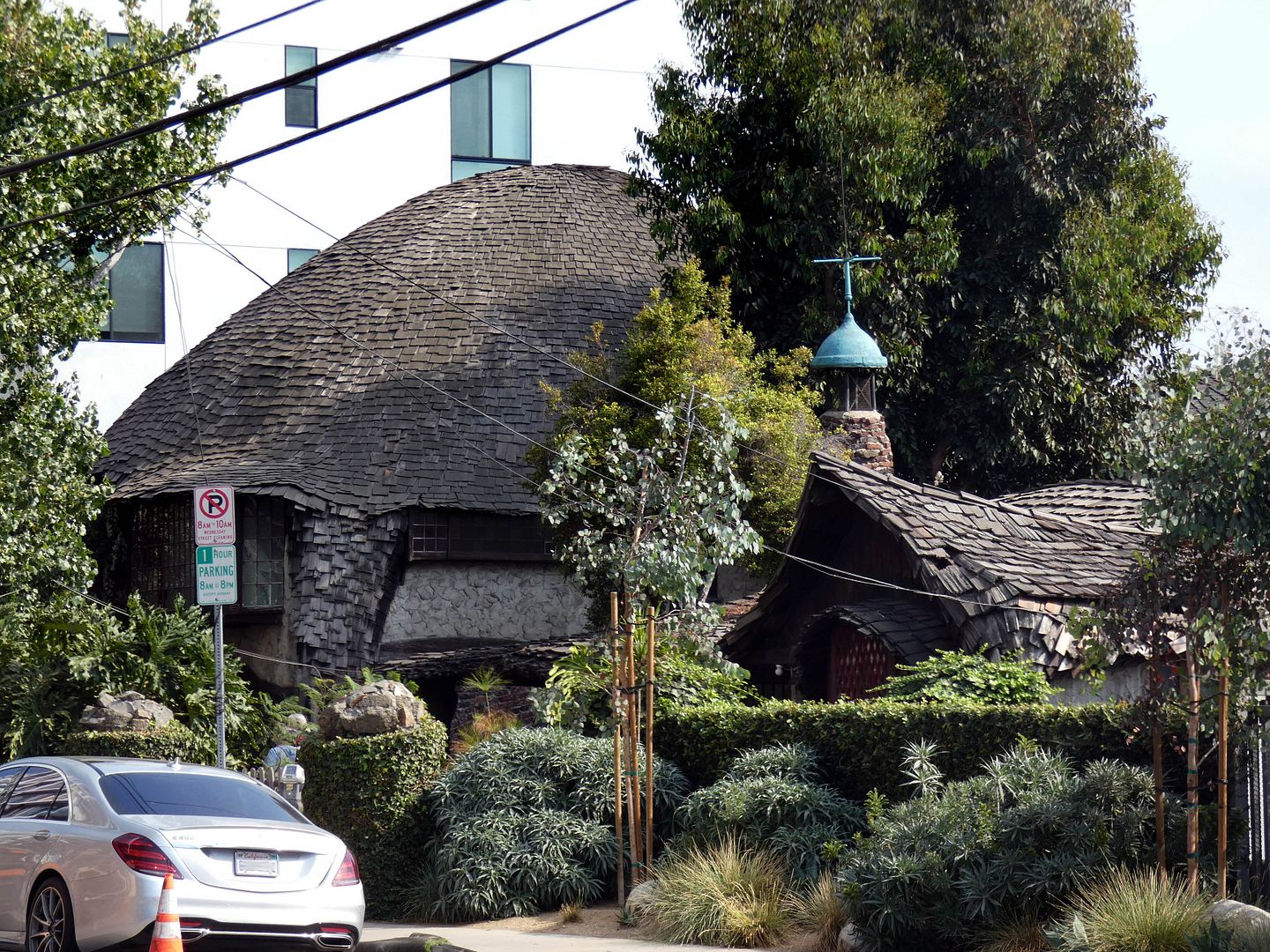
Photo Essay: These Hobbit Houses Are a Long Way from Middle Earth (Updated for 2025)

[Last updated 11/23/25 12:54 PM PT—According to the Los Angeles Times, real estate agent Michael Libow—also the owner of the Spadena House in Beverly Hills—has purchased the The Hobbit Houses for $1.8 million. He says he plans to keep the rental units and is adding this structure to his collection of storybook houses.]

[Updated 3/3/25 12:49 PM PT—The Hobbit Houses have been listed for sale for 10 days. The price is $1.9 million.]

Its official name is the "Lawrence and Martha Joseph Residence and Apartments." 

 
But most people know the complex simply as the "Hobbit Houses."

February 04, 2017

Where Church and State Collide

Assalamu Alaikum. السلام عليكم

Or, as we say in Catholic church services: "Peace be with you." (And also with you.)


After expanding my horizons a bit over the last few years, I've realized that I'm a big fan of Islamic art. I quite enjoy visiting mosques, though I was raised Catholic and find myself without prayer these days. And I've had the time of my life traveling to two different Muslim countries (Morocco and Tunisia).


Thankfully, it turns out I don't have to hop a plane to North Africa or the Middle East to visit one—because there's a big one in Culver City that accepts visitors of all faiths.


It's a little complicated, though, because lots of non-Muslims don't feel so comfortable with this mosque in a major LA suburb. Maybe that's because it was initially bankrolled by Saudi Arabia—specifically, $8 million to open it in 1998, donated by the (now late) Saudi King Fahd and his son, Crown Prince Abdullah ibn Abdulaziz (though the mosque no longer receives funds from overseas—instead sustained by donations from its congregants).


And a recently declassified report from the FBI identified it as a site of "extremist-related activity both before and after September 11." (Suspiciously, the mildly redacted document has been moved from its original file location on the U.S. House of Representatives Permanent Select Committee on Intelligence website.)


And, it's true that 15 of the 19 terrorists associated with the 9/11 attacks hailed from Saudi Arabia.


It's possible one or more of them may have attended the Culver City mosque for whatever reason at any point during their time on the West Coast.


But then again, Saudi Arabia wasn't included in the recent so-called "Muslim Ban [archived link]."


But Saudis have had some troubles crossing our borders in the past—before the current presidential administration, that is. In 2003, the State Department wouldn't let Saudi diplomat Fahad al Thumairy (a high-ranking member of the clergy at the mosque) back into the country.


Somehow, though, the King Fahad Mosque has continued to thrive—and, by all appearances, keep the peace.


That's no easy task, since all Muslims aren't the same. In fact, there are two major denominations of Islam—and they don't always get along with each other very well.


But somehow, surrounded by these hand-painted, patterned tiles...


...that are inscribed with calligraphy...


...and marble walls...


......under that 72-foot minaret...


...and a dome so typical of Islamic architecture...


...the two factions can come together to face the holy city of Mecca (which happens to be in Saudi Arabia) in prayer.


On the one hand, you have the Sunnis—the majority population of Muslims who follow the teachings of the Prophet Muhammad as carried on by the man he deemed his successor.


On the other side of the divide, you've got the minority Shiites (a.k.a. Shia), who claim that the successor should have been a relative of Muhammad—and, judging by blood lines, they've got a certain divine right to accession in the Islamic religion. But Muhammad didn't select one of his relatives before he died back in the year 632 A.D.; so, in practice, his descendants have no power.


Although the Culver City mosque is primarily Sunni-leaning, you can find both Sunni and Shiite Muslims together facing Mecca and praying in its 63,000 square feet of prayer space.


Elsewhere in the world, you'll find most of the Shia in Iran and Iraq. But the Shia have had a hard time uniting even just with each other—instead, splitting off into three different sects. And, as I said, it's complicated—because, judging on religious denomination alone, there's no clear way to differentiate the "good guys" from the "bad guys."


And whenever the majority—in this case, the Sunnis—is given absolute power without a system of checks and balances, disaster is practically inevitable. Once seen as loving, peace-making people, the Sunnis are now better-known for their militant faction (the minority within the majority faith) that has given rise to ISIS.


In Iraq and Syria (the last "I" and "S" in ISIS), dissent has become deadly. The Islamic State seized large portions of both countries and have made enemies out of just about everybody.

Sunnis are executing Shia based on faith alone (under the assumption that the Shia are unbelievers). But plenty of Sunnis have died as a result of the attacks, too, despite being on the "right" side of the argument.

Sometimes it seems like these radicals are just trying to bring on the apocalypse. They're trying to tear everything down and start anew. They're ready to blow up whatever they need to, no matter who gets hurt in the process. The casualties are "a small price to pay" for the larger goal at hand.

Unfortunately, the Islamic State is not so much a religious group as a militia. It's a political and military movement, not a religious one.

But it leverages religion to make a point.

The King Fahad Mosque has been reported to "reject Western values." Maybe that's because it encourages those who walk through its doors to cover up a little more than we Californians are used to. Or maybe it's because you're asked to remove your shoes before entering and, if you're a woman, to head upstairs for your own distraction-free "safe space" for prayer, far from the male gaze.

Or maybe it's because you may break bread and participate in interfaith services at the mosque, no matter how you pray, who you pray to, or what you think of Muslims. You are welcome there all the same.

Related Posts:
Photo Essay: Pico-Union Project, From Temple to Church to Mosque
Photo Essay: Aimee's Castle on the Lake

June 17, 2019

Photo Essay: A Mid-Century Cathedral of the Oil Industry, Saved By Hollywood

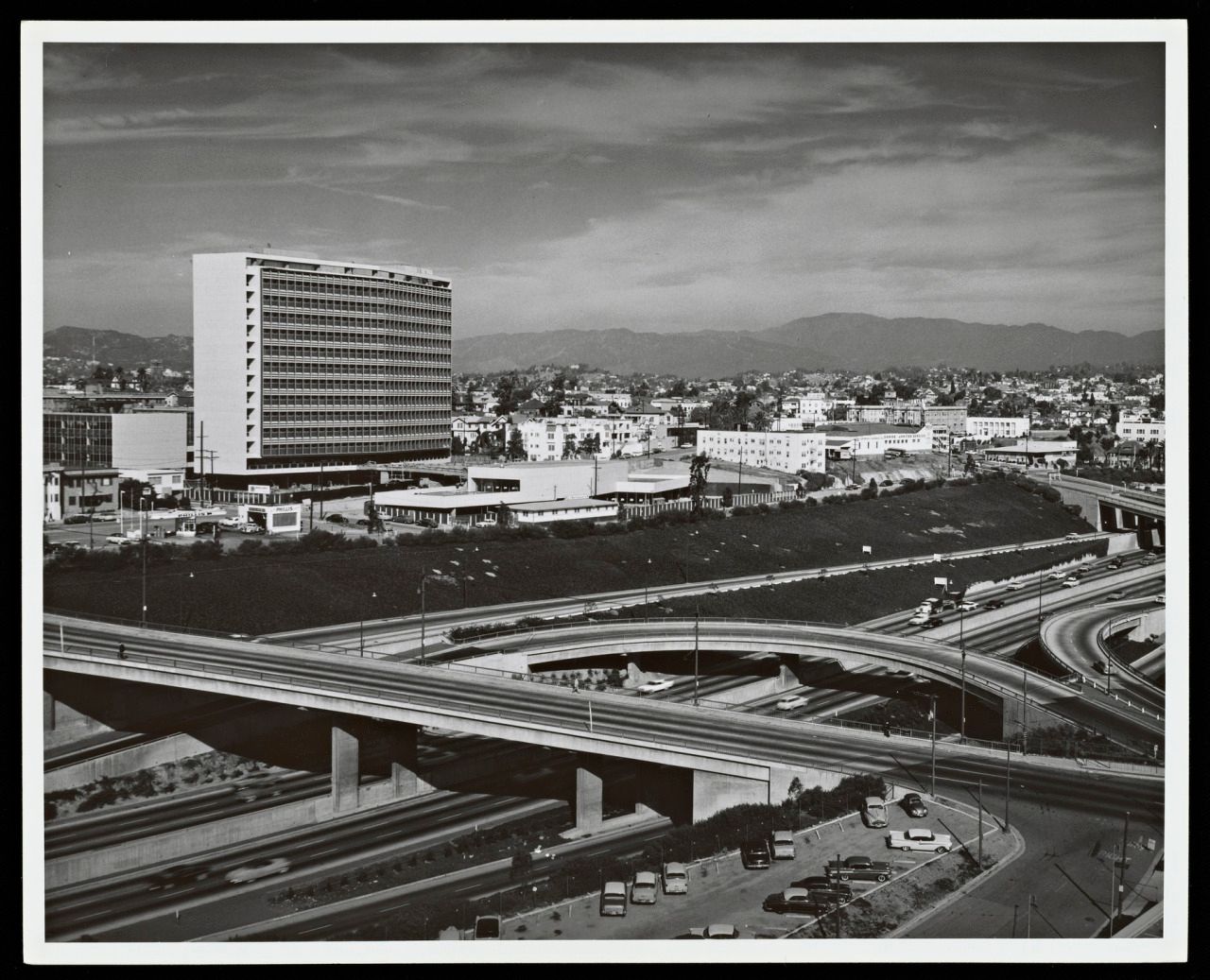
In 1955, the Four Level Interchange that connected the 101 with the 110 had only been open for a couple of years. The section north of it had just been designated the Pasadena Freeway, and the section south of it—the Harbor Freeway—continued to inch towards San Pedro.

The area immediately to the west of the 110 near the stack interchange was a bit of a "no man's land" at that point—too far east to be MacArthur Park or Westlake, and too far west to be Downtown Los Angeles or Center City (and now cut off from it by the freeway).

Some people still call it "City West." Lots of people don't even know it's there.


circa 1957 (Photo: Julius Shulman, Julius Shulman Photography Archive. Getty Research Institute.)

And that's where the former Union Oil Company of California chose to build its LA headquarters, known as Union Oil Center (and after 1983, as Unocal Center).

July 13, 2020

Pandemic Amusements: In the Swimming Pool

Since the beginning of the coronavirus pandemic and subsequent shut-down, I've been craving certain things.

Some of those craving I've been able to satisfy—like for donuts and onion rings.

Others have proven more elusive—like how my skin craves for human touch.

But since March—or, at least since it stopped raining and started to really heat up—I've been dying to go swimming.

With public swimming pools shut down for months, and unnecessary travel deemed too risky, I've been beached in my apartment with no laps to swim.

And to make matters worse, when the public pools did reopen, I found out that my local West Hollywood Park facility was being demolished—and its replacement wouldn't open until September 2021.

I didn't feel comfortable enough to swim indoors at the Beverly Hills High "swim gym." My other top choice would've been the Annenberg Community Beach House—but that, too, is closed for the year.

I could travel farther afield to try a new lap adventure (stay tuned for dispatches from the "Hey Rookie" pool, formerly part of Ft. Macarthur in San Pedro), but everything is just so uncertain.

I needed a nice, wet dose of familiarity. Especially during a time when even the most mundane activities seem dangerous.


So that brought me back to the Culver City Municipal Pool, a.k.a. "The Plunge," in Veterans Memorial Park.

Originally dedicated in 1949, it surpasses my other "regular" swimming spots in its Olympic size and quality of its locker room, though we swimmers don't currently have access to the later.

But nevermind, I told myself. I'd arrive with my bathing suit already on, wearing a top layer that could easily be stripped off and tossed aside. I'd line my car seat with towels for when I'd have to drive home soaking wet.

It's a little nerve-wracking returning to any routine these days—but for the last several months, I kept arguing that outdoor pools would be safe, given the open air and all that chlorine.

Parasites, bacteria, and fungi thrive in wet environments. Viruses prefer dry air. And so far, this novel coronavirus doesn't seem to survive chlorinated water.


So, last Wednesday I set my alarm for 7 a.m. and logged into the website to reserve my spot. As a non-resident, I wouldn't have first choice over my time slot—but I didn't have a problem getting one on the first day that the Culver City Plunge would reopen.

I was actually particularly excited about swimming under the current health restrictions—because that meant that I'd get a lap lane all to myself.

I hate sharing a lane, especially if we have to "circle swim." Every time someone comes up behind me—because invariably they're a faster, stronger swimmer than I am—it feels like I'm being chased by a shark.

It really stresses me out. Especially when they're swimming like they're training for the Olympics—and I'm just trying to survive 20 minutes of a modified doggie paddle alternated with a backstroke.

But today, under the new rules, I had a full 45 minutes of a whole lane all to myself. And it was glorious.

It seemed that every time I flipped over to stroke backwards, I'd get to watch a plane either taking off from or landing at LAX.

I peered at those commercial jets as they sliced through my blue-sky view, interspersed with the iridescence of chlorinated water droplets on the inside of my black aviator sunglasses (which have altogether replaced goggles in my swimming gear).

I could feel the ripples of water scraping against the gooseflesh of my legs as they kicked back and forth. It was as though I could feel each drop individually.

I could feel the waves seeping into my scalp, too—through my swim cap and the hair that I'd piled atop in a tight bun.

I wasn't sure I'd use the entire 45-minute slot—I rarely swim more than, say, a half hour—but I relished in the unshaded sunshine, the 80+-degree weather, and the quietude of my fellow lap swimmers who were making the most of their time in their own lanes, sparing not a moment for frivolous chit-chat.

And of course there was no section of the pool reserved for "recreation swim"—a.k.a. kids and families.

We can't really recreate right now. We've got to get down to business—in and out, no lingering, no funny business, keep it moving.

I was so happy with my pandemic swim today that as soon as I got home, I logged on to reserve another slot as soon as I could.

Of course, it's completely booked for the next two weeks.

But if I set my alarm early again this week, I might be able to snag a spot in a water aerobics class next week.

I'm sure the craving will be back by then.

And maybe at some point soon, I'll be brave enough to try another outdoor pool somewhere new.

Related Posts:
Swimming in Circles Under a Wide Open Sky
The Swimming Pool That Transports You From Beverly Hills to Bedford Falls

October 06, 2013

A Birthday Visit to the Heart of Screenland

[Last updated 3/20/21 9:59 PM PT—new photos added]

I was all alone on my birthday, with no plan, but with the overwhelming sense that I should be doing something special. Then again, all I really wanted, for once, was not to be alone.

With all of Southern California's offerings to choose from—save for a lot of those cultural institutions and historical attractions which are actually closed on Mondays—I ended up settling on a touristy treat that likely evokes as much eye-rolling as those double decker bus tours: a Hollywood studio tour.

When people say "Hollywood," they don't necessarily mean Hollywood Boulevard or even old Hollywoodland. They mean the movie-making communities of Silverlake (Edendale) and Culver City and now, Burbank.

circa 2021

June 12, 2011

Photo Essay: Taste of the Nation LA 2011

I've spent the last two days pretty much in bed or in the bathroom, writhing in pain, since I woke up Friday morning with food poisoning from dining out the night before.

I lost eight pounds in one day.

I think I lost my mind a little too.

But by the time I got sick, I'd already bought a ticket to today's Taste of the Nation event in Culver City, and despite my weakened constitution, I decided to go anyway.

Last year I'd pigged out with friends at the Wine & Food Festival in New York and had a grand ol' time, so I figured I'd go to a similar event in LA (OK, Culver City) to schmooze with chefs, bartenders, mixologists, and fellow foodies. After all, these are my people!

I arrived con gusto but could only really eat for a third of the event's duration, and then sat against a tree groaning. I'd eaten at least a nibble of every dish I'd taken, but if I didn't absolutely love it, I threw the rest out (causing enormous feelings of guilt since the whole point of the event was to raise money to end childhood hunger).

I sipped many cocktails but finished none.

And when I'd had my fill, I went home to recuperate.

Here are some of the highlights of the day:


Lamb terrine from Comme Ça


Cold beet & scallop* from Simon LA
(*looked pretty but my poisoned stomach could not handle cold seafood)


Lamb pop w/fava reduction* from LA Market
*favorite


Toasts from Church & State


Fattoush salad* from Lucques/AOC/Tavern
(*not a good representation of what these guys can do, was good but seemed too simple for the event)


Octopus lettuce wrap "taco" w/coriander flower from Tres / The Bazaar by Jose Andres


Egg toast w/olive tapenade & tomato from Campanile


Lamb slider from Go Burger


Highland Park Swizzle by Bols Genever


Rice Pudding* from Craft
(*I didn't actually eat it but it looked great)


Chicken pops* from Lukshon/Father's Office
(*I didn't actually eat it but it looked great)


Rabbit Rillettes from Le Saint Amour


Kaya toast* from Susan Feniger's Street
(*this was a somewhat deconstructed version of what you get in her restaurant, still very good)


Quinoa crabcake from Border Grill


Grilled cheese on raisin nut bread* from Foundry on Melrose**
*favorite
**most boisterous booth, with lots of bell-ringing


Paloma


Beef & pork "bolognese" (aka sloppy joe) from Short Order*
(*coming soon to the Hollywood Farmer's Market)


Chocolate pudding "donut" from Fonuts


Key lime pie cupcake* from Sprinkles
*favorite

I'm back in my apartment, writhing in pain, wondering if I should've stayed in bed today instead. But I never want to be left asking, "What does it taste like??" And now I know, even if all I got was just a taste...of a lot of different bites.

To become a fan on Facebook, click here.