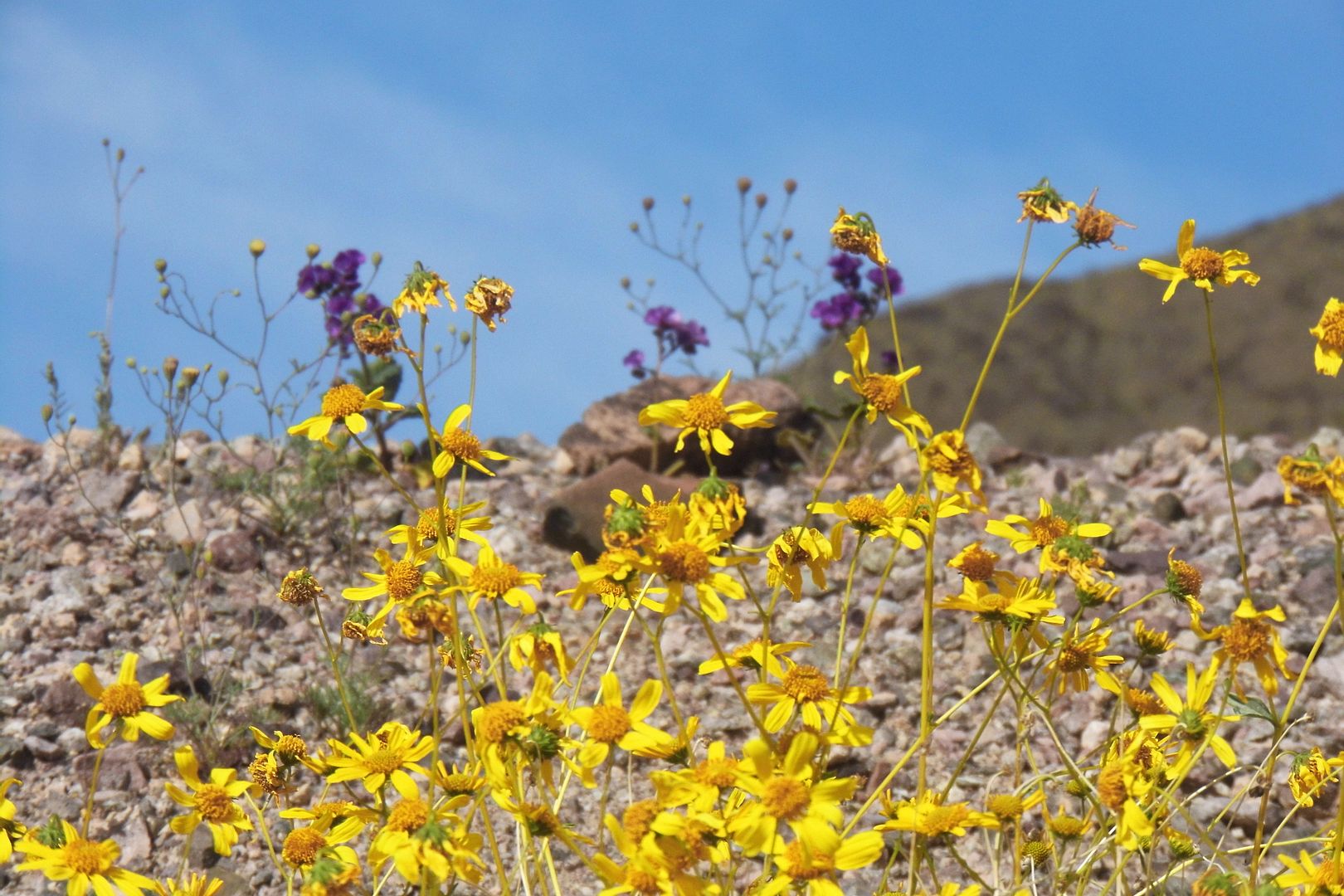
For all the times I've visited Death Valley National Park—starting way back in 2008—I don't think I've ever seen any wildflowers there.
I remember hearing about wildflower blooms there during the springtime, but Death Valley isn't the kind of place that you can just decide to visit on a whim. It takes some planning ahead to get a room for the night, and some significant driving to get there from Los Angeles.
I missed the "superbloom" that occurred in 2016, having just started a new job and still bouncing back financially from years of unemployment. I've regretted that for 10 years.
Now, there's a once-in-a-decade bloom happening in Death Valley again—and this time, I was prepared. All the way back in January of this year, I started booking hotels in anticipation of a very good wildflower bloom about the occur. I wasn't sure when it would hit, so just to be safe I reserved a room for every weekend in March, and the first weekend in April.
Usually wildflower season hits Death Valley later in the spring, following the burst of color that occurs annually—to varying degrees every year—in Anza-Borrego and the Antelope Valley. But this year, the desert environs much farther north of LA caught up to the Southern California floral explosion timing-wise.
And on the first weekend of March 2026, I'm pretty sure I got pretty close to the peak of the best wildflower bloom that Death Valley has had in a decade.
[Last updated 7/27/25 9:55 PM PT—The Ryan Historic District was officially listed on the National Register for Historic Places in January 2025. For more info, click here and here.]
In 2013, Death Valley Conservancy received a donation of a 40-acre site—3000+ feet above sea level, overlooking the valley below, 15 miles from the main visitors' area at Furnace Creek.
Part of the Hillside Group of mines, it had been the main operation for borate mining in Death Valley for Pacific Coast Borax Company from 1914 to 1927.
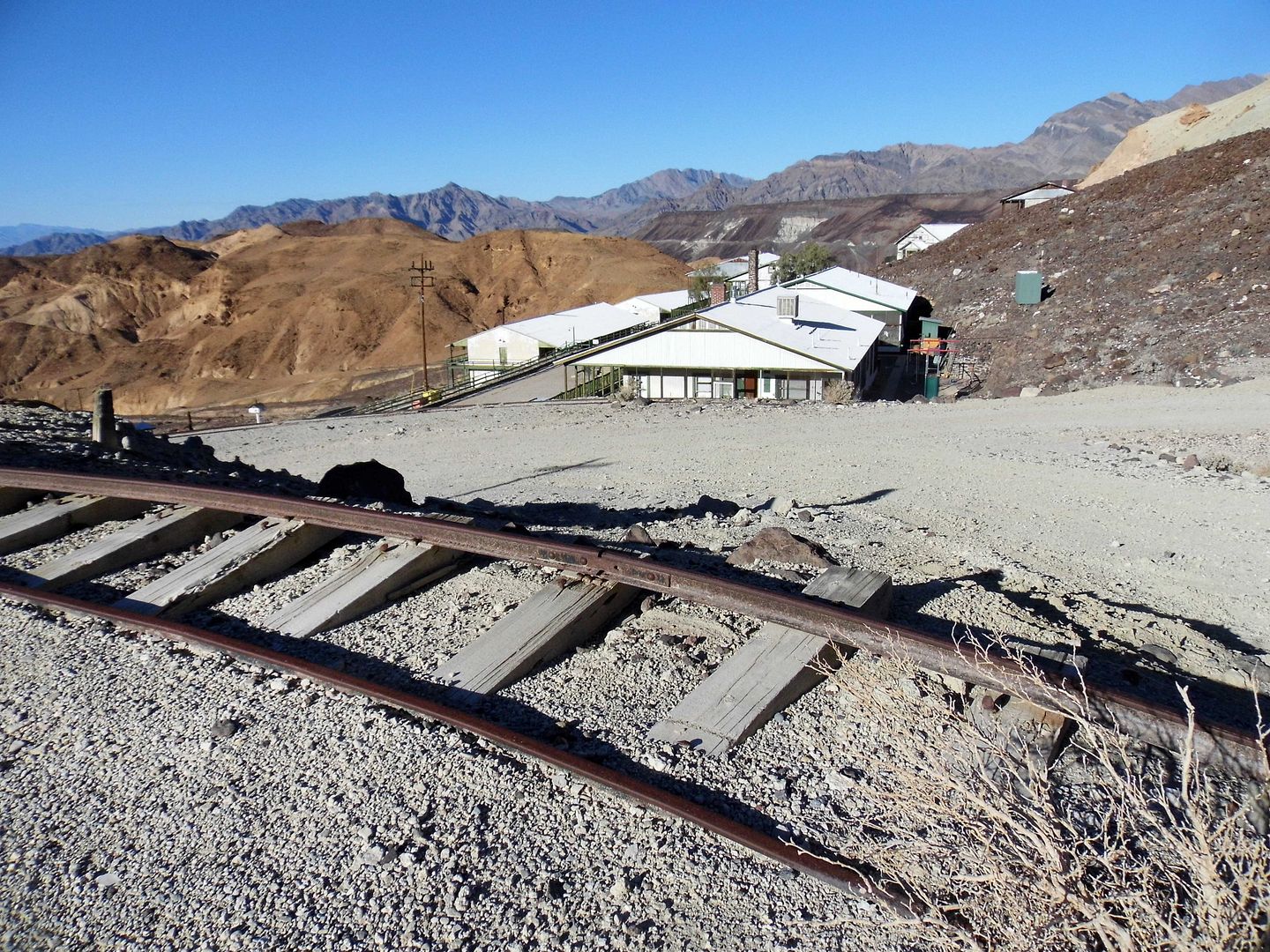
Borate ores mined here were transported or processing via the narrow-gauge Death Valley Railroad (dismantled 1931) to its eastern terminus at Death Valley Junction.
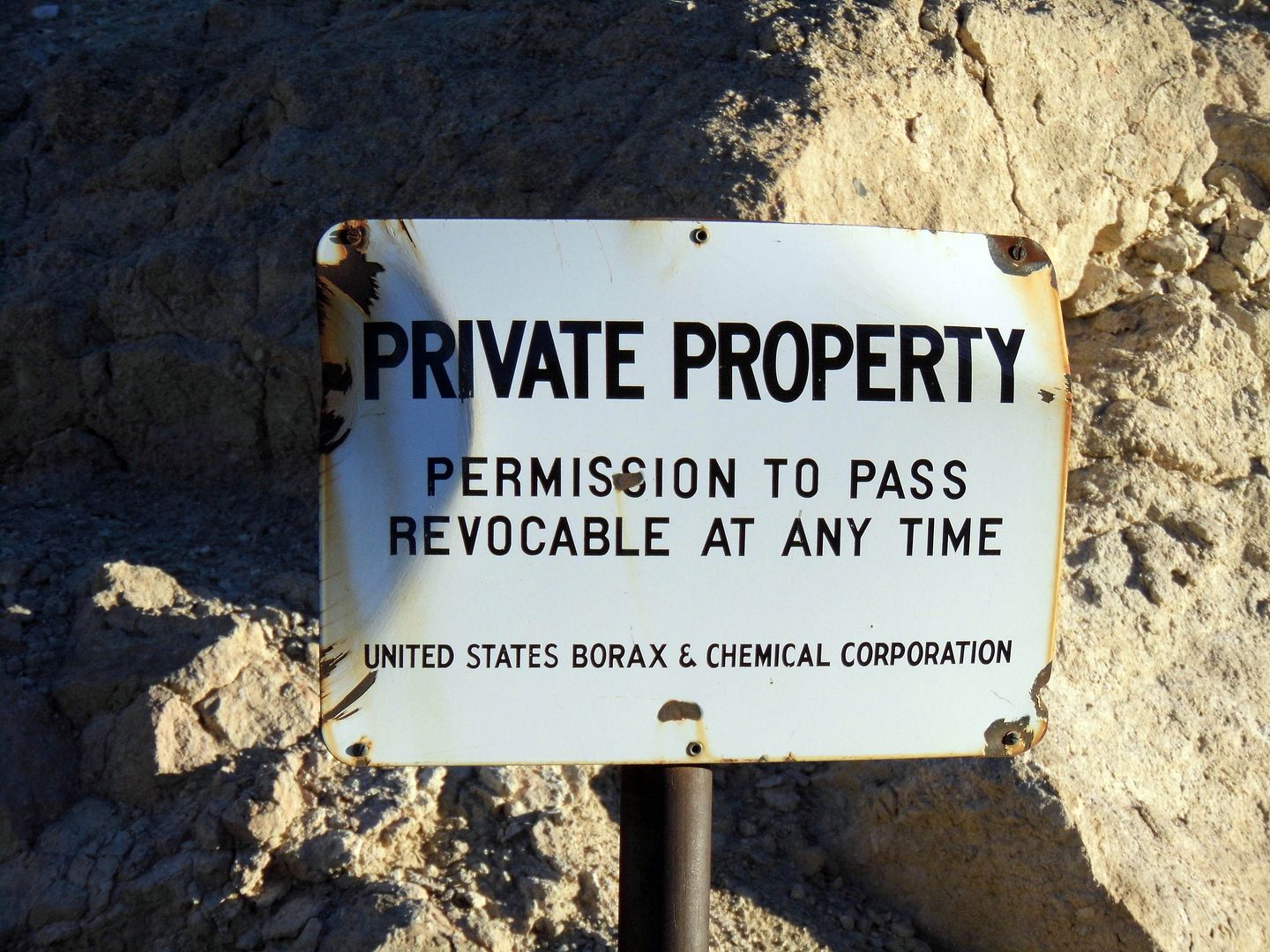
In 1927, PCBC relocated its operations to Boron (a.k.a. the Kramer District), where it became known as U.S. Borax as of 1956 and heretofore Rio Tinto, since1968.
Today we know the area simply as Ryan Camp, named after PCBC's field engineer John Ryan—but this conservancy-owned parcel outside the bounds of Death Valley National Park is more than just an old mining ghost town. And it's far from abandoned.
Take one of the tours offered in the spring and fall—led by the full-time, live-in caretaker—and you'll see how Death Valley Conservancy is delivering on its mission to "preserve what is left and restore where possible." And that includes the second life of Ryan, when PCBC got into the tourism business and converted its facilities into the Death Valley View Hotel.
Operated by the Death Valley Hotel Company—whose holdings also included facilities at Death Valley Junction and Furnace Creek (until the 1960s)—it provided desert accommodations full-time until 1930, when the railroad was dismantled.
Visitors would arrive from Death Valley Junction via gas-fueled motor coaches along the former mining rail right-of-way...
...or, after 1930, from Furnace Creek Inn, if it was full and guests came to Ryan to take advantage of overflow accommodations.
Sure, there was a fascination with the hot, unforgiving desert in the early 20th century—but at Ryan and its Death Valley View Hotel, the main attraction wasn't necessarily the view, but rail trips through the workings of the old abandoned borax mines on the "Baby Gage" (more on that in a little bit).
Since tourists had come all that way—and to such a remote area—they'd make a whole trip out of it, staying at the hotel and eating in the dining room that had been fashioned out of the old mining camp's messhall.
There was a kitchen in the back, but I doubt any travelers came here specifically for any of the hotel amenities.
The novelty was in how you'd be surrounded by all this mining stuff—frozen in time and literally frozen on the tracks—and you could pay your respects in a kind of outdoor reliquary of Old West-ament artifacts.
There's another reason why people still visit Ryan, though the property was mothballed by 1962. A film crew made the ridge above the old power house (circa 1924) famous when they featured it in the film Spartacus.
It looks exactly the same now as it did back then. (Scroll to the bottom of this post to watch the clip.)
Of course, the movie's depiction of what's become known as "Spartacus Hill" doesn't show the circa 1924 warehouse that likely also housed staff (including kitchen personnel)...
...though it's fared the hot, dry summers and occasionally snowy winters very well.
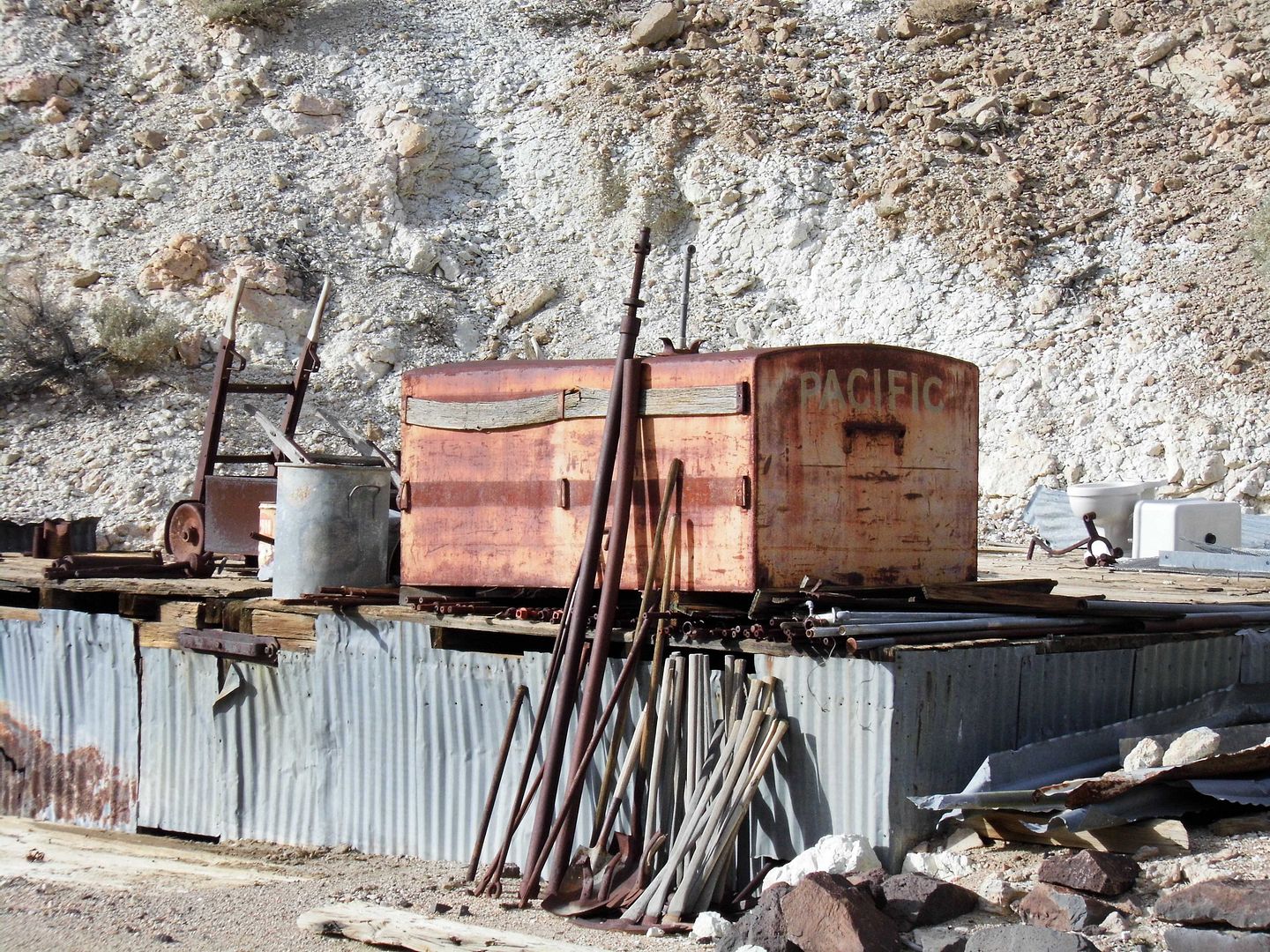
And it's still a kick to see rusty old relics emblazoned with "Pacific" and "U.S. Borax"...
...as well as the old ore cars still in place.
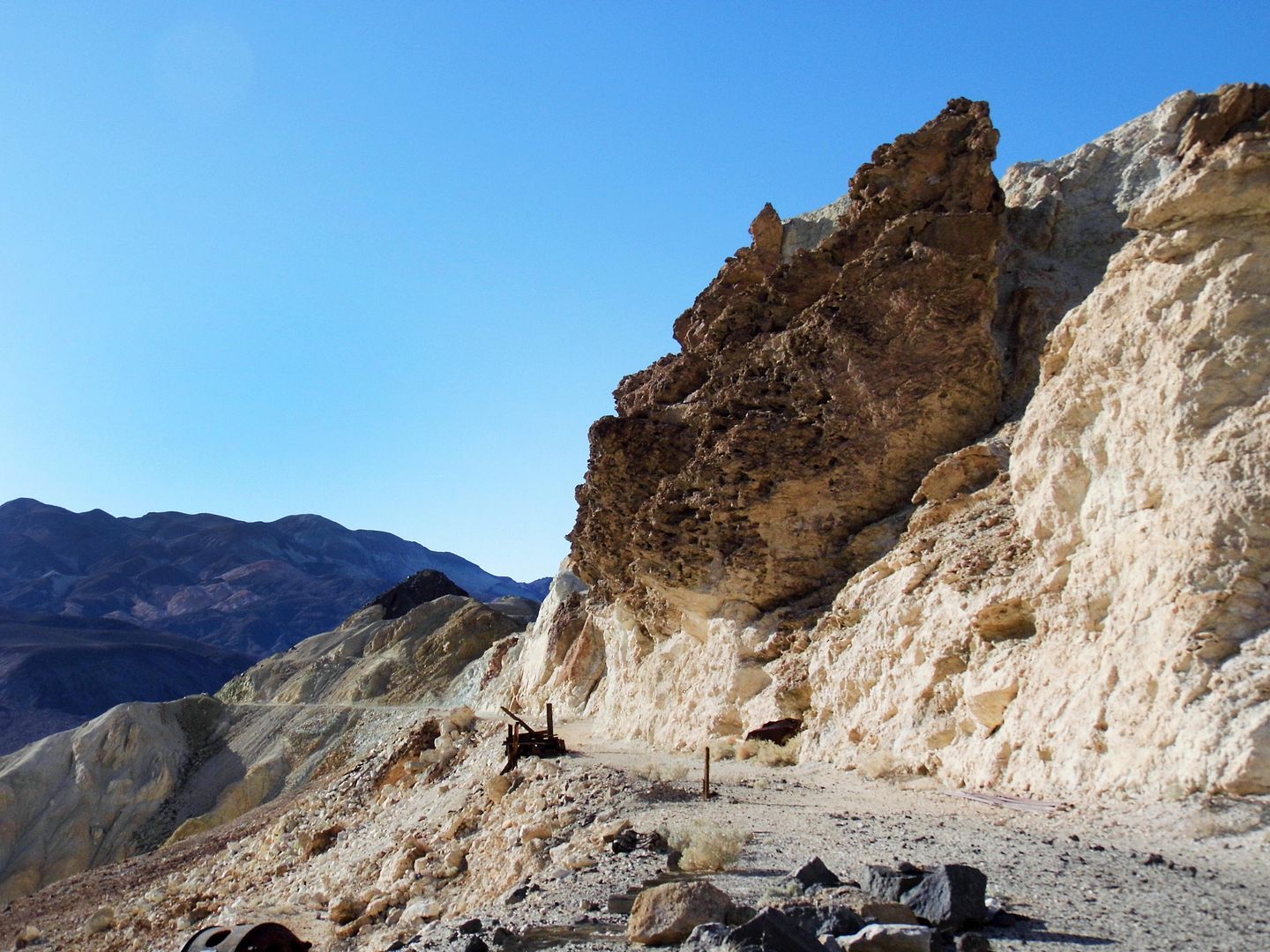
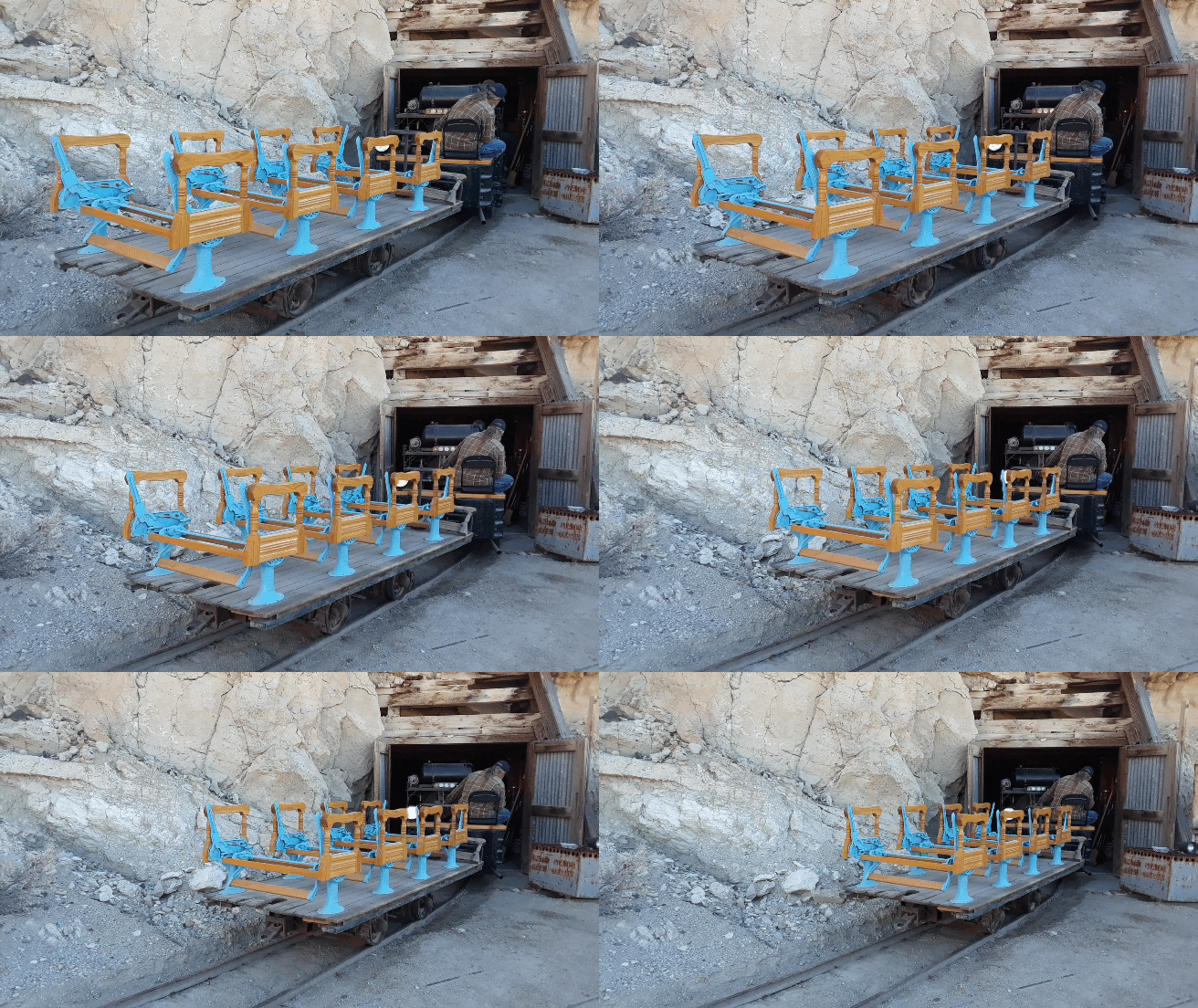
Probably the highlight of the tours given today is the 24-inch baby gauge railway that once hauled water, timber, explosives, and other supplies to the Grandview, Lizzie V. Oakley, and Widow mines to the south for a total of 6 miles.
The "Baby Gage," as they called it, also hauled borate ores back to Ryan, where they were transfer to the Death Valley Railroad and mosey on their way to Death Valley Junction.
When the Death Valley View Hotel began to welcome tourists to Ryan, its operators added seats to the Baby Gage so it could carry passengers "'round the Funeral Mountains" to the Widow Mine, 4 miles away—right there through that same old haulage tunnel—until it ceased in 1949.
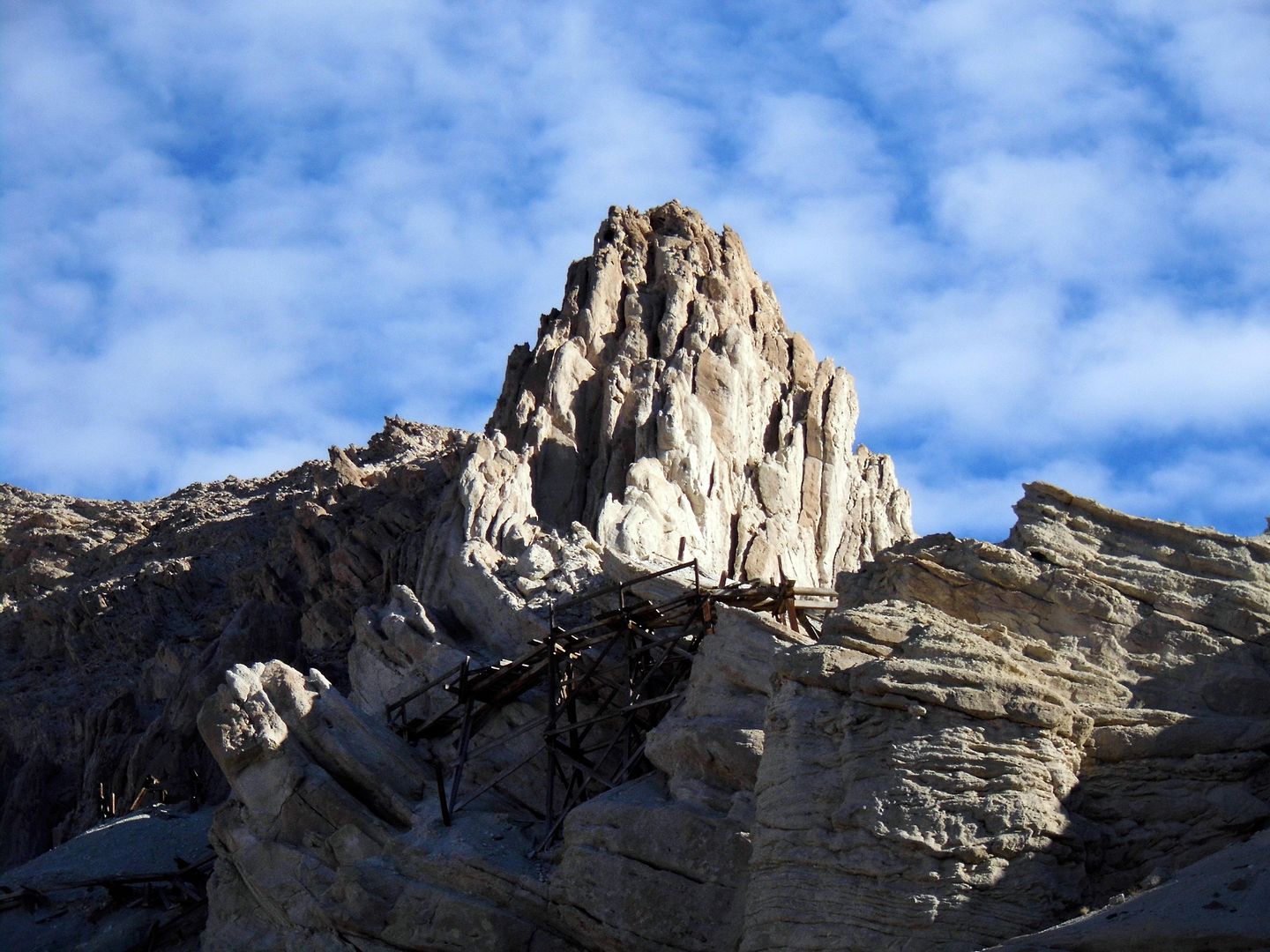
From the present-day Baby Gage display, you can look up and get a good view of the Upper Biddy McCarthy Mine...
...where there are still remains of a skip track, a dump trestle, and who knows what else?
Now, one of the reasons that Ryan lent itself to being repurposed as a destination getaway is because it wasn't just a mine—but an entire company town that was home to the miners, their families (including enough children to necessitate a schoolhouse), and other staff.
And you can still see some of the worker dormitories, staff houses, and guest houses...
...which were outfitted with electricity, steam heat (generated by an oil-fueled boiler), and refrigeration and supported by a sewage system and an ice-making plant.
The huge, two-story house of Superintendent William Smitheram (until 1916) was converted (sometime between 1919 and 1921) into a hospital building, replete with a surgery room—though no surgical team was staffed alongside the nurse who gave onsite care. It later was retrofitted to provide rooms for hotel guests.
With its corrugated galvanized steel paneled roof, Bunkhouse #1 was constructed in 1920 and then converted into Guest House #1 for the hotel.
Its outer stairs and veranda are being restored and/or rebuilt, while the interior guest rooms are being returned to their former glory...
...right down to the 1920s-era patterned carpet, which has been successfully reproduced by Brintons in the UK.
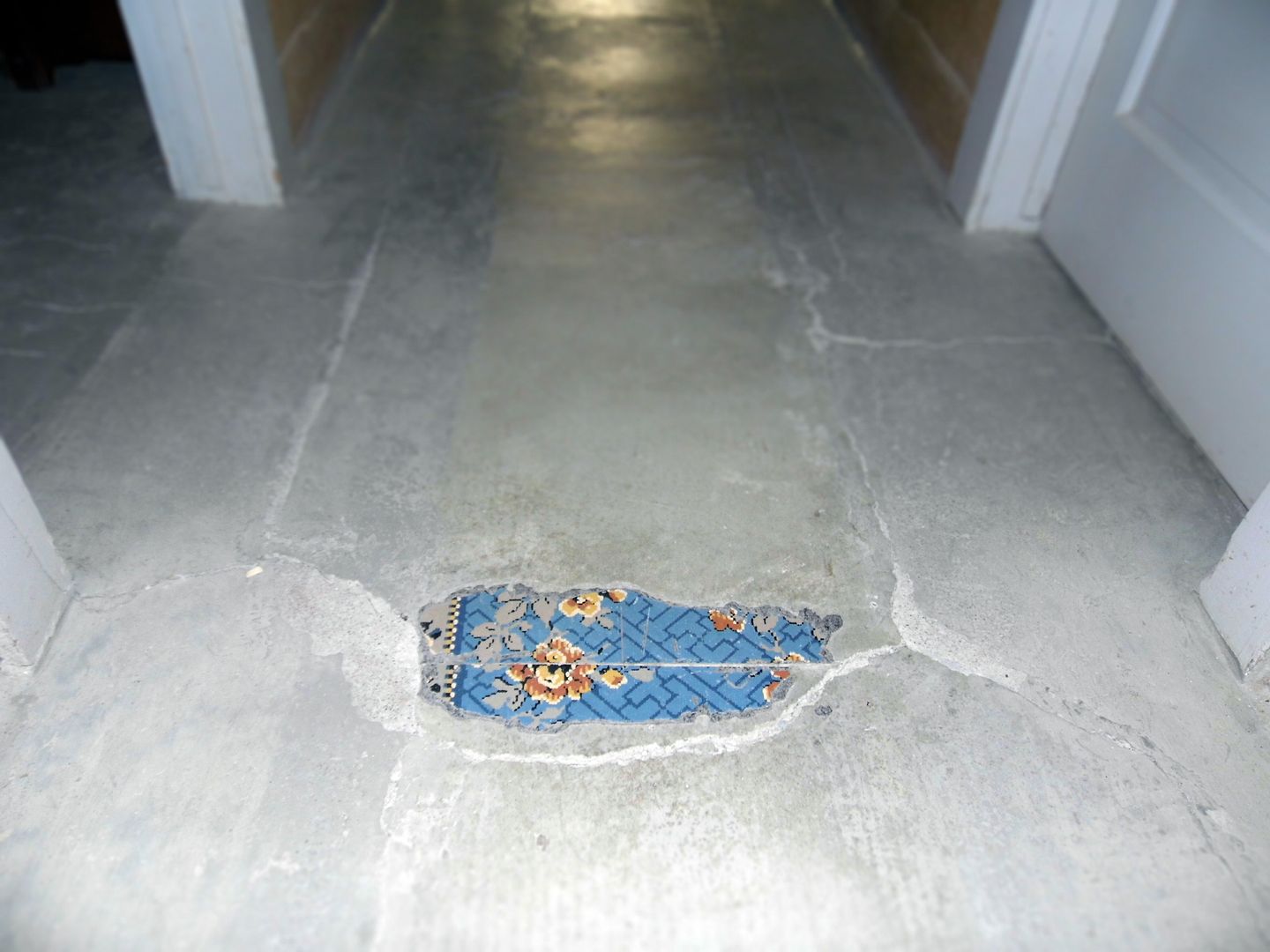
Many different patterns of linoleum once appeared throughout the camp's buildings...
...but what remains now are often just fragments, yet to be identified (much less reproduced).
And there's plenty in Ryan that's gone forever, not to be preserved or restored—like various shops, garages, and cabins that burned down or were demolished or moved elsewhere.
One of Ryan's landmark structures was actually relocated to the camp via rail in 1919—the rec hall (a.k.a. clubhouse a.k.a. dancehall).
It was dedicated in 1907 as St. Mary's Catholic Church in the gold mining camp of Rhyolite, Nevada. It nearly ended up in the Goodsprings mining district, but it moved to Ryan instead.
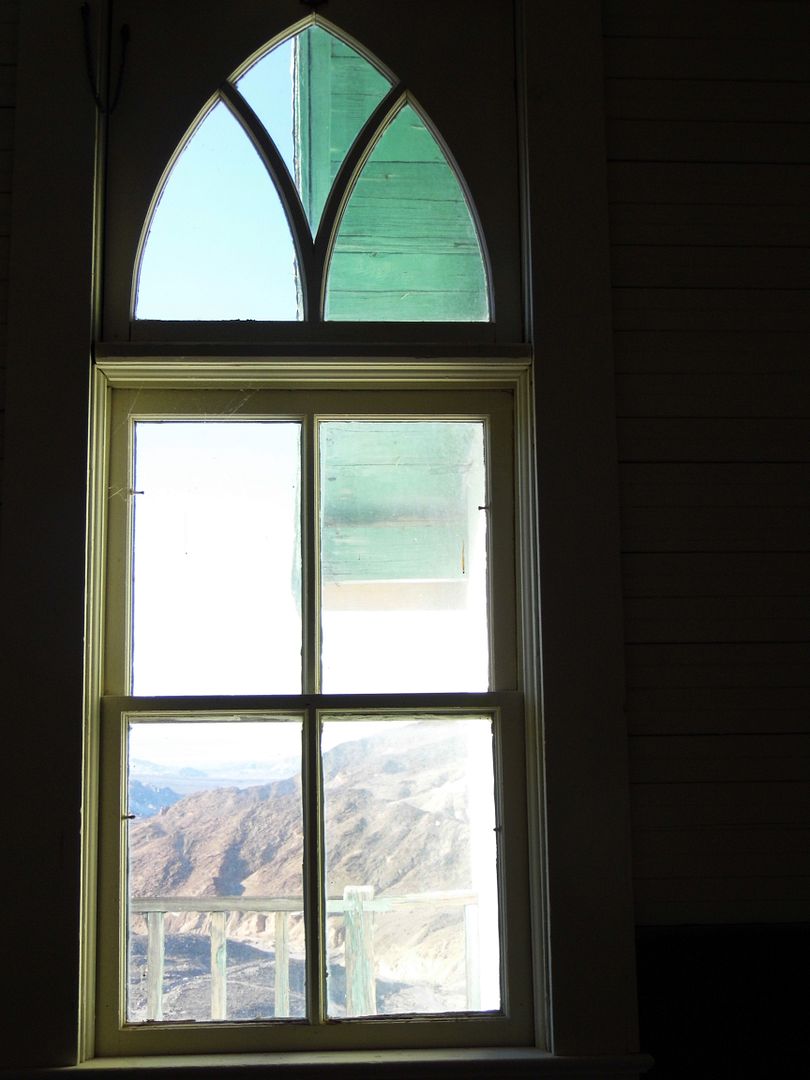
After its arrival, a stage was added for community meetings and secular recreation, though its interior still evokes an ecclesiastical purpose.
Stabilizing and restoring the rec hall is one of the major undertakings for Death Valley Conservancy's efforts in Ryan right now.
And finally, there's the schoolhouse building (circa sometime between 1919 and 1922)—which, like so many other structures in Ryan, is clad in industrial corrugated metal. A playground stands eerily abandoned in its recess yard.
Inside, the old school desks sit empty, the water-damaged wallpaper curling with every passing day that the bell no longer calls children to class.
I know it may be tempting to try to catch a glimpse of Ryan, but it is tightly patrolled and non-scheduled visits are strictly prohibited. Trespassing is not tolerated and prosecuted under the fullest extent of the law.
I arranged my visit as part of a public tour in November 2018 and received permission to enter structures and photograph the site.
I would consider the definitive history of Ryan's period of significance in mining and tourism to be the dissertation "Life and work in the Ryan District, Death Valley, California, 1914-1930: a historic context for a borax mining community" by Mary Ringhoff, available to read via USC Digital Library.
For lots more contemporary photos (circa 2012), visit Steve Hall's Death Valley Adventures. For the National Park Service publication "Death Valley Historic Resource Study: A History of Mining," click here.
My biggest problem when I spent the night at Villa Anita in Tecopa, California on my way to Death Valley...
...was that I tried to make sense of it.
But by nature, it's nonsensical.
That doesn't, however, mean it's meaningless.
Villa Anita is a work-in-progress in the spirit of such assemblage masterpieces as Zorthian Ranch and folk art castles like Nitt Witt Ridge, with a healthy sprinkling of the spirit of Noah Purifoy mixed in.
But out there in the easternmost reaches of the California Mojave desert, it didn't make any sense to me...
...because once I entered it...
...I lost my sense of the surrounding desert.
And I'd rather die of exposure...
...than have the world cave in on me.
I find myself drawn to modernist homes that blur the lines between the indoors and outdoors with large plate-glass window walls and trees and boulders that breach the building's frame.
But at Villa Anita, the labyrinth of pathways may take you outside and around the exterior of the tiny house that was built in 1951...
...but while you're searching for your way out, you're usually under some type of cover, be in pallet or tarp...
...and there are walls just for the sake of being walls.
Each room is meant to be a kind of sculptural vignette...
...but I'd rather live surrounded by sculpture...
...rather inside one.
Villa Anita's creator says that its construction began as a way to make the Death Valley desert bearable year-round.
But air conditioners and swamp coolers can do that.
Death Valley is bearable to me because I bare myself to it.
I lay bare my fears and insecurities, my loneliness, weakness, and inadequacies.
People come to desert towns like Tecopa to hide from the world, perhaps...
...but not from themselves.
Charles Manson's second-in-command, Paul Watkins, lived out his life's second act in Tecopa—with his second wife and two daughters—right there on the Old Spanish Trail Highway, by Villa Anita.
He wasn't fooling anyone. And he didn't deny his Manson family ties. (He even authored a book, My Life With Charles Manson, published in 1979.)
But the Death Valley desert gave Manson's main disciple a second lease on life. He founded the Death Valley Chamber of Commerce. He became the unofficial mayor of Tecopa.
We all go to the desert for different reasons.
But no one has really managed to conquer the desert yet. The desert changes you—not the other way around.
And so, the next morning, after my one night at Villa Anita, I was relieved to slough off all the distractions and clutter of this massive art experiment and expose Death Valley to my new, naked skin.