Search

Showing posts sorted by date for query bugsy. Sort by relevance Show all posts

June 07, 2026

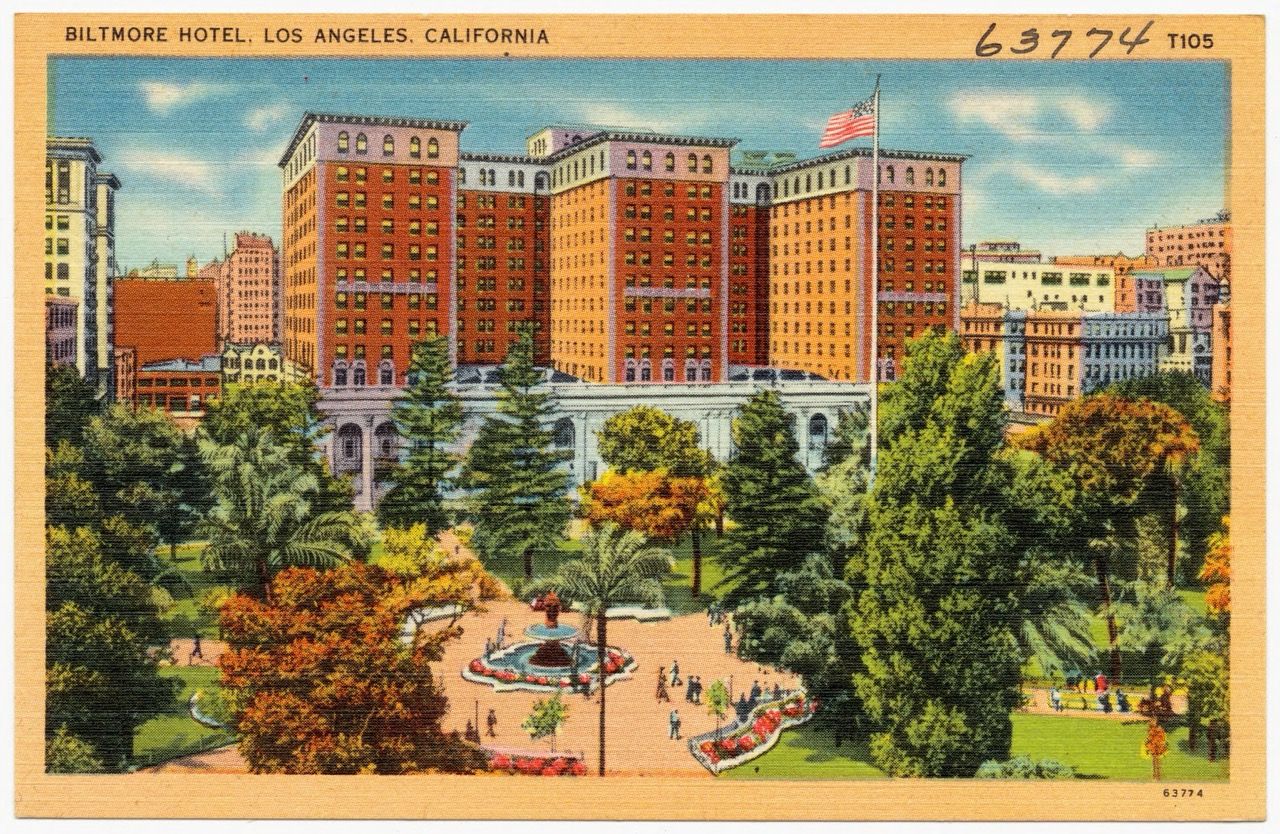
Photo Essay: Plunging Into the Biltmore Hotel's Tiled Pool Palace

I haven't written about the Biltmore Hotel in Downtown Los Angeles yet—despite having taken a tour with the Los Angeles Conservancy—because I just didn't think I had anything to add to the existing reporting.

Tichnor Brothers, Publisher, Public domain, via Wikimedia Commons

Located opposite of Pershing Square—once Downtown LA's "Central Park"—the Beaux Arts-style hotel by Schultze and Weaver gets a lot of press coverage, and for good reason. Today, this architectural masterpiece provides luxury accommodations much as it did back in 1923, when it was the largest hotel west of Chicago.

October 20, 2020

Photo Essay: Hollywood Forever Cemetery, Where Dead Stars Still Draw Crowds

[Last updated 9/17/23 10:20 PM PT—Removed photo/mention of Alfred Hitchcock, as he's not buried at Hollywood Forever.]

Every year, around this time of year, I think I might like to go check out the Día de Muertos event at Hollywood Forever Cemetery in Hollywood, California—the largest of its kind outside of Mexico. But the closer it gets to the date, the more reticent I become to deal with the festiveness of the festivities.
 

Well, this won't be my year to go, as the event—which usually occurs a few days before the Day of the Dead—is canceled for COVID-19. 


But I'm kind of relieved. And kind of grateful, too. Because the pandemic has allowed me to visit Hollywood Forever a few times on a weekday, without the crowds, and with nothing special going on except the cemetery itself. 


In the nearly 10 years that I've lived in LA, Hollywood Forever has really become a thing—partially because of its outdoor movie screenings and its concerts and other events at the Masonic Lodge.


Most of the building is part of the cemetery’s administration complex. It's the upstairs main meeting room—the "lodge"—that's got the most esoteric origins, with its wood beam ceilings and mystical energy. 


Designated a national historic landmark, the Morgan, Walls and Clements-designed lodge was completed in 1931 with interiors (including lighting fixtures and furnishings) also designed by the firm in the Spanish Renaissance style. 


On the outside, the Spanish Baroque-style structure has been stripped of many of its visible ties to freemasonry—but it once served as the home base for the members of the Southland Lodge No. 617, who used the entire complex as a community center until the 1960s. 


That part of the cemetery stood essentially abandoned for three decades—despite being at the main entrance.


Hollywood Forever—which Isaac Van Nuys and his father-in-law Isaac Lankershim opened in 1899 as Hollywood Cemetery—is perhaps best-known for its celebrity grave sites. It is Hollywood, after all. And it's directly behind the Paramount Studios lot, too.  

  
As with most cemeteries, I'm a bit more interested in the art and architecture (like of the chapel and the  columbarium dome behind it, both circa 1928). 


But Hollywood Forever (also formerly known as Hollywood Memorial Park Cemetery) has the added bonus of peafowl, which have resided there for over 15 years. 

clock tower (built 1930)

On the west side of Hollywood Forever—with entrances off of Gower Street (named after Hollywood pioneer Mary Love Gower, who once owned the land)—is the Beth Olam Jewish Cemetery. 
                  

That's where you'll find the final resting place of Mel Blanc, the "Man of 1,000 Voices" (Bugs Bunny, Yosemite Sam, Sylvester the Cat, Porky Pig)...


...and actress Estelle Getty, who was born the daughter of Polish Jews and not, like her character Sophia from The Golden Girls, Italians from Sicily. 


Hollywood pioneers are buried at this cemetery, too...


...like Paramount co-founder Jesse Lasky, producer of The Squaw Man (also namesake of the Lasky-DeMille Barn, Hollywood's "first movie studio," which now houses Hollywood Heritage).


The Abbey of the Psalms Mausoleum, designed by Marston & Maybury, started out in the 1930s...


...and has grown over time to also include the Sanctuary of Memories (and of Faith, Light, Trust, and so on). 


With the 8-foot, bronze statue of Johnny Ramone in 2004, Hollywood Forever also solidified its status as a destination for music fans...


...looking to pay tribute to their favorite punk idols...


...which also include Johnny's bandmate, Dee Dee Ramone, who's buried just down the way. 


Johnny isn't actually buried there yet—his ashes will be interred there after his wife, who is holding onto them, passes away. 


His neighbor in the (Sound)Garden of Legends will be fellow rocker Chris Cornell, who was buried next to the statue in 2017.  


They're both near the south shore of Sylvan Lake—one of two original lakes (the other one, more centrally located, has since been filled in)—where the Classical Revival-style Clark Family Mausoleum (circa 1920, by Robert Farquhar) occupies Clark Island, both named after Los Angeles Philharmonic founder William Andrews Clark, Jr. 

 
Facing the Italian carrera marble monolith is a likeness of Russian-born actor Anton Yelchin, who died at the age of 27 in 2016.


In addition to bronze statues, a number of other memorials can be created by Hollywood Forever's in-house studio of stonemasons. 


That helps make each gravesite a special destination in its own right—like the one for Terry, the dog who portrayed "Toto" in The Wizard of Oz (though she was actually buried at a pet cemetery that was destroyed for the construction of the 101 Freeway).


The last new structure to be built is the Fairbanks Memorial Reflecting Pool in Fairbanks Gardens (circa 1939), named after swashbuckling sex symbol Douglas Fairbanks. 

 
It sits just west of the Italian Renaissance-style Hollywood Cathedral Mausoleum, designed by the Pasadena architectural team Marston and Van Pelt. It was constructed out of California granite and completed in 1922. 

     
That's where Mickey Rooney is buried, his interment visible from the exterior. 


Inside, the crypts are covered in slabs of Alabama marble...


...some, like that of silent film-era Hollywood heartthrob Rudolph Valentino, flanked by bronze urns. 


Tjere are shrines to those interred in the mausoleum, too—like to actor Peter Lorre in the Alcove of Reverence. 

 
Even the darker corners of the mausoleum—where the niches are less often frequented by fans—there is vibrant color and light, thanks to panels of stained glass windows.

 
Some were fabricated by American Art Glass Co., circa 1945...


...while others don't carry an artist signature or maker's mark (though Judson Studios is known to have contributed art glass to the Cathedral Mausoleum, perhaps the skylights). 

    
While Hollywood Forever was one of the first "lawn park"-style cemeteries in California, the burial plots currently aren't restricted to just low-profile markers. But Cecile B. DeMille's sarcophagus is surprisingly modest for such a heralded director. [Ed: Previously I had a photo here of a tombstone marked "HITCHCOCK" that I attributed to director Alfred Hitchcock, which is incorrect. Rookie mistake. I removed it on 9/17/23. ] 


When I visit, I like to make a loop from the Santa Monica Boulevard gate entrance, through the cemetery, and back to the exit by passing the old pump house...


...so I can try to spot any of the feral cats that the cemetery helps feed and shelter. 

 
The cats tend to hang out just east of the bird pens, where dozens of peacocks can escape the crowds or head out onto 64 acres of lawn for a little strutting and grooming. 

                
Although I think I've seen each of the cemetery's 40 peacocks and peahens over the course of a handful of visits, I still haven't made it to the final resting places of Judy Garland, Bugsy Siegel, Tyrone Power, Marion Davies, Griffith J. Griffith, or Harry Chandler. 

And I'm sure there are other "must-see" graves that I've been missing out on.

But I'll surely be back. Especially if this pandemic continues to drone on like it has. 

For a full history of Hollywood Forever up until 1999, click here. 

Related Posts:

June 28, 2019

Photo Essay: Welcome Back, Formosa Cafe!

Until 2017, one of the most stalwart mainstays of Hollywood nightlife was the Formosa Cafe, located along Route 66...


...across the street from the movie lot that was, at one time or another, Pickford-Fairbanks Studios, United Artists Studio, or Samuel Goldwyn Studio.


The Cantonese-themed bar and restaurant, known for its appearance in the Lana Turner scene in L.A. Confidential, has been closed for two and a half years.


But the closure was only temporary, as the 1933 Group—also known for its restorations of Highland Park Bowl and the barrel-shaped Idle Hour—took over ownership of it.


The nightlife group completely restored the the old Pacific Electric Red Car trolley-turned-dining room...


...and made it actually look like a train again.


Of course, lot of work was done on stuff you can't see, too.


The Formosa Cafe was preserved as a historic landmark in the early 1990s, when its lease expired and it was threatened with demolition as plans to expand The Lot attempted to encroach on the restaurant's footprint. In 2004, the developer of the "Gateway" shopping mall next door agreed to build around it after being wooed by its charms.


It's satisfying to see it survive another preservation threat—and keep the floor safe belonging to Bugsy Siegel intact.


First opened in 1925, Formosa Cafe was more or less family-run from 1945 to 2014.


But the oldest section of the restaurant  the train car—PE #913, in service from 1902 to 1906.


And it's key to preserving the history of the Formosa.


In fact, when it first opened, the Formosa—then known as The Red Post Cafe—was just that old red streetcar!


Fortunately, much of the original decor and memorabilia—including all those photos of all those celebrities who've passed through the doors of the Formosa—was saved from the last (historically inappropriate) renovation.


1933 Group managed to get them back from the last owner.


If there's anything new that's been added, it's hard to tell. The restoration is that seamless.


In fact, the entire back bar area was added on, enclosing an outdoor portion of the restaurant's former iteration.


The pagoda looks as though it could've been there for ages.


And based on the renovations to both the structure and the menu, it looks like the Formosa is ready to have a new heyday.


There's still a lot of life left in this former Hollywood starlet.


And Hollywood sure does love a comeback story.

 
The Formosa Cafe has been in "soft open" for a week...