Search

Showing posts sorted by relevance for query "s. charles lee". Sort by date Show all posts

January 29, 2022

Photo Essay: The 91-Year-Old Bakersfield Fox Theatre Glitters Just As Brightly As In 1953

It really says something about the city of Bakersfield, California that it was, at one time, on the radar enough to receive one of the Fox theatre chain's movie palaces...
   
 ...and also that it fell off the radar enough for that palace to be left alone for over 90 years and be spared from the wrecking ball and development.

March 17, 2020

Photo Essay: The Jewel Box of the Cosmetic World and Its Pink Powder Puff (Updated for 2025)

[Last updated 2/8/25 9:43 PM PT—Added Mel's section to the bottom of this post.]

♫"...If you think that you can be an actor, see Mr. Factor, 
he'd make a monkey look good..."♫
- "Hooray for Hollywood"

Growing up in the age of drug- and department-store cosmetics like Revlon, Cover Girl, and Maybelline, it's easy to think that "Max Factor" was just another brand name.

In fact, some people have theorized that Max Factor is a kind of portmanteau of the medical practice of "maxillofacial" surgery, or "Max Facs."

But there was, indeed, a Max Factor—or, rather, a Maks Faktor.

Born in Poland, Maksymilian Faktorowicz is the man we should credit for inventing lip gloss—and many other staples of our everyday makeup cases.

He's the one who created the heart-shaped lips—like those of a Pierrot clown—for silent movie star and "It Girl" Clara Bow.

On the flipside, he also exaggerated Joan Crawford naturally thin lips, creating an overdrawn look nicknamed the "Hunter's Bow."

His pedigree was unmatched, having worked for the Imperial Russian Grand Opera's cosmetician at only age 14. Later, he became the on-call beautician to the family of Russia’s Czar Nicholas II.

After immigrating to the United States, and moving to LA with his family in 1908, he founded Max Factor & Company in 1909. Without a permanent headquarters, he set up shop in various different neighborhoods and in buildings that weren't his own (including, for a while, the Pantages building).

In 1913, he caught a break when he persuaded Hollywood director Cecil B. DeMille to rent the wigs he'd custom-made.

But in the land of make-believe, it was "make-up" that brought Max Factor the most attention.

Until he started "making up" both starlets and average women, the term "make-up" was only associated with theater actors and vulgar women with bad reputations.

That all changed after he settled into his own home—and threw the doors open to the public, welcoming them into an opulent setting that was perfect for lured high-society and professional women (and way too nice for hussies).


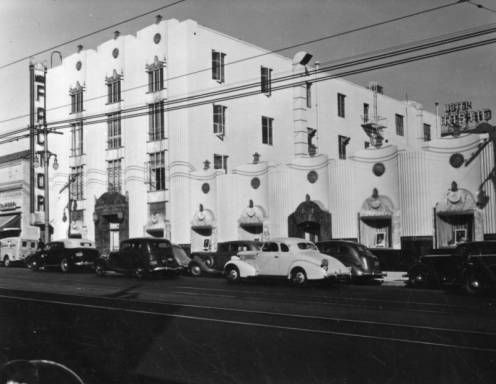
circa 1939 (Photo: Works Progress Administration Collection, via LAPL)

He chose the Hollywood Fire and Safe Building, built in 1913, as his future home in 1928—disastrously close to the stock market crash that would delay its opening until 1935. 

May 14, 2026

Photo Essay: Riding the D (Or, Bringing the D to Beverly Hills)

When you move from New York City to Los Angeles, everybody outside of LA says, "Oh, but you have to drive." 

That's not a bad thing to me. I often wished I had a car when I lived in three of the five boroughs. And by the time I moved from Brooklyn to Manhattan in 2003, I'd been avoiding the subway ride home late at night for years already. At one point when I was making enough money, I took cabs to work every day. 

But living in Beverly Hills since 2011, I have felt the pinch of not even having the option to ride the subway. If I wanted to, say, ride the Expo line to an event at the Coliseum (so as to avoid traffic and high parking fees), I'd still have to drive five miles (or 20 minutes) and park my car in the Metro lot. 

Thank goodness for the bus lines, which have gotten me where I've needed to go many times when my car has been in the shop and I couldn't afford rideshare.


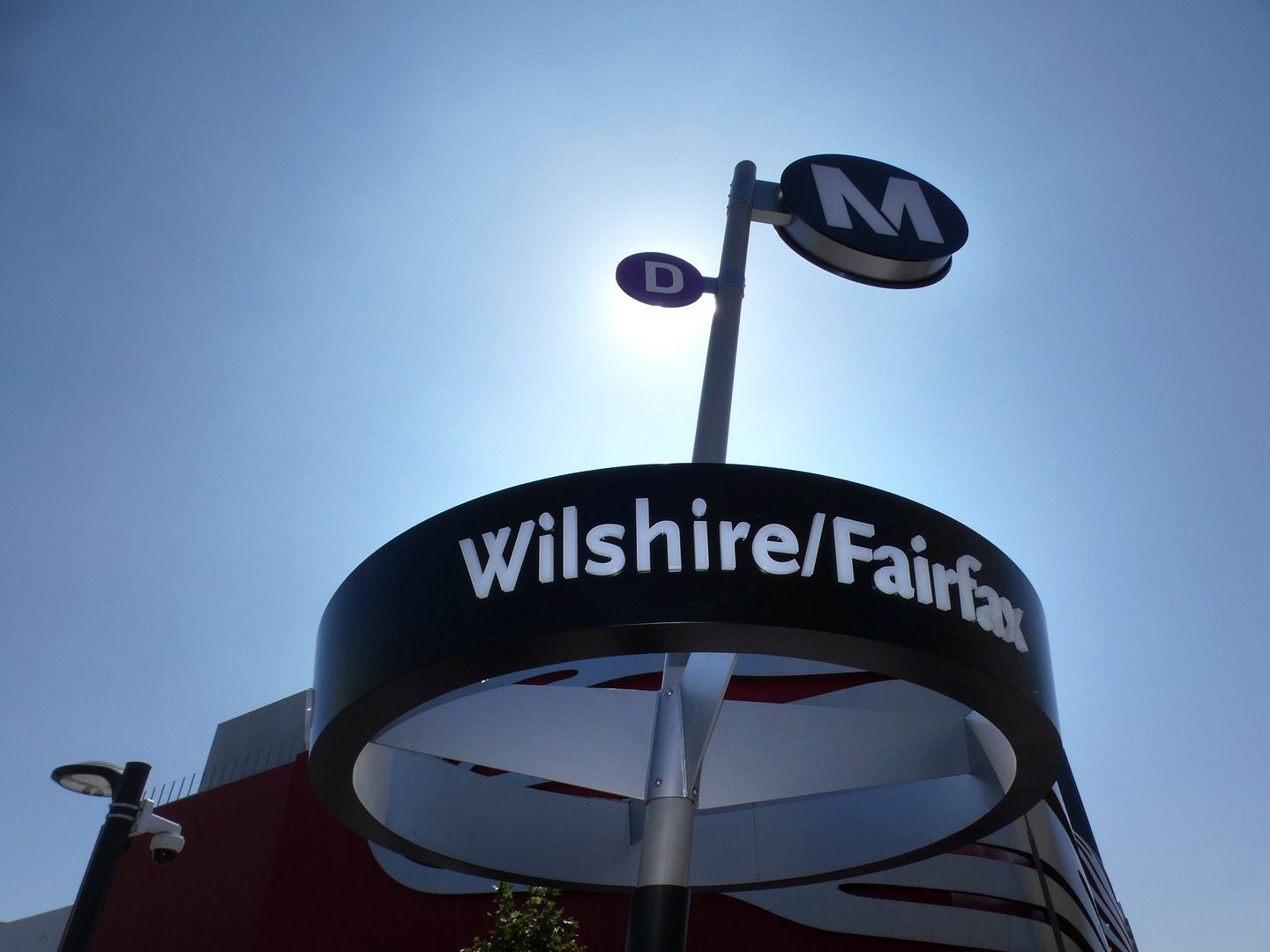
So even though public transit has not been part of my daily routine, I was still excited that the LA subway was finally coming to Beverly Hills, thanks to the Purple Line Extension—or what's now known as "the D." 

September 13, 2022

Photo Essay: Inside the Apple Takeover of the Tower Theatre on Broadway in DTLA

Back in 2012, I had what I thought at the time was a "last chance" to get inside the Tower Theatre on Broadway in Downtown LA before it got renovated for some other purpose.

circa 2018

October 21, 2019

Photo Essay: The Horror Collection Hiding In a Prohibition-Era Basement Bowling Alley

One of my favorite buildings in LA is the four-story Max Factor Building in Hollywood, built in 1914 and purchased by the cosmetics king in 1928. It was then known as the Hollywood Fire & Safe Building.


But by the time Max Factor had his grand opening in 1935, architect S. Charles Lee had turned the cosmetics company headquarters into the "Jewel Box of the Cosmetic World"—with curved windows, ornamental lamps, bas-reliefs, imported marble, and more ornamentation in the Hollywood Regency style.

July 01, 2017

Down the Rabbit Hole


When I signed up for today's day-long tour of local theaters with the Theatrical Historical Society of America's annual "Conclave" conference, I had no idea I'd find myself convalescing at home later.

Usually the dangerous adventures are those I go on by myself. But I suppose that's when I'm the most careful.

I have a certain expectation, I guess, that when I've paid for a ticket—especially one that's as much as $175—part of what I get with my money is some sense of security.

You'd think I was paying for safety and guidance, if nothing else.

But it turns out that I may be safest at all when I'm alone. Although I've fallen on the trail more than once, it seems that my biggest injuries—both emotional and physical—have come at the hands of another.

And taking one not-so-little fall today has sent me down the rabbit hole of distrust and misanthropy and fatalism.

But somehow, I managed to dodge any twinge of regret—despite the pain I'm in right now, despite the injuries I've sustained, and despite the tears I've cried.


I've taken quite a few tours of theaters around Southern California, but instead of that making me feel accomplished, it shines a spotlight on the ones I haven't yet been able to get into.


And one of those was the Westlake Theatre, built in 1926.


Some Art Deco touches—like the ticket booth—were added by S. Charles Lee as part of a "modernization" in 1935.


But mostly, the former first-run movie theater (which also staged vaudeville productions) explodes with Churrigueresque details, both inside and out.


It was grossly converted into a swap meet in the 1990s, keeping many of the original details (besides filling in the orchestra rake with a flat poured concrete floor)...


...although not maintaining them very nicely.


The swap meet closed in 2011 and, with the building now designated a Los Angeles Historic-Cultural Monument and listed on the National Register of Historic Places, there's been some hope to revitalize it as a performance space.


Less interested in the vestiges of the retail flea below, I headed up to the balcony to see what ornamentation remained.


Whether it was plaster molds or peeling paint...


...I had my eyes cast upwards.


And that was my mistake.


When I proceeded into the balcony seating area, I could tell that our group had no business being up there.


Seats had been replaced by Santas, which, in the absence of railings, were the sturdiest things to hold onto up there.


It was dark, but I've gotten better about being in the dark. I've been less afraid.


And not only was I not alone—but the others in my group had flashlights that helped me see.


Photo: Public domain

So, when I got to the projection booth, I just walked in. I didn't feel my way with my foot before stepping. I didn't pull out my cell phone for light. I just put one foot in front of the other.

And one foot went straight through a hole in the floor.

I barely knew what had happened to me. I noticed my camera in my right hand hitting the floor before I noticed that I was crotch-deep in a hole, my left leg dangling, and my right ankle, foot, and toes twisted.

"Are you OK?" someone kept asking me. But he was standing outside of the projection booth, and didn't advance closer. I had a sense of more people standing behind me, but no one came over to help. No one pulled me out of the hole.

I might as well have been alone.

The man persisted in asking me if I was OK. Finally, I said, "I'm OK. I'm not good, but I'm OK."

But the truth is, I was only conscious. Nothing was broken. But I wasn't OK.

And I'd just wasted precious time by falling into a hole in the floor. So, what could I do? I got up, brushed myself off (not realizing my face was also covered in dirt or that I was bleeding), and took more photos.

When I realized that the rest of the itinerary for the day had changed from what I'd originally signed up for—with the next three theaters being those I've already been to before—I just wanted to go home.

So, I left, in tears.

Maybe I'd already been thrown off-kilter first thing that morning, because the organizers had given me the wrong meeting time, and the bus had already left without me. After having already paid for all-day parking Downtown, I'd rushed to the Westlake Theatre in my car, and I'd scrambled to find an organizer to give me my badge and a quick orientation.

But I'd arrived late, so I'd marched on to get my photos and see as much as I could before we all got ushered back out all too soon. I wasn't as careful as I should've been. But I didn't really know how careful I needed to be in there.

No one had given me a waiver to sign. No one had told me to wear sneakers. No one said, "Watch out for the hole in the floor."

In the hours that followed, I felt grateful that the hole had been big enough to fit my entire thigh, and that my rear end had been plentiful enough to cushion my fall.

I was relieved that my car was right there, so I could drive myself home instead of being stranded on that bus.

I was even somewhat satisfied to have crossed the Westlake Theatre off my list—though now I have no love for that place, given what happened to me there.

It could've been a lot worse. But it reminded me how easily I can fall down the rabbit hole when something bad happens—both physically and mentally.

I have an autoimmune disease, so, as it is, my body is constantly attacking itself. But when I catch a sniffle or, God forbid, eat something bad like I did last week, it sends me into a disabling flare-up. A tummy ache turns into a migraine. And a stubbed toe can throw out my back.

That's why it was so hard on me when someone rear-ended me three years ago, giving me whiplash and head trauma. I'm still dyslexic from it. I'm not sure that will ever go away.

I guess this is what my parents—particularly my mother—tried to protect me from when I was a child, forbidding me from riding my bike past a certain perimeter or going to the movies or the mall or staying after school for much of anything.

Bad things happen.

Worse things happen.

And I was so easily devastated by the lack of care and concern, the disorganization, and the negligence that I faced today. The THS organizers refunded my money and sent flowers to my apartment this afternoon with a note that apologized for the "inconvenience" I'd encountered.

That's nice, but it wasn't merely inconvenient. It was thoughtless and heartless.

But when it comes down to it, I just can't stay home and hide from the world. The fear of what might happen is just as bad (if not worse) than what actually happens.

It's almost better to get stung than to keep running from the bees.

Related Posts:
S.O.S.
Twice Fallen, Twice Shy
A Kick in the Head, Part 4 - Conclusion
It Got Worse
I Am Woman, Hear My Story

July 17, 2014

Photo Essay: Open House at the Restored Alex Theatre, Magic Hour

I missed the last open house at the Alex Theatre, when they were preparing for their most recent restoration.

I was a bit disappointed, because I always like getting the perspective of both the before and after. And my attraction to the beautiful decay often makes me prefer the "before."

So when I visited the Alex – the former Alexander Theatre, built in 1925 – I found myself looking for as many of its older elements and features as I could.


Its notable spire, which shines bright along Brand Boulevard at night, isn't actually original to the building, but added during a 1940 restoration by S. Charles Lee, known for his towers.


A sweeping terrazzo floor pattern leads to an adorable box office...


...an Art Deco-looking cutie that acts as a gateway to the Greek Revival forecourt...


...clearly inspired by the Egyptian Theatre in Hollywood.


My visit coincided with the last remaining rays of sun...


...which beamed golden through the starburst pattern of the front entrance...


...into the outer lobby.


In the inner lobby...


...you can find two lion statues that once flanked the Alex stage from 1948 to 1993, relocated and on display.


The current proscenium repeats that starburst pattern from the front...


...and although it's not the most ornate theater house in LA...


...it's also not the plainest, with some nice details...


...and a row of colored incandescent bulb lighting.


The backstage area has been adapted from that of a movie house to a full facility for live stage shows...


...which is the type of programming they are trying to become a bigger contender in.


The most recent renovation reportedly improved a lot of the Alex's behind-the-scenes features, though I managed to find one patch of what appeared to be an original wall...


...and a dressing room that wasn't quite as spiffed up as the rest.


These, of course, are the areas I love.


I was surprised they let me just walk around pretty much wherever I wanted on a "self-guided tour,"


...though as I explored every inch of the bowels of the theater, more than one staffer asked me if they could help me find something.


"No, just taking pictures," I'd say, turning every doorknob, peering around every corner, switching lights on and climbing every stair.

Related Posts:
Photo Essay: Upon the 90th Anniversary of the Egyptian Theatre
Partying Like It's 1922 at The Egyptian Theatre
Photo Essay: The Art Deco Theater Inside Academy Cathedral, Inglewood

June 01, 2014

Photo Essay: The Art Deco Theater Inside Academy Cathedral, Inglewood

Most people only know Inglewood now as the (surviving) LAX-adjacent town that houses Ray's Donuts, the Forum and, formerly, Hollywood Race Track.

It was once a thriving upper middle class suburb for whites only, so much so that when the film exhibitors needed to expand the premieres of their first-run movies beyond Downtown and Hollywood, they went to Inglewood (and Glendale).

Inglewood used to be full of single screen movie houses. Some didn't survive fires or earthquakes, and others were merely phased out as multiplexes took over.

The Academy Theater opened in 1939, and remained a first-run cinema until it closed and nearly immediately reopened as a church in 1976.


It probably survived so well because it was never reinvented as a Spanish-language or grindhouse cinema or kung fu house.


Designed by famed theater architect S. Charles Lee (also of the Tower Theatre) in the streamline moderne style of Art Deco, the Academy is all circles and curves...


...and glass bricks and etched glass and aluminum and mirrors, typical of the style and era.


Now that it's been converted into a "cathedral," you can witness the addition of crosses and soundproofing, as well as purple seats and carpeting and curtains.


The undulating walls remain, as well as other original features of the Academy, like an ornate HVAC grille...


...an etched glass mural by Millard Sheets (usually covered by purple draperies)...


...and even a fire door upstairs by the projection booth (preserved in pristine condition from its major wood-paneled makeover in the 1970s).


You can still find the red and blue marquee letters, stored alongside some holy robes...


...which are brought out now to spell messages like "WORSHIP WITH US" instead of "NOW SHOWING" or "COMING SOON."


The neon tower is undergoing a paint job and restoration as we speak, still serving as a beacon to the community, for a slightly different purpose.


Inglewood has changed a lot since becoming incorporated in the 1970s, now with a much more diverse population and much fewer theaters, but they've still got the cool ocean breezes that initially attracted their residents. And it's a city that forces you to look up – not only at the glowing neon tower of the Academy, but also at the planes flying over, to and from LAX.

Related Posts:
Photo Essay: Vision Theatre Rising
Photo Essay: Last Chance Look at the Tower Theatre (Lobby, House & Balcony)