Search

Showing posts sorted by relevance for query marilyn monroe. Sort by date Show all posts

March 17, 2020

Photo Essay: The Jewel Box of the Cosmetic World and Its Pink Powder Puff (Updated for 2025)

[Last updated 2/8/25 9:43 PM PT—Added Mel's section to the bottom of this post.]

♫"...If you think that you can be an actor, see Mr. Factor, 
he'd make a monkey look good..."♫
- "Hooray for Hollywood"

Growing up in the age of drug- and department-store cosmetics like Revlon, Cover Girl, and Maybelline, it's easy to think that "Max Factor" was just another brand name.

In fact, some people have theorized that Max Factor is a kind of portmanteau of the medical practice of "maxillofacial" surgery, or "Max Facs."

But there was, indeed, a Max Factor—or, rather, a Maks Faktor.

Born in Poland, Maksymilian Faktorowicz is the man we should credit for inventing lip gloss—and many other staples of our everyday makeup cases.

He's the one who created the heart-shaped lips—like those of a Pierrot clown—for silent movie star and "It Girl" Clara Bow.

On the flipside, he also exaggerated Joan Crawford naturally thin lips, creating an overdrawn look nicknamed the "Hunter's Bow."

His pedigree was unmatched, having worked for the Imperial Russian Grand Opera's cosmetician at only age 14. Later, he became the on-call beautician to the family of Russia’s Czar Nicholas II.

After immigrating to the United States, and moving to LA with his family in 1908, he founded Max Factor & Company in 1909. Without a permanent headquarters, he set up shop in various different neighborhoods and in buildings that weren't his own (including, for a while, the Pantages building).

In 1913, he caught a break when he persuaded Hollywood director Cecil B. DeMille to rent the wigs he'd custom-made.

But in the land of make-believe, it was "make-up" that brought Max Factor the most attention.

Until he started "making up" both starlets and average women, the term "make-up" was only associated with theater actors and vulgar women with bad reputations.

That all changed after he settled into his own home—and threw the doors open to the public, welcoming them into an opulent setting that was perfect for lured high-society and professional women (and way too nice for hussies).


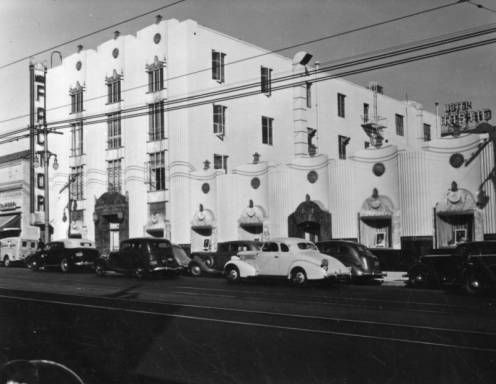
circa 1939 (Photo: Works Progress Administration Collection, via LAPL)

He chose the Hollywood Fire and Safe Building, built in 1913, as his future home in 1928—disastrously close to the stock market crash that would delay its opening until 1935. 

April 05, 2019

Photo Essay: The Bygone Celebrity Playground of Borrego Springs

[Last updated 4/6/21 8:27 PM PT—details regarding Hoberg family members clarified]

When I first visited Borrego Springs, nestled in the heart of Anza-Borrego Desert State Park, I'd actually wanted to stay in the nearby mountain resort town of Julian.

But it was September, and apple-picking season was beginning to peak.

The desert, however, was still a little too hot for most tourists, so we had no troubles booking a room in the valley.


I didn't know a thing about Borrego Springs before I visited—save for what a New York Times article had described as something like "The Next Palm Springs That Never Came to Be."


That article suggested we stay at the Palms at Indian Head, and we obeyed. Knowing me, always to root for the underdog, it was the perfect place for me to escape as well.


At the foot of Borrego Palm Canyon, The Palms at Indian Head was originally built in 1947 and opened in 1948 as Hoberg’s Desert Resort, owned by brothers Frank and George Hoberg. In 1950, after Frank's death in 1948, its proprietor became Mildred K. Hoberg, who'd been widowed by a third Hoberg brother, Paul. She moved to the desert with her own widowed mother and three teenage children.


Hoberg sold off the property in the 1950s, remarried, and moved to Northern California. But by 1958—after much of the resort burned down—it had already been rebuilt in a modernist style and renamed “Borrego Palms.”


Eventually, even the new post-and-beam version fell into disrepair and was forgotten, with all eyes shifting to Palm Springs instead. In 1993, new owners started restoring the property to its original splendor, naming it "The Palms" and adding "at Indian Head" after the mountain that rises up behind it, which some say is shaped like the head of a Native American chief.


circa 2008

Unfortunately, the underground observation deck for the swimming pool has been permanently sealed off (though I got a glimpse through it back in 2008 when I stayed there).


circa 2008

The architect of the rebuilt The Palms at Indian Head is unknown—but its design can hold its own among the creations of other desert modernists, like Albert Frey.


circa 2008

And it's in good company, too—as Borrego Springs features architecture (including pioneering use of steel construction) by such Mid-Century luminaries as William Kesling, Cliff May, and William Cody.


circa 2008

Architectural pedigree aside, sunset was absolutely magical at the Palms at Indian Head, as the cottontails emerged from their warrens and hopped freely through the bushes, and the bats began to dive-bomb the placid surface of the swimming pool water (while we were still in it, of course).
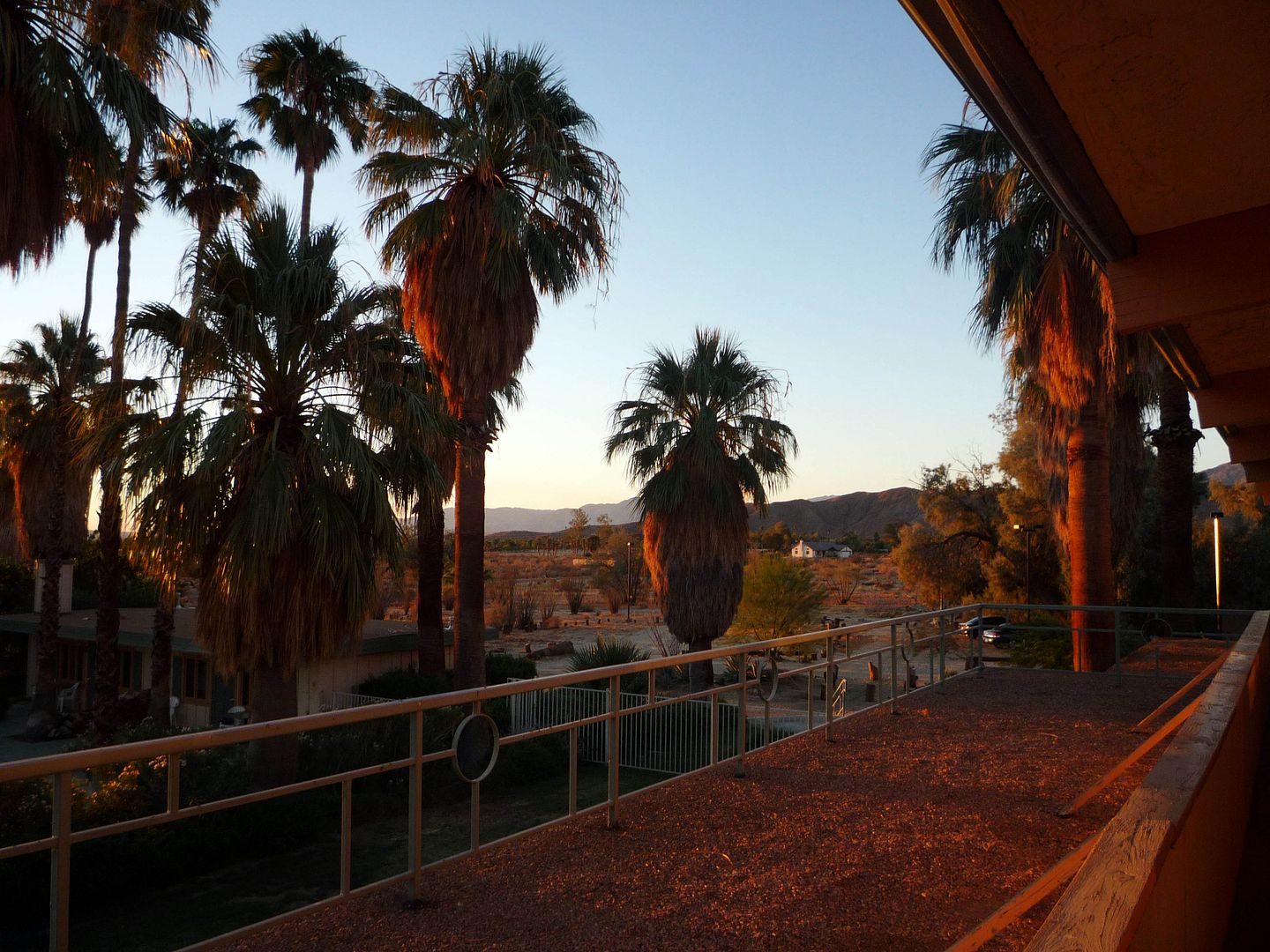

circa 2008

Having done it myself, I could also see why the likes of Marilyn Monroe, Clark Gable, Bing Crosby, Orson Welles and other glitterati enjoyed waking up here.


circa 2008

I didn't want to leave, back then—especially not to return to my East Coast life. (It would be another 2+ years before I could move to California permanently.)


circa 2008

The Palms at Indian Head had just been restored, and I was having all these fantasies about becoming its live-in caretaker.


circa 2008

Things like that are possible in the desert, after all.


circa 2008

I liked that Borrego Springs never became the next Palm Springs and retained its remoteness and quietude.


circa 2008

I also loved that the Palms at Indian Head kept the ruins of much of the original property.


You can still walk right through them—despite how architecturally unstable they may seem—though the exterior walls have been painted an incongruous shade of lavender.


There are few signs of trying to demolish the old remains or even make it safer to visit...


...with rusty spikes sticking out at every turn.


It's fascinating to try to piece together the plot of the old Hoberg Resort, walking on sidewalks that led to nowhere, standing behind walls with huge chunks missing out of them.


It's the spooky feeling of walking through someone else's memory...


...piecing the bits together as the details crumble around you.


I wonder what Mrs. Hoberg would think, to see it today.


Original shower stalls and even toilets are still standing, sheltered by salmon- and mint green-colored tile walls.


But beyond this upright skeleton, this standing shell of a bygone resort, there lies the desert...


...wide open and blue, with the day-moon rising and a frondless palm piercing the sky.

Related Posts:
Just Deserts.
Photo Essay: Borrego Springs Ranch (Closed, Reopened as La Casa del Zorro)—Updated for 2019

March 08, 2024

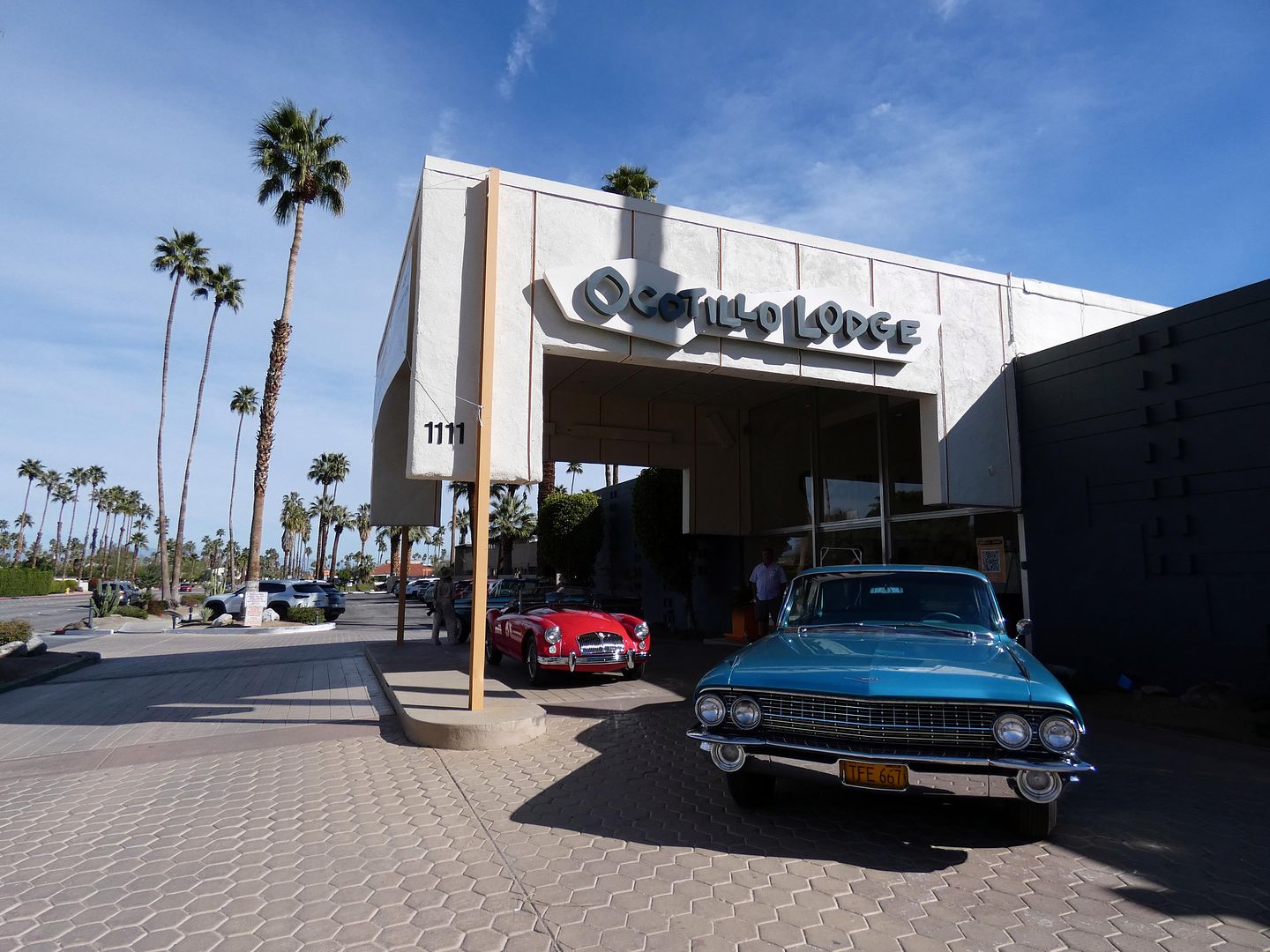
Photo Essay: Desert Resort Living In a Mid-Century Modern Lodge

It's one of those places I'd drive past so many times—and never really understood what it was. 

I thought the Ocotillo Lodge on East Palm Canyon Drive in Palm Springs was a motel, and that it was being converted into condos. 


The real story is that it was a hotel (kind of)—and then it was converted into condos in the 1990s. But right now, it's going through an upgrade/restoration. 

February 23, 2013

Photo Essay: Rockhaven Sanitarium, Closed to Public, Interior

[Last updated 10/13/20 12:50 PM PT—video added at bottom of post]

I grew up with a profoundly mentally disturbed mother.

We spent a lot of time as young kids, squirming in the waiting room of her psychiatrist's office while she tried to hash out the details of her own childhood. As I look back, I think she should have been hospitalized, or, at times, committed to some kind of facility. With constant threats of suicide - specifically, drowning herself in the bathtub - she was a danger to herself and, as we found out, to both of her children.

I'm surprised we made it out of there alive.

But all the while, she refused to admit her own craziness, and instead turned the diagnosis back on us, sending me to a psychiatrist of my own as early as the age of three, and refusing any sessions that my multiple therapists asked her to attend.

Even when her own brother, to whom she always seemed somewhat unnaturally attached, died in a hospital, strapped to a bed, under the grip of schizophrenia, she didn't seem particularly alarmed.

Meanwhile, I questioned my genetic mental legacy, and wondered what synapse-firing fate would befall me as I grew older.

Outside a place like Rockhaven Sanitarium, the last standing sanctuary for the mentally ill in the Crescenta Valley just outside Los Angeles, it doesn't seem like such a bad place, if one is to be sent away.


But upon entering the hallways which once housed facilities for electroshock therapy, water therapy, and massage therapy...


...I became emotionally distraught.


There are no existing signs of such medieval torture therapies...


...especially since the sanitarium only just closed about seven years ago...


...and had been operating as a modern facility, mostly for the elderly and demented in its latter days.


But the decor and the equipment had probably not been changed or upgraded in decades, as evidenced by mysterious stains on the carpet...


...the shadows which nearly engulfed the light eeking through the curtains...


...and the tiny closet windows, which provided a potential escape route to captive patients like Marilyn Monroe's mother.


The vacant rooms are surprisingly undisturbed, with some personal effects carefully placed...


...but the hallways are empty.


Many of the rooms are not.


They smell of age, loneliness and abandonment.


The energy is not one of convalescence...


...but of deterioration.


Once you arrived at Rockhaven Sanitarium, it was unlikely you would ever leave.


And while some might complain about being "on the outside looking in," these patients were permanently on the inside looking out...


...watching life pass them by...


...unless someone came to visit.


Termites have now gotten to many of the windows, some of which are covered, their glass cracked.


The old, walk-in refrigerator holds no cold food...


...nor any kitchen personnel.


The burners do no cooking.


And, except on rare occasion...


...nobody ever comes in to visit anymore.