Search

Showing posts sorted by relevance for query central park. Sort by date Show all posts

February 10, 2017

Photo Essay: The Coney Island Carousel in Central Park

"The thing with kids is, if they want to grab for the gold ring, you have to let them do it, and not say anything. If they fall off, they fall off..." — Holden Caulfield, The Catcher in the Rye


I've got a lot of brass rings to try to grab in New York City still.


There are a lot of carousels there that I haven't made it to yet.


I don't remember ever even seeing one in Flushing Meadows-Corona Park; and I never made it to Forest Park in Queens. And, in my defense, the Sea Glass Carousel and Jane's Carousel both opened after I'd moved to California.


So, on my last trip to NYC, I found myself outside the wrought iron fence of the Friedsam Memorial Carousel, one of the "Scenic Landmarks" of Central Park...


...and—with a turntable measuring 50 feet in diameter—one of the largest carousels in the country (with some of the largest horses).


The current Central Park Carousel is actually the fourth one to be located more or less on this site at the south end of the park, in the former "children's district" near West 64th Street, just down the way from Tavern on the Green and Sheep's Meadow.


It was crafted in 1908 by two Jewish immigrant woodcarvers from Russia, Solomon Stein and Harry Goldstein, who'd partnered in their Artistic Carousel Manufacturing Company of Williamsburg, Brooklyn.


They gave the carousel a pair of decorative chariots...


...and 57 hand-carved horses (52 of which are jumpers).


Of course, the first Central Park Carousel in 1871 was actually powered by real horses (and a mule).


The subsequent two burned down (which happened far too often).


This one, though, had stayed in Brooklyn for over 40 years, spending its last decade or so abandoned in an old BMT trolley terminal in Coney Island until it was donated to Central Park in 1951.


The music comes courtesy of a Ruth und Sohn band organ from Germany with 86 keys, two drums, a tambourine, and cymbals. It plays 20 paper roll records of waltzes, marches, and polkas.


The Central Park Carousel was restored in 1990, giving a little new polish to its flamboyant, bejeweled horses with big heads and giant teeth, characteristic of the "Coney Island style" made most famous by Charles Looff.

With a carousel career that really only lasted about a decade (at which time the "Golden Age" was coming to an end), Stein and Goldstein made less than 20 carousels. There isn't much of their work left out there to ride besides the Central Park Carousel (except perhaps the King Arthur Carrousel at Disneyland).

But it actually feels like I've got too many carousels to ride, while I can still climb up there (and not surpass the weight limit) and while they're still around.

There's still a chance that any of them could burn down or be washed away in floods or monsoons.

Maybe I can't get to them all, but I don't want to know.

So don't say anything.

Related Posts:
A Change of Heart in Central Park
Photo Essay: The Faces of the Griffith Park Merry-Go-Round

February 08, 2017

A Change of Heart in Central Park: Tavern on the Green

In the time I spent living in New York City, I never really knew why everyone always made such a fuss over Central Park.


Sure, I liked to sit on the Great Lawn for Philharmonic concerts and fireworks and run up to Rumsey Playfield for free Summerstage shows; but I was usually more interested in what was along its perimeter—The Met, The Plaza, The Frick, The Guggenheim—than Strawberry Fields or Sheep's Meadow.


I never even rode in a hansom cab in Central Park—despite enjoying the opportunity to travel en calèche in Tunisie.


But I'm coming around a bit. When I'm back in New York, I'm trying to cross some places off my list, and Central Park keeps coming up. Case in point: Tavern on the Green.


Several years ago, Maria and Mike were talking about taking a trip down to "The City" from Upstate, and as they rattled off where they'd like to go, they mentioned Tavern On the Green.


"Uck, why?" I bemoaned, "It's not even that good." But back then, you didn't really go for the food anyway; you paid for the experience. Back then, I was more interested in new trends rather than the establishment.


What I didn't understand until I found myself there six years after having moved out of New York City was that going to Tavern on the Green—established as a restaurant in 1934—is a rite of passage.


I didn't yet know that although the restaurant had been a staple of the 20th century, the structure it was housed in dated back to the 19th century, having been designed by designed by Calvert Vaux and Jacob Wrey Mould and built in 1870 as a sheepfold—to house the sheep that would graze the meadow (hence its logo, which I never paid much attention to, either).


Upon the conversion of the Victorian Gothic building into a restaurant, that flock of sheep relocated to Prospect Park in Brooklyn. Seventy-five years later, Tavern on the Green filed for bankruptcy and closed, the building once again transforming, but this time into a visitor's center.


Lucky for me, this historic eatery—the one I had so mistakenly underestimated and, in fact, had denounced—underwent a massive restoration and reopened as a dining establishment in 2014.

And I'll admit: I was wrong about the place. Of course I want to eat in a 19th century former sheepfold. It almost doesn't matter what I eat there or how it tastes. What history have we here!

Fortunately for me as well, the meal surpassed all expectations—and was punctuated by a dessert of the best carrot cake I have ever had, hands down.

What other iconic NYC experiences have I dismissed and missed out on? The probability seems definite; the possibilities seem infinite.

Related Posts:
Alone in A Crowd: Central Park Edition
Photo Essay: Central Park Arsenal

August 04, 2009

Alone in A Crowd: Central Park Edition

There are too many people in Central Park. It is so magnificent that it draws residents and tourists alike to its sprawling lawns, eroded boulders and placid lake. All of its secret nooks and meditative coves have been discovered and appropriated. When you walk down a mulch-laden path or under a stone archway and hear a rustle, surely it is not a bird or a squirrel, but a photographing naturalist or a romantic couple canoodling in the underbrush.

I've never spent much time in Central Park, save for one disastrous Chase Corporate Challenge (which I walked), a few Summerstage concerts, and a New York Philharmonic picnic under fireworks. But after examining its map in search of places in the city to explore - an examination that probably contributed to my map-dominated dreams - I decided to give it a try. Feeling a little under the weather when the weather was holding up so well, yesterday I headed out to take an easy walk along the lake.

Of course its west shore was closed for construction.

But I found a nice walk along the north and eastern shores, weaving in and out of the westernmost boundary of The Ramble - the section of Central Park that most resembles wilderness.


A butterfly was about as wild as it got, but it was quiet on the paths that snaked away from the boat-filled, manmade lake. Only when I took winding paths back down to the edge of the water did I rediscover signs of the city: the skyline, and an authoritative woman's voice barking into a megaphone at the boaters, "Keep it moving!"


You can never really be alone in New York City. You're constantly on top of other people who want your seat, don't like the way you smell, wonder how much money you have in your wallet, and think you're out to get them.

But without people (though maybe not those people), New York would be stripped of much of its beauty. Trees need to be preserved. Flowers need to be planted. Bridges need to be stabilized. Lakes may not need to be built in the middle of a city as an urban oasis, but it sure is nice when they are.

bandshell

As I emerged from The Ramble, I tried to appreciate those sites that most people love in Central Park: the food vendors, the street performers, the portrait sketch artists, and the zoo. But I found myself drawn to a neglected stone structure, built nearly 80 years ago and barricaded. The Naumburg Bandshell stands empty while drummers perform out on the mall, for the people, amongst the people.


I didn't talk to anyone, though I nodded in acknowledgement when I passed a bicyclist or jogger, which was often. I gave dirty looks to the women who tried to maneuver in front of me in line at The Boathouse. Chocolate frozen custard in hand, wiping its drippings off my pink t-shirt with the other, I glided through the southeast exit of the park like a ghost, unnoticed and unnoticing.

Help me become a blogger in Antarctica - vote here!

To become a fan on Facebook, click here.

Bookmark and Share

September 11, 2024

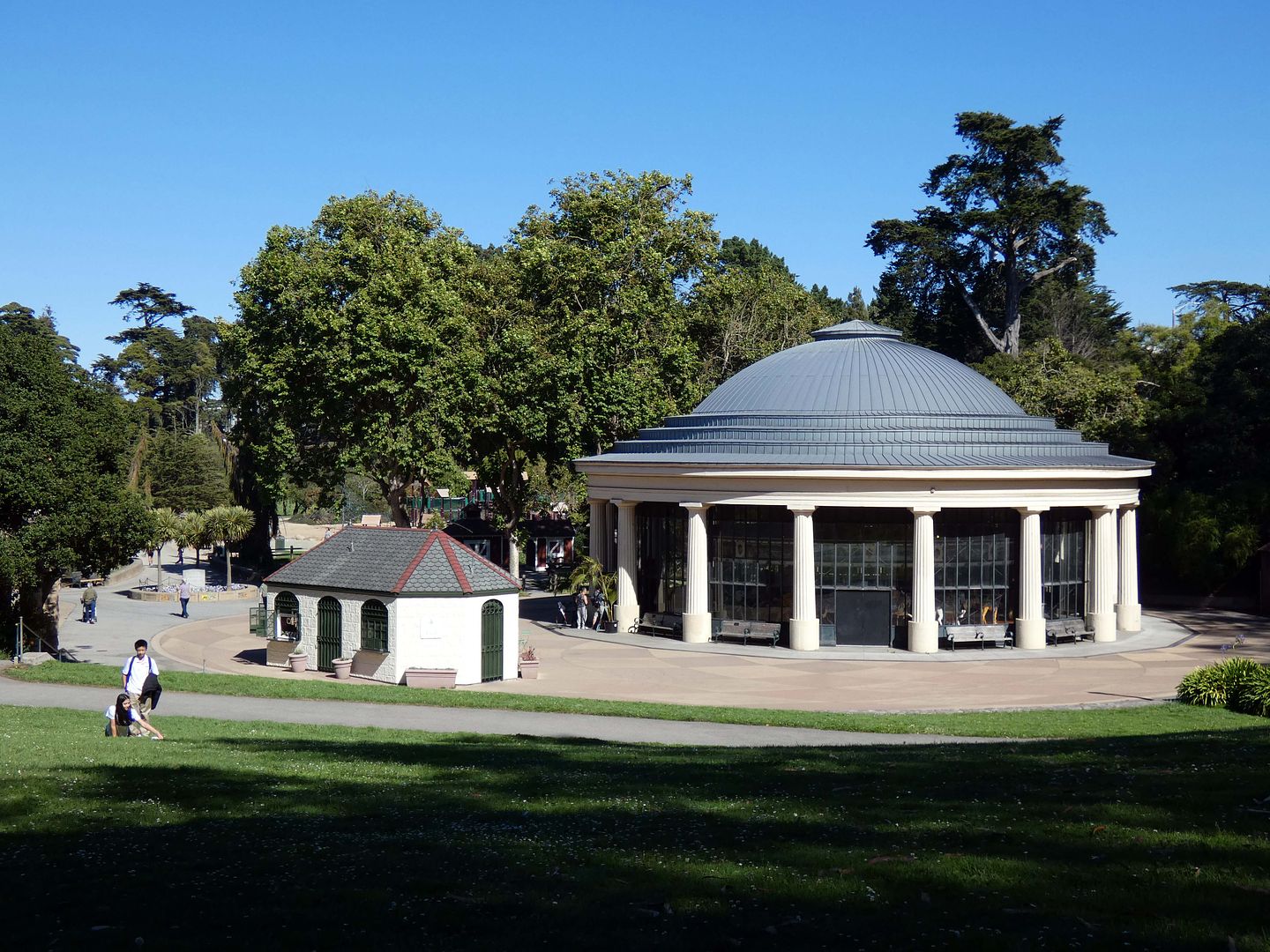
Photo Essay: A Los Angeles Carousel Has Made San Francisco's Golden Gate Park Its Home for Over 80 Years

This is just so typically me. 

I go years (or decades) without visiting a place—and then as soon as I go back once, I end up going back a bunch of times. 

Because it's so easy for me to shift my attention elsewhere. But once something gets back into the front of my mind, I realize how much I've missed out on. 

Such is the case with San Francisco. 

I was just there in January, after having not really been there since 2006—save for a couple of hours two years ago—and ever since, I've been itching to go back. 

This time, California Preservation Foundation's Doors Open California program gave me the perfect excuse to return. 

But first, I had a lot of places to cross off my list. 

 
Take Golden Gate Park, for instance. It feels very much like San Francisco's version of Central Park in New York, with meandering paths and sprawling lawns and a few historic points of interest—including its own vintage carousel. 

October 11, 2010

Photo Essay: Central Park Arsenal

The arsenal in Central Park is one of the sites featured in Open House New York's annual weekend that's normally open to the public during the week.

At Fifth Avenue and E. 64th Street, you can see the musket railing of the front door stairs...


...and snare drum lights...


You can even view the WPA murals in the lobby which have aged to such a dark pallor that they're nearly impossible to photograph.

But on this weekend, there is one area that we got to see that's normally only accessible to Parks employees: the rooftop garden.


Up there, you're amongst the turrets of the arsenal that was built as a castle, first in white stucco, then restored to red brick. You're overlooking the Central Park Zoo and legions of tourists.

But it's quiet, except for the bees.


To become a fan on Facebook, click here.

December 27, 2016

Photo Essay: The Former Navy Surplus Annex That Became a Mini Railroad

In 1945, World War II was coming to an end, and the U.S. Navy had a logistical problem: surplus property. The war was still on, so when one naval district had property it didn't need, there needed to be a way to redistribute it to another naval district that did need it.

Thus, the Navy formed its Material Redistribution Center in Torrance, a 90,000-acre annex to the (now demolished) Long Beach Naval Station on Terminal Island, in October 1945.

But just months later with the war over, the focus shifted from redistribution to disposal—but, in effect, the Naval Annex ended up being a dead end for that surplus, where it sat in storage for decades until it officially closed in 1973.

There, a cluster of buildings—including 15 Navy surplus warehouses—stood abandoned until 1979, with the sale of partial acreage to the City of Torrance and the formation of Wilson Park.


Meanwhile, Southern California Live Steamers had started in 1941, two years into World War II, as a miniature live-steam engine club. They didn't have a track, or even a clubhouse. They met in their founder's backyard in Beverly Hills.


In 1948, Walt Disney and fellow Disney animator Ollie Johnston joined the club.


Once the club had become more established, they moved to Lomita, where "Little Engines" were being built and sold by fellow Live Steamer Irene Lewis (who'd been befriended by Disney, thanks to their common interest in trains).


By 1989, Wilson Park—envisioned as a “central park for all people”—had been open for a decade...


...but five acres in the back were still vacant, save for those old abandoned Navy warehouses.


The City of Torrance asked SCLS to come and operate a tiny railroad in their neck of the woods...


...so the engine club laid 1000 feet of track along the newly-established "Crenshaw Line"...


...where their miniature trains would run—for free—at speeds of just 10 to 15 mph.


The City of Torrance has a rich history of railroads...


...including the Union Pacific Railroad...


... and the Harbor Subdivision, a historic line of the BNSF Railway that was built to connect the freight rail in Downtown LA to the Ports of LA and Long Beach.


The BNSF Harbor Subdivision still runs right next to Wilson Park.


The present-day SCLS home in Wilson Park features a number of tiny buildings in a kind of model train "village"...


...as well as an almost full-sized depot.


Twice a month, the Live Steamers host public run days, which are still free—even if you ride all three of their trains in one visit.


And you might as well ride them all, too, since it's not just one track you're riding.


There's an inner track, and outer track, and a spur track...


...the latter of which is a straightaway along the perimeter of the park...


...that dead-ends, forcing you to get up off your seat, turn around, and sit back down facing the other way while the engineer turns the engine around on a turntable.


Running multiple trains at the same time means there's a bit of traffic on the rails—and sometimes you've got to wait for another tiny train to make the switch and pass before you can proceed.


But there's one train at Wilson Park that doesn't run at all—and it's not a scale model, either.


Some of the tiny trains run past it, but it never moves.


It's an old Red Car from the Pacific Electric Railway, which, in the 1920s, was the largest operator of interurban electric railway passenger service in the world. But it's not one from the PE Torrance Branch (a spur off the Gardena Line) that brought passengers from LA to San Pedro, right through Torrance (its station now known as The Depot Restaurant).


This car in particular, PE No. 4601, originally hails from the Bay Area as part of the East Bay Electric Lines fleet.

Even though this Red Car isn't a native Angeleno, its history is fascinating. According to my fellow blogger, The Militant Angeleno:
This Red Car shell, originally built in 1911 as a 72-foot "Blimp" style car which ran in the Bay Area, was purchased by the PE and was involved in a crash with a freight train in 1946. Torrance resident Forest Wilson purchased it from the PE for $50 and converted it into a 60-foot long (wrecked section removed) house where he lived with his wife until his death in 1986.
Legend has it that after Wilson's wife sold the "Red Car House" to the City of Torrance (for $1), it suffered invasions of hornets and vandals, the latter of whom broke the windows and did what vandals do (and hornets don't).

Now, it's somewhat protected behind a tall, double chainlink fence. It won't ever run again. No one will ever live in it again. It hasn't been converted into a diner. But hopefully it will be restored at some point, so people can once again climb aboard the Red Car, whose fleet is nearly extinct.

Related Posts:
Photo Essay: Griffith Park's Holiday Light Train
The Ghost Train of Griffith Park
A Travel Town Birthday in Griffith Park
Photo Essay: A Last Ride on the Last Red Car
Photo Essay: Abandoned Naval Housing, Western Avenue