Search

Showing posts sorted by relevance for query nine sisters. Sort by date Show all posts

September 07, 2011

Photo Essay: Low Visibility Hiking at Bishop's Peak


I woke up Saturday morning in San Luis Obispo kind of dying for a hike. I'd abandoned my plans to hike Black Hill in Morro Bay State Park the previous afternoon because it was so dark, damp, and foggy at only 5 p.m. I'd tried to hike along the ocean with Jesse at Andrew Molera State Park in Big Sur earlier the previous afternoon, but our group hit high tide and a flooded beach, and some of our hiking companions were not as willing to walk through the water as we were.

So although I'm normally inclined to try to sleep in, I set my alarm for 7 a.m., grabbed a quick breakfast of Portuguese French toast at the Madonna Inn's cafe, and drove to one of the Nine Sisters of San Luis Obispo: Bishop's Peak.

It was foggy enough down below, at the bottom, as it had been the day before and pretty much my entire trip up and down the coast.

But the peak itself was completely obscured by clouds. I couldn't even see the top. If I was going to hike, I was going to have to hike into the clouds.


Quite frankly, I was a bit worried about getting lost in the woods, disoriented by the swirling mist.


I also worried about hypothermia, though I'd dressed in layers. I knew that I'd break a sweat with a 1200 foot elevation change, and it was already so damp out...and cold.


Not only could I not see where I was headed...


But I also had no clue where I'd been with no view of the landscape down below.


In the thickest part of the cloud line, I passed an older couple of hikers on their way down. "Not much of a view today, huh?" I commiserated.

"Oh, there will be at the top," the woman assured me.

I looked up there and saw pure white. Really?


And then I began to break through...


...Until I actually saw beams of sunlight, and blue sky ahead, through the thick atmosphere.


I looked out and saw a snowy sea, vast mountain peaks peeking out over the top of it like islands spotted in the distance.


By the time I began my descent, the morning's mist - more than the kind of marine layer we get in the beachside communities in LA - had burned off enough to reveal the land below.


I did not get lost. I did not catch cold, slip and fall, or shiver to my death. I was not abducted by a forest-dwelling kidnapper.

I did, however, get to see what it was like below, amidst, and above the clouds, seeing the same rocks before and after the sunshine hit.

Before:


After:


Related reading:
Under the Milky Way Tonight, and Every Night
Above the Clouds


To become a fan on Facebook, click here.

January 26, 2019

Photo Essay: Birding Morro Bay's Parks, Estuaries, and Harbor

I think it was nearly two years ago, during the Owens Lake Bird Festival, when someone suggested I try the bird festival in Morro Bay.


I'd been to the area only once before, having taken a good look at Morro Rock—a volcanic plug that's one of the Nine Sisters of San Luis Obispo, a.k.a. the "Gibraltar of the Central Coast"—and turned around and gone on my merry way.


But my experience in the Owens Valley taught me that a bird festival could be a great way to get to know any particular area—even if all I ended up seeing were familiar favorites (like the Western gull, above).


But Morro Bay had much more than that in store for me, as the king tide sent waves crashing against the cliffs, drowning the beach and sending lots of fish to the shore in its gigantic swells.


At MontaƱa de Oro State Park, the cormorants were poised and well-positioned to go fishing.


California scrub jays (Aphelocoma californica, formerly known as the western scrub jay) perched and screeched, swaying to the wind and the waves.


House finches, song sparrows, and wrentits sang out in the open, while bushtits stayed under cover.


I'm good at spotting where a bird is—but not necessarily what it is—so I'd ask, "Who's that guy over there?" and one of our guides would get it in the 'scope to have a closer look (like at the California thrasher, above).


We'd then examine beak shape and plumage feeding behaviors and mating rituals.


Watching birds is like fishing, but without the murder. Sometimes you've got to wait a while before something tugs on your line. Sometimes to have to really search for and stalk the birds. And then other times, a California towhee just poses for you on the roof of a park structure.


Unashamedly, I'll admit that among the highlights of the morning bird trip along the Bluff Trail and the state park campground was spotting two peahen, an exotic species that have taken up residence in the park...


...and the multitudes of cottontails that dined and dashed along the trails we treaded.


Another fruitful excursion turned out to be at the Morro Bay State Park marina...


...were we plopped ourselves down in tandem kayaks (to keep the water traffic to a minimum)...


...and were led on a watery tour around the bay by Central Coast Outdoors.


Before we even started officially birding, I spotted my first sea otter of the trip—all alone out there, clapping merrily to itself, causing quite a splash and clatter.


Just beyond it erupted a feeding frenzy of pelicans diving down and fish leaping up out of the water, right there between the sand bar and the shore.


Because the tide was so high, we could take our kayaks over the submerged pickleweed and get closer to the shorebirds—like the long-billed curlew in the salt marsh—than normally possible.


Intriguingly, the sandpipers, sanderlings, willets, and white pelicans—not to mention the great egrets and great blue heron—in the back bay didn't seem to mind us gliding across the surface of the water, even as we paddled, even as we gawked and pointed at them.


Being on a bigger boat—especially a motorized one—is a little more disturbing to the loons and grebes in the water below. But the bird festival's boat cruise did offer yet another way to see Morro Bay from the water, so I gladly came aboard.


It was also a good opportunity to get an even better look at a peregrine falcon, like the one I'd seen high up in a tree above the marina...


...as well as an osprey or two...


...since they like to hang out on the top of the masts just as much as the falcons do.


In this light—and this up close—we could see how iridescent cormorant feathers can be...


...and how much preening it takes to keep them that way.


The brown pelicans and the gulls hung out lazily on the sandbar...


...though they were nothing compared to the napping sea lions that lounged on a former dock they've commandeered.


The sea, however, was restless—beating up against the black oystercatchers on the rocks of the breakwater.


The surf sent smaller boats into topsy-turvy mode...


...and left the cormorants to spread their wings in order to dry off.

Related Posts:
Birding Without Binoculars
Photo Essay: Birding Anza-Borrego During the Superbloom
Photo Essay: Birding the Channel Islands

January 22, 2019

Photo Essay: In the Pink at the Madonna Inn

[Last updated 12/25/19 11:07 PM PT—photos added]

*All photos by the author except where noted.


Photo: Cory Doctorow via Flickr (CC BY-SA 2.0)

"This must be documented," I've found myself saying a lot lately. The sense of urgency surrounding my time in California has waned, but not by much.


And after realizing it would take me a half-dozen years to get back to California's Central Coast, I figured I'd better make this most recent trip count.


So of course, since I was staying in San Luis Obispo for the Morro Bay Winter Bird Festival, I had to return to the Madonna Inn (though I was staying about three miles down the road at the Motel 6).


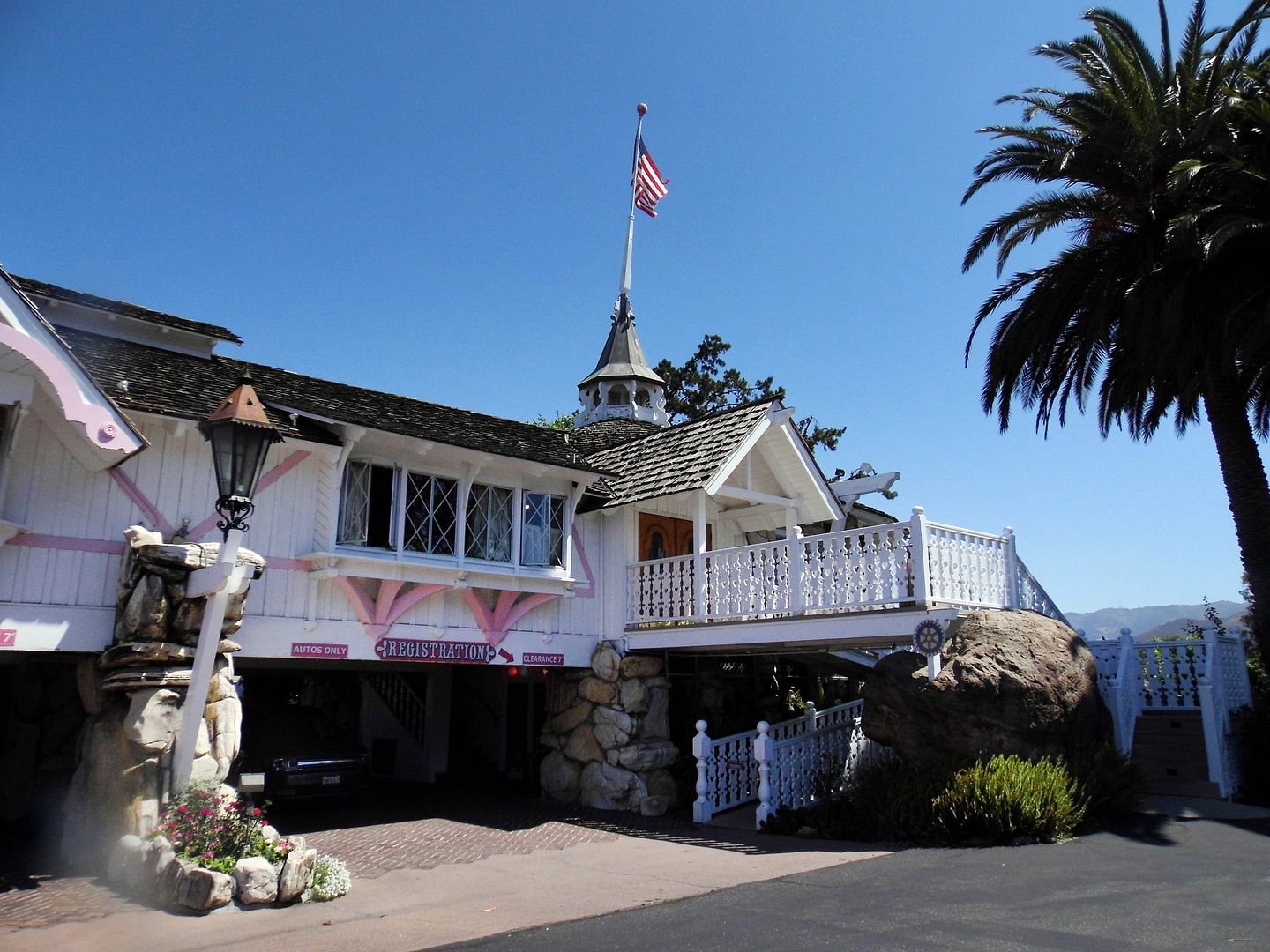
Built by local rancher Alex Madonna and his wife Phyllis in 1958 as a motor lodge with a whole lot more panache...


...most of the Madonna Inn as it stands now dates back to the late 1960s.


A fire had wiped out most of the accommodations in 1966—and Madonna, having made his fortune in construction, simply rebuilt (again, without the help of an architect).


Only after he replaced what was lost in the fire, he kept going.


The Madonna Inn became so popular that he continued to expand the guest quarters to encompass three separate buildings and a total of 110 rooms...


...in addition to the check-in/reservations office and "Round Room" and attached dining establishments (built circa 1960).


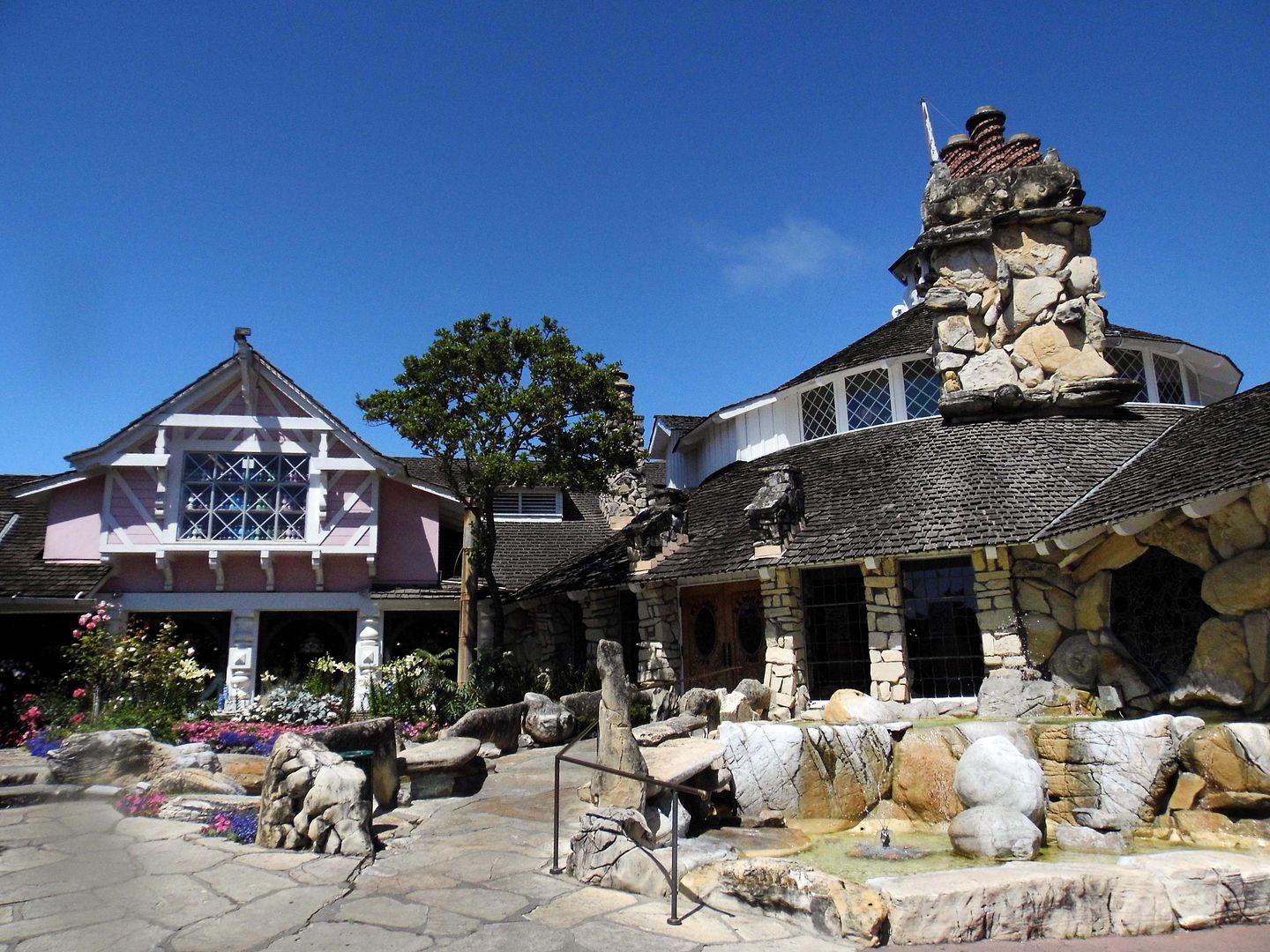
At the top of the hill (the lower eastern portion of Cerro San Luis Obispo, one of the Nine Sisters of the city), there's Building One—with its spiral staircases and storybook railings and flamingo pink golf carts that give just a teensy glimpse of the opulence that lies inside each of the uniquely deco-ed guest rooms, each with their own theme (chosen by Phyllis).


Loosely based on the design of a Swiss chalet, the Madonna Inn is a kitschy roadside attraction made of local rock during the day.


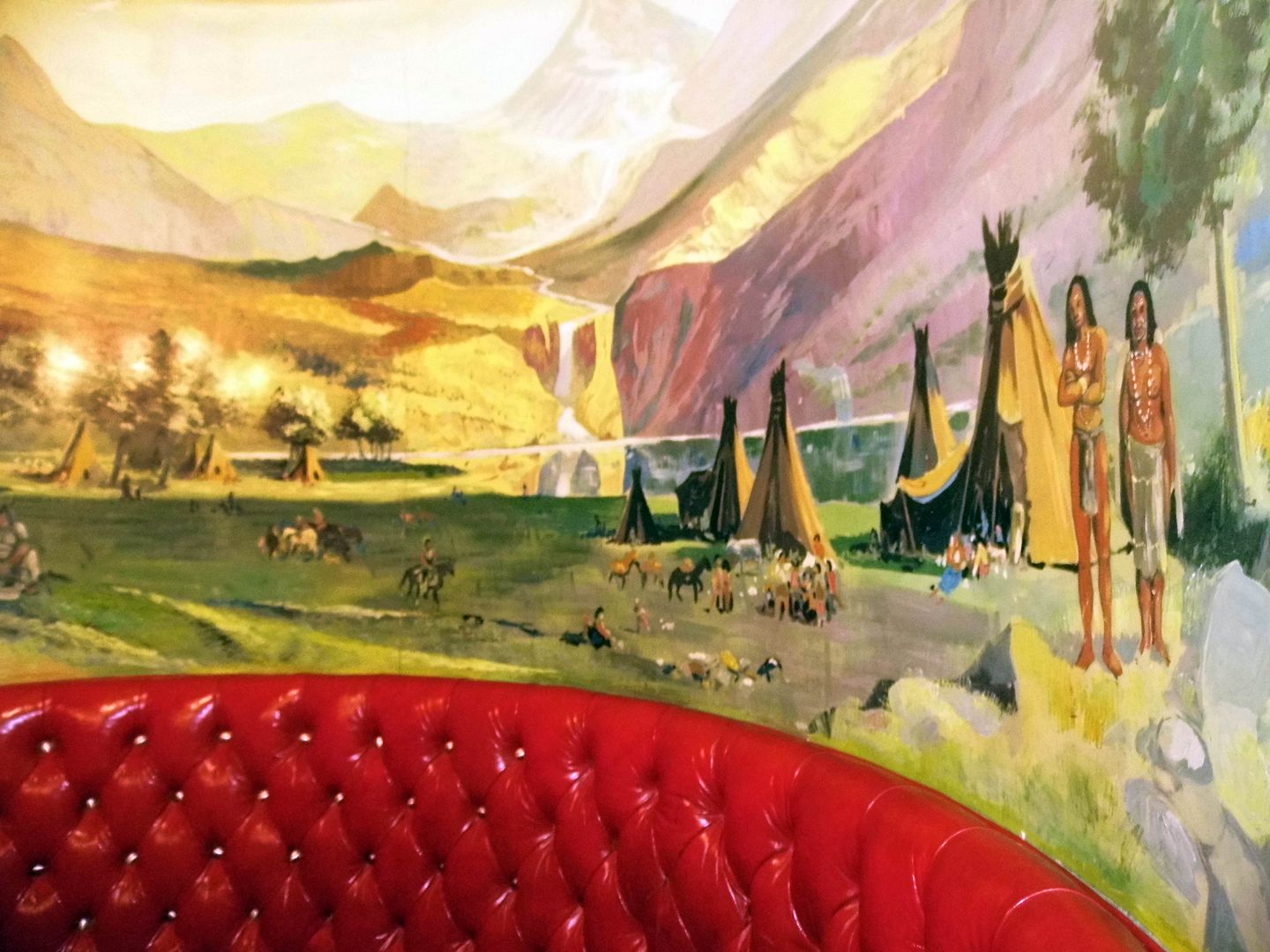
It features a renowned bakery and breakfast and lunch spot, the Copper Cafe, where you can dine in a booth lined with painted murals depicting California history...


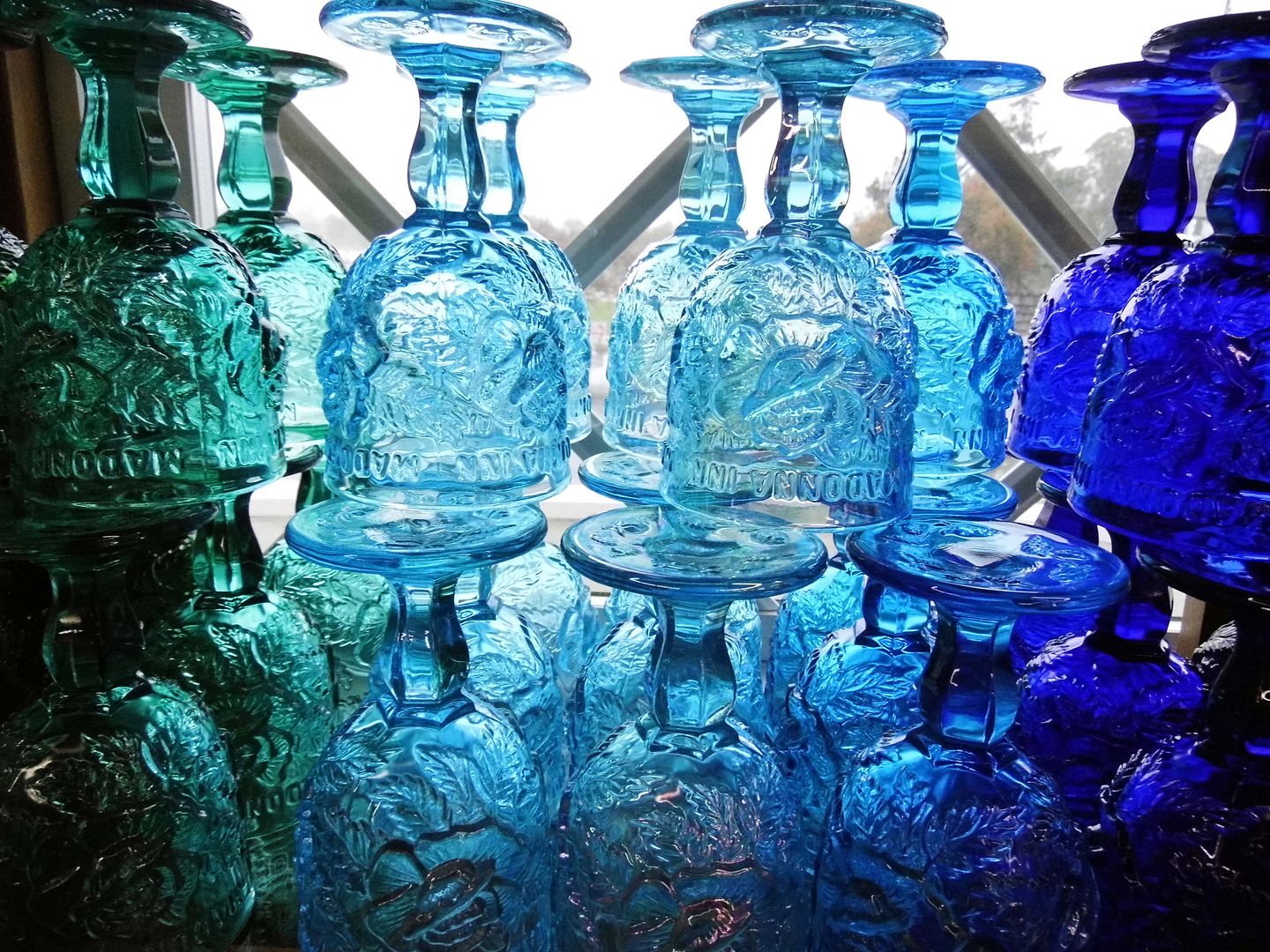
...and drink out of glass goblets that come in every color of the rainbow (not just pink).


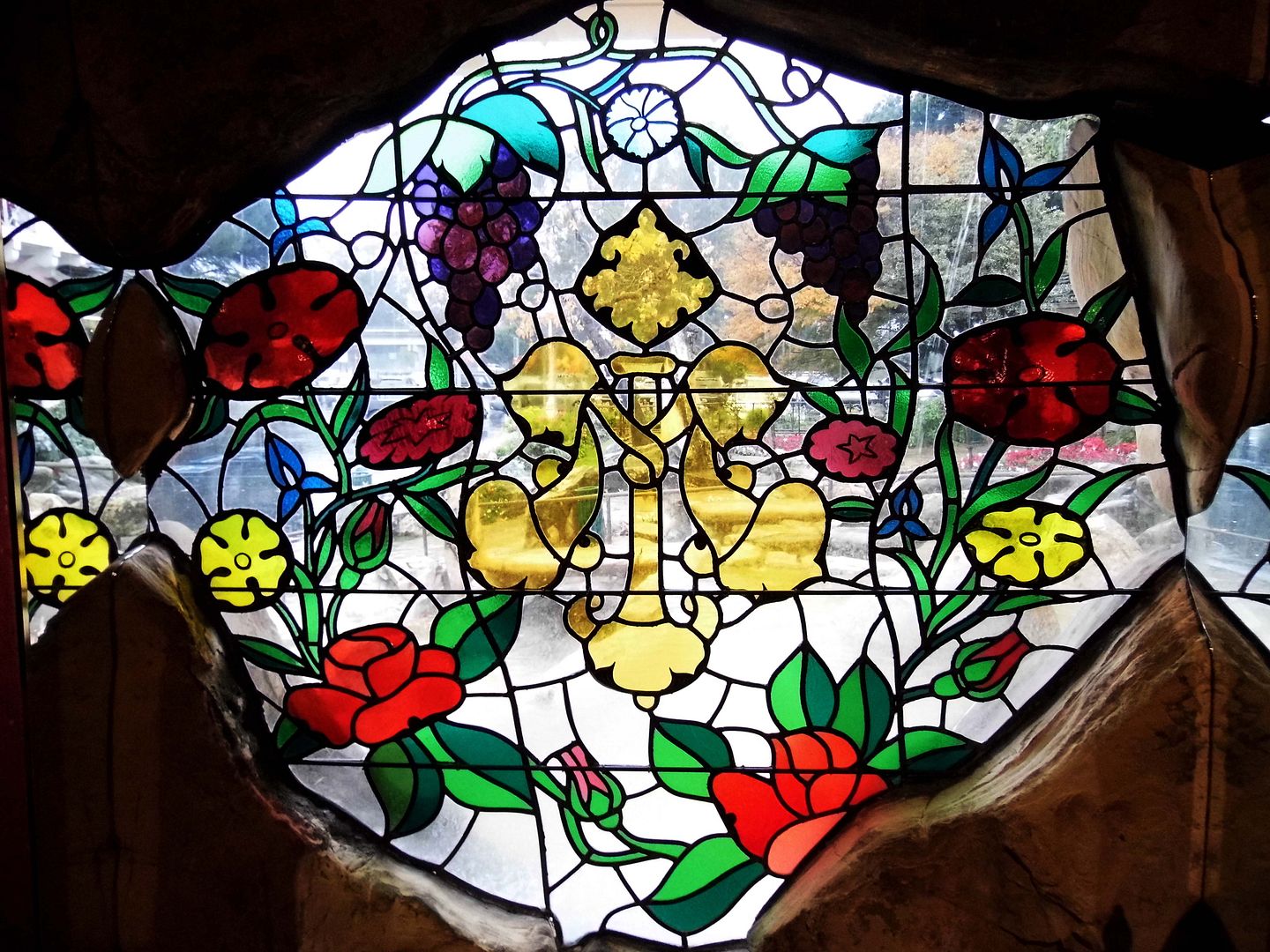
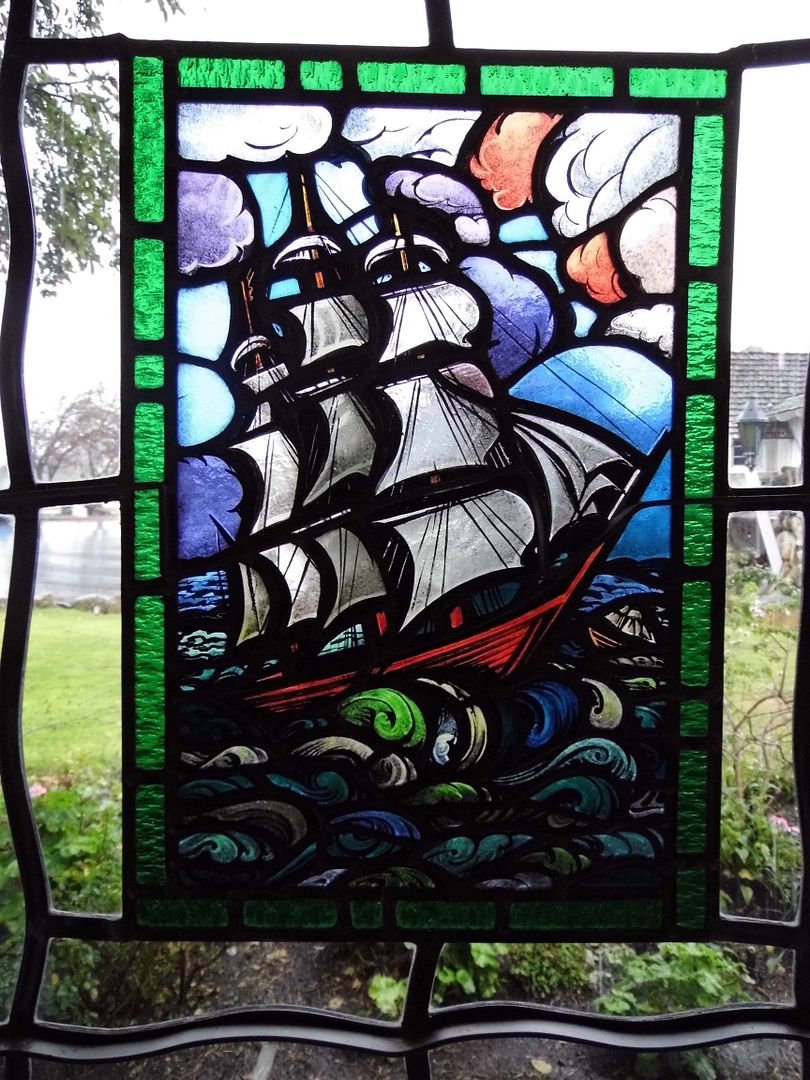
During daylight is the best time to admire the custom leaded glass windows that enclose the dancefloor, dining room, and lobby...


...with more historical depictions.


But at night, The Madonna Inn simply sparkles. And it's quite the destination even if you're not spending the night.


The lobby is adorned with a gleaming bronze bust of Alex Madonna, of course...


...as well as seraphim...


...and cherubim.


One such cherub beckons you to approach a staircase heading downstairs...


...past the painted portraits of Alex and Phyllis Madonna...


...for a tasting of some local Central Coast wines.


More of these little baby angels point the way upstairs along a white marble balustrade to the gift shop, where you can splurge on various pink wares (including goblets).


It's all angels, wine, and roses at the Madonna Inn.


At the Silver Bar Cocktail Lounge, you can order any number of pink cocktails—from the Daisy Mae (kind of a tequila sunrise, with house-made raspberry syrup) and the Flora Dora (a raspberry gin mule) to the Raspberry Gimlet (above).


Perched upon a pink leather stool, above a red carpet festooned with pink roses...


...you can admire the work of Bavarian wood carver Alexander Zeller, one of the many artisans hired to provide custom woodworking for the Madonna Inn.


In the outrageous Gold Rush Steakhouse...


...you can dine in a hot pink booth under the branches of a gold tree that stands more than 16 feet tall and nearly 30 feet wide...


...as you sip a quartino of pink wine...


...and, on a Saturday night, listen to the swinging stylings of The Rose Garden band.


When they're busting out big band classics like "Sing, Sing, Sing" or "In the Mood"...


Photo: Waifer X via Flickr (CC BY 2.0)

...it's hard not to get up and jump, jive, and wail yourself out there on the dancefloor, even if you don't know exactly the right moves, and even if you don't feel like dancing with a partner.


If you leave at night rather than staying in the Safari Room, Austrian Suite, or the room with a carousel horse suspended from the ceiling, a neon stagecoach with a galloping team of horses will send you on your merry way to wherever you lay your head.

But if you can get a reservation early enough and can afford the nightly rate, it sure is a more complete experience to wake up and shower in one of those crazy rooms.

Related Posts:
Photo Essay: Low Visibility Hiking at Bishop's Peak
Photo Essay: An Inn for Presidents, Padres, and Patron Saints
Photo Essay: Haunted Accommodations In A Silver Mining Ghost Town