Search

December 19, 2013

Photo Essay: Castle Green Open House, Old Town Pasadena

We East Coasters have long been drawn to Pasadena.

Some of us move there to escape the blustery cold. Others, like myself, just really like to visit.

One such East Coaster, Colonel George Green, escaped to Pasadena and invested in the Hotel Green on Raymond Avenue, more or less next door to the Santa Fe Depot (now Del Mar train station). In 1893, he expanded it with a new wing across the street, "The Annex," connected by an enclosed bridge.


That new wing became known as Castle Green, which still stands across the street from the site of the original Hotel Green, demolished in 1935, though the Castle Green annex has been split into two: the Castle Green apartments, and the (new) Hotel Green.


The bridge extending across the street was demolished too, but it still extends from the sidewalk to the second floor of Castle Green.


It is a curious, hulking landmark of what is now known as Old Town Pasadena...


...an architectural beauty of steel, brick and concrete that was saved, despite falling into decline after rail travel gave way to the automobile...


...and the Great Depression hit.


Even from the outside, the Moorish, Spanish, and Victorian influences employed by architect Frederick Roehrig are clear...


...with turrets and terracotta roof tiles...


...both imposing and inviting.


Ever since I first spotted the Castle Green, I knew I had to get in.


But since it's primarily occupied by private, luxury condo owners, and rarely open to the public, I took the first chance I got: their holiday open house.


The ballroom, which was added later for the wealthiest of Easterners to party brilliantly, was decked out in Christmas decor...


...as were the offices.


The ground floor is really something to see, with original mosaic tile...


...and Islamic art influences in the Moorish & Turkish Rooms...


...whose window carvings are reminiscent of screens found in mosques.


These rooms were originally known as the "Ladies Rooms," set aside for female patrons.


In a time that electrical lighting was new and innovative, the Castle Green's rooms were not gas-lit.


The staircase leading upstairs is Carrara marble, though you may find some wainscoting that is faux painted on top of slate to appear like marble.


Looking up the stairs from the ground floor lobby, you can see straight to the ceiling of the sixth floor...


...whose celestial mural design is punctuated by a hanging chandelier.


If you start at the top and work your way down...


...at the top of the stairs...


...you find the wrought iron caged elevator...


...the oldest 24-hour manually operated elevator still operating in California.


There are other, seemingly secret stairways...


...and dark, side hallways...


...but the main hallways on either side of the elevator are lined with private condos...


...each with their own distinctive style...


...some with their original hardware...


...others with Art Deco lighting.


Some of the apartments have a view of the mountains and the bridge below, the site of the former Hotel Green just beyond...


...while others get a good view of other parts of the Castle Green building itself.


There are vacant units, available for occupancy...


...though mostly the Castle Green is full, its residents each settling into their own unique styles.


We got to see nearly a dozen of those apartments, their fireplaces and Christmas trees and setees and dogs and kitchen counters all vastly different from one another. I think that was the draw for most of the attendees, but I prefer empty spaces.


Before returning to the ground floor after my six floor descent, I did stop by the second floor gallery space, which now occupies the former enclosed bridge. There aren't many signs of the former luggage trolley, and even the windows have been changed over the years, but it is scenic. It's understandable why the veloway (Pasadena's elevated bikeway) started here.

I couldn't help but walk to the end of it, to the curb of the west side of Raymond Avenue, and picture what once was, when it used to extend all the way across the street to the main hotel, which is no longer there.

One way for visitors to get to see at least a glimpse of Castle Green - including its decorative ground floor - is by visiting the Thomas Paine Society in the basement, which does occasionally take visitors and give tours of its collection. And, of course, like many historic buildings in the LA area, it's available for movie shoots (and weddings).

Related Posts:
Photo Essay: Gamble House, Pasadena
Photo Essay: Where Old Meets New at Caltech

December 13, 2013

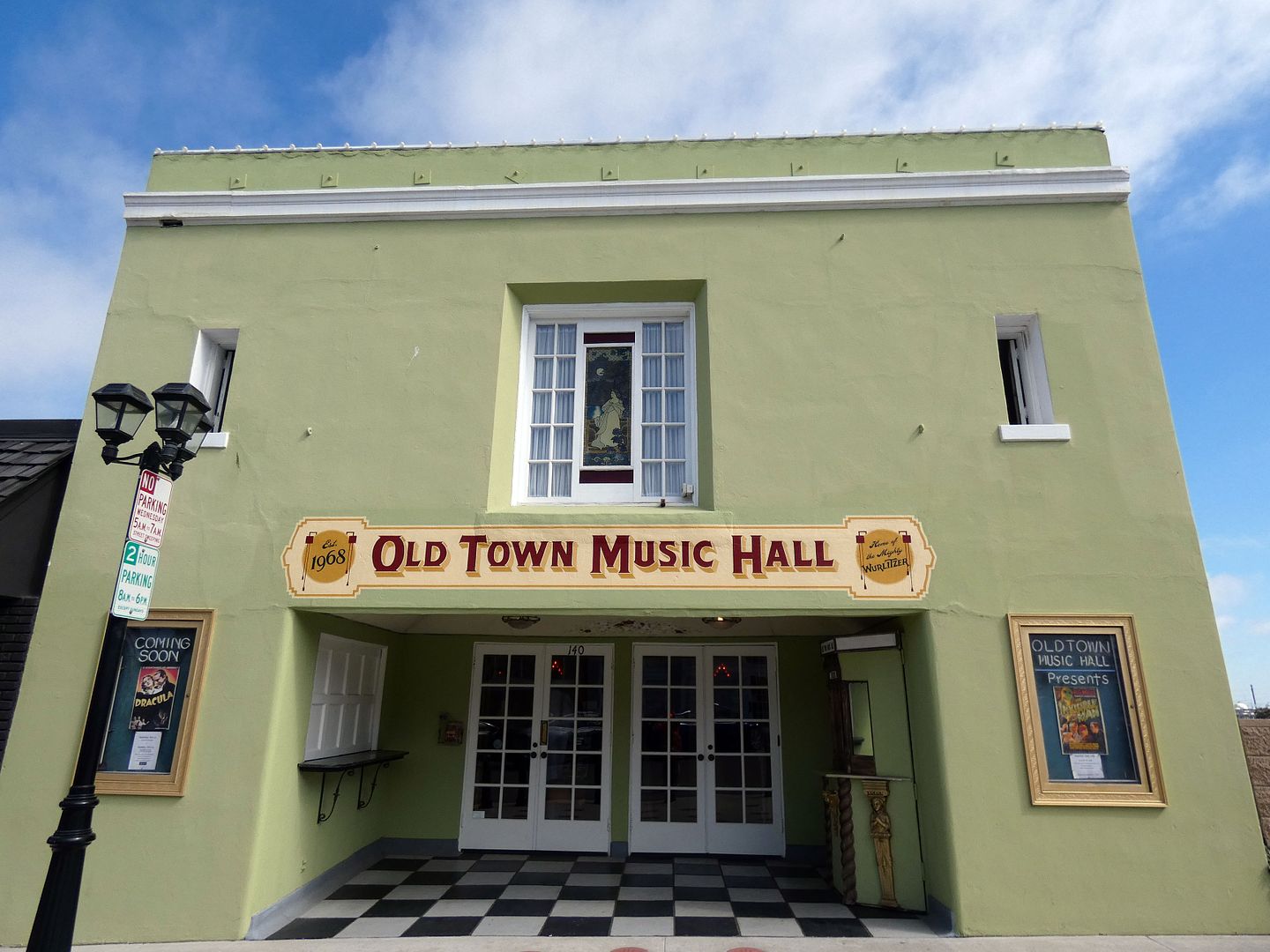
Photo Essay: Old Town Music Hall (formerly The State Theater), El Segundo (Updated for 2021)

[Last updated 10/18/21 8:33 PM PT—new photos added, Bill Field's death noted]

Originally opened as the State Theater in 1921 in one of Richmond Street's existing buildings (one of a few original brick buildings from when Richmond Street was first constructed in 1917)...


circa 2021

...what's now Old Town Music Hall in El Segundo was intended to be a live performance venue specifically for the employees of the neighboring Standard Oil Refinery (now Chevron). 

December 12, 2013

Photo Essay: Calico Ghost Town


Calico was probably the first California ghost town I'd ever heard of, but for years I'd chosen not to go, rebuking its cheesiness and overt commercialism and historical reenactments.

But once I'd already done Pioneertown and Bodie — no more "legit" on the ghost town tourism scale — then, eventually, I felt I must do Calico.

After all, I kept driving by it, on my way to and from Vegas.

December 11, 2013

Photo Essay: Route 66's Daggett, From Silver to Solar

You don't hear a lot about silver mining in California. The Golden State usually takes a backseat to Nevada when it comes to silver trails.

But silver was in abundance in the area east of Barstow, now populated by a number of unincorporated ghost towns and their environs: namely, Calico (photo essay forthcoming), and neighboring Calico Junction, later renamed Daggett.


Situated along the Southern Pacific Railroad, Daggett is currently a bustling thoroughfare for freight trains, with a BNSF Railway station on the Needles subdivision.


But, like many towns along Route 66, despite being accessible right off the 40 Freeway in the Mojave...


...Daggett has shrunken in its geographic footprint and population...


...now home to only a couple hundred people...


...many buildings lost...


...and others decrepit.


Despite housing an airport and a former commercial solar project...


...and its successful history in the borax industry (once the terminal of the 20 mule team run from Death Valley)...


...Daggett shrank (as did Calico), as nearby Barstow grew, and became the hub of the Mojave Desert that it is today.

Stay tuned for an exploration of Calico Ghost Town...

Related Post:
Photo Essay: The Living Ghost of Yermo

December 09, 2013

Photo Essay: Selecting a Steep Trail at Wildwood Canyon

I'm starting to think that facing my fear of heights is only making it worse.


I typically like to do small conditioning hikes - say, three miles in an hour with some significant elevation change - because you don't have to drive far out of an urban area to get to one, and they don't take up much time but you get a good workout out of them.


Wildwood Canyon - next to Stough Canyon - is a good example of that: not too far away from Burbank's commercial district, but just far enough into the Verdugo Mountains to be appropriately wild.


It's also small and simple enough to navigate easily, with four trailheads all leading up to the same ridge trail (which you can then take up farther into the mountains for a bigger workout).


The second and third trailheads are notoriously steep, so I drove my car all the way to the top of the main road to enter the canyon from a longer, more gradual fire road...


...which shows signs of erosion along the canyon walls.


It's not bad at first, and when you get to a saddle at the top of the trail, this time of year you might find a nice seasonal surprise...


...giving you a moment to catch your breath before you start your descent.


You're basically at the top of the trail now, and have to wind your way down - either all the way down to the bottom of the main road (and Trailhead #1), or braving the slippery, steep Trailhead #s 2 and 3...


...which are probably easier to climb up than down.


For views, this is a nice, scenic way to go, with Downtown LA visible in the distance.


But for those of us with any issues with heights or vertigo...


...it is often nail-biting.


Even at the top of the not-steepest trail, it's easy to say, "I have to go down that?"


And it's easy to remember being traumatized by much worse climbs...


...much steeper trails...


...and still feel traumatized, even though this one is comparatively easy.


As I descended the lowermost trail (to Trailhead #1), I got deposited in a relatively wild, woodsy area deserving of the canyon's "Wildwood" moniker...


...and then had an easy (albeit sluggish) walk up the paved main road back to my car, where I started.

It was a good scouting mission, worthy of a return visit to try perhaps to climb up one of the steep trailheads and come back down the more gradually sloping fire road.

But I wonder if I should keep facing this fear, or if it's gotten the better of me. Sure, I've survived all of these excursions, but perhaps more mentally and emotionally damaged than if I hadn't attempted them at all.

At some point, will they get easier?

Or have I merely reached my limit?

Related Posts:
Photo Essay: Stough Canyon & Old Youth Campground
Knowing My Limits
Reaching My Limit