Search

May 29, 2016

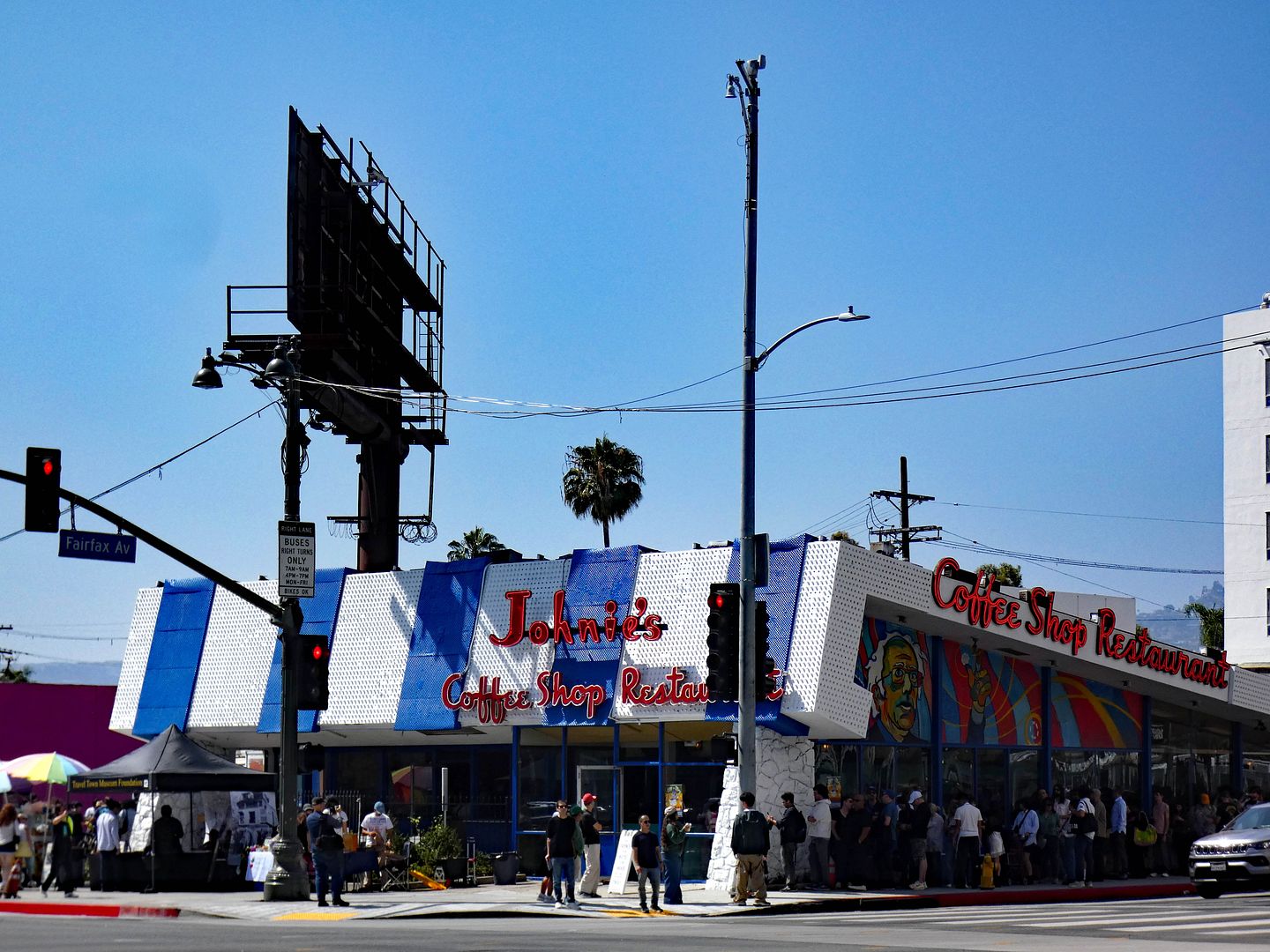
Photo Essay: A Hollywood Diner Campaigns for a Hollywood Candidate [Updated for 2026]

[Last updated 5/15/26 10:56 AM PT—After a decade, Johnie's had been looking pretty sad. Almost all of the incandescent light bulbs on the roofline were out; the neon was only partially working; and the blue and white paint looked faded and dirty. Mutual aid group The Community Solidarity Project had continued using it after the 2016 election for grassroots activism—including organizing, distributing goods to those in need, and holding occasional events—but in the meantime, owners (the Gold family, which also owns the vacant 99 Cent Store and Sizzler Restaurant next door) deferred a lot of maintenance. That is, until the opening of the Metro at its intersection on Museum Row.

Photo: 2026

That's when the Gold family took the opportunity to repaint and clean up the façade and remove a lot of the "Bernie's" branding (though not all of it) and open Johnie's Coffee Shop up as a temporary gallery for Gary Baseman's artwork, created on restaurant menus and placemats. What's next for Johnie's? That's not yet public knowledge. But thankfully the bankruptcy of the 99 Cent Store chain does not seem to have negatively impacted its future.]

May 24, 2016

The Legacy and Legends of California Camels

The first thing anybody asks when they hear you've gone to a camel dairy is, "What does it taste like?"

Sad to say, after visiting Oasis Camel Dairy in East San Diego County, I still don't know.

The females do get milked there, but the farm isn't permitted to serve or sell camel milk in a drinkable form (or even as cheese)—only as soaps and lotions.

But apparently camel milk is actually far closer to human milk than the stuff we normally drink from cows, which aren't even native to the United States.

Camels, however, existed in what is now known as North America millions of years ago. In fact, the camel family (which also includes llamas) originated here. (Theoretically, they migrated to Asia across the ice bridge of the Bering Strait.)

But the camelops—as they were called at the time—went extinct around 11,000 years ago—which is also when our native horses and mastodons disappeared.

Fossils of them have even been found, for example, in the area of the former Rancho La Brea (where the Tar Pits are now), Anza-Borrego Desert State Park, and Death Valley.

Of course, their distant descendants made their way back to North America from the Middle East and Africa by way of the U.S. Camel Corps, a now-infamous experiment of the Army. In the mid-1800s, the idea was that the animals would already be acclimated to dry, hot conditions—and, occasionally, sandy—and could be useful as military beasts of burden in situations that would be too trying for horses or mules.

The camels made the 1200-mile trek from Texas to California on foot in the now notorious "Camel Brigade," which brought them to Fort Tejon. Their military service ended shortly thereafter. Although they could maintain a decent speed while carrying a lot of weight, and they were good at finding watering holes, Congress refused to further fund the project in the advent of the Civil War.

At that point, camels had found their way back to this continent, but were left with nothing to do. Some were killed, stolen, and mistreated. Some were turned loose and roamed wild. Others were sold off to circuses and carnivals, where they were raced (as at the Indio Date Festival and Riverside County Fair) and could use their skills as pack animals to give camel rides.

Which brings us back to Oasis Camel Dairy.


Now, having taken camel rides myself in both Morocco and Tunisia, I probably shouldn't have been surprised to see some of the camels harnessed up to be climbed on by children. And although they're able to carry much more than the posted weight limit of 200 lbs, I still felt bad for them.


Their ancestors were soldiers, and now they get to be paraded around as a curiosity.


They're certainly well-behaved...


...charming...


...gentle...


...and handsome...


...but camels want to work.


It's in their nature.


But here, at the only camel farm in Southern California (that I know of), the boys get taken out for off-site events and demonstrations and made a spectacle of, sometimes dressed up like Scheherazade.


Do they mind? Who knows—because at least when they're back at the farm, they're the studs...


...breeding with the females.


As long as they're having babies...


...they're producing milk that can be used by the dairy farm to make skincare products.


This little cutie was born in mid-April, making her just three weeks old at the time this photo was taken in early May.


Calves are born relatively big, weighing around 65 to 85 pounds at birth. And they grow up so fast.


This calf is the daughter of Zohan, the herd bull, and Jamila—and she's already learned how to give side-eye.


But she's not the baby anymore, because her new half-brother arrived late last night...


...the son of Zohan and Lily, who's working on standing up and learning how to walk.


Oasis Camel Dairy has another open house this weekend, giving visitors the rare opportunity to see a brand new baby calf who's just a few days old.

It'll be hard for me not to go back. Everybody loves to gawk at a new baby.

Related Posts:
Photo Essay: Fort Tejon and the Ghost of Peter Lebec
One Hell of a Sandstorm
Photo Essay: Secrets of Death Valley

May 23, 2016

Photo Essay: The World's Largest Outdoor Pipe Organ

Although many of the buildings from the Panama-California Exposition of 1915-17 were built with the intention of tearing them down after two years, there were a couple of "anchor" structures that were always meant to be permanent.


The California Building (now the San Diego Museum of Man) was one, and the Spreckels Organ Pavilion was another.


In fact, as the "World's Largest Outdoor Pipe Organ," it still embodies that "World's Fair" type ethos—a long-standing testimony to the progress of man.


It's an achievement for sure, but it's technology is a bit antiquated now.


Most pipe organs you find are in churches and theaters—and, even then, many of them have been removed, displaced, disassembled, lost.


But a park as big as Balboa deserves a music pavilion as big as this one, and their current civic organist has managed to attract crowds (sometimes of 1000 or more) with somewhat more contemporary repertoire, even paying tribute to David Bowie after his death.


There have been free organ concerts in the park every Sunday since it opened (with the exception of when the Navy took over during World War II), but on this particular Sunday, we had the opportunity to brunch with the Spreckels Organ Society and take a tour of the organ itself—behind the pipes.


On the outside, the pavilion is a relatively conventional Italian Renaissance (whereas the rest of the park introduced Spanish Colonial to the people of San Diego), with stone ornamentation by the Tracy Brick and Art Stone Company of Chula Vista.


Its setting may not technically be ecclesiastical...


...but—like the California Building—it certainly feels like being in church.


The main pavilion structure—which serves as both band and bandshell—is relatively monstrous at 75 feet tall. Then again, it needs to be, with all those pipes it houses.


The organ console has been upgraded and improved throughout the years, with various stops being added...


...and each new civic organist having their own take on how to play it.


Some might choose to play it very loud, or very soft, depending on the tremulants they use.


Regardless of the organist, there's a certain hand-to-foot coordination necessary in order to operate the keyboards and pull the stops with hands and to press pedals and compensate for busy hands by using the feet. It's a full-body workout.


The inside of the pavilion structure acts as a kind of museum and hall of fame, displaying lots of historic photographs and artifacts.


It also houses the civic organist's office.


But most importantly, this is where all those pipes are—the tiniest of them measuring smaller than the size of a pencil.


But any good pipe organ (especially one as big as this) doesn't just play music by pumping air through pipes. It also gives its organist the opportunity to bang the drums...


...ring the chimes...


...crash a cymbal...


...strike the triangle...


...and sound the horn.


This is also where the compression chamber is—and entering it through a two-step pressurization process feels a bit like gaining access to a bank vault.


In there, the bellows are pumping air...


...and there's an intricate nerve center of electronics...


...where parts move systematically, like the inner workings of a clock...


...somehow creating a symphony of organized chaos that can project clear across the park (without the help of speakers).


It was a big statement at the time that it first opened, on New Year's Day 1915—just as John D. and Adolph B. Spreckels (sons of the wealthy "Sugar King" Claus Spreckels of San Francisco) intended it to be, when they spent around $100,000 on it as a gift to "the people of the world" and "the people of San Diego." (Adolph unfortunately passed away before its opening.)


In fact, without the contributions of multi-millionaire John Spreckels (at one point the wealthiest man in San Diego), the Exposition in Balboa Park may have never happened.


But the organ pavilion is the only thing that bears the Spreckels name—in Balboa Park, that is. His legacy also includes the Spreckels Theatre Building in Downtown San Diego and the Spreckels Mansion in Coronado (now operating at the Glorietta Bay Inn), which is situated right behind his Hotel del Coronado, whose candy shop is also named after him.

At the organ's grand opening, it started with 3400 pipes—and, in the time since, it has swelled to over 5000 pipes, edging a 1931 organ in Austria out of the top spot by adding 280 pipes, making it the world's largest in its centennial year.

Your move, Austria. You've got to add 57 pipes to reclaim your status.

Related Posts:
Photo Essay: First Congregational Church Organ Crawl
Photo Essay: The View from Above Balboa Park's Former Expo Grounds
Photo Essay: Taking a Spin Into the Last Century in Balboa Park
Inside the Belly: Steinway & Sons Piano Factory Tour
Photo Essay: The Musical Instruments of the Nethercutt Collection