Search

Showing posts sorted by relevance for query sid grauman. Sort by date Show all posts

October 18, 2012

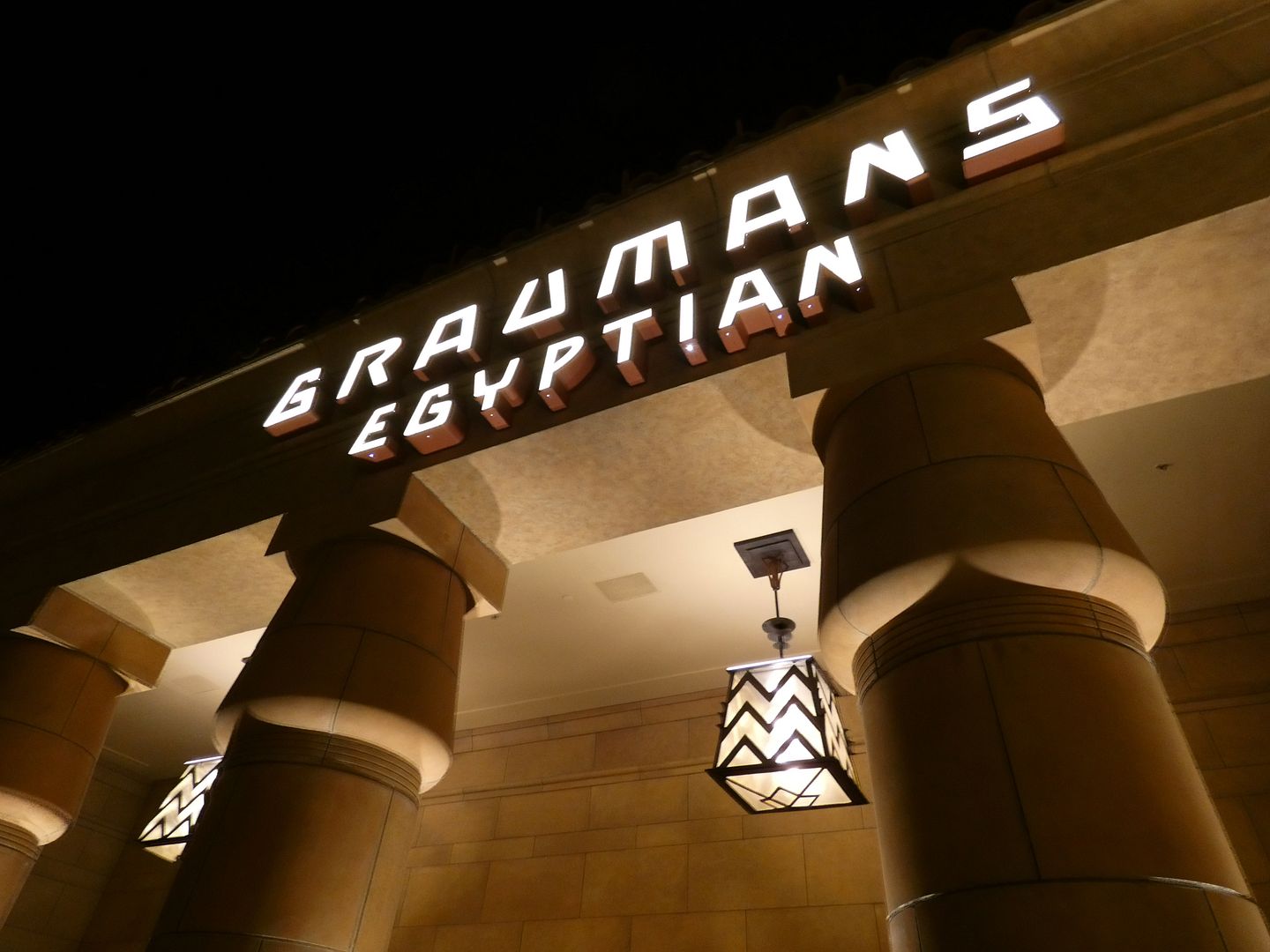
Photo Essay: Upon the 90th Anniversary of the Egyptian Theatre (Updated for 2020—Sold to Netflix)

[Last updated 12/24/20 11:01 PM PT—information on sale of theatre and new ownership added]

Ninety years ago, Los Angeles' center city was still Downtown, filled with glittering marquees and glitterati. Hollywood consisted mostly of lemon groves and farmland—and what did a hicktown like that know about the movies, or live entertainment?


Sid Grauman set out to change that.


In 1922, the Egyptian Theatre was built relatively quickly by Hollywood setbuilders and other artisans, primarily out of the same materials (chickenwire, plaster, etc.). And lucky for Sid Grauman, it opened just weeks before the discovery of King Tut's Tomb, which sparked a worldwide obsession with all things Egyptian.


The Egyptian Theatre - with its hieroglyphic embellishments and imposing "stone" architecture - was a hit...


...and hosted all of the biggest Hollywood movie premieres with all of the biggest stars in its massive courtyard...


...starting with Douglas Fairbanks' Robin Hood.


Like many historic theaters of Los Angeles, the Egyptian changed hands several times, and was modernized over and over again to try to keep up with the times, and the increased foot traffic on Hollywood Boulevard.


American Cinematheque—the theater's current owner [until May 2020]—embarked on a massive $15MM renovation of the Egyptian to return it to its original splendor, preserving or restoring many of the surfaces.


The exterior, exposed to the elements, could use a little touch-up.


The interior is gorgeous and modern, and not immediately evocative of what one might expect inside an Egyptian Revival historic monument. There are two dogs adorning the lobby which are not original to the building, but reportedly are original props from the Elizabeth Taylor Cleopatra film. [Update: These have been removed from the theatre and are currently in the possession of Hollywood Heritage.]


Original lighting fixtures with original glass still remain...


...along a ceiling whose intricate stencil pattern has been painstakingly restored and, in some cases, reproduced using original stencils.


Inside the theater itself, the ceiling "starburst" pattern was merely cleaned...


...decades of nicotine and tar (from years of cigarette smoking) having preserved the colorful paint underneath.


In the wings, you can see where present day technology and amenities meet the original walls...


...with sound panels merely obscuring the walls (rather than requiring them to be torn down, since these panels are usually inside the wall).


If you look up from one of the side aisles, you can see the original singer's boxes...


...and if you're lucky enough, your tour guide will take you up to stand in one.


Sid Grauman was infamous for his over-the-top stage shows that preceded the movie screenings, full of singers, dancers, and elaborate pageantry - a tradition he brought over to the Chinese Theater, which opened five years later.


Upstairs, you can still see some unrestored areas, like the old bathroom and dressing rooms, which currently store some original old furniture that will hopefully one day make its way back out in public view.


The building - primarily constructed of hollow blocks - was also not up to earthquake code, so during the renovation some of those walls were covered in a plastic to try to prevent anything crumbling under significant seismic activity.


A new marquee was added as well - not exactly like the original, but certainly evocative of it.


This week the Egyptian celebrates its 90th anniversary with a number of events, film screenings, and a gala event on Saturday night.

Of course I have to go.

But of course I had to get a good look at the theater first.

Update: In May 2020, a deal was finalized to transfer ownership of the Egyptian from American Cinematheque to Netflix. 

Netflix plans to "restore" the theatre to an earlier time period—including reversing some of the updates and renovations that have been done. 

It will still allow American Cinematheque to run repertory screenings and festivals on weekends, while it will use the theatre as a screening room for its original productions throughout the rest of the week. 

Related Posts:
Photo Essay: Behind the Scenes at Grauman's Chinese Theater

May 30, 2012

Photo Essay: Behind the Scenes at Grauman's Chinese Theater (Now TCL, Updated for 2019)

Last Updated: 1/12/19 8:47 PM PT

When I was back home earlier this month, Maria asked me if I ever did any cheesy touristy things in LA, like taking a tour of the Chinese Theater. I said, "No, not yet."


And then this weekend, I had my chance.

March 27, 2013

Photo Essay: The Million Dollar, Sid Grauman's First Movie House (Updated for 2017)

The Million Dollar Theater is one of those historic Broadway theaters that's only open to the public for special events every now and then.


Circa 2017

March 03, 2014

Hollywood's Biggest Night, at the Million Dollar Theatre


After having first toured it about a year ago, I was glad to return to the Million Dollar Theatre in Downtown LA's Historic Broadway District for a real public event. After all, the best way to save these theaters is by actually using them.

And what better way to use it than to celebrate Hollywood's biggest night with a glittery live simulcast of the Oscars awards ceremony, red carpet attire (modern or vintage) encouraged?


We even had a paparazzo stationed at a step-and-repeat for our arrivals.


It was nice to see the lobby filled with audience members dressed in all types of garb...


...including a couple in Oscar nominee costumes.


It took me a long time to take a seat — or stay in one — being more inclined to wander the hallways and climb the stairs up to the balcony level, reminding myself of the opulence of Sid Grauman's early masterpiece, that pre-dated the Chinese and Egyptian theaters in Hollywood.


It was the perfect event for me, with no TV but always looking for a social viewing opportunity for awards shows and major sporting events. And having a number of fancy dresses and not enough places to wear them.

For another couple that I met who flew into town for this event, the draw was almost more obvious: "I just love old buildings," the woman said.

I hear you, sister.


It felt right to see Leo and Matt and Bradley and Brad in their tuxes on the big screen at the Million Dollar...


...seats filled with spectators...


...our own tuxedoed hosts welcoming us to the festivities.

During the ceremony, we cheered. We hooted and hollered. We laughed, commiserated, toasted champagne, and snacked on popcorn and M&Ms. The ceremony host, presenters and winners on the screen couldn't hear us, but it didn't matter. We were — together — all part of the event, as much as those who were actually at the Dolby Theater in Hollywood, less than eight miles away.


When the last award was handed out, I didn't quite know what to do with myself. They'd run out of champagne long ago. Last call had passed. Everyone was filtering out of the auditorium, down from the balcony, back to their cars to go  home. But I wanted to stay. There's never enough party for me.

But after lingering for a bit, I accepted defeat and exited the front lobby doors, pausing briefly for a photo in front of the backlit, red lettered marquee, I in my fur.

Now I just can't wait til next year.

Related Posts:
Photo Essay: The Million Dollar, Sid Grauman's First Movie House
Partying Like It's 1922 at The Egyptian Theatre

November 26, 2023

Photo Essay: The Egyptian Theatre Rises From Its Restoration Tomb

In May 2020, a deal was finalized to transfer ownership of the Egyptian Theatre in Hollywood (a.k.a. Grauman's Egyptian) from the non-profit American Cinematheque to the very much for-profit streaming service (and now film studio) Netflix. 

And it caused quite an uproar.

Because when the City of LA's Community Redevelopment Agency sold the Egyptian to American Cinematheque in 1996—for just $1, a symbolic transaction—it was so that the historic property could be made accessible for the public good. 

To complicate matters, one of the American Cinematheque board members at the time worked for Netflix. 

Now, I don't know what American Cinemetheque's bylaws state in reference to potential conflicts of interest. It may be that the board reviewed the situation and decided that the possible interested person didn't stand to gain anything financially by the transaction, and so it wasn't an actual conflict of interest.

But it seems as though A.C. may not have even had the right to sell the property at all—much less transfer it to a corporation that would use it for private gain. 

Sure, the streamer will still allow the non-profit to occasionally screen repertory cinema and festivals; but it will primarily use the theatre as a screening room for its original productions. 

How did Netflix get around the Supreme Court decision of 1948 (known as the "Paramount Act," the "Paramount Decision," and the "Paramount Decree") that forbade movie studios from owning their own movie theatres and booking their own films there, as a violation of anti-trust laws? 

The same year that Netflix bought the Egyptian, the U.S. Department of Justice motioned to lift the ban—and a judge granted the motion. 

The anti-trust regulation of movie theatres was terminated—which means studios can once again legally own their own movie houses and monopolize the market, potentially edging out smaller chains and independent-run cinemas. 

It's a funny thing, a digital-first platform turning to brick-and-mortar—much like Amazon.com opening real-life grocery stores. (Or Amazon Studios taking over the Pacific Culver City multiplex for Prime screenings last December.)

They've both already cannibalized mom-and-pop retail by shifting consumer behavioral patterns online—so moving to physical locations feels a little like they're turning the knife. 

 
I appreciate that Netflix wanted to take over and preserve an existing, historic theatre rather than building something anew (or, gasp, tearing something down in the process). So, I had to put all this drama aside for myself—because in the end, no matter who owns it, the Egyptian is a 101-year-old Hollywood landmark. I want to support it; I want to help it stay open and active; I want to experience it. 

March 13, 2018

Mexican Wrestling In a Mayan Porno Palace [Updated for 2025—Closed]

[Last updated 9/14/25 10:42 PM PT—The Mayan Theatre closed this weekend as its longtime operator did not renew its lease. The building is still under the same ownership, which seeks a new tenant. At least for now, the Mayan will no longer host its popular salsa dancing events, Exotikon, or Lucha VaVoom.]

I've remarked before that the older I get, the more burnt I like my toast. I just prefer stronger flavors as the years wane on.

circa 2020

But it didn't occur to me until recently that the same is true when it comes to my tastes in architectural design. I'm gravitating more and more towards Frank Gehry, Art Deco ziggurats, and Brutalism than, say, the clean lines of International Style or even Arts and Crafts.
 
circa 2020

I'm even coming around to appreciating the new façade of the Petersen Museum. There's something about how horrible it is that makes me really respect it. At least it's a bold statement.

circa 2020
 
So when it comes to most of the historic movie palaces of Los Angeles, I'm in seventh heaven. Whether it's the Million Dollar or the United Artists, give me cornices and reliefs and plaster molds and mosaics and murals and chandeliers and all the other stuff—the more, the better!


That's one of the reasons why the Mayan Theatre—not on Broadway in LA's Downtown, but close enough—has been calling my name.


With an ornamental "stone" sculpture consisting of seven concrete bas-relief busts of warriors wearing Mayan headdresses by Baja-born painter and archaeologist Francisco Cornejo...


...the exterior gives visitors the feeling of entering a pre-Columbian temple...


...a theme that continues throughout the interior as well, whether in The Hall of Feathered Serpents (downstairs lobby) or The Hall of Emperors (balcony lobby).


There's no shortage of stuff to look at inside the Mayan Theatre.


And although much of it is awash in contemporary colors like pink and hot purple thanks to a modern LED lighting system...


...there's also a great amount of authenticity to the architectural designs by Morgan, Walls, and Clements (also responsible for The Deco Building, Adamson House, and the El Capitan, Leimert, and Wiltern theatres).


Building this theatre—as well as its neighbor, the Belasco, also designed by the same architecture firm—was part of an effort to establish a new theatre district west of Broadway.


That effort was spearheaded by oil magnate Edward L. Doheny, who owned both theatres.


But the new "fashionable" district never really took hold.


The Mayan originally opened in 1927 not as a movie palace but as a legit theatre—one that specialized in musical comedies (some even produced by movie palace impresario Sid Grauman).


It didn't start programming "talkies" until two years later—and even then, it continued to host I've theatrical performances through the 1940s before eventually switching to Spanish-language films and, later, adult films.


Like Downtown's other legit theatre, The Morosco (now The Globe), the way that the Mayan has managed to survive this long is by having transformed into a nightclub and concert venue.


The seats have been removed (though you can still sit on the floor of the risers in the balcony)...


...and twice a year, a ring is brought in for Mexican wrestling (at least, an Americanized version of lucha libre) and burlesque.


Appropriately, the event is known as "Lucha VaVoom," and it's as outrageous as the structure that surrounds it.

I mean, if you're going to try to revive an ancient style, you might as well go as far as you can with it.

Related Posts:
Photo Essay: The Aztec Hotel's Mayan Legacy
Photo Essay: Frank Lloyd Wright Ennis House, Exterior
Photo Essay: Frank Lloyd Wright Ennis House, Interior
Upon the Disappointing Lack of a Mayan Apocalypse