
Many things have fascinated me about Southern California, since before I even moved here—but one of the biggest standouts among those fascinations has been Channel Islands National Park.
And I treasure each opportunity I get to go.
I'm not talking so much about Catalina Island, and its charming beachside town of Avalon—but the wild isles of the archipelago, the national park islands, like San Miguel, Anacapa, Santa Rosa, and Santa Cruz. (Unfortunately, Santa Barbara Island is currently hard to get to because of damage to the dock.)
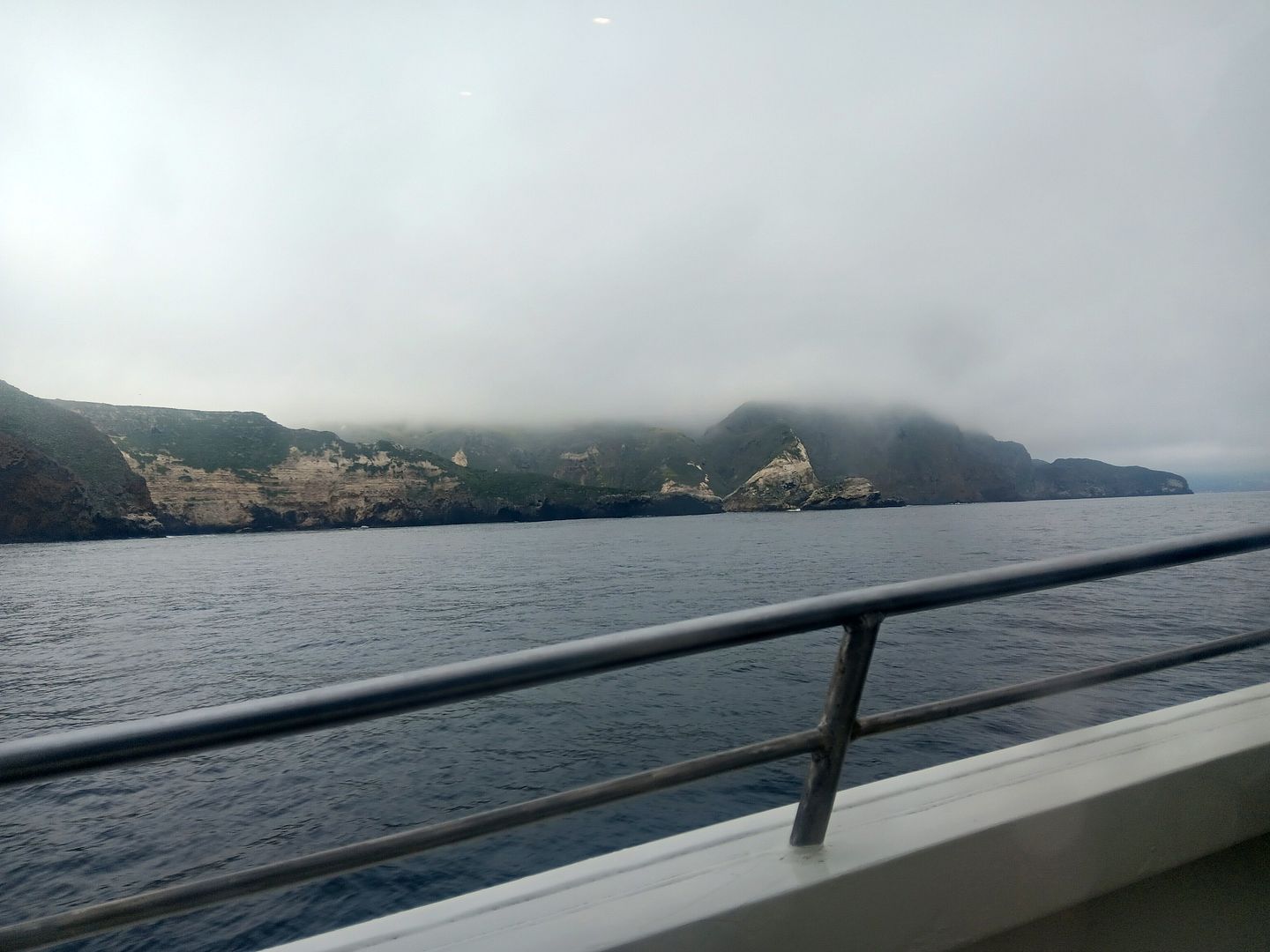
At nearly 100 square miles, the largest of those is Santa Cruz Island—and its multiple anchorages call for many return trips to see as much of it as possible.
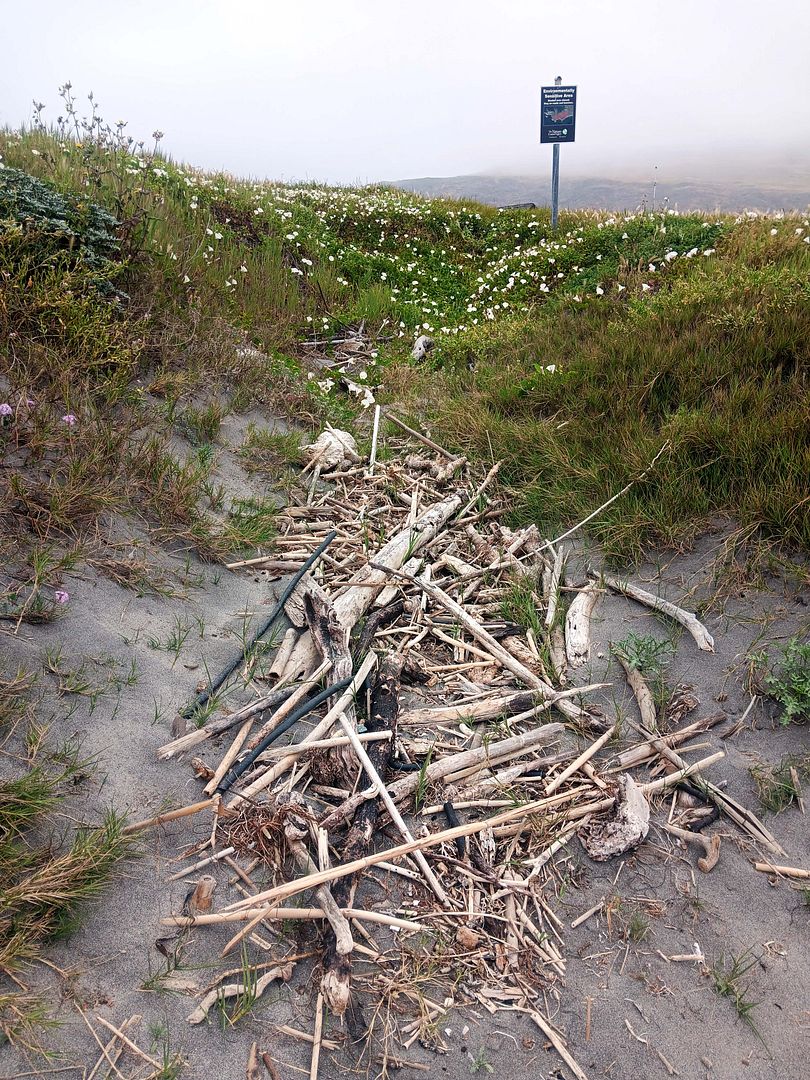
I'd already done Prisoner's Harbor and Cueva Valdez in the past—but this month I had the chance to visit the most remote anchorage, at the extreme western end of Santa Cruz Island, Forney Cove (sometimes called "Forney's Cove").
It was one of those special excursions that Island Packers does every year—the ones I favor booking, because of how much I love limited access and exclusivity.
Getting to Forney Cove is rough: You've got to brave the unforgiving sea and its turbulent currents, in a boat that hugs the craggy shoreline past Profile Point and Painted Cave. Plenty of ships have wrecked there over the last couple of centuries.
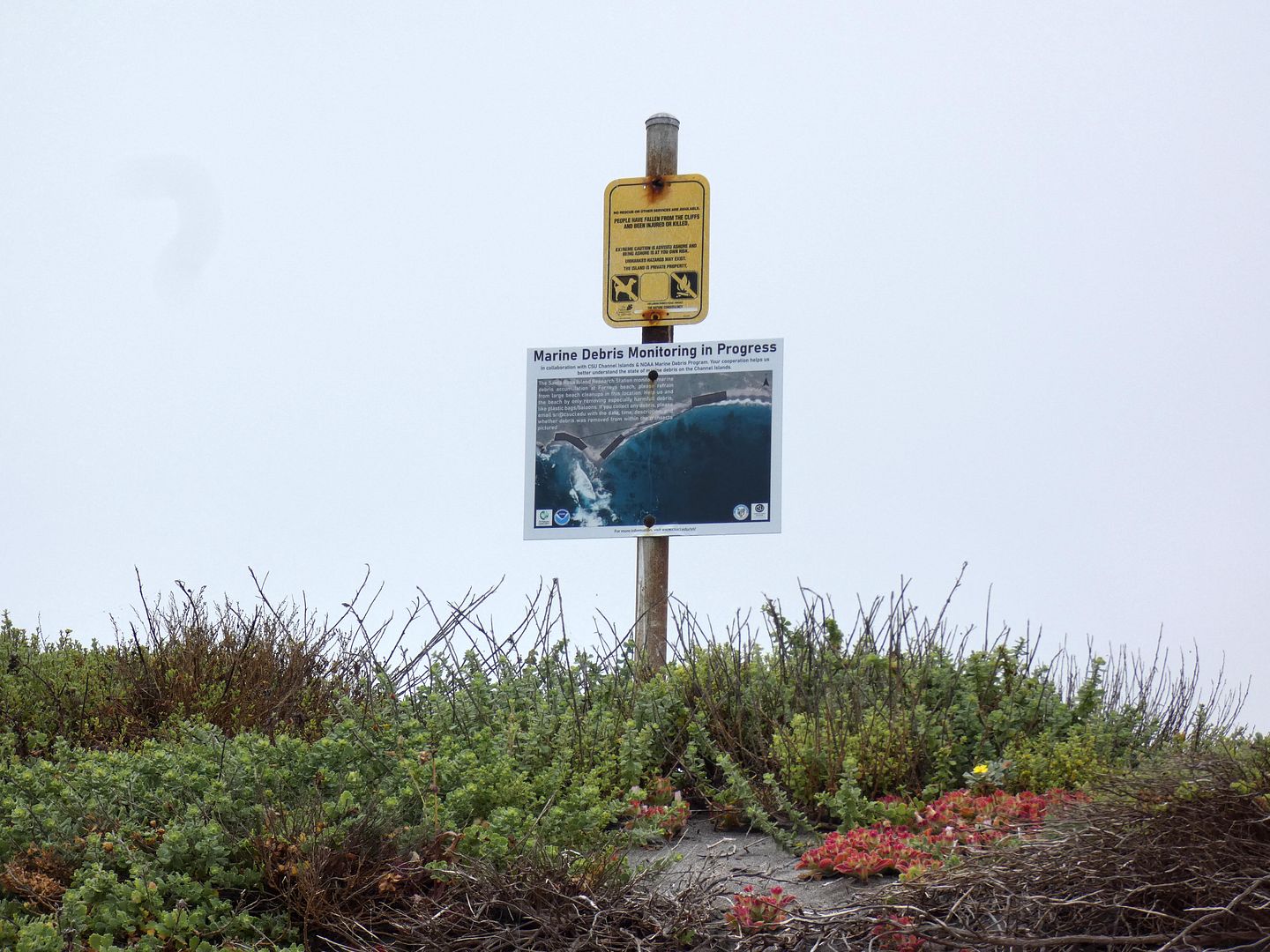
Now, Cal State Channel Islands and University of California use the area for research—and The Nature Conservancy, which privately owns this part of the island, restricts access to accompanied visitors who must sign a waiver.
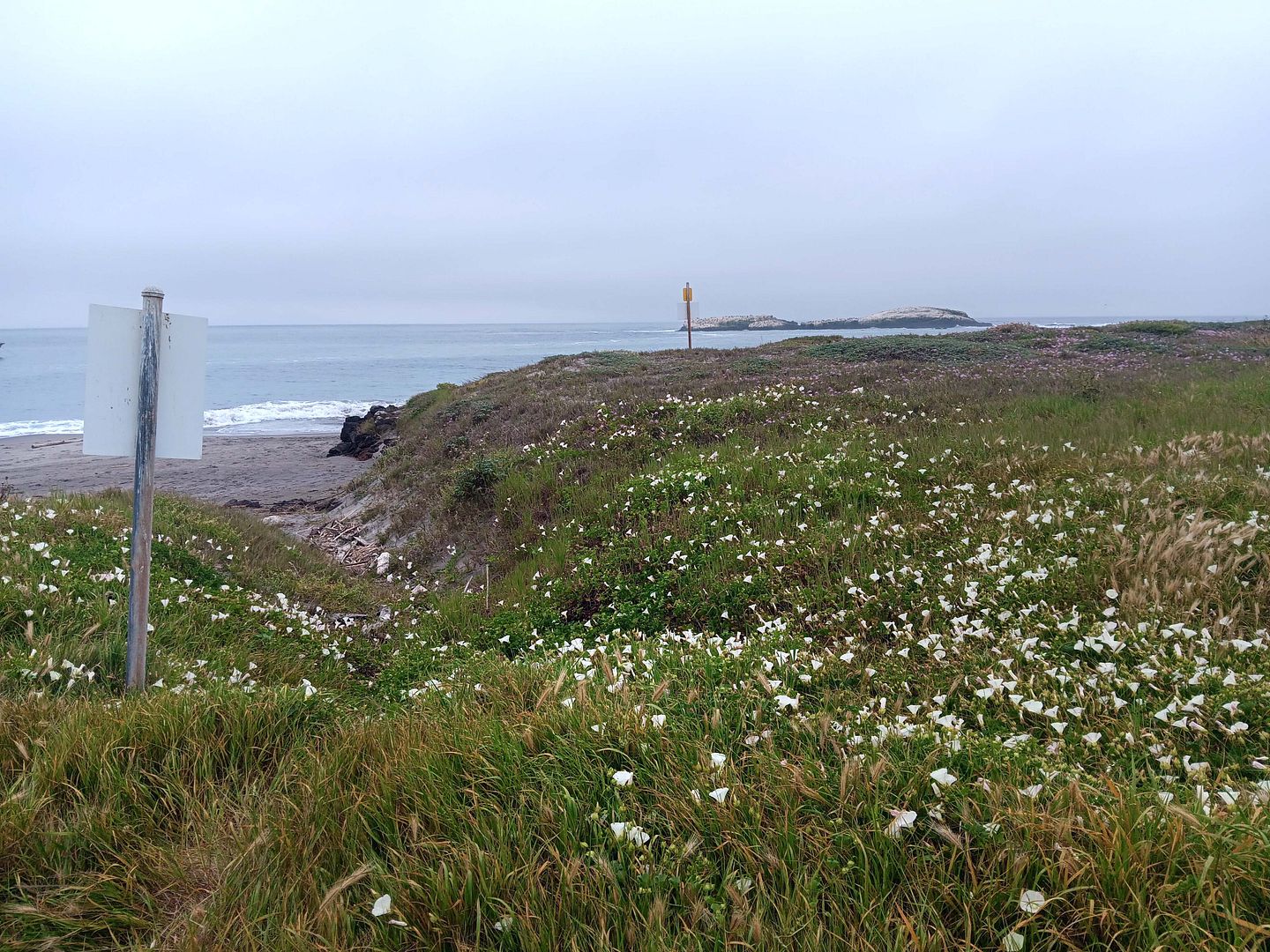
For our trip, we could either hang out on the beach or take a walk to Fraser Point. Not knowing exactly what I was bound to see, I set off wandering.
Santa Cruz is uninhabited now—at least, there are no permanent civilian residents—but it once held multiple Indigenous villages. After the Chumash were forcibly removed and sent to missions on the mainland, the island was subdivided into tracts and used (partially, at least) for sheep ranching.
There were some structures built at this part of the island, which is relatively flat and easily accessible from the beach (unlike the giant cliffs you'll find elsewhere on the Channel Islands).
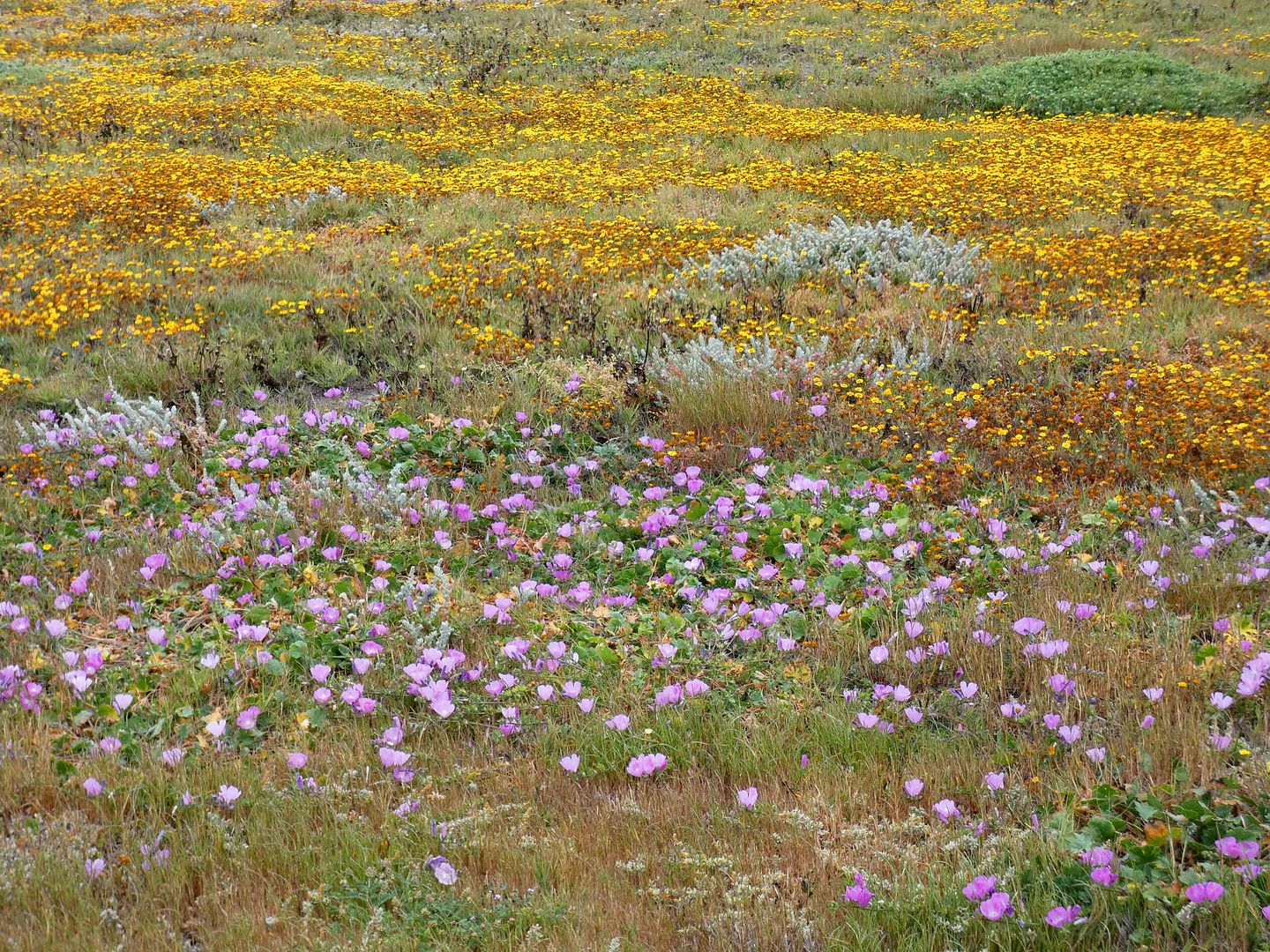
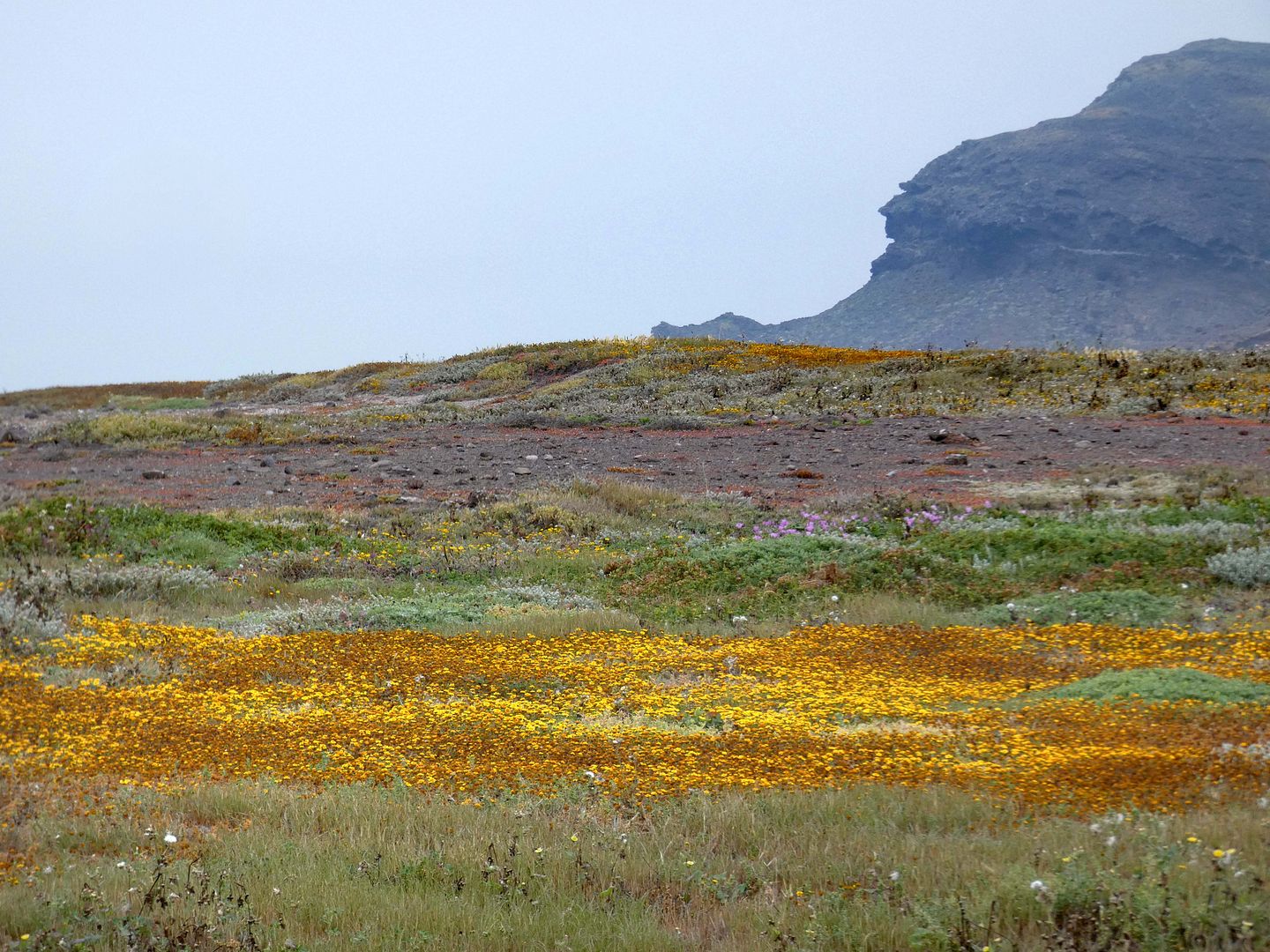
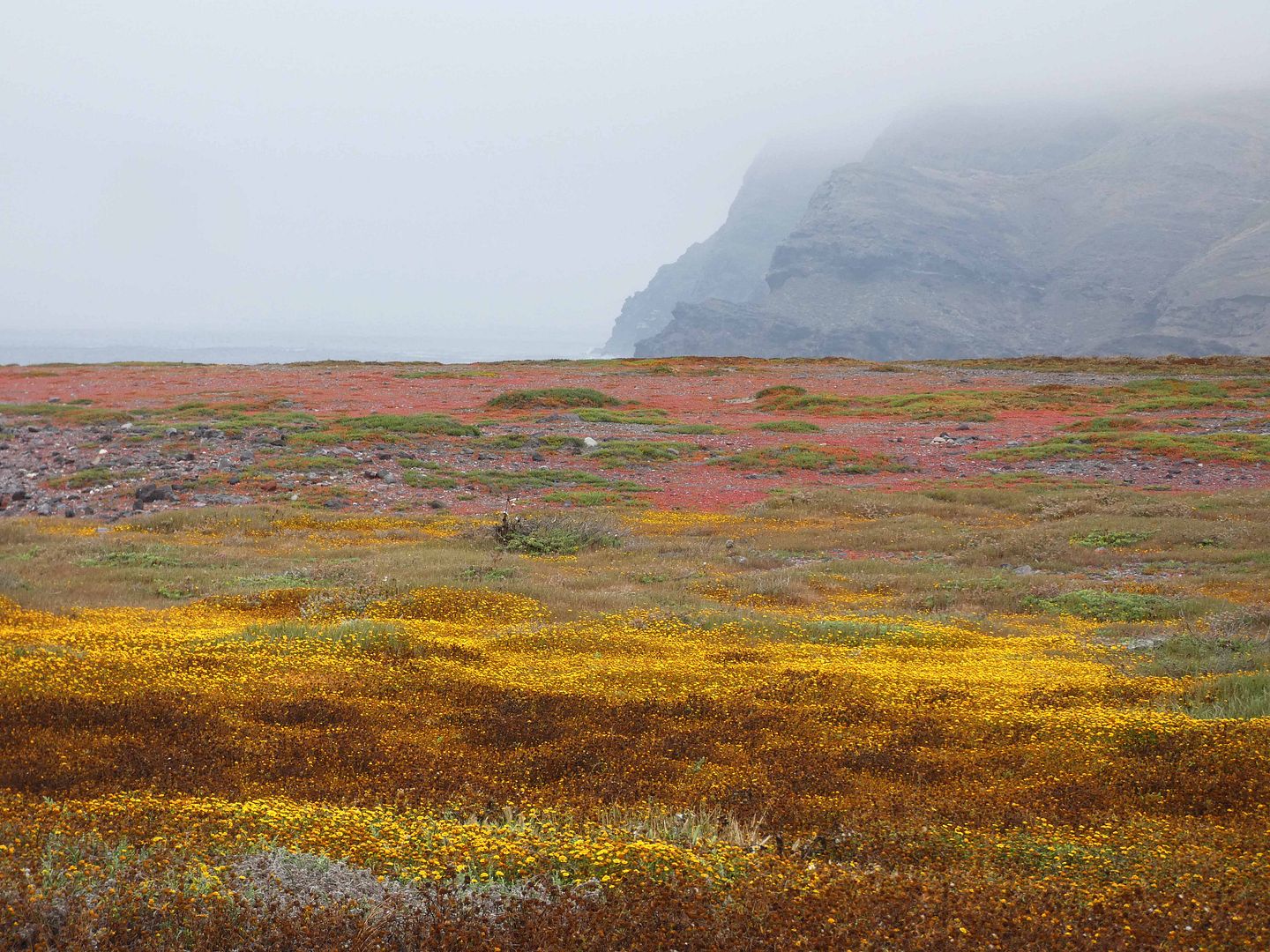
But all of those are gone now—and in springtime, it's all thick swaths of wildflowers.
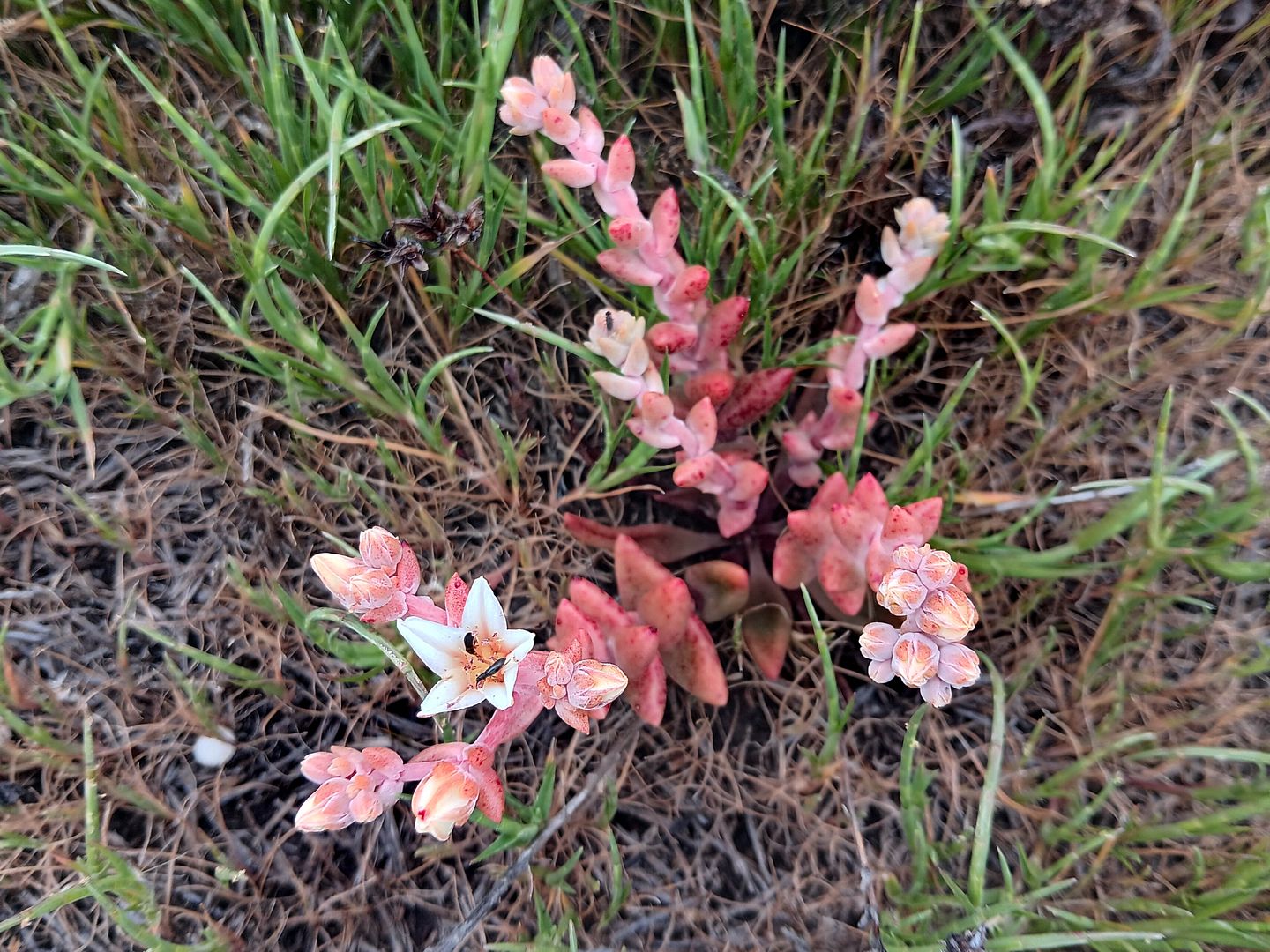
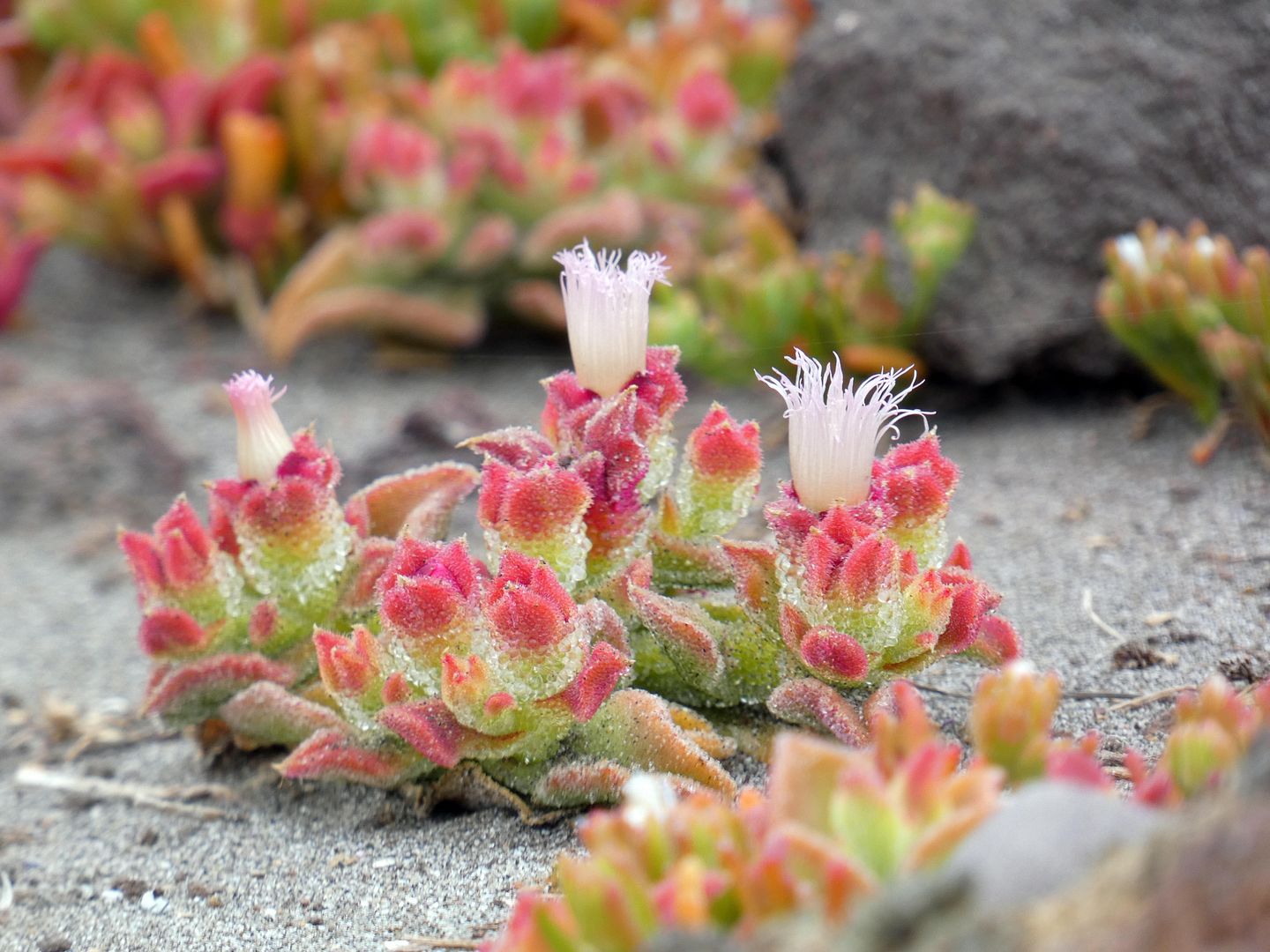
For the botanically-inclined, a huge draw to Fraser Point is the Santa Cruz Island liveforever (Dudleya nesiotica)—an endemic plant that only grows here, on this island, and on 32 acres of this part of the island. It's doing okay now that it's not getting munched up by grazing livestock, but it still needs protection.
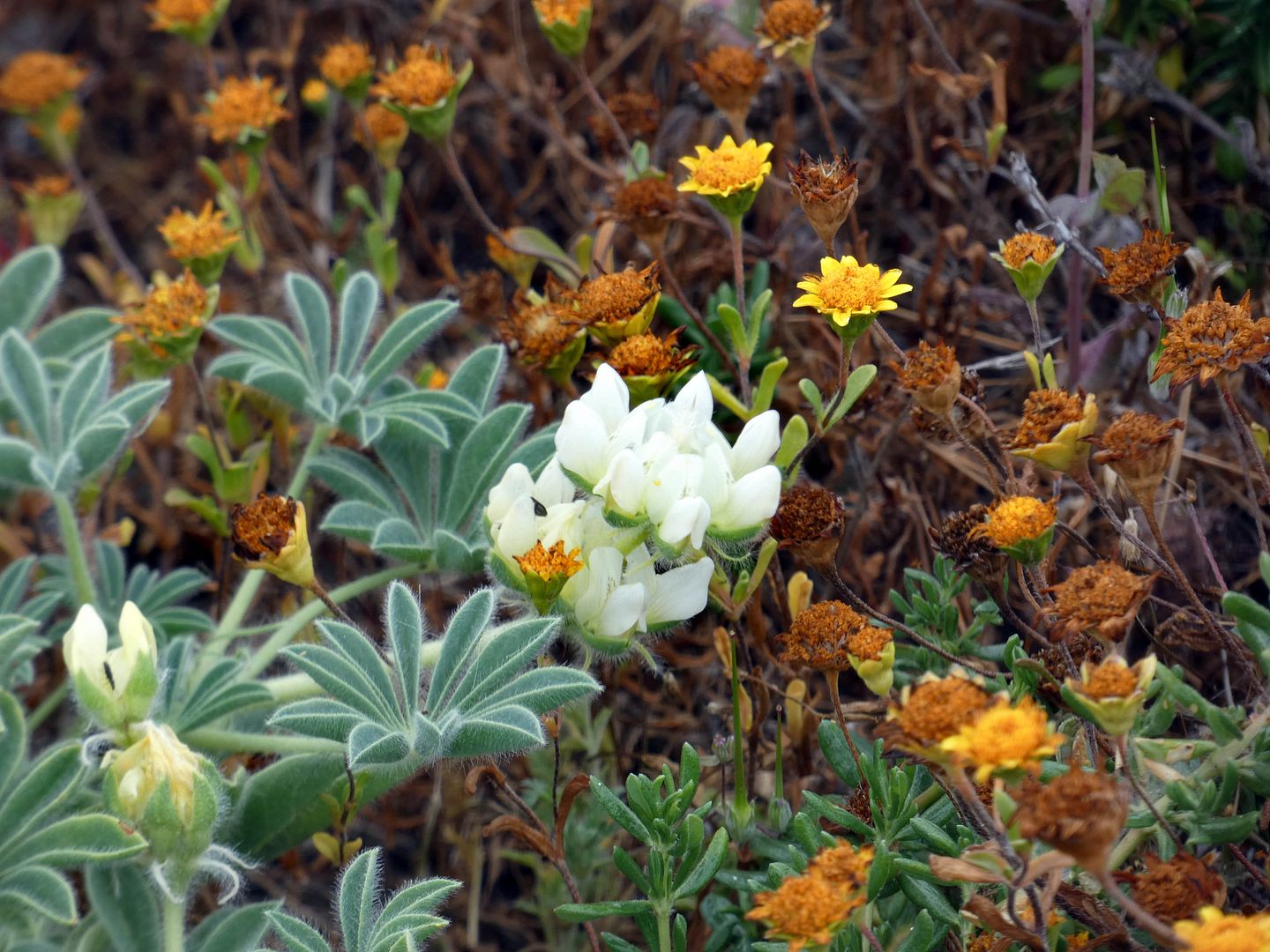
There's no real trail from the beach to Fraser Point, so a naturalist marked a path with pink flags so that we could avoid trampling the rare dudleya plants...
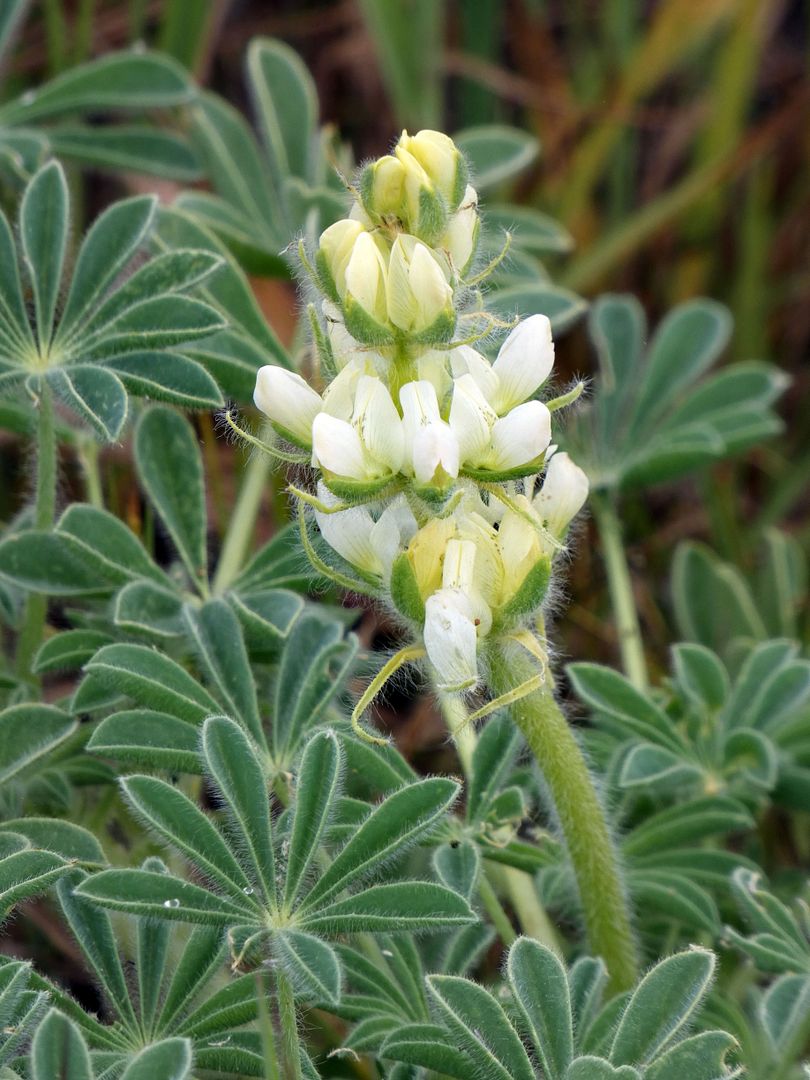
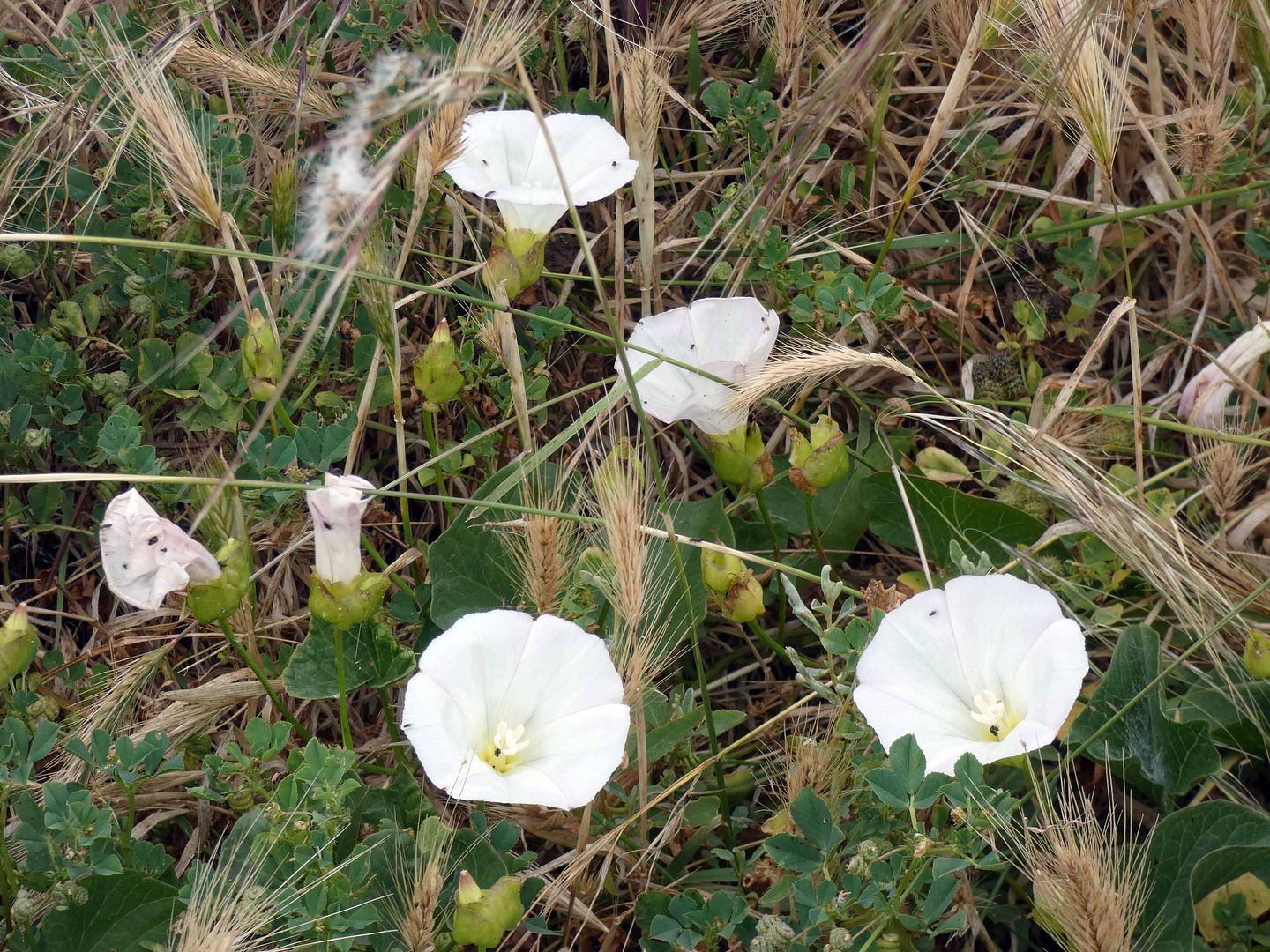
...and we could enjoy the diversity of the other plants, like the less frequently seen white-colored lupines.
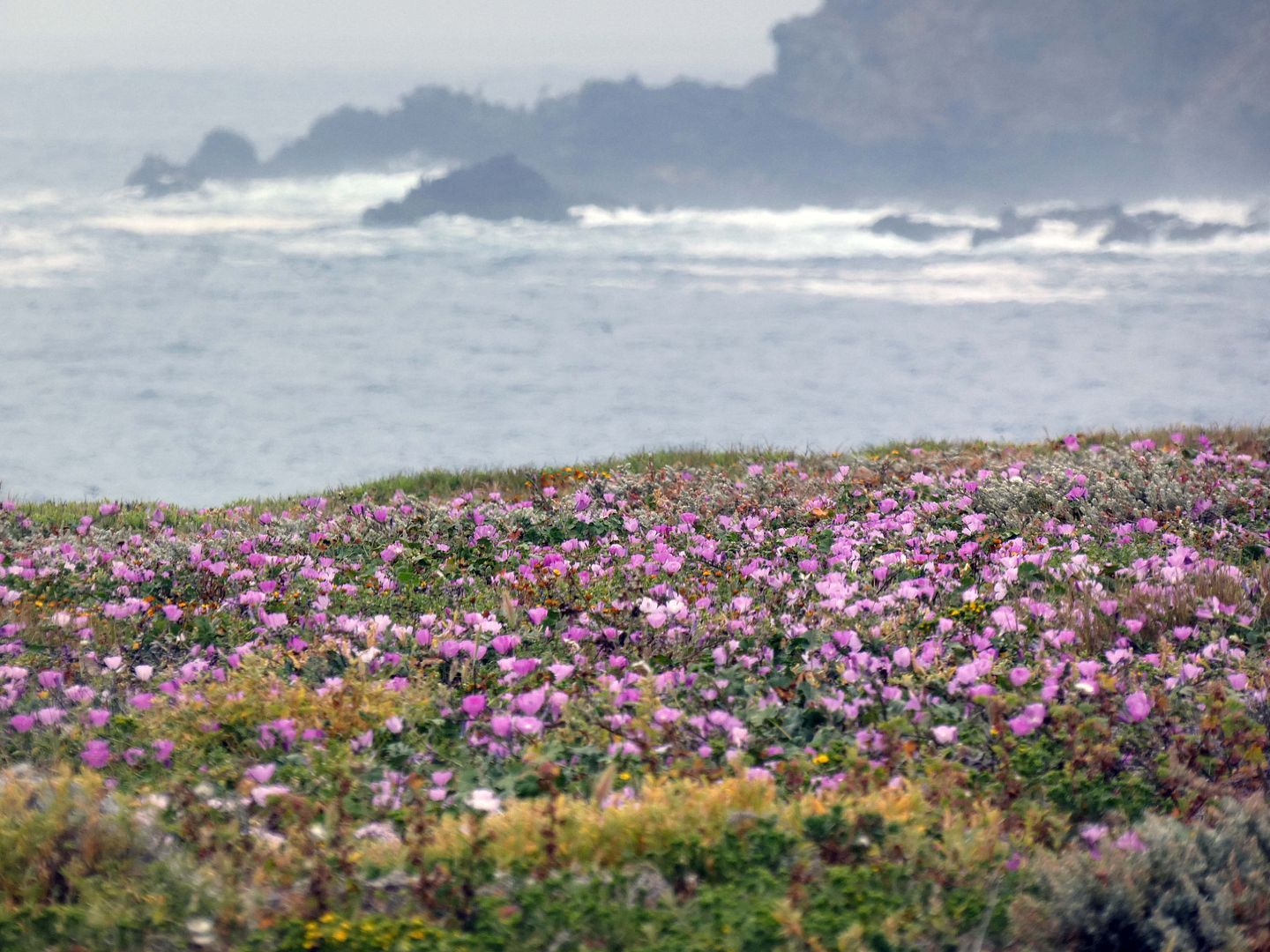
It was a welcome foggy day after a massive spring heatwave, which probably helped keep the delicate wildflowers from shriveling up...
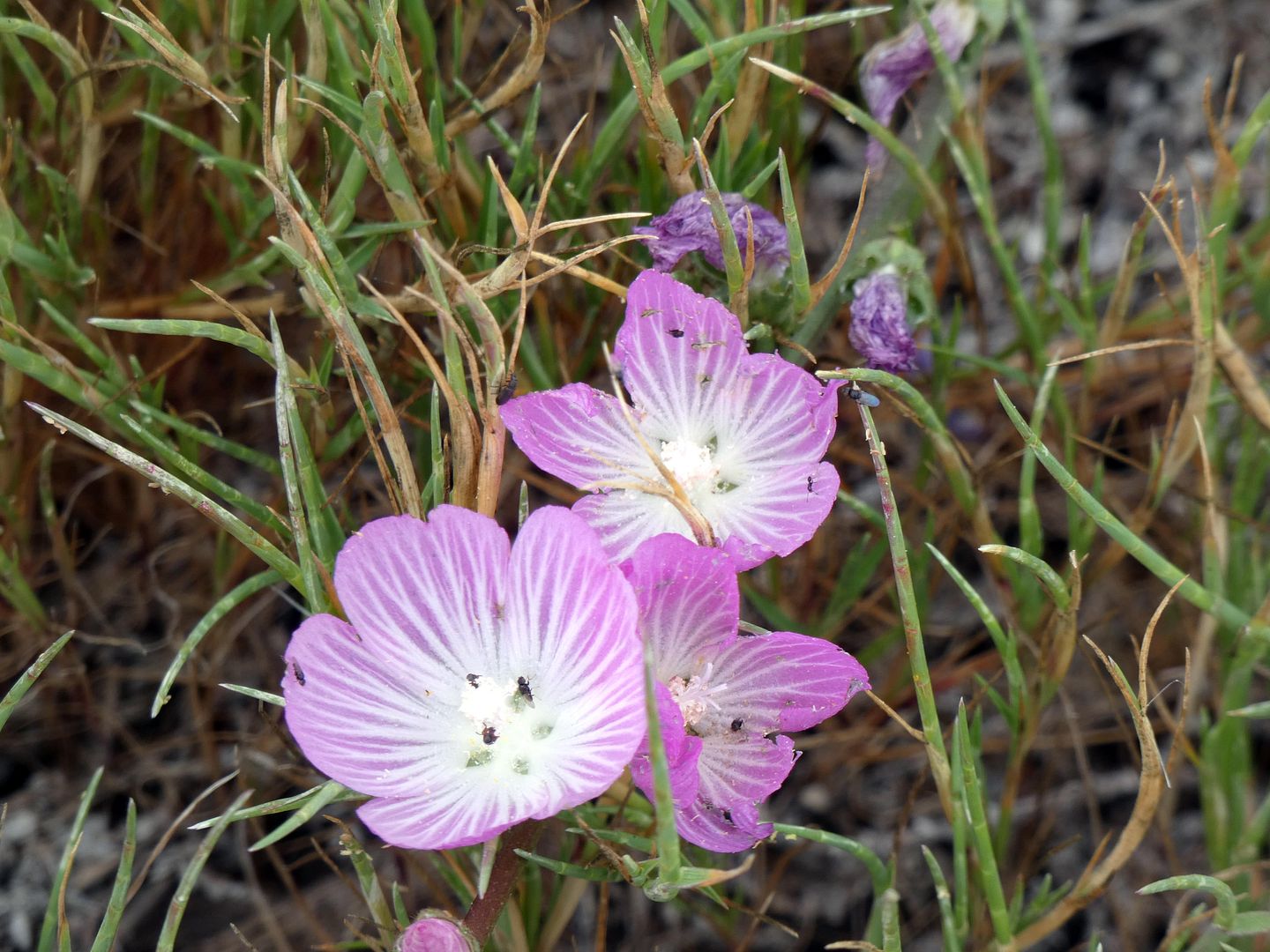
...like the checker bloom/prairie mallow (Sidalcea malviflora)...
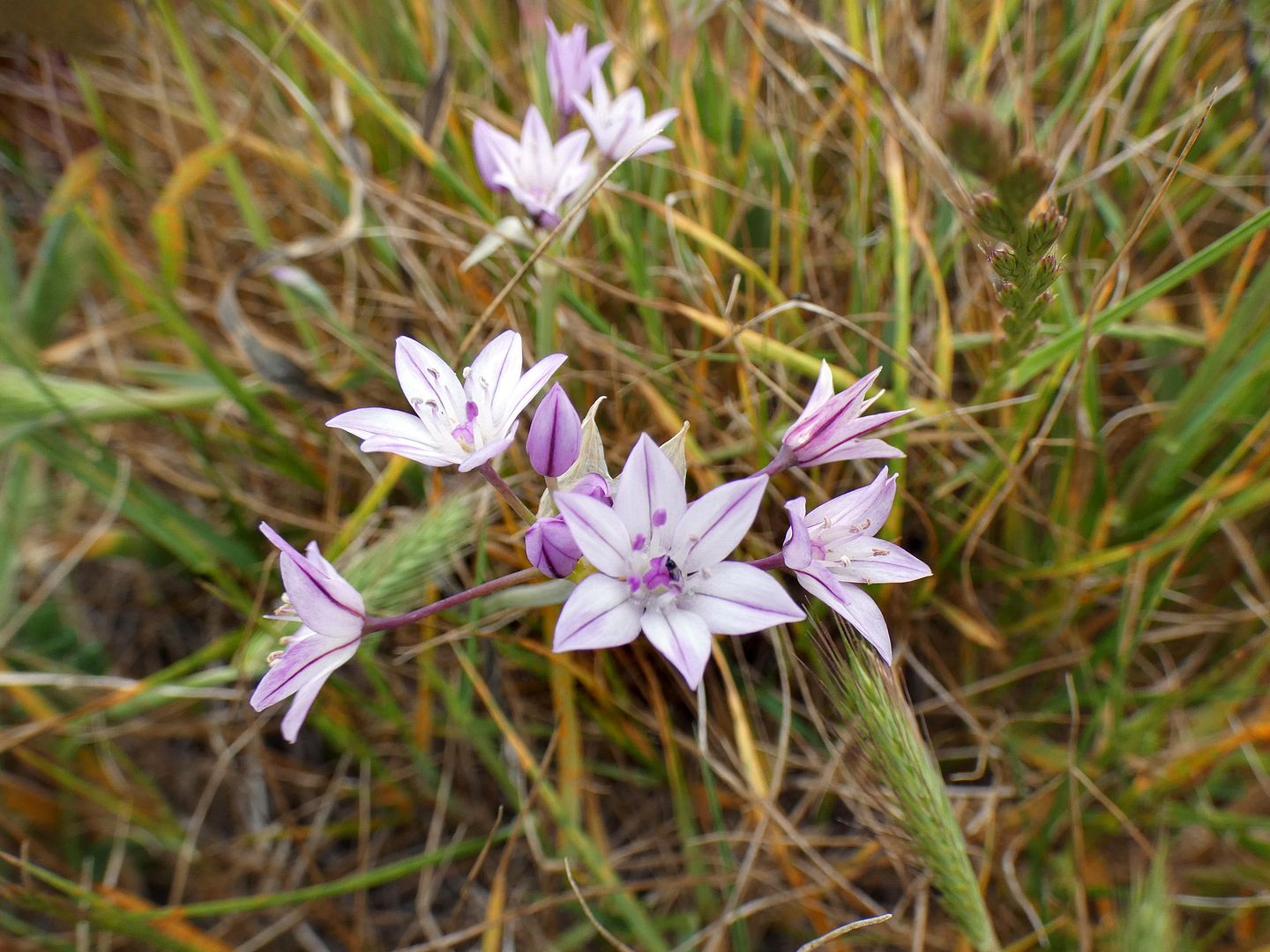
...and the early onion (Allium praecox).
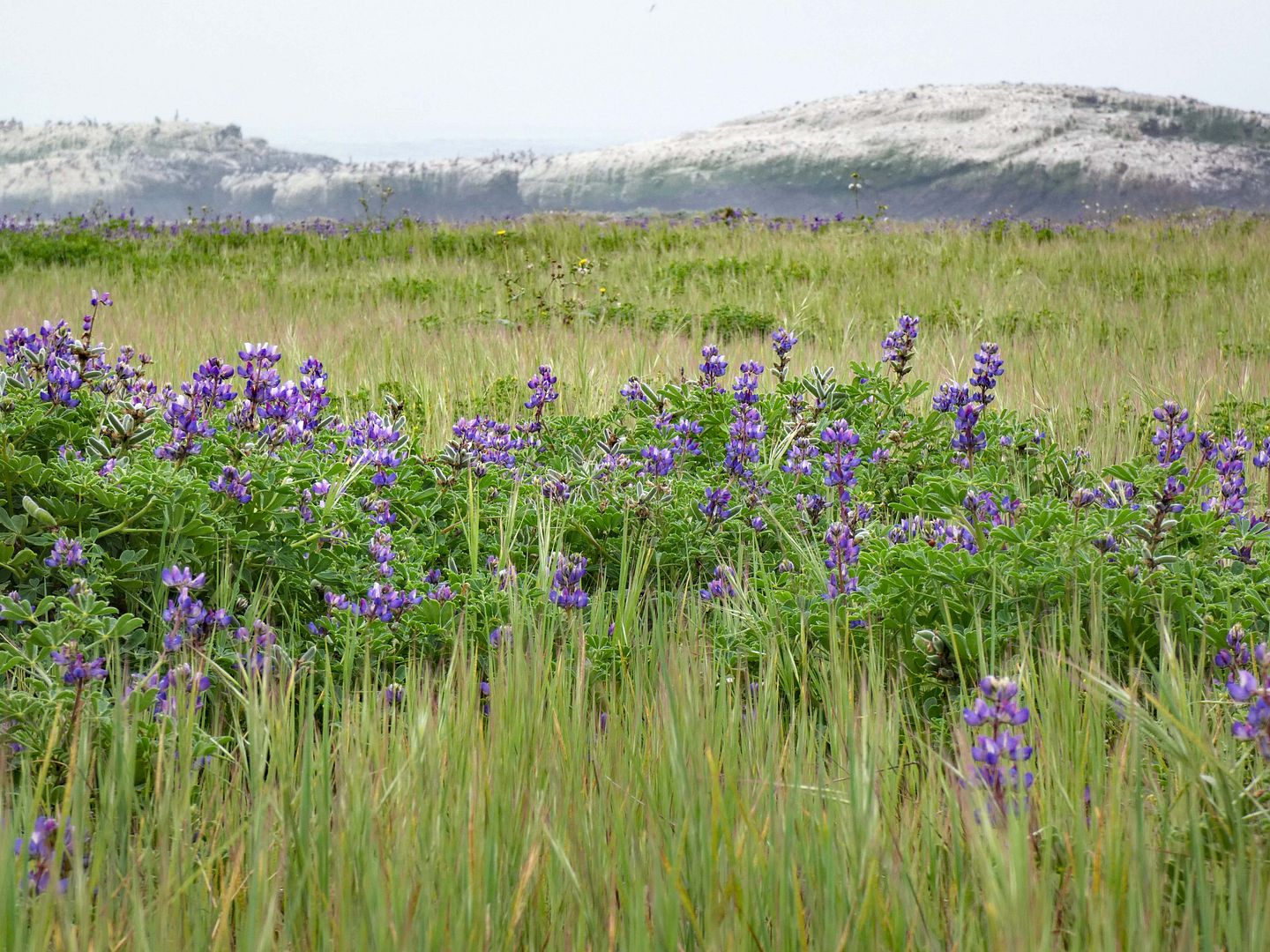
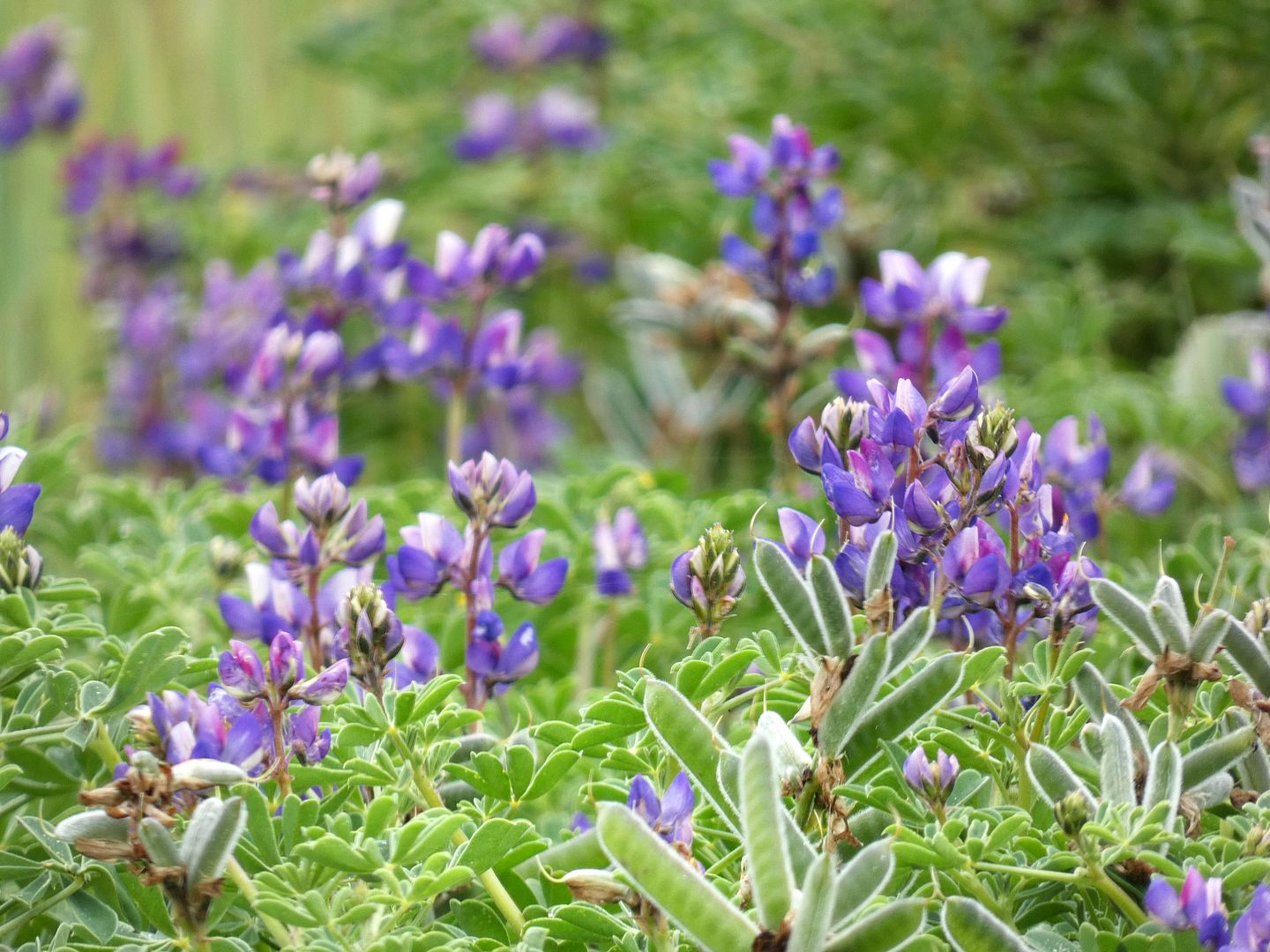
Hollowleaf annual lupine—a.k.a. succulent lupine (Lupinus succulentus)—has sprung up through the tall grass with a shocking burst of purple.
And it's unlike any of the other purples I saw from the trail.
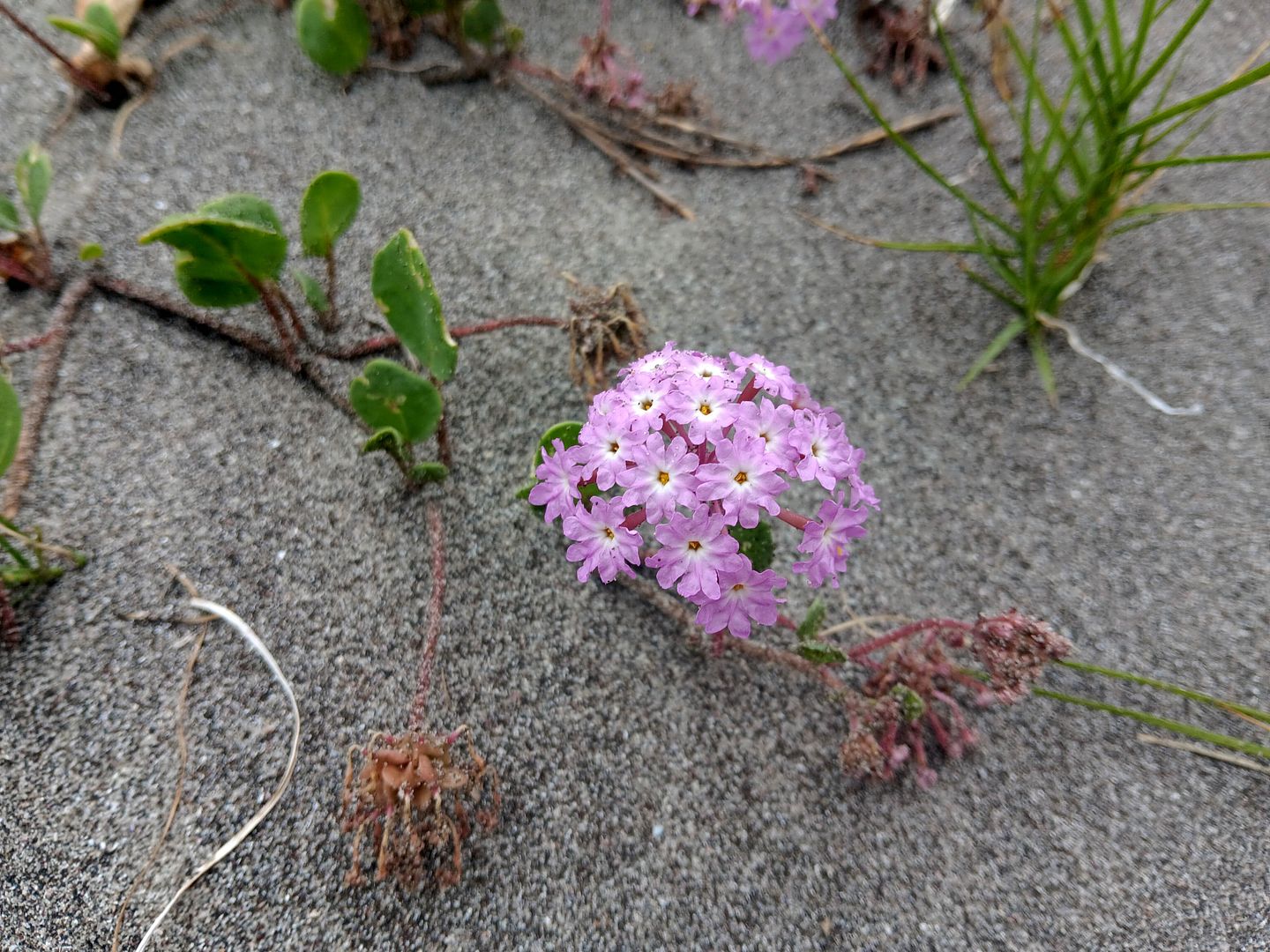
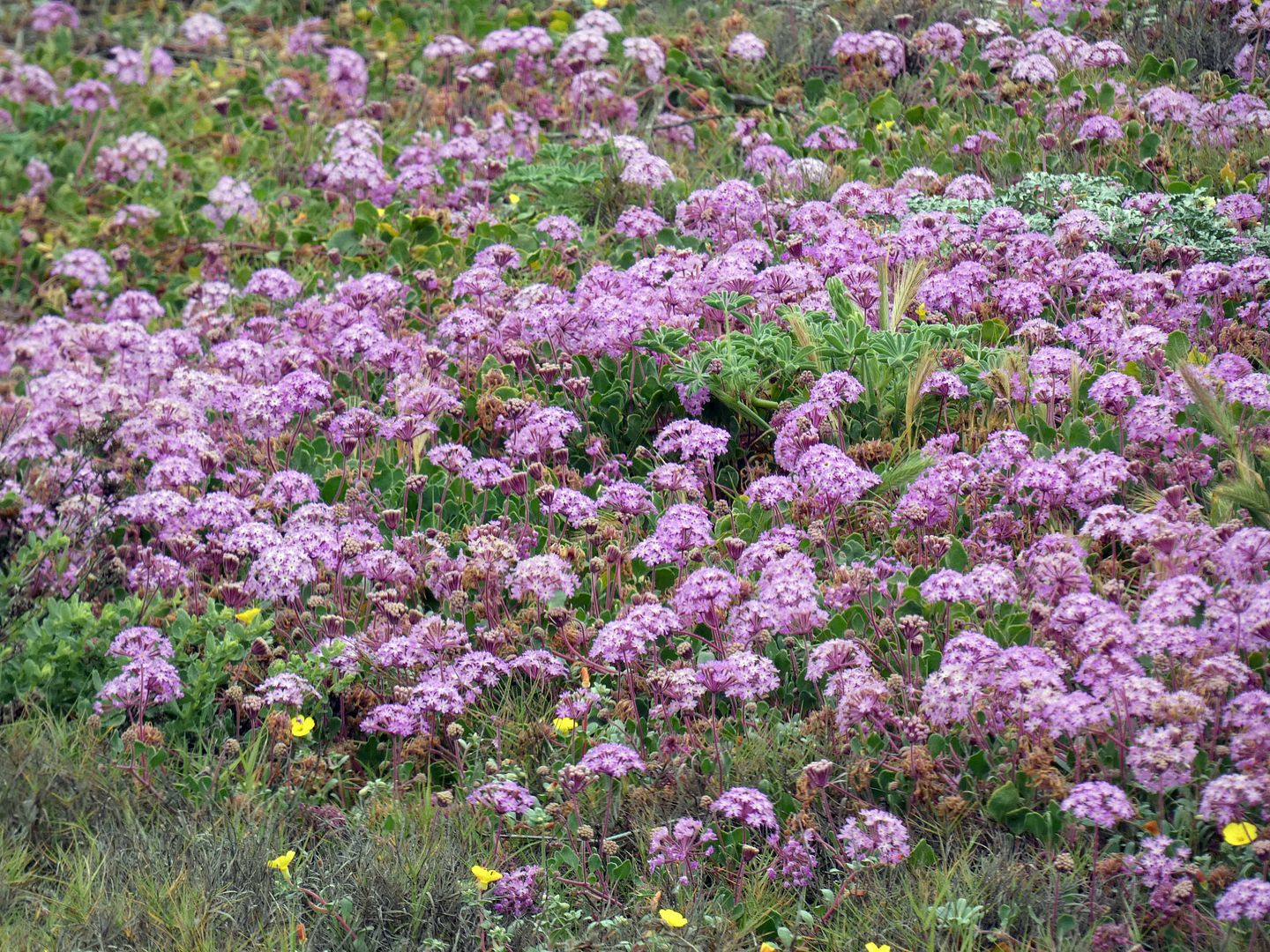
The lavender-colored Abronia umbellata is actually known as pink sand-verbena—and it thrives both in the sandy bluff by the beach and on the flat hilltop leading to Fraser Point.
The hike is considered "flat"—but there's a definite incline. And blazing a trail through the tall grasses and tip-toeing around the precious petals requires considerable effort.
Along the way, there was a striking patch of the trumpet-shaped flowers of Island morning glories (Calystegia macrostegia), which are predominantly found on the Channel Islands, their namesake.
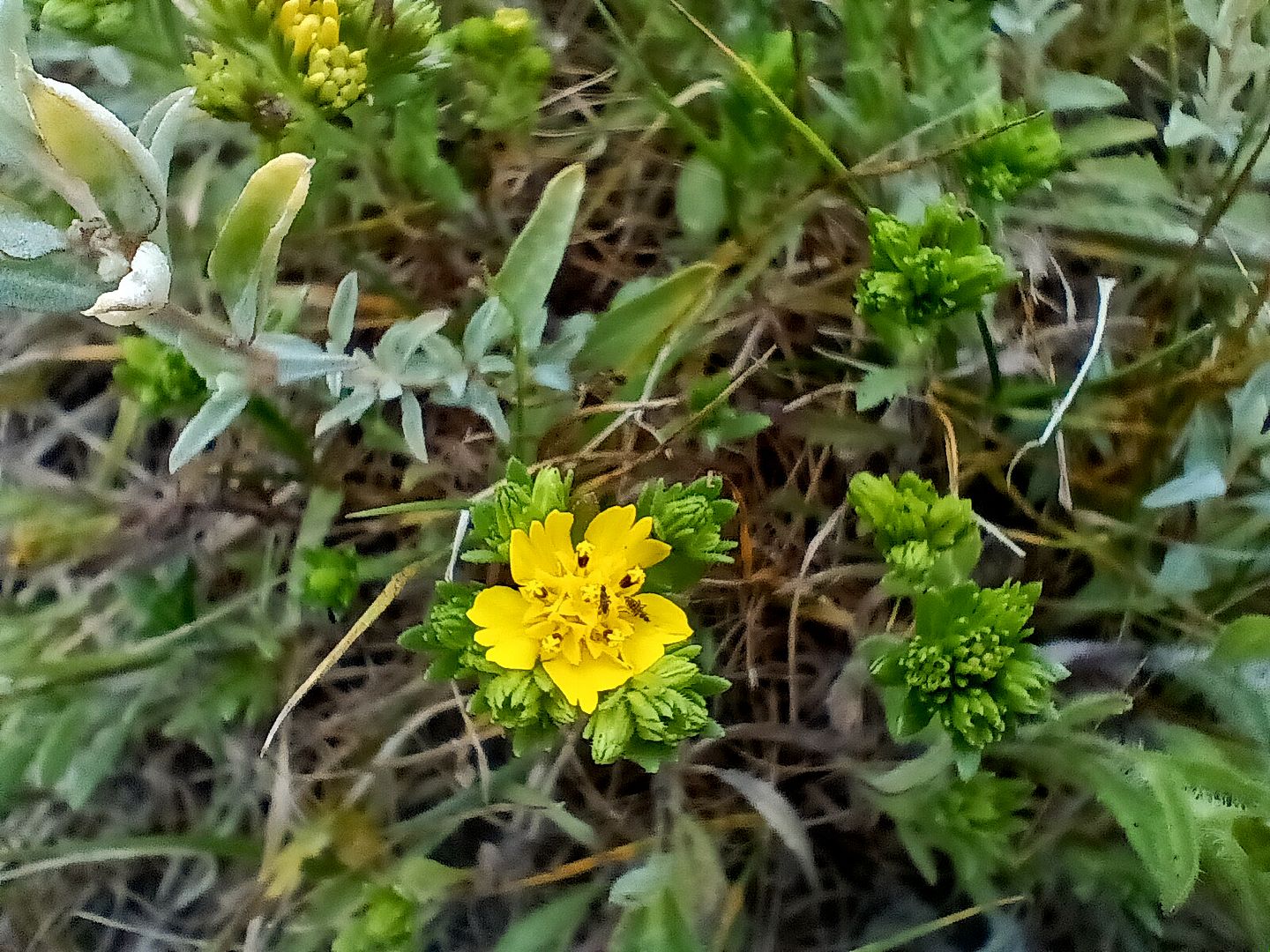
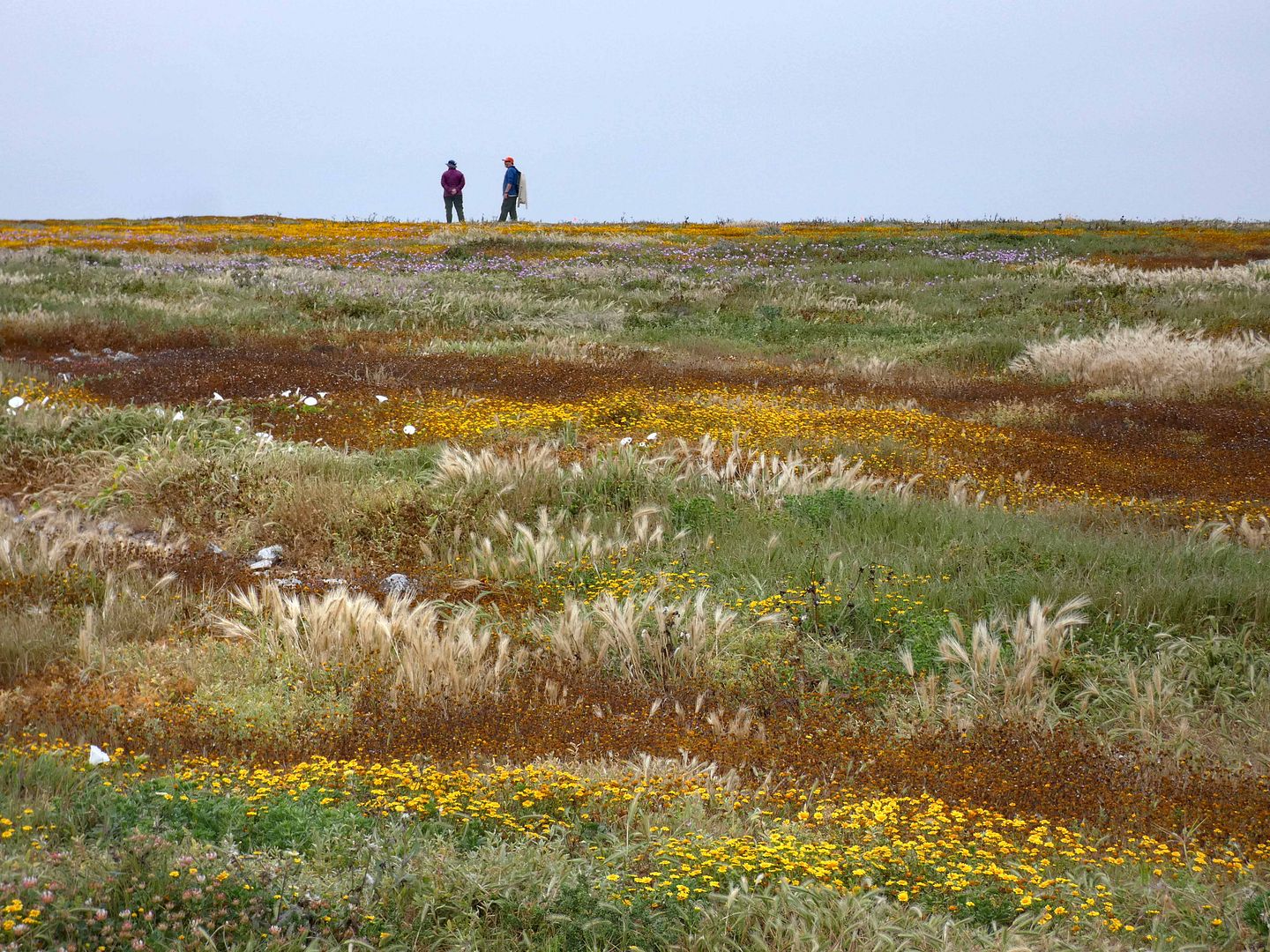
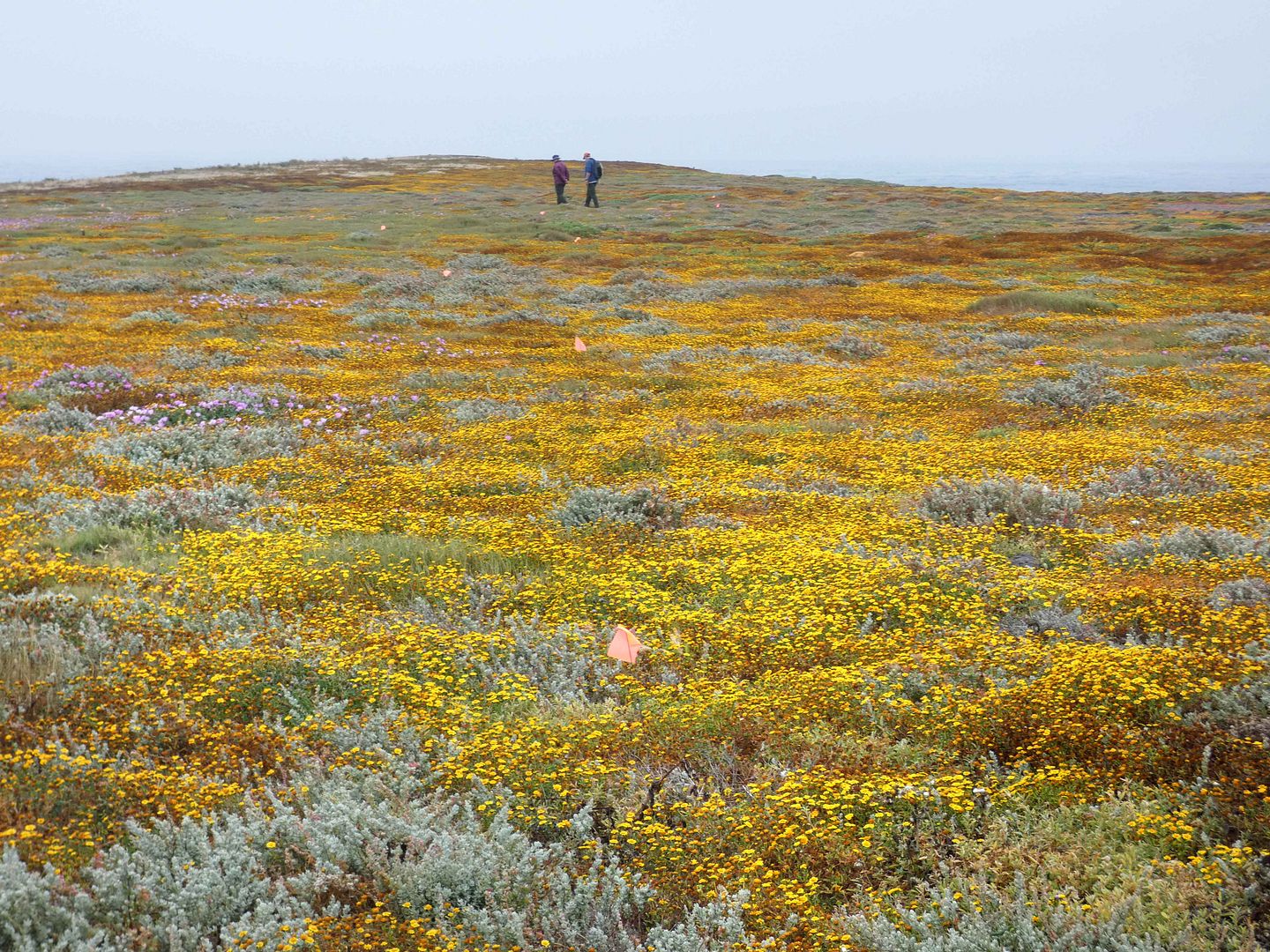
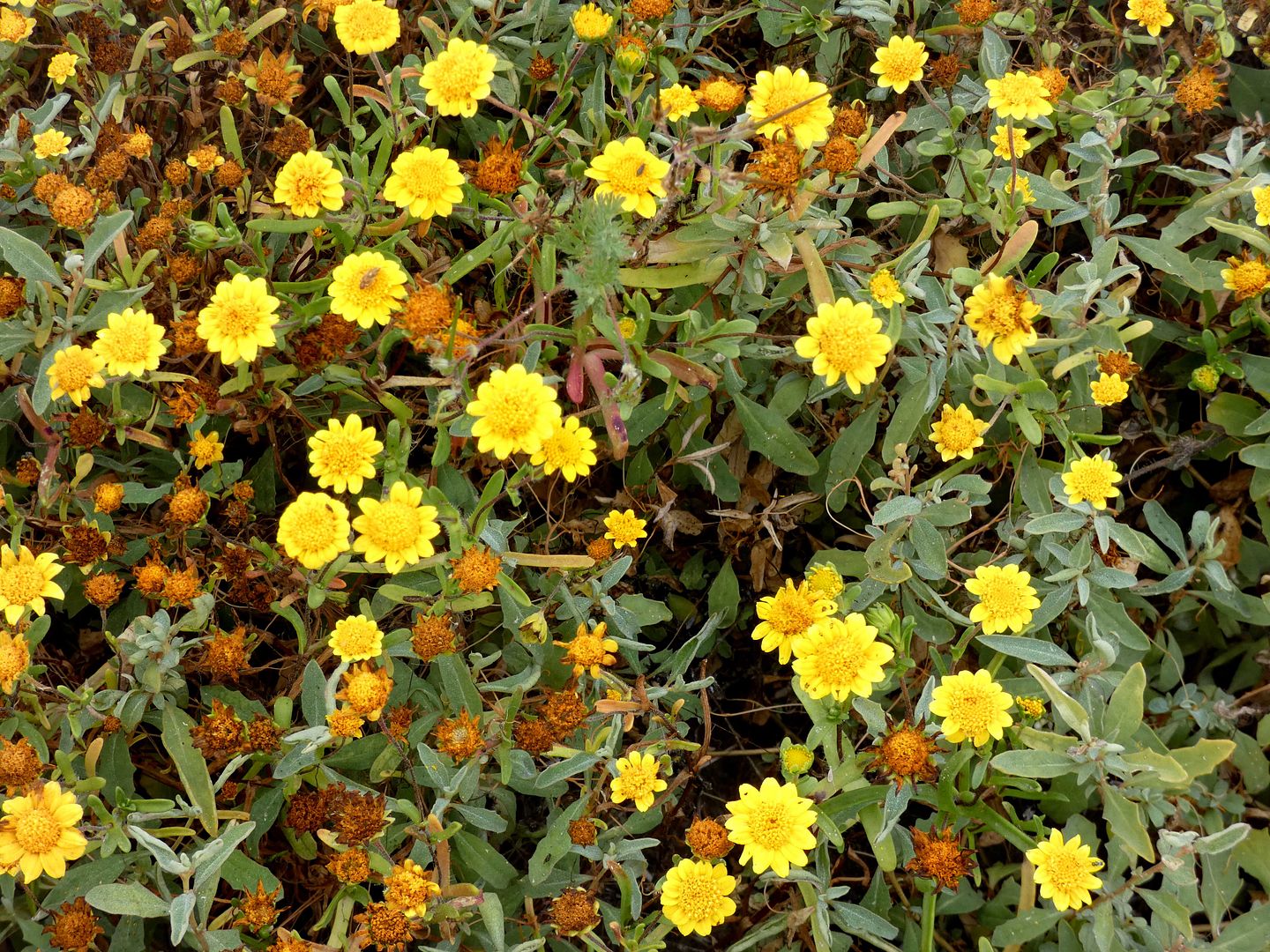
And, oh, all those goldfields (Lasthenia gracilis). This is a superbloom nobody is talking about.
It seemed a shame to crush the little yellow flowers—but sometimes it was necessary to do so in order to preserve the dudleya.
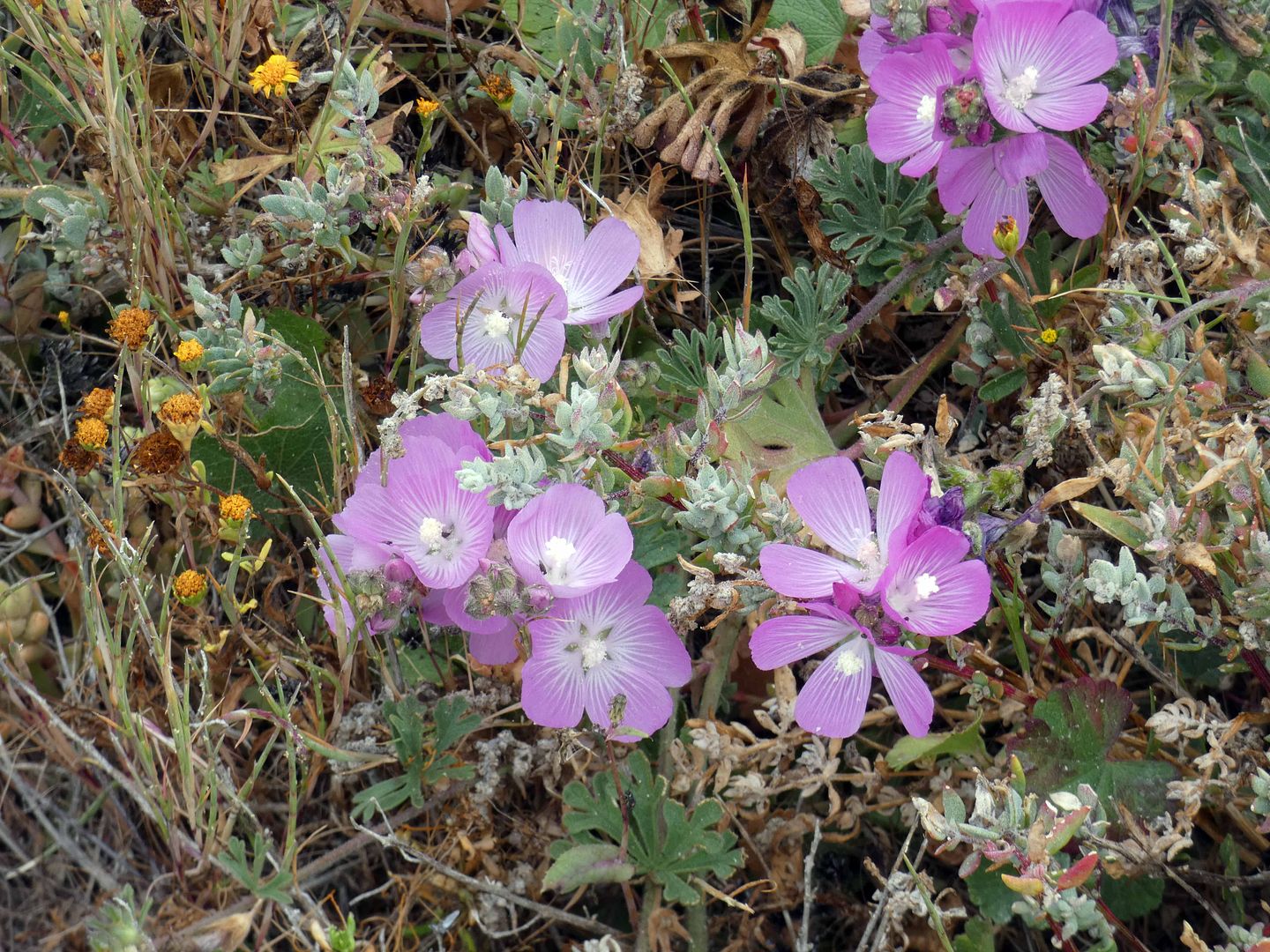
Other plants that were underfoot are invasive/non-native anyway—and therefore less devastating to stomp upon—like the cudweed everlasting/Jersey cudweed (Pseudognaphalium luteoalbum) surrounding the checker bloom.
But all together, all these plants formed a stunning tableau—one that brightened the landscape, despite the density of the fog.
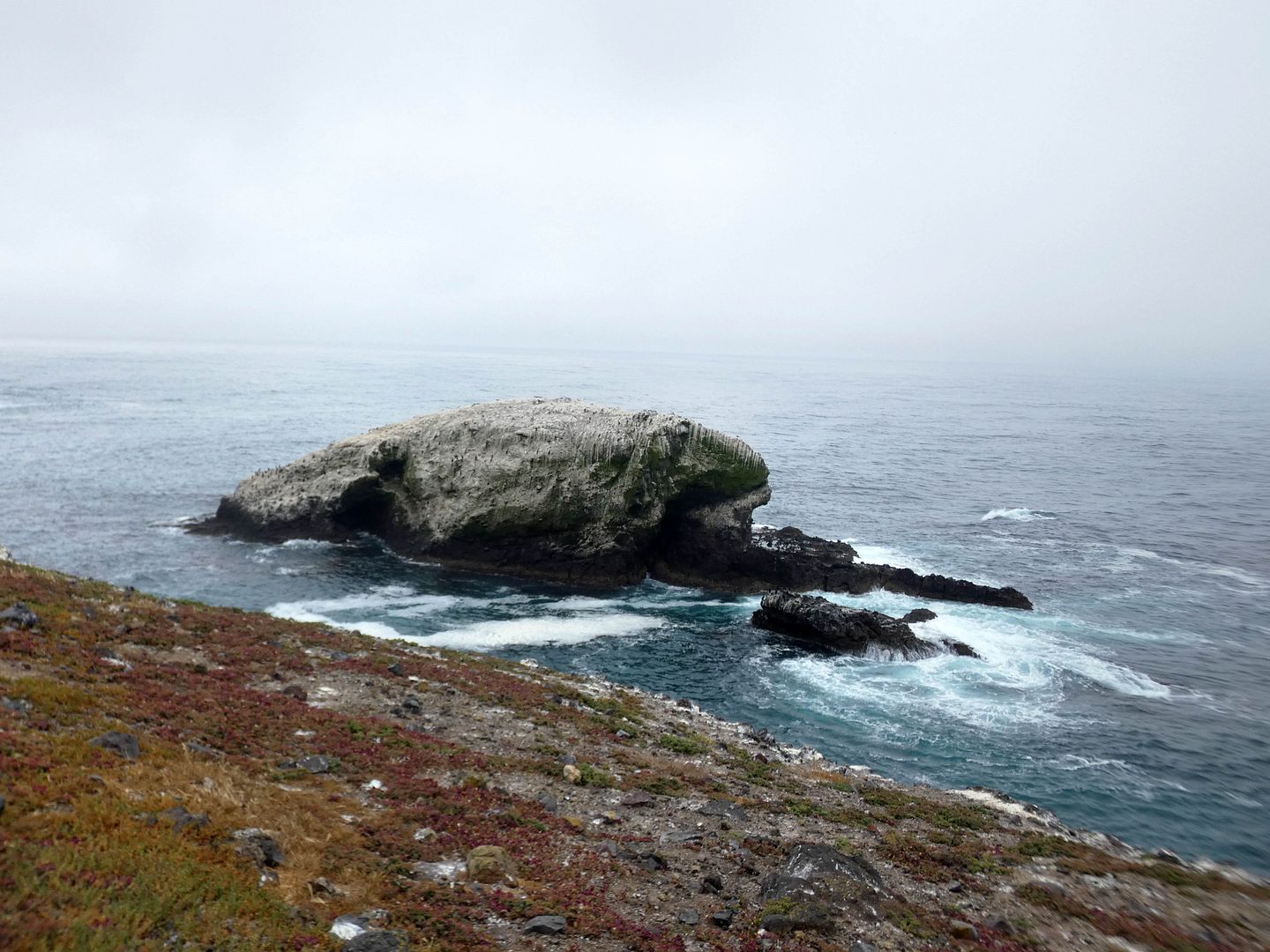
For a brief moment, maybe just a few minutes, the sun did come out to illuminate the bird island off Fraser Point...
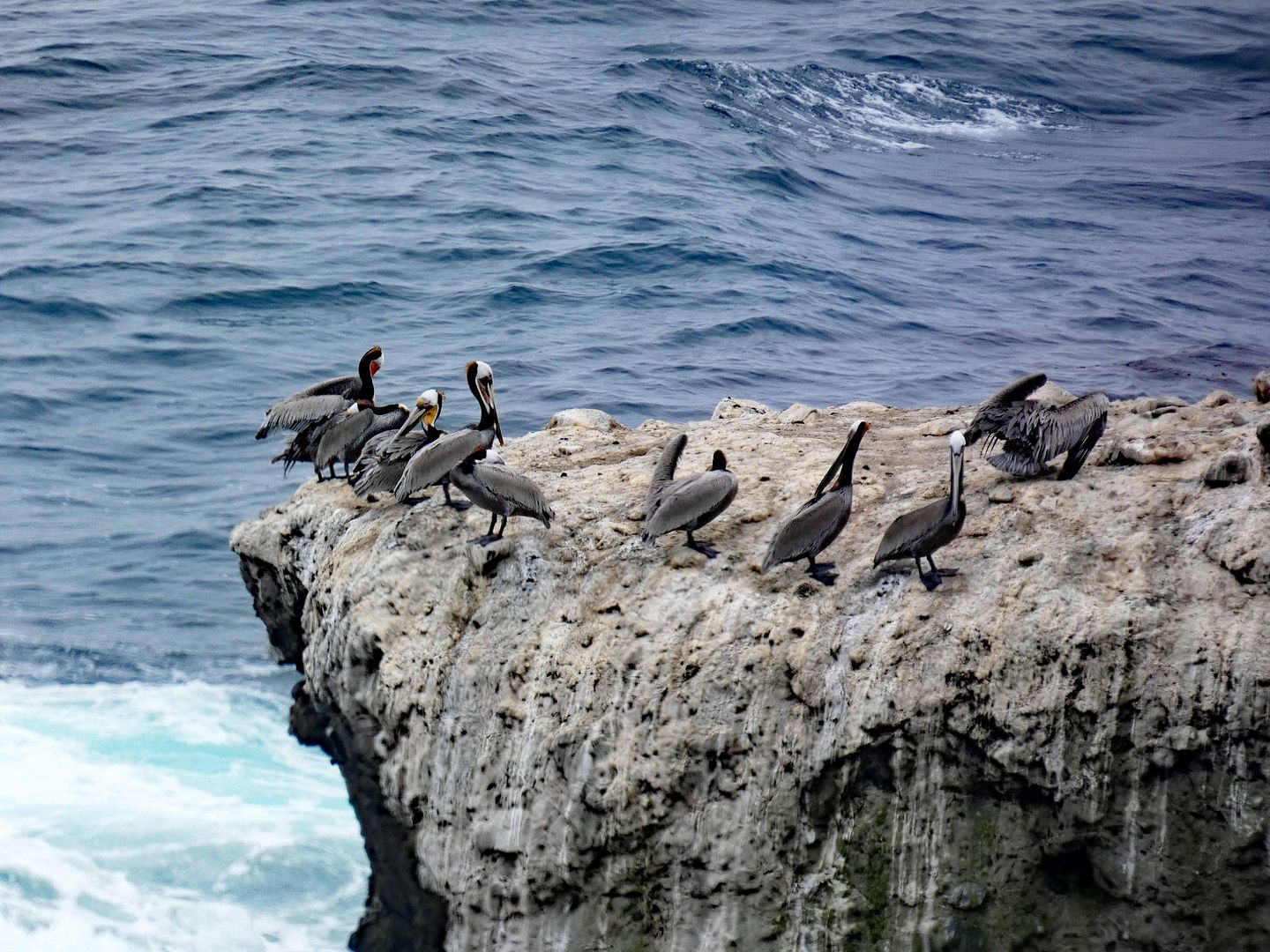
...where brown pelicans prodded at their feathers and spread their wings to shake off the sea...
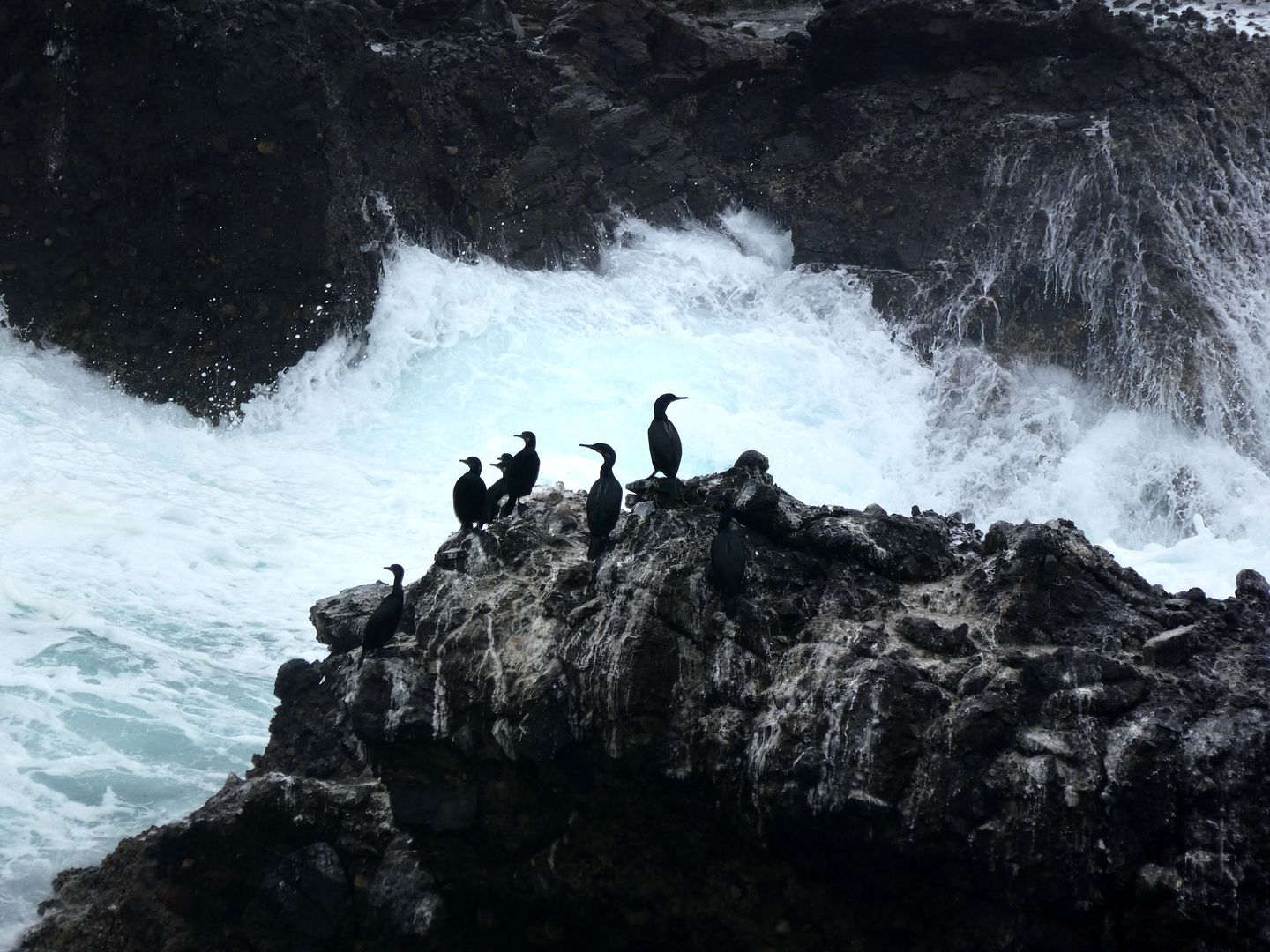
...keeping their distance from their avian neighbors, the Brandt’s cormorants who occupied their own jagged, surf-battered rock among the crashing waves.
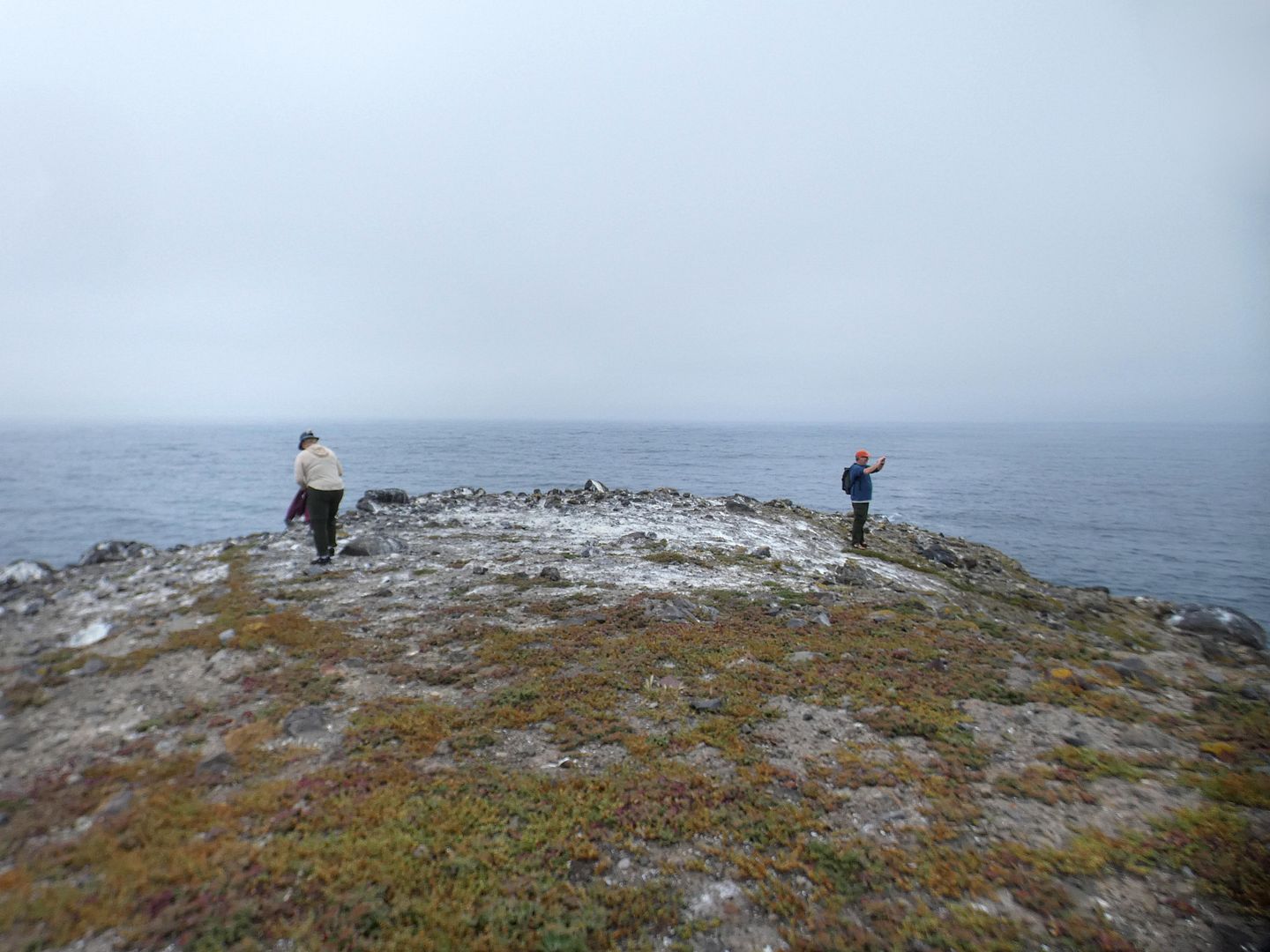
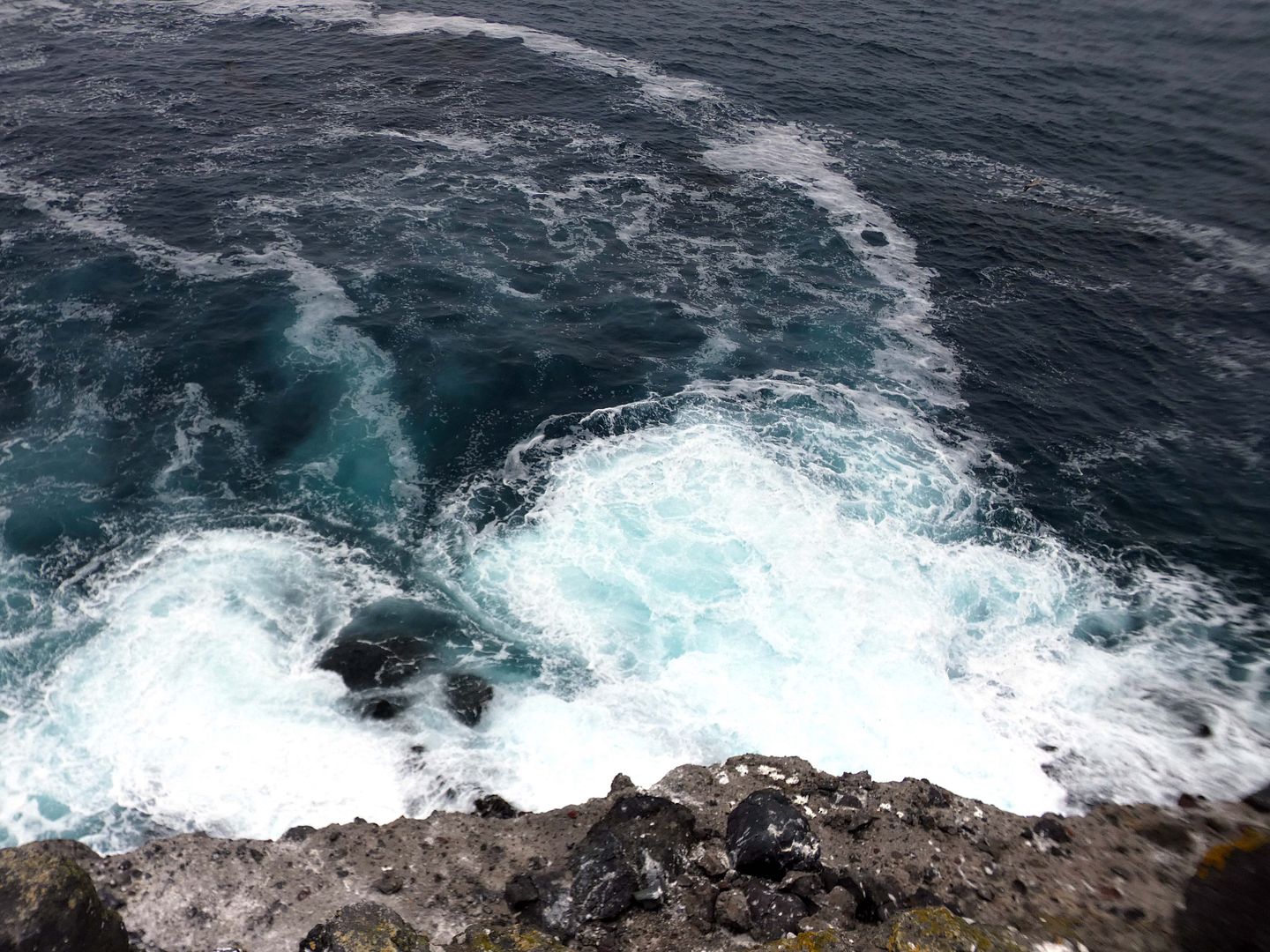
When I reached the end of the line—that is, the "point" of Fraser Point—I found it slightly underwhelming, until I looked down.
I'd never seen the Pacific Ocean quite like this—with clear, blue-green pools erupting in a swirling symphony of sea spray.
When I returned to the beach, retracing my steps along what was now a single-track trail, I tried to give in to my urge to go swimming. But while I could tolerate the winter-cold water temperature, I didn't feel safe in the surf. So, I let a few waves crash into me, getting me wet from the waist-down, and then I retreated to a rock to eat my lunch.
I didn't see much other wildlife on the island, save for a few songbirds and a grass spider (no foxes!). But on our boat ride back to Ventura Harbor, we did spot a soaring bald eagle (there are some nests on Santa Cruz) and a couple of sea lion pups cuddling on a ledge inside Painted Cave.
And save for some serious seasickness on the way out, and a fly infestation on the way back, I couldn't have asked for a better trip.

Hi,
ReplyDeleteWonderful photos, as usual. I don't know if this is ever on your radar, but have you noticed a drop in the number of tourists at any of the locations you've visited that would normally have more tourists? Just curious.
Well, I know I can't afford to travel as much as I used to, so I wouldn't be surprised. Vegas has definitely been suffering from lack of tourism dollars. Death Valley was not that busy during the super Bloom when I was there, and maybe I was just early, but I expected more people. That being said, all the neighboring hotels were sold out that Saturday night. This particular trip was sold out, but it had a very limited capacity of only like 40 people. I have found that local event tickets have been harder to get and are selling out immediately so maybe people are sticking closer to home.
Delete