Search

Showing posts sorted by date for query dentzel. Sort by relevance Show all posts

September 11, 2024

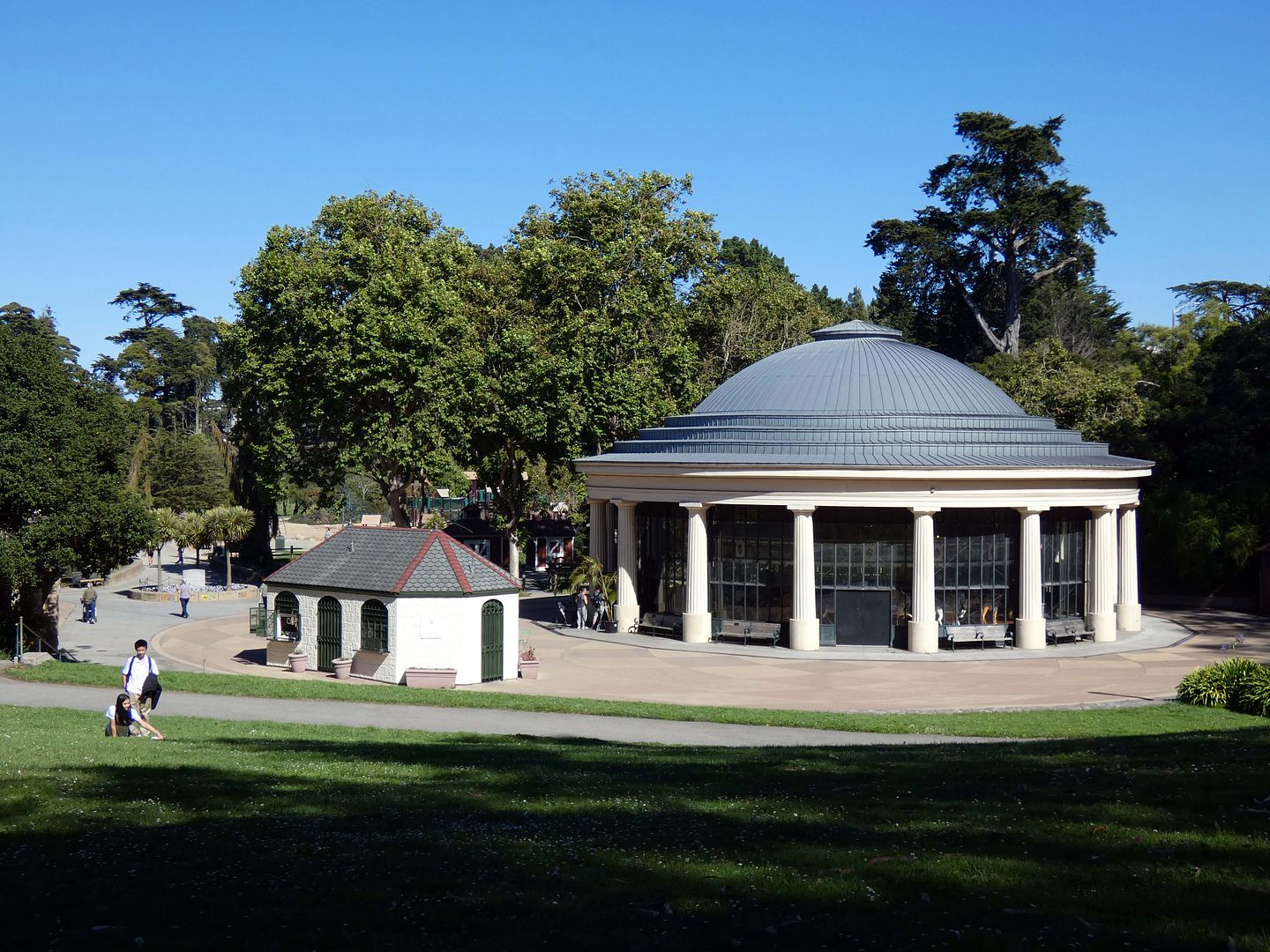
Photo Essay: A Los Angeles Carousel Has Made San Francisco's Golden Gate Park Its Home for Over 80 Years

This is just so typically me. 

I go years (or decades) without visiting a place—and then as soon as I go back once, I end up going back a bunch of times. 

Because it's so easy for me to shift my attention elsewhere. But once something gets back into the front of my mind, I realize how much I've missed out on. 

Such is the case with San Francisco. 

I was just there in January, after having not really been there since 2006—save for a couple of hours two years ago—and ever since, I've been itching to go back. 

This time, California Preservation Foundation's Doors Open California program gave me the perfect excuse to return. 

But first, I had a lot of places to cross off my list. 

 
Take Golden Gate Park, for instance. It feels very much like San Francisco's version of Central Park in New York, with meandering paths and sprawling lawns and a few historic points of interest—including its own vintage carousel. 

December 31, 2017

Photo Essay: The Faces of Knott's Berry Farm

When people think of Knott's Berry Farm today, maybe they still can smell the chicken dinners or the boysenberry pie.


Maybe they feel the jolt of the roller coasters or the racket of an Old West gunfight reenactment.


As for me, I think of the faces.


Its ghost town wouldn't seem nearly as ghostly without those haunting, creepy figures.


It started with the "Calico Belles," Marilyn (inspired by the real Marilyn Hargrove Schuler) and Cecelia (inspired by the real Cecilia Peterson)—concrete figures sculpted and painted in 1954 by Claude Bell, Knott's resident sculptor.


They were modeled after two "Calico Saloon" dancing girls named Marilyn Schuler and Cecelia Peterson and sat on a bench at Calico Square.


Back then, getting your photos taken with their facsimiles was nearly as popular as seeing the real live girls doing the can-can in a show.


Since then, they've been replaced by Ruby and Flo, and more figural sculptures "of the period" have popped up around the park—even outside of the ghost town, as far over as Camp Snoopy.


Those saloon girls were just the beginning of Claude Bell's notoriety—having created Dinny the Dinosaur (a Brontosaurus) in 1975 and Mr. Rex (a tyrannosaurus) in 1986 out of steel and concrete (well, shotcrete) to help advertise his restaurant, the Wheel Inn (now demolished), in the town of Cabazon.


Moreover, credit can't be given entirely to Claude Bell for creating some of the most memorable faces at Knott's Berry Farm, as the animals in the menagerie merry-go-round were carved by craftsmen at the Dentzel Carousel Company nearly decades before Walter Knott opened his berry farm.


In fact, this antique Dentzel—one of only three found in Southern California (the others at Disneyland and Castle Park)—is among the oldest operating ones you can find anywhere.


Built in 1902, it resided at Hershey Park in Pennsylvania until 1936, when it moved to Brady Park in Canton, Ohio. It arrived in Buena Park in 1955.


In addition to its horses, it's got a giraffe, a deer...


...two pigs...


...a goat...


...and four ostriches.


Of the three rows on two separate platforms—for a total of 48 animals—only six of them have had to be replaced with fiberglass replicas.


This 1902 model is not to be confused with the carousel that was part of the Knott's Lagoon attraction, which had its own Dentzel carousel. The Lagoon was bulldozed and paved over for parking, and that carousel was auctioned off as part of Bud Hurlbut's collection in 1990.


Now, I go to a lot of amusement parks and county fairs and such. I'm up on all the latest trends and thrills. But no matter how much G-force the modern-day roller coasters can make me experience, and no matter how "real" virtual reality becomes, nothing will ever compare to the artistry and craftsmanship of these old, antiquated, mechanical machines with their galloping horses and snickering faces.

And nothing can haunt me quite like creations of Claude Bell and the other faces of Knott's Berry Farm.

Related Posts:
Photo Essay: Upon the 75th Anniversary of the Ghost Town at Knott's Berry Farm
Photo Essay: Old Trapper's Lodge Statues
Photo Essay: The Faces of Bonnie Springs Ranch, Old Nevada
Photo Essay: Castle Park and The King of Theme Park Train Rides
Photo Essay: The Faces of The Santa Monica Pier Carousel

July 09, 2017

Photo Essay: Castle Park and The King of Theme Park Train Rides

Somehow, the concepts of amusement parks and theme parks have conflated into one.


And while theme parks are, indeed, amusing...


...not every amusement park has or even needs a theme (especially in the advent of "thrill rides," like at the themeless Six Flags).


From Santa's Village to Disneyland (whose multiple themes include "adventure," "fantasy," the "frontier," and the land of "tomorrow"), there's no better way to escape the humdrum of real life than to travel back in time or to a land that's far, far away...


...than to run off with the circus, so to speak, at least for a couple of hours.


In the case of Castle Park in Riverside, you'd be transported back to Camelot...


...to the time of Merlin and other figures of Arthurian legend.


Castle Park opened in 1976, seven years before Medieval Times would take the concept to another level with its immersive dinner theater show (and 10 years before Medieval Times would arrive in Buena Park).


And while there are still glimpses of 11th century life in England...


...the current experience at Castle Park is definitively domestic...


...with pieces of Americana, like the antique car ride...


...and the Castle Park Railroad.


The two-foot narrow gauge railroad was built by Castle Park founder Wendell "Bud" Hurlbut, who'd already made a name for himself in miniature locomotives and train-based amusement park rides designed for Knott's Berry Farm (like the Calico Mine Train).


You can credit Hurlbut's creations for Knott's with helping it expand beyond a berry farm and chicken dinner restaurant into a full-fledged amusement park.


Trained (or, rather, self-taught) as a mechanical engineer, Hurlbut is considered one of the country's first theme park creators.


Even the ultimate train fan himself, Walt Disney, used to visit him at Knott's while he was building the Calico ride. And while many may think that Disney created the "hidden" line of waiting would-be passengers (with all of those switchbacks), he actually borrowed the idea from Hurlbut.


His work was so revolutionary and groundbreaking that after his death in 2011 (when he was still operating the Hurlbut Amusement Co. in a barn across the street from Knott's, well into his 90s), his train-building business was bought by Katiland Trains, the biggest amusement park train manufacturer in the country, located nearby in Riverside County.


With no children to pass them down to, much of the contents of his workshop were sold off in 2012. (He'd already sold the park decades before.)


As much as he's associated with trains, Hurlbut actually began his amusement park career as a carousel man at Knott's in the 1950s.


That's when he operated a 1905 Dentzel Menagerie-Jester Head model that had been relocated there (to the Lagoon) from Hershey Park in Pennsylvania.


In 1985, when Hurlbut was expanding his Castle Park beyond an arcade and miniature golf course, he moved the historic carousel to Riverside and added it to what was becoming a fully developed amusement park.


Its Ruth band organ had previously been rescued from The Pike in Long Beach (1911-1979).


Among the 20 menagerie animals on the two-level platform, you'll find a tiger...


...a lion and a goat...


...two bears and two pigs...


...three deer...


....and four each rabbits, cats, and ostriches.


Among the 30 horses scattered between three rows, 18 are jumpers and 12 are standing.


And of the 50 total animal figures, 19 are made of their original carved wood and 31 of them are fiberglass reproductions. Many of the original figures that were replaced by copies were auctioned off in 1990.


Before Hurlbut died, a documentary filmmaker asked him what regrets he had in life. His answer? "That carousel auction," he said.

Related Posts:
Photo Essay: Upon the 75th Anniversary of the Ghost Town at Knott's Berry Farm
Photo Essay: A SoCal County Celebrates the Sahara

June 14, 2017

Photo Essay: How to Grow a City, From the Ground Up

As much as Orange County was once known as the "Orange Empire," you don't see many signs of that today.

All the orange groves—and orchards of other citrus fruits—seem to have given way to real estate developments.

And for that, you can blame the very same family (and company) that created such a massive agricultural enterprise in the first place: the Irvines.

Those who started out gangbusters as citrus-growers (shifting the area's land use away from ranching, grazing, and lima bean farming) ended up growing something far more profitable than any fruit: a city.

And while Irvine has already shown tremendous growth—from the ground up—since the late 19th century, it doesn't show any signs of stopping.


As early as 1897, after the death of the first James Irvine (a.k.a. James I), James II began giving away some parcels of the family's expansive Irvine Ranch. Those donations created wilderness areas, open spaces, and—in the case of Irvine Regional Park (then known as Orange County Park)—a gigantic, 160-acre playground for picnics and other recreation that's also Orange County's oldest park and California's first county park.


Over the course of the 120 years that followed, the quiet canyon park grew to a total of 477 acres—preserving many historic coast live oak and sycamore trees, some more than 500 years old, throughout the "little hollows and gullies" of the diverse ecosystems that range from native oak and riparian to coastal sage scrub.


The county park remained pretty wild for the first 10 years of its existence; but in 1913, its officials dredged the spring-fed marsh and banked it to form a lake. A year later, they added a boathouse and, in 1928, rechristened Orange County Park as Irvine Park.


It wasn't until the 1930s, though, that the Works Progress Administration contributed the picnic tables, BBQ pits, and Craftsman-style structures—like the hexagonal "Exhibit Hall" and the restaurant, both designed by Santa Ana architect Frederick Eley.


Those buildings are now used today as a ranger station and a nature center.


And, fortunately, there's still a lot of nature to be had at Irvine Regional Park—including a cacophony of birds—even though it spent years during World War II as a military training facility called Camp Rathkey (and a while even as a tuberculosis camp).


The most efficient way to get to know this historic park—and brush up on your Irvine history—is to take a ride on the Irvine Park Railroad.


Over the course of 12 minutes, you'll learn more about the park's centuries-old trees and poison oak grove than you ever would on your own.


The current 1/3 scale railroad didn't open until 1996 (as a venture to save the bankrupt county and inject some cash into the then-failing park)...


...but it recalls the bygone days when park visitors used to ride the rails upon a tiny train, back in the 1920s to the 1950s


The propane-powered train itself is a miniature replica of an 1863 C.P. Huntington mini at locomotive, manufactured by Chance Rides in Kansas.


It chugs along at a leisurely 7 mph...


...with a horsepower clocking in at 60.


The meandering, three-quarter mile ride transports you as much back in time as through the park.


While some of the Irvine-donated lands went to other good, non-commercial causes (like the UC Irvine campus), the Irvine Company eventually evolved from large-scale citrus growers to real estate developers.


And so once that train ride is over, and you eventually have to leave the park, you're catapulted back into modern-day Irvine—a corporatized city of massive shopping centers, master-planned residential communities, and other real estate holdings of The Irvine Company that seem to be in a never-ending phase of new development.


The Irvine Spectrum outdoor mall, for example, opened in 1995 and added a modern (but vintage-inspired) carousel in 2001. Manufactured by Barrango from South San Francisco—which has only part of carousel culture since the 1980s—the carousel at Irvine Spectrum certainly isn't the first one to have been plopped down into a shopping center.


But its placement there is interesting nevertheless, with a Spanish-themed design that matches the aesthetic of the plaza it's in—itself inspired by the Alhambra in Granada, Spain.


Among its 32 figures are fiberglass horses...


...as well as other menagerie animals that represent the designs of many of the renowned carousel carvers of the late 19th and early 20th centuries.


There's the flying mane horse...


...which was originally sculpted by M. C. Illions and Sons Carousel Works (1908-1927)...


...steed horses (sculpted by D C Muller Brothers, 1890-1928)...


...and armored horses...


...which were sculpted by Brooklyn's own Charles Carmel...


...a former carver for Charles Looff.


Carmel was also responsible for the design of the jeweled horses found here.


Among the menagerie, there's the not-very-Spanish camel design by Allan Herschell, as well as a white tiger, a cat with a fish in its mouth, a wild boar, an ostrich, a bear, a jackrabbit, and a deer by Gustav Dentzel.


And as though Irvine Spectrum hadn't gotten big enough already, The Irvine Company added a ferris wheel just one year after it had installed the carousel.


Not just any ferris wheel, either—but a "Giant Wheel" that rises 108 feet high off the ground.


Although made in Italy by Westech Limited, its dangling gondolas have been named after cities in Spain—like Madrid, Ronda, and Pamplona.


From up there, more than 100 feet off the ground, you can catch just a glimpse of what's become of the Irvine family's land empire: now totaling 93,000 acres, more than 1/5 of present-day Orange County. That includes nine miles of coastline and 22 miles inland.


And you can also see how the Irvine Spectrum continues to add new stores, restaurants, and parking structures—with active construction sites clattering away as that big wheel keeps on turning.

Of course, it's not all retail, residential "villages," and workspaces. Irvine Regional Park isn't even the exception when it comes to open spaces.

The Irvine Company has permanently preserved more than 60 percent of Irvine Ranch, carving out 57,000 acres for wilderness and wildlife so they won't fall prey to paved roads or any traffic other than that of the foot.

Look at it as The Irvine Company saving themselves... from themselves.

Related Posts:
Photo Essay: The Ranch That Built An Empire of Oranges
Photo Essay: The Dead Mall of the Carousel
No Single Riders
Photo Essay: The (Temporary) View from Above Vegas
Video of the Day: From the Ferris Wheel