Search

Showing posts sorted by relevance for query la river. Sort by date Show all posts

June 11, 2012

Los Angeles River's Beautiful Ugly

Technically, it's still illegal to visit the Los Angeles River, a feature of Los Angeles' past and present which exists somewhere between watershed project, natural resource, real estate development, and public open space.

For years, the river's locked gates have been a beacon for homeless, gang members, and the other disenfranchised, disadvantaged, and ne'er do wells of the city.

There are stretches of it which have been turned into greenways with bike paths and river walks, but technically, it's still illegal to go there.

Thankfully, on Sunday, we had a key. And a permit.


The Los Angeles River isn't known so much as a river but as a concrete channel that cuts through the city. Because of the films and TV shows that have featured it over the years, most people know it more as a white-washed, dry ditch hidden in the nether regions of LA, home to body-dumping, skateboarding, and drag racing à la Thunder Road.


But thanks to a water reclamation project, for the first time since the river was covered in concrete as a flood control measure, there's a steady supply of water to the river, which was once fed by a number of creeks and tributaries in a time when LA was actually quite wet.


You can see the beginnings of the LA River at Owensmouth Avenue in Canoga Park (formerly called Owensmouth), where the Arroyo Calabasas meets the Bell Creek. Their concrete walls are conveniently labelled as such.


At the headwaters, the LA River lives up to almost all of its stereotypes: it's industrial, rusted, abandoned, green, and slimy. We didn't see any cadavers but there were a few healthy pigeons enjoying a bath.


A short distance away, near Balboa Park in Encino, the LA River becomes a real river at Sepulveda Basin, one of three soft bottom stretches of the waterway....


...near the Sepulveda Dam which was also built to control the floods that ravaged the Valley in the 1930s.


But whereas most of the Valley was left with a channelized, hot, dry, concrete-floored "river," Sepulveda Basin has managed to thrive as an open space with a nearby wildlife refuge.


We felt confident enough to actually get in the water with our bare feet...


...dodging mostly rocks and plants and birds...


...and the occasional gook.


The area is wild to visit because it looks quite similar to the stretches of the river that run through downtown, with the various bridge crossings and the high-banked sides...


...but this section, though not swimmable, would be fully navigable by water vessel.


And unlike Glendale Narrows, another soft-bottom section where nature has more or less taken over and the waters continue to break up the concrete floor, whose fragments simply float away, this section seems almost untouched. I wanted to spend all day there.


Instead we moved on to visit The Great Wall of Los Angeles, an extensive mural project that runs for a half mile along the concrete walls of the Tujunga Wash, a tributary of the Los Angeles River in the Valley Glen area...


...depicting the history of various ethnic minorities in California from prehistoric times to the 1950s, as well as other pop cultural and social milestone events like the Baby Boom and the birth of Rock and Roll.


The mural, like much of the LA River, lies behind a fence.


In fact, for the last 60+ years, it seems that all people have done is try to hide the LA River - limiting its access, obscuring the view of it with hedges...


...and turning their houses and buildings away from it.


At least now, when you're driving through downtown, or Studio City, or Burbank, you get to see those blue and white signs identifying the river, so you have some sense of its crossings...


But it's impossible to follow the river from beginning to end, or along any long stretches - by foot, bike, or car (or boat). It's a stop-and-start waterway that sometimes sends you walking in circles, the path dead-ending at, for example, CBS Studios, which is not letting in recreational visitors anytime soon.

For those of us obsessed with uncovering the hidden treasures of LA, exploring their beauty where others only find ugliness, the LA River has tremendous draw.

But those who have dreams for the river wish to remove the concrete and restore it back to its natural state.

Even upon my second day-long visit, I don't want to change it. I just want to get to it.

Related Reading:
Los Angeles River's Ugly Beauty

For more photos, click here.

To become a fan on Facebook, click here.

May 16, 2011

Los Angeles River's Ugly Beauty


On Sunday's Hidden Los Angeles / Friends of the Los Angeles River tour of the LA River, our tour guide Jenny Price told us that she liked to start the tour pretty, get ugly, and then end again on pretty.

But obviously her perspective - one she shares with FoLAR and many of the other community organizations rallying around raising awareness for the river - is that nature (as seen in the Glendale Narrows section, and in the wetlands of Long Beach) is pretty, and concrete is ugly.

I beg to differ.

I came to the LA River for the concrete, for the city's industrial heritage. Its long, white-washed expanses of smooth, steep, sloped walls drew me in, down into the river.

Both parts of the river collect trash - empty bottles and jars, shopping carts, plastic bags - but the trash seems to collect more in the overgrown, swampy areas that now house a number of flourishing species of seabirds.

Everything seems to just pass through the concrete stretches, one of LA's many wide open spaces - this one, depressed under street surface, tucked away beneath bridges and overpasses and chainlink fences. Are those not beautiful too?

The current campaign for the LA River is essentially to clean it and green it, which, they hope, means removing the concrete, which had been added to its banks and bed to control flooding. They want to give Los Angelenos a sense of identity, reminding them that the city was built around this river. Many of LA's residents don't even know the river exists, or where exactly it is.

But will changing it - trying to return it to nature, to restore it to its pre-concrete existence - do that?

As I stood under the bridge at 6th Street in Downtown Los Angeles, I mourned the LA River I'd seen in so many TV shows and movies, now with water constantly flowing throughout its entirety (making it entirely navigable, an essential quality to it earning its EPA designation). But it's hard to celebrate the river's new-found flow, when we were warned to stay away from the water - not because of rising levels, but because of its potentially toxic quality after the morning's rain.

No reenactment of Thunder Road for me.

I would argue that all of today's LA River is beautiful. I would hate to treat the river's concrete as merely a mistake or a bad decision, and try to return the river to its prior state, ignoring the history of which it now serves as a reminder. That kind of attitude is what leads to the demolition of important buildings simply because they're deemed "ugly." Arts and Crafts furniture was once used as kindling because it was ugly. Except, decades later, someone decided it wasn't ugly, it was important.

Isn't the LA River important?

Here are some photos from the so-called "pretty" to the so-called "ugly," back to the so-called "pretty." Decide for yourself.

Glendale Narrows:


Arroyo Seco Confluence:


Downtown (aka "Thunder Road")


Maywood Park:


Long Beach wetlands:


For all the photos from this tour and a prior visit to the Studio City stop along the LA River, click here.

To become a fan on Facebook, click here.

June 03, 2023

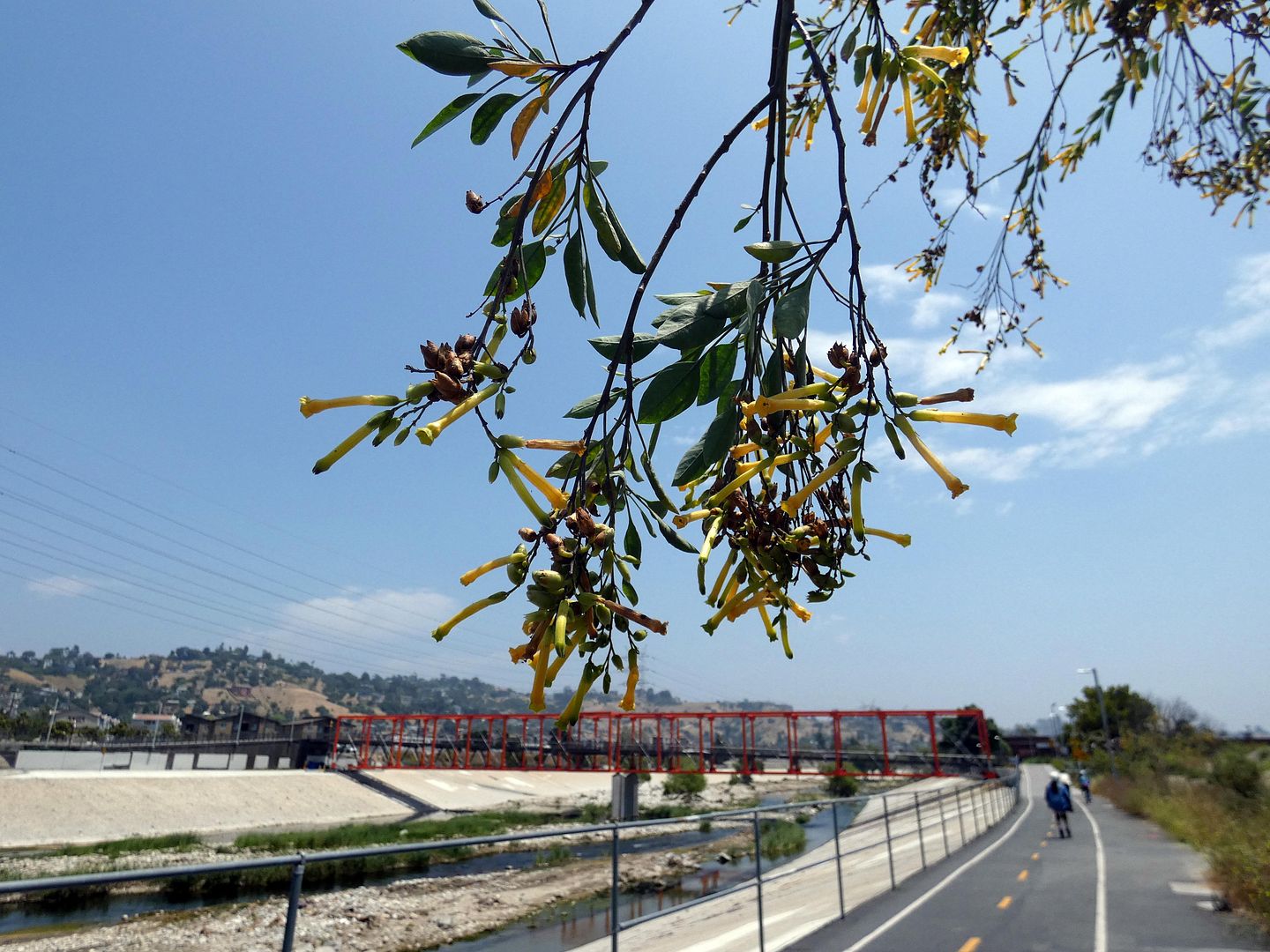
Photo Essay: Another LA River Bridge Tries to Unify Two Sides of the Same City

In early 2020, I was working on an article for KCET's SoCal Wanderer that brought me to Rio de Los Angeles State Park—one of three California state parks along the Los Angeles River, this one located in the Los Angeles neighborhood of Cypress Park. 

It’s a project first initiated nearly 30 years ago—and, having opened in 2007, it's now become part of the Los Angeles River Revitalization plan to restore 11 miles of the LA River between Griffith Park and Downtown Los Angeles.

But three years ago, there was no easy way to get from the park, formerly part of the Taylor Yard railyard, to the other side of the river (an area known as Elysian Valley/Frogtown).


That changed last year, when the Taylor Yard car-free bridge opened up in the Glendale Narrows section of the Los Angeles River.