Tonight everybody was screaming "I love you Alison!" People are obsessed with Alison Goldfrapp. I kind of am too.
I remember seeing her on late night TV years ago, singing her single "Utopia," hitting all these bizarrely high notes and thinking she must be lip-synching and then realizing that she wasn't.
I got free tickets to a Goldfrapp show at Irving Plaza around the release of their second album, and I remember not being able to take my eyes of Alison. She had all this sparkly stuff on her face and some crazy flapper outfit on, and given her band's change in musical direction from Portishead rip-off to electro dance, she did all these little moves around the stage. Entrancing.
It's been a few years since I've seen her live but I've been lucky enough to get some freebie promos of all the remixes and singles released since then, and I happily bought the excellent new album Seventh Tree after listening to the full album stream several times over on ArtistDirect.com.
Tonight's show at the Beacon was a little disappointing to me because Alison was recovering from a cold and we got to see her nasty side, stomping off the stage after some technical difficulties, cursing into the mic. But she also had a great little stomping march dance and more sparkly stuff on her face, and despite the cold was able to hit those piercingly high notes in "Utopia" once again. And I was really glad to see her live again, and to be able to share it with Edith.

Making up for lost time and missed opportunities, one adventure at a time.
Showing posts sorted by relevance for query utopia. Sort by date Show all posts
Showing posts sorted by relevance for query utopia. Sort by date Show all posts
April 29, 2008

May 07, 2014
EVENT: Murphy Ranch Hike with Obscura Society LA
I don't do many LA hikes more than once...

...but when I do...

...it's usually to Murphy Ranch.

After all, it took me at least three visits just to find all of the ruins I was looking for.
And now, since I know the creepy, abandoned area pretty well, I'm inviting people to come hike it with me for my next event as field agent for Atlas Obscura.
From the official event listing:

Related Posts:
Photo Essay: Murphy Ranch in Rustic Canyon
Photo Essay: Rustic Canyon's Twisted History
Photo Essay: The Lost Ruins of Rustic Canyon
Photo Essay: Solstice Canyon
...but when I do...
...it's usually to Murphy Ranch.
After all, it took me at least three visits just to find all of the ruins I was looking for.
And now, since I know the creepy, abandoned area pretty well, I'm inviting people to come hike it with me for my next event as field agent for Atlas Obscura.
From the official event listing:
Join Obscura Society LA as we step back in time to explore the ruins of an attempted Nazi utopia – right here in the Santa Monica Mountains
If Hitler had ever made his way stateside, he would have been welcomed by a group of his supporters living in deep seclusion in a compound mere miles from Brentwood.
Join Obscura Society field agent Sandi Hemmerlein (me!) as we explore Murphy Ranch – a famed, creepy hiking destination, with a sordid history of Nazi sympathizers and art colonists, hidden deep on the canyon floor of the Santa Monica Mountains.
Now entirely tagged with graffiti, the various structures of the compound (cisterns, water tanks, a burned-out machine shed, and the main power house) were all meant to sustain as a Nazi holdout for years in isolation.
We'll start our journey at the wrought iron gated entrance of this would-be "Hitler Bunker," designed by famous African-American architect Paul Revere Williams, and work our way through the 50 acre property, where a four-story mansion was also planned. On the day after the bombing of Pearl Harbor, the United States federal government raided the compound, shutting down their command center and the Nazi utopia that never was.
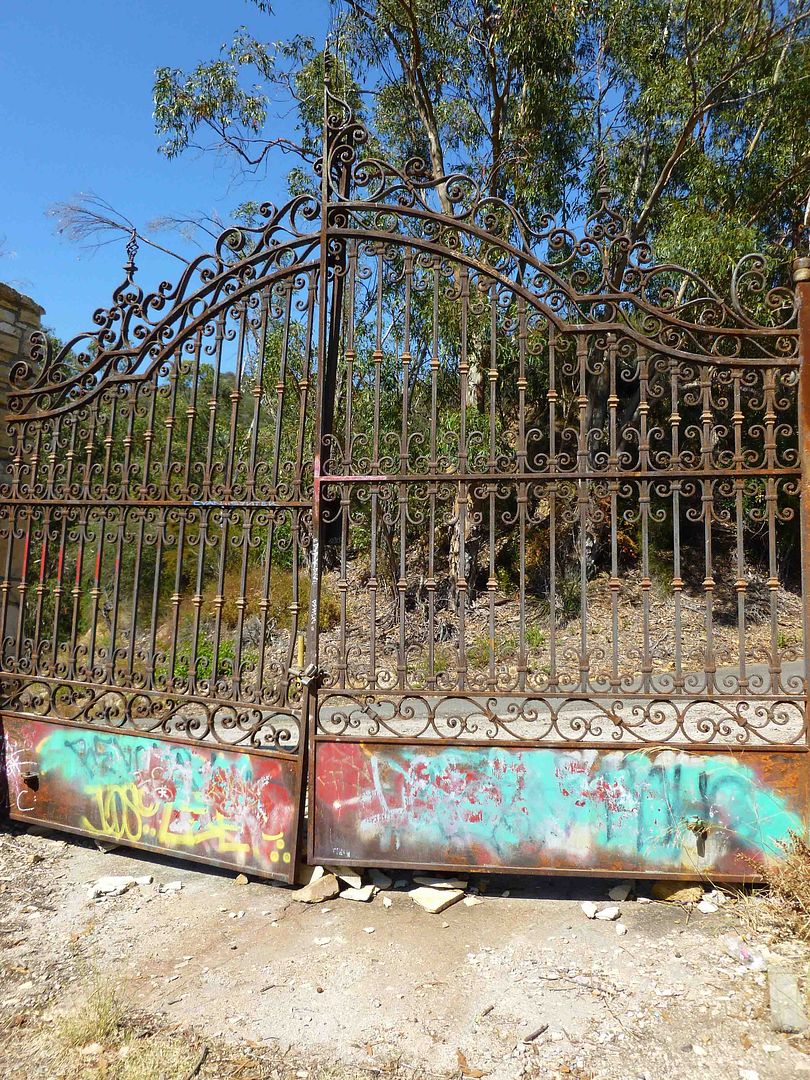
Now city-owned, this secluded parcel of land has been home to wealthy ranchers, immigrant bohemians, local artists, and even the famous novelist Henry Miller. Wildfires have ravaged the Rustic Canyon area on several occasions, but many of these ruins remain ripe for exploring.
Notes for this adventure:
- Murphy Ranch is located in a remote canyon in the Santa Monica Mountains with no services and no cell phone service.
- We will email out exact meeting location to all attendees closer to the event date.
- Street parking is available, but limited and in a residential area. Please be respectful of the neighbors, and carpool if possible.
- We will be hiking about 3.5 miles round trip at a moderate pace. Please plan accordingly with water, snacks, and proper shoes.
- This is a reverse hike, meaning we will descend into the canyon first and then climb out of it when we exit. Please reserve your energy for the uphill climb at the end!
- There are a couple of different route options, but this hike will require a significant amount of stair-climbing, as well as paved and dirt trails.
- Be prepared for heat! Please bring water and sun protection (sunscreen, hat, sunglasses, etc.).
- Dog-friendly! Just be sure your pup can climb up and down stairs, as well as bring proper clean-up equipment.
I don't usually post detailed directions to a lot of the places I explore, but I'm looking forward to helping a group of intrepid explorers find where the good stuff is at one of my favorite places in LA.
Photo Essay: Murphy Ranch in Rustic Canyon
Photo Essay: Rustic Canyon's Twisted History
Photo Essay: The Lost Ruins of Rustic Canyon
Photo Essay: Solstice Canyon
June 12, 2018
Photo Essay: How Bellfounding Helped Build an Unfinished Utopia

I knew about the bells, but only tangentially. I'd never encountered them in person, never heard their din or ding or clatter or cacophony.
I didn't know how musical they'd be.
I've kind of got a thing for bells—church bells and liberty bells and sleigh bells, not to mention bell towers, carillons, and chime towers.
So, while I was in Phoenix for a wedding, I wanted to see how Paolo Soleri's bells were made at his Cosanti studio in Paradise Valley.
Normally, you can take a tour and see a foundry demonstration, but as it was Memorial Day, the studio was open to visitors but had suspended any other programming.
So, I looked around, took some photos, and rang some bells.

Bell design and fabrication wasn't Soleri's first love...

...but his output became so popular that the endeavor funded his true passion, architecture.

Well, not exactly architecture in the traditional sense, but a kind of earth-conscious, experimental bent on building that he called "arcology."

And while the structures at Cosanti Originals give a glimpse into that ecologically utopian built environment that Soleri dreamed of, the only way to truly experience it is to visit his "city"-in-the-making, Arcosanti.

Never one to be satisfied with just a passing encounter, I booked a tour and a room to spend the night.

Located in the Sonoran Desert about an hour north of Phoenix, Arcosanti is a world away.

Born and accredited in Italy, Soleri apprenticed with Frank Lloyd Wright at Taliesen West in Scottsdale and Talisen in Wisconsin. But then, upon his return to Arizona, he took Wright's concept of organic architecture and, with it, made a sharp left turn.

And in 1970, he began his experiments in urban planning and living—with, in true FLW style, the help of a number of apprentices and interns who were there to learn from the master.

Originally intended to house 5000 people, it hasn't gotten anywhere close to that—and the extant structures are so old (some nearly 50 years) that most of the incoming funds have to be allocated to maintenance, upkeep, and repairs.

The buildings that have cropped up on the compound are weird and wondrous, to say the least.

It makes you wonder whether they're conversation-starters for the students who've been continuing Soleri's legacy since his passing in 2013—a way to break the ice and inspire them way beyond what they'd ever learn in architecture school.

The structures look somewhat Brutalist (or even Communist), but the philosophy behind them is far kindler and gentler.

It's about maximizing city living while minimizing the impact on the environment—not necessarily to escape urbanity, per se, but do embrace it without sucking the life out of the land it's built upon or its denizens.

The first structure to be built at Arcosanti was the South Vault, at the top of the hill...

...featuring precast panels made of silt and colored in the mixture rather than being painted later.

It's now the centerpiece of a prototype of how a dense population could live together in a smallish space, walking everywhere they need to go and abandoning their driving habits.

Sunlight abounds, especially with the quarter-sphere semi-domes built for ceramics and bronze-casting.

Natural methods are used to heat and cool the residences, including harnessing the greenhouse effect and taking advantage of the late-day breezes and microclimates that occur on the property.

As daylight waned after taking the last tour of the day, it was time to retire to "Camp"—a motel-style row of a dozen rooms with concrete floors and huge picture windows looking out at the mesa.

When you spend the night at Arcosanti, you can roam about the property as you please without a guide and observe how the light and shadows change the arches and crescents and circles and spheres. In the summer, it's quiet—it could accommodate as many as 500 people, but it doesn't.
Not yet, anyway.
But the people who do share the space are convivial, sharing cafeteria-style meals in the dining hall and leaving their doors and windows open for the breeze, the view, the socializing, and of course the windbells.
I hoped to encounter one of the critters the staff had warned me about, though I shut my door tightly when I went to bed, as instructed. I heard neither scratching nor roars, only the pitiful cry of a peacock, looking for a partner, long as the night wore on.
To me, this was the opposite of futurism—a way of stepping back in time when earthen materials (mud, adobe) were all you had to choose from, and you couldn't go very far for any other supplies.
Will we ever return to those days? Sometimes it seems like we've passed the point of no return.
And we seem to have given up on any inkling of utopia, too. It's just became... passé.
Maybe we've just gotten too used to being miserable, we've given up on ourselves and the planet, and we've got to just make peace with what we've got.
Related Posts:
Photo Essay: The Design of Living at A-Z West
Photo Essay: Under a Desert Dome
Photo Essay: Llano Del Rio Company Colony, Abandoned
October 03, 2017
Photo Essay: A Day In the Life Before Disaster Struck
When contemplating the Chernobyl disaster, I haven't been able to stop thinking about what it must've been like to live right there in the town of Pripyat, the Soviet vision of Utopia that was built as a company town for the nearby nuclear power plant.

It was an "Atom City." It was modern. It was the future.

But now that it's being consumed by over 30 years of overgrowth, it can be hard to envision what it was like back in 1986—when, though no atomic bomb was dropped, a "silent killer" hung heavy in the air and fell upon the belongings of all those who'd moved there (and some who'd been born there).

The pieces of the puzzle all come together based on the buildings that remain. And, as far as the casual eye can tell, all the buildings do remain, including the post office...

...and the high-rise apartment buildings, though most of their radioactive contents (furniture and personal effects) have been removed and buried elsewhere as hazardous waste.

Wood floorboards where families once walked to breakfast and to bed now sprout bright green moss.

And a red fox loiters around the outside of where Chernobyl workers and their families bought electronics for their new homes in their new, utopian city.

The field has lost its clearing for soccer balls to score, and the floodlight tower has got no power.

The Avanhard Stadium (Стадіон «Авангард») is monolith of wood rot—devoid of players from the Stroitel football club, a team comprised of local "builders."

In fact, aside from the occasional concrete that rises above, everything in Pripyat kind of looks like some kind of field or wooded area. You can barely recognize the divided boulevards that used to bring traffic in and out of town.

Ornamental gardens and fountains in town squares have been replaced by wild fungi and nightshades.

And while the water was only drained from the Azure swimming pool (Басейн Лазурний) in 1998...

...after a dozen years of liquidators charged with cleaning the Chernobyl mess swimming laps in its eight lanes...

...it's just as obscured and abandoned now as any of the other buildings that were vacated in 1986.

But the people of Pripyat did love their sport once.

Sports and sporting facilities and gymnasiums were so prized, in fact, that they were given their own space in Pripyat's own palace—that is, the Palace of Culture "Energetik" (Энергетик).

Among the "performing arts" variety of cultural institutions (which included a cinema, theatre, and concert hall)...

...there were also courts for shooting hoops...

...a gym, a boxing ring, a handball court, and even a firing range.

The grandeur was intended for both recreation and entertainment—but it was, at its core, a palace of the state.

There was no such thing as art for the sake of art to the Soviets. There was always meaning behind everything.

And the Soviet regime that designed the Palace of Culture made sure that its programming contained just the right balance of propaganda.

But as long as the people of Pripyat prospered, who would mind?

Perhaps at the Pripyat Cafe, at the marina along the Pripyat River, you could just have a meal without making a nationalistic statement.

But even so, the act of eating at "The Dish," as it was known, couldn't have been just a matter of nutritional intake.

Not with its colored-glass mural, "Radiance," to gaze upon.

It's one of the most beautiful and most horrific glimpses into the daily lives of the Pripyat townspeople...

...because its raw-edged, strip-cut construction is so delicate that it's pieces are disintegrating.

A few panels have fallen off the window and been cast aside, perhaps at one time propped up against the wall. But now, as the discarded pieces sinks into the floor, visitors traipse across the colored glass strips and shards—and the crunch is deafening.

It can be difficult to find "before" photos of Pripyat (for some of the cafe, click here)...

...but, in most cases, it's pretty easy to imagine, say, the water vending machine without the rust.

To really get a perspective of what Pripyat was like before the third trumpet of the apocalypse sounded, maybe you need to visit during the winter, after the trees have all lost their leaves.

Maybe you need to climb to the rooftops to get an aerial view. After all, you can see Reaktor 4 in its new safety containment structure from up there.

Or maybe there's no sense in preserving Pripyat—either in practice or in memory. Maybe it's okay to let the sun set upon this company town, to walk across the already-broken glass, and to tear down the railings as they rust.

But my inclination at a place like this is to preserve—not only what it used to be, but what it is right now.

Eventually, we will lose Pripyat—whether it's its black-and-white version or in full Kodak color.

The Hotel Polissya (Готе́ль Полісся) won't be habitable for thousands of years—and neither will any of the other buildings on Kurchatova Street, at the main square, or pretty much anywhere in Pripyat at all, for that matter.

Soon, nature will entirely obscure what became a command post for the Chernobyl cleanup effort (that is, once its guests were evacuated).

It's already started to happen.

The ecosystem has forged on—without us delicate humans to ravage its fruits and put them into supermarkets and restaurants.

And so, it's not far-fetched to think that what was once a palace will become merely a sacristy in a cathedral of trees—and, without its walls or windows, a portico that leads to a faded, forested folly in alternating shades of red, gray, and green.
For photos of everyday life in Pripyat before the Chernobyl disaster, click here (via Gizmodo).
Related Posts:
Crossing Over Into the Zone of Alienation
Photo Essay: The Abandoned Hospital Where Radiation Illness Fills The Air
Photo Essay: The Hallowed Halls of Pripyat's Primary School, Evacuated
Photo Essay: Amusement Park, Shuttered By Nuclear Fallout
Photo Essay: The Train Graveyard of The Exclusion Zone
Meet Simon, The Red Fox of the Radioactive Red Forest
It was an "Atom City." It was modern. It was the future.
But now that it's being consumed by over 30 years of overgrowth, it can be hard to envision what it was like back in 1986—when, though no atomic bomb was dropped, a "silent killer" hung heavy in the air and fell upon the belongings of all those who'd moved there (and some who'd been born there).
The pieces of the puzzle all come together based on the buildings that remain. And, as far as the casual eye can tell, all the buildings do remain, including the post office...
...and the high-rise apartment buildings, though most of their radioactive contents (furniture and personal effects) have been removed and buried elsewhere as hazardous waste.
Wood floorboards where families once walked to breakfast and to bed now sprout bright green moss.
And a red fox loiters around the outside of where Chernobyl workers and their families bought electronics for their new homes in their new, utopian city.
The field has lost its clearing for soccer balls to score, and the floodlight tower has got no power.
The Avanhard Stadium (Стадіон «Авангард») is monolith of wood rot—devoid of players from the Stroitel football club, a team comprised of local "builders."
In fact, aside from the occasional concrete that rises above, everything in Pripyat kind of looks like some kind of field or wooded area. You can barely recognize the divided boulevards that used to bring traffic in and out of town.
Ornamental gardens and fountains in town squares have been replaced by wild fungi and nightshades.
And while the water was only drained from the Azure swimming pool (Басейн Лазурний) in 1998...
...after a dozen years of liquidators charged with cleaning the Chernobyl mess swimming laps in its eight lanes...
...it's just as obscured and abandoned now as any of the other buildings that were vacated in 1986.
But the people of Pripyat did love their sport once.
Sports and sporting facilities and gymnasiums were so prized, in fact, that they were given their own space in Pripyat's own palace—that is, the Palace of Culture "Energetik" (Энергетик).
Among the "performing arts" variety of cultural institutions (which included a cinema, theatre, and concert hall)...
...there were also courts for shooting hoops...
...a gym, a boxing ring, a handball court, and even a firing range.
The grandeur was intended for both recreation and entertainment—but it was, at its core, a palace of the state.
There was no such thing as art for the sake of art to the Soviets. There was always meaning behind everything.
And the Soviet regime that designed the Palace of Culture made sure that its programming contained just the right balance of propaganda.
But as long as the people of Pripyat prospered, who would mind?
Perhaps at the Pripyat Cafe, at the marina along the Pripyat River, you could just have a meal without making a nationalistic statement.
But even so, the act of eating at "The Dish," as it was known, couldn't have been just a matter of nutritional intake.
Not with its colored-glass mural, "Radiance," to gaze upon.
It's one of the most beautiful and most horrific glimpses into the daily lives of the Pripyat townspeople...
...because its raw-edged, strip-cut construction is so delicate that it's pieces are disintegrating.
A few panels have fallen off the window and been cast aside, perhaps at one time propped up against the wall. But now, as the discarded pieces sinks into the floor, visitors traipse across the colored glass strips and shards—and the crunch is deafening.
It can be difficult to find "before" photos of Pripyat (for some of the cafe, click here)...
...but, in most cases, it's pretty easy to imagine, say, the water vending machine without the rust.
To really get a perspective of what Pripyat was like before the third trumpet of the apocalypse sounded, maybe you need to visit during the winter, after the trees have all lost their leaves.
Maybe you need to climb to the rooftops to get an aerial view. After all, you can see Reaktor 4 in its new safety containment structure from up there.
Or maybe there's no sense in preserving Pripyat—either in practice or in memory. Maybe it's okay to let the sun set upon this company town, to walk across the already-broken glass, and to tear down the railings as they rust.
But my inclination at a place like this is to preserve—not only what it used to be, but what it is right now.
Eventually, we will lose Pripyat—whether it's its black-and-white version or in full Kodak color.
The Hotel Polissya (Готе́ль Полісся) won't be habitable for thousands of years—and neither will any of the other buildings on Kurchatova Street, at the main square, or pretty much anywhere in Pripyat at all, for that matter.
Soon, nature will entirely obscure what became a command post for the Chernobyl cleanup effort (that is, once its guests were evacuated).
It's already started to happen.
The ecosystem has forged on—without us delicate humans to ravage its fruits and put them into supermarkets and restaurants.
And so, it's not far-fetched to think that what was once a palace will become merely a sacristy in a cathedral of trees—and, without its walls or windows, a portico that leads to a faded, forested folly in alternating shades of red, gray, and green.
For photos of everyday life in Pripyat before the Chernobyl disaster, click here (via Gizmodo).
Crossing Over Into the Zone of Alienation
Photo Essay: The Abandoned Hospital Where Radiation Illness Fills The Air
Photo Essay: The Hallowed Halls of Pripyat's Primary School, Evacuated
Photo Essay: Amusement Park, Shuttered By Nuclear Fallout
Photo Essay: The Train Graveyard of The Exclusion Zone
Meet Simon, The Red Fox of the Radioactive Red Forest
Subscribe to:
Posts (Atom)