Search

Showing posts with label Writing. Show all posts

September 28, 2026

Hitting the Road to Resort-O-Rama

Around this time in 2023, I caught wind of a brand-new conference event in Northern California, called Resort-O-Rama. 

It was from the organizers of Tiki Oasis—a huge and long-running tiki festival that takes place every year in San Diego, and that I'd been too intimidated to ever attend (maybe because I wouldn't be "tiki" enough!).

But Resort-O-Rama somehow seemed more approachable to me—maybe because it was new, or maybe because it was more generally centered on Mid-Century aesthetics, which I'd earned my place among as a documentarian of many Mid-Century buildings and as a regular attendee of Modernism Week in Palm Springs. 

But three years ago, I was working harder than I'd worked in over 10 years, with no paid time off—and making less money than I'd made in almost 20 years. I had neither the time nor the money to get myself up to Northern California for a long weekend. 

Fast-forward to 2026, and I hear that Resort-O-Rama is happening again. I'm working a little less hard—still with no PTO—and making a little more money. But, I thought, there's still no way I can get myself there on my own. At least, not just for fun. 

Besides, I've still been working on The Los Angeles Breakfast Club history book—and, although a year later than we initially expected, we're in the final stretch. 
  Courtesy Resort-O-Rama

June 05, 2025

I Could Write a Book

[Last updated 8/29/25 10:38 AM PT to update the book cover and revise the book team.]

I've been a professional writer since I was a senior in high school (and broke a national news story). But since then, I've aways written short pieces—newspaper and magazine articles, essays, blog posts, poems, short stories, and the like. 

I always knew I wanted to publish a book sometime in my future, but I wasn't sure if I could actually write something that... long. And besides, I haven't been able to figure out what the story would be—and where the story would end. 

But then in 2022, I answered a call for help put out by The Los Angeles Breakfast Club: It wanted to publish a history book for its 2025 centennial, and it was looking for writers to pitch in. 

The club was lucky enough to have a few published authors among its ranks—including me, but also those who'd actually written books before. But in the end, those writers had other things going on in their lives and careers. And I was the last man standing, as it were.

It was really the perfect scenario for me: I would be brought on to make the words, but I would be part of a team that would also include Club Historian Rachel Skytt, who would handle most of the heavy lifting when it came to research and crafting the overall narrative of the book. 

With someone else to outline the book and each of its individual sections, I didn't have to worry so much about structure—something I'm not really trained on doing when it comes to long-form writing—and could just focus on wordsmithing. 

The only original research I'd really have to do—besides some fact-checking and contextualizing based on what was going on in the world and in Los Angeles in the early- to mid-20th century—would be to interview current members who'd been around long enough to remember the club when it was hanging on by a thin strand of bacon fat.

January 01, 2024

Year In Review: 2023 Updates to Past Posts

At the end of each year now, it's no longer only about reflecting on the new experiences I've had over the last 12 months—but also recognizing how the world around me has changed.

And I can't help but document it.

That brings me back to some places—either physically or just mentally and emotionally—that I thought I'd be "done" with after one visit. 

Unfortunately, the scales were tipped way too far in one direction last year. We lost many more people and things than we were able to save.

And, in some cases, it didn't have to be that way. 

But life is loss—constant loss, in fact. And the sooner we come to terms with that, the sooner we can get to appreciating what we've got now. 

One of my most devastating experiences is whenever I find myself saying, "I never got to go."

But as time passes, the sentiment changes. Now, increasingly, it's the heartbreaking statement, "I never got to go back."

Here are some of the updates I made to past blog posts in 2023, reflecting changes that happened in that year or developments that had happened previously but I only got to documenting that year.

December 31, 2023

In Case You Missed It: 2023 Edition

Happy New Year! (Almost.)
 

This year, a lot of my creative efforts shifted towards producing videos for KCET's "SoCal Wanderer" show instead of writing articles for the SoCal Wanderer blog, which meant I was doing a lot of retreading of old ground instead of exploring new places. 

December 27, 2022

How I Wandered SoCal for KCET in 2022

I haven't often reposted the articles I've written for KCET here—often because much of the content that has gotten published here first has eventually made its way into my KCET guides.

But as time has gone on, I've created more and more original content for my SoCal Wanderer column on KCET.org. In fact, probably more in the year 2022 than in any other years prior.

SoCal Wanderer articles are on a little bit of a hiatus—at least, compared to what they've been—since I was hired to work in-house at KCET in actually a different capacity. They may not resume anytime soon. 

So in the meantime, here's a recap of the articles I did contribute over the past year, in case you missed any of them. Click on the titles to open the articles in a new tab/window.


January 11, 2022

I Had So Much Potential

Sometimes I wonder how far I could've gone, had my parents just supported me a bit more.
   

December 23, 2021

Another Year Of Wandering SoCal for KCET (2021 Edition)

In addition to my work here at Avoiding Regret, I've also been contributing to KCET's website for almost seven years—primarily as the columnist behind its "SoCal Wanderer" blog, but also sometimes writing stories for other sections (like "Lost LA"), too.

This became enormously challenging during pandemic lockdowns. How do you write about travel when you're not allowed to—or are too scared to—go anywhere?

I've had to get really creative since March 2020. 

But I haven't been keeping myself "locked up" too much and have still managed to stay safe. So, I've been passionate about sharing what I've learned with my readers. 

I don't often repost my KCET articles here, often because much of the content that gets published here first eventually makes its way into my KCET guides.

But with the year ending, I thought it worthwhile to round up all my 2021 articles in case you'd like to check them out. 

Here they are in chronological order, starting with February. (The COVID-19 surge was just too bad in January, so we took the month off.)

Enjoy!

December 26, 2020

Photo Essay: Top Posts of 2020

What a weird year it's been. 

But despite the pandemic's closures and lockdowns, I still managed to get out and about—safely, often from the safety of my car. 

I just had to shift my focus away from scheduled group events and travel outside of Southern California and back to exploring my own backyard. 

And there's still a lot to explore.

This year, I've been grateful for California "car culture" more than ever—and have tried to make the most of it. 

I've spent a lot more time alone this year than I have since 2012 or 2013, but I'm more comfortable with my own company than I've ever been. 

And I'm glad some of those solo adventures were interesting enough for people to click and read.

So here's my annual list of "Top Posts" from the year, each of which was published sometime between New Year's Day and Christmas Day 2020. 

Click on the title or on the image to give the full post a gander.

1. Photo Essay: Pasadena's Vacant Hospital of St. Luke, Patron Saint of Physicians, Doctors, and Butchers


Thanks as always for reading! I've got plenty of past adventures already "banked" and ready to be shared in 2021. 

And although I've slowed down a bit (and am following the local government orders as closely as I can), I'm nowhere near stopping. 

Related Posts: 

December 23, 2019

Top Posts of 2019

If you're new to my site this year, welcome and thank you for taking the time to discover something new through my travels and adventures.

If you're a returning visitor, thanks as always for your loyalty and attention. I read all comments on this blog and on social, as well as all emails that come in (though I may not reply right away).

This site has always been a passion project for me. I have a few Google Ads enabled and just installed a digital "tip jar" to help fund the research that goes into these posts—but my blog was never meant to become a business on its own.

I am, however, grateful that it's become a powerful online portfolio of my work, which has led to a longstanding gig as "SoCal Wanderer" for KCET in addition to occasional contributions to the public media company's "Lost LA" and "Artbound" columns.

Some challenges this year—at least, on the technical side—included the permanent shutdown of Google+ in April (which really negatively impacted my traffic from both social and organic search) and the Photobucket power outage at the end of December that rendered nearly all of my images temporarily broken.

Regardless, I think 2019 was a good year for both writing and photography, so I'm proud to share the Top 10 posts of the year (for now, without photos):

  1. The Worst of the Superbloom, At Walker CanyonMy heart sank. "People are the worst," I thought, as I climbed higher and away from the crowds.
  2. The Tam O'Shanter: The Storybook Inn That Fed Walt Disney (And His Imagination)Disney animators used to eat there so often, they nicknamed it "the studio commissary."
  3. Photo Essay: Inside the Fence at Surfridge Ghost Town, LAX AdjacentIt's nice to see something good come out of something bad for once.
  4. Photo Essay: The Forgotten Highway Between LA and BakersfieldIt's actually not that easy to follow the entirety of the Old Ridge Route because, like Route 66, its alignment did change—and portions of it were even buried with the construction of the California Aqueduct.
  5. Lost Spirits: The Disneyland of Distilleries (After the Fire)Some things are never really lost, if you can clone them later on.
  6. Photo Essay: The Warehouse Restaurant, A Marina Eatery for 50 Years and CountingOnce a celebrity hangout, The Warehouse appears to be in the capable hands of its current owners, who bought the business in 1996.
  7. Banned from Boeing? Post-Woolsey Fire Edition (Updated)Boeing couldn't possibly be blacklisting me because they didn't want journalists showing up, could they?
  8. Photo Essay: The Town That Built The Hoover DamIf you were going to build something big—really big—in the middle of nowhere, you couldn't expect your workforce to commute.
  9. Reenacting Western Migration, On the Brutal Stagecoach Route Between LA and San DiegoBy all reports, the journey was, quite simply, treacherous—replete with annoyances, discomfort, and plenty of hardship. 
  10. Photo Essay: Riding the Tijuana-Tecate Tourist Train, Upon the 100th Anniversary of "The Impossible Railroad"
    The Tren TurĂ­stico is for tourists like me—and it no longer freely crosses back and forth across the U.S.-Mexico border.

I used to set a goal for myself of writing a new post every other day—or, on average, 15 a month, or about 180 a year.

I achieved that goal every year from 2011-15, and came up just a little bit short in 2009-10 and 2016-18.

This year, I had to revise my goal to 2 or 3 posts per week, or somewhere around 100-150 posts for the year. I'm going to come somewhere within that range, though it still feels like I'm falling way short.

If you're hungry for more content than that, I've got a lot of past posts that I continue to update as needed. You can start with my Top Posts of All Time and then move on to the prior years' Top Posts, below.

Related Posts:

Photo Essay: Top Posts of 2018
Photo Essay: Top Posts of 2017
Photo Essay: Top Posts of 2016
Photo Essay: Top Posts of 2015
Photo Essay: Top Posts of 2014
Photo Essay: Top Posts of 2013
Photo Essay: Top Posts of 2012

September 08, 2019

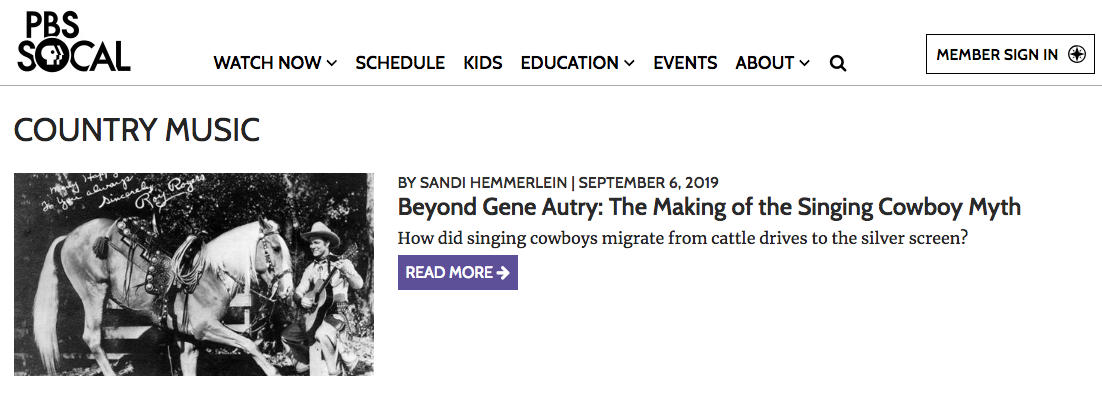
From Cattle Drives to the Silver Screen: The Mythology of The Singing Cowboy (via PBS SoCal)


Excerpted from my article for PBS SoCal, 


For lots of people, the nickname “The Singing Cowboy” conjures memories of and nostalgia for Gene Autry.

But while Autry left an indelible mark on SoCal with his film career (and patronage of L.A.’s Autry Museum of the American West), this second-generation Texan wasn’t the only celluloid cowboy of song.

Nor was he the first....

....And Hollywood screenwriters and composers didn’t invent the singing cowboy archetype out of nowhere, either.

Unknown to many, real-life cowboys on cattle drives from Texas into western states actually sang from the 1870s to the 1890s.

Not only that — but they had to sing.

According to pioneering musicologist and folklorist John A. Lomax, if a cowboy couldn’t sing back then, he wouldn’t get hired in the first place. Those who led the drives wanted melodies that would be ideal to ride by (and would lull the cattle to sleep at night)....

....These cowboys rode along the Utah, Navajo and Santa Fe Trails of the Great Western Cattle Trail “with a song on their lips,” and they gave voice to “the freedom and the wildness of the plains.”

To read the rest of the article, visit the PBS SoCal website here. 

April 23, 2019

Paying My Own Way


Photo: Fort MacArthur Battery Osgood-Farley, circa 2018

I don't actually consider myself so much a reporter or journalist—mostly because I rarely take assignments.

Most of the places I visit don't know ahead of time that I'll be writing about them. Sometimes I don't even know if any given place will make it to my blog.

It depends on whether I have something to say about it after I go.

I'm primarily a writer. So although many of my posts are photo essays, having pretty photos isn't enough to warrant an entire post. I've got to feel inspired.

And that means I rarely have to worry about fulfilling any promises or meeting any expectations.

I just go do what I want to do—and if it's thought-provoking or fits into the overall narrative of Avoiding Regret, I write about it.

Most often, I don't get comped. I buy my tickets like anybody else. I'm not special.

I like the anonymity of it. It feels like the only way to accurately portray an experience with integrity.

If you're a food critic like Jonathan Gold was, you don't tell the restaurant when you're coming. You hope they don't know what you look like. You try to eat the exact same meal that all the other patrons eat.

Sure, I end up spending a lot of my own money on trips and museum admissions and bus tours and house tours and train rides and such—ones that maybe I could get gratis. Instead, if I'm lucky, I can deduct a fraction of them on my taxes. And if I'm really lucky, I can write about them later and make a little freelance money off the article.

But I always do first and write later.

Sometimes I think I'll probably write about a place—and then I make a visit or take a tour and come up empty. That's why I haven't written about the Biltmore Hotel in Downtown LA. Or the Adventurers' Club of Los Angeles. Pasadena's Bungalow Heaven. Farm Sanctuary. Malibu Temple. The Robinson Helicopters factory. The Tuna Club on Catalina Island.

All these places I've been. All these photos I've filed away. But the words haven't come.

At least, not yet.

Sometimes they do later—and then I'm playing catch-up.

Sometimes it happens when a place is about to close or be demolished. Sometimes it's when somebody dies.

I can't predict it. I just obey the inspiration.

When I must write is when I write.

At least that way, I can keep it on my terms.

Related Post:
To What Do I Owe?

July 11, 2018

Miracle on Wilshire Boulevard: From Growing Beans to Counting Beans (from PBSSoCal)

I was honored when PBS SoCal asked me to opine on what makes Wilshire Boulevard—one of its "10 Streets That Changed America"—so remarkable.

I was torn between the Art Deco theatres (including the Hollywood temple that's essentially a theatre) and the Art Deco department stores, but ultimately, I chose the latter.

And that's how I learned that the first dedicated left-turn lane in the U.S. was created on Wilshire to make it easier for motorists to pull off the road and spend some money.

To find out more of what makes Wilshire Boulevard "miraculous," read the blog post here or click the screenshot below.


Highlights include:


Bullocks Wilshire (now Southwestern Law School)


The May Company (soon to be the Academy Museum)


Desmond's


Seibu/Orbach's Department Store (now the Petersen Automotive Museum)

Related Posts:
A Different Story to Tell
How to Rose Parade—Featured on Frommers.com
Unearthing Green Burial from Its Obscurity

May 08, 2018

Dispatches from the Illicit Underground, Hot Off the Presses

A few months ago, I was asked to tell a story about Downtown LA's underground activity—both literally and figuratively, particularly during the Prohibition period.


Screenshot from District 8 Media

That story has just been published in the "DTLA Noir" chapter of DTLA Book 2018. To read it yourself, click the big image above or here.

The hardcover book will be distributed to a number of hotel rooms (like at the Freehand and the Los Angeles Athletic Club) and sold at brick and mortar retailers (like the Autry Museum, The Broad, and OUE Skyspace).

Or you can order a physical copy on Amazon.com—and not just for my story, but for the very good company I'm keeping with my fellow Angeleno writers Kim Cooper, Hadley Meares, and James Bartlett.

Related Post:
Underground Secrets and Australia's 9News

January 29, 2018

How to Rose Parade—Featured on Frommers.com

Presenting my first (and first of many, I hope) slideshow for Frommer's (featuring some additional photos not published on my own blog):


I've been preparing for this moment since at least 2014.

Does this mean I'm a "real" travel writer now?

Related Posts:
A Different Story to Tell
Underground Secrets and Australia's 9News
Unearthing Green Burial from Its Obscurity

December 28, 2017

Photo Essay: Top Posts of 2017

Well, here we are in the final days of 2017—time to reflect back on the year that was.

I crossed a couple items off of my bucket list, fell in love with some new places I'd discovered (but, thankfully, no people), and fell into a hole in the floor.

I rode some trains, and I paid my respects to some dead planes.

I have my own favorite moments of the year, but as is my annual tradition, here follows what brought the most eyeballs to this site. (They're not necessarily the ones that people liked the most; they're just the ones that the most people looked at.)

It pleases me to no end that one of the most-read posts of mine was a personal story—a bit of a memoir that went back almost 20 years and came full circle this year.

After all, not all regrets have something to do with a particular place, and avoiding regret isn't always about crossing something off a list.


Sentimental Lady


Photo Essay: On the Sleeper Car to San Diego


Photo Essay: Making Magic Monsters That Move at a Robot Factory


Down the Rabbit Hole


The End of the Line at the Subway Terminal Building, Underground


Photo Essay: Birding Anza-Borrego During the Superbloom


Photo Essay: A Different Type of Church


Photo Essay: The Last of Pantages' Vaudeville Palaces


Photo Essay: The Boneyard at the Former Cal-Aero Flying Academy


Photo Essay: Where Airplanes Go To Rest

Related Posts:
Photo Essay: Top Posts of 2016
Photo Essay: Top Posts of 2015
Photo Essay: Top Posts of 2014
Photo Essay: Top Posts of 2013
Photo Essay: Top Posts of 2012

September 25, 2017

Standing With Those Who Choose To Not Stand

[Last updated 11/25/22 4:24 PM PT with added newspaper clipping]


Well, it's happened: I've lived long enough to see history repeat itself.

And while I don't normally pay much attention to the happenings on the sidelines of most professional sports games and teams, the recent #TakeaKnee controversy has an awfully familiar ring to it.

Back in the winter of 1993, a few months before I was to graduate from Henninger High School in Syracuse, New York, I found myself standing in the hallway of a TV studio located just off of New York City's Times Square. A producer was rounding up a busload of us kids, who'd braved the interstate snow to appear on national television.

"All those who are for the Pledge of Allegiance, stand over here, and all those who are against the Pledge of Allegiance stand over here," she said, splitting us into two opposing factions across the hall from one another.

I stood my ground. "Well, it's not a matter of for or against," I complained, as my classmates shuffled into their respective queues.

"Just pick one," another crew member wearing a headset barked, and so I got in the "against" line.

I, of course, had been dutifully reciting the pledge for as long as I could remember. I hadn't formulated any opinions against it because I was just robotically following the lead of the voice that had been coming across the school loudspeaker for years on end.

Until, one day, it didn't. And I noticed.

And that's how Henninger High School ended up getting its own episode of the popular 1990s daytime talk show The Montel Williams Show—and how I ended up not only on air, but on stage.

During the class year of 1992-3, I'd taken up the baton of "teen reporter" for the local Syracuse city newspaper, The Herald-Jounal, after my older sister had vacated the position upon graduating a year ahead of me. Most of the articles were pretty mundane—covering some football win or school play or awards ceremony—but I decided to investigate why the loudspeaker had gone silent in the morning.

And I cracked open quite a case—enough to elevate my story from the high school column all the way up to the news desk, enough for the news editor to call the school office and pull me out of class to do some additional reporting, and enough for the article to land on the front page of the Sunday paper, .

The headline read:

PLEDGE OF ALLEGIANCE SUSPENDED AT HENNINGER HIGH 
BECAUSE OF ETHNIC SLURS 

And that juicy bit of news was enough to catapult the story into the national spotlight via the Associated Press.

Papers all over the country read about what had been happening in our small city classrooms. According to our Principal Peter Kavanagh, the article said, "It became very, very divisive between kids who stand for the pledge and those who don't... The African-American kids perceive it as a philosophical issue."


The Ithaca Journal, Ithaca, NY (1/18/93) Clipped from Newspapers.com

And there it was, in black and white.

That is, the white kids in school were largely, the ones who did stand to recite the Pledge, as well as those who called out the less privileged students who didn't for literally getting a "free lunch" while at school.

Teachers had begun to complain to the administration about the tensions they were witnessing, which were getting pretty heated—and, not knowing what else to do, our principal tried to defuse the racial debate by removing the catalyst altogether.

To some, I was a hero for writing that article. To others, I was a troublemaker and a traitor. Life was already pretty hard for me both in school and at home—and, that January, it got even harder.

And that's when the calls from talk shows began to pour in. Phil Donahue, Sally Jessy Raphael, Montel Williams... they were all clamoring to put us on their respective shows.

Of course, I threw my journalistic integrity out the window and dove head-first into the political debate, arguing about the meaning of free speech and reminding those who were in an uproar that saying the Pledge of Allegiance may be a privilege, but it's not a requirement or an obligation.

Both the Supreme Court and the New York State education law of the time agreed on that—and they still do.

And while the First Amendment covers the right to speak freely—including to voice criticism of the government—it also covers the right to not speak, whether it's in protest or just because you don't feel like it. (And, thanks to the Fifth Amendment, you don't even have to incriminate yourself.)

Like the kneeling of professional athletes during the National Anthem, the big issue with the Pledge of the Allegiance wasn't so much the utterance of those particular words in that particular order, but the sitting as opposed to standing.

"Probably 70 percent of the kids just stand and talk to their neighbor when it's said in school," the article quoted Andrew Messer, commander of the neighborhood's American Legion Post, as saying at the time. "It's the same thing you see when they play the National Anthem at any ballpark. It's unfortunate, but that's how people think these days."

Well, 1993 turns out to be a lot like 2017.

Backstage at the TV studio, I caught an early glimpse at what was to become the "shock" programming of talk shows with controversial subjects and attention-grabbing guests—something we'd started to see with The Morton Downey, Jr. Show in the late '80s and The Maury Povich Show in the early '90s, but that wouldn't come to full fruition until The Jerry Springer Show would have a few more years under its belt.

In the battle of "for" versus "against" the Pledge of Allegiance on The Montel Williams Show [Ed 6/18/20—on an episode they titled "The Pledge of Allegiance Is Not For Me," S3 E25, which aired 2/4/93] the producers had split the guests on the stage into two sections—one that was starkly white, and one that was deceptively black.

In truth, no one in the audience on the "for" side was black. But there were non-minority students on the "against" side—they just hadn't been put on the stage.

And one of them was me.

When our class president at the time had been placed on the stage and looked around her—clearly picking up on the narrative that was about to emerge, based on color palette alone—she pointed to me in the audience section and declared that I needed to get up on the stage.

And, from that point forth, I was no longer objective.

Up there, cameras rolling, I pleaded with my fellow classmates in the audience and across the other side of the stage—as well as with the viewers at home—to understand that this was not the way to instill a sense of patriotism in today's youth. And, considering how much the rest of us always mumbled our way through the Pledge, just saying it every day did not make us patriots.

In fact, I said, I didn't even know anything about the history of the Pledge of Allegiance or its intended meaning until I read a sidebar that ran alongside the article I wrote for the city paper. (According to that, the word "God" wasn't added until 1953, and students used to give a military salute to the flag, rather than putting their right hands over their hearts.)

For me, I love singing "The Star-Spangled Banner." I just love the song—as a piece of music. It's not like any of us born in the 1970s or later know a thing about "the rocket's red glare" or "the bombs bursting in air." We're lucky to have been spared those things.

But if someone wants to respectfully and quietly kneel down during the performance of our national anthem to make a statement, that seems quintessentially American to me.

Let's exercise our right to protest! And let's make it count—let's make our actions shine a light on the injustices and the discriminations of our country.

Don't stand up, take your hat off, and then drunkenly blather on about this or that while spilling beer on the row in front of you.

But if you do, that's your right, too.

In both cases, not everybody has to like it. We can disagree with each other's choices. We can even engage in spirited debate to try to understand the other side and make them understand our side.

And then move on. Because whether you stand, sit, or kneel doesn't really matter. What is absolutely essential is what you do when the music stops playing.

Related Posts:
A Missed Calling
Singing for My Survival

January 13, 2017

Photo Essay: Night of the Living Neon

There's always this struggle between art and commerce—a conflict nearly as old as Man versus Man and Man versus Nature.

If you love to create, you have to find a way to support yourself either by selling those creations or doing something else for money.

I love to write, but I can't live off poetry and photo essays. So, I've rented my writing skills out to proofread books that other people have written about estate planning, dentistry, fatherhood, religions, and so on.  I've edited tomes on diabetes and arthritis. I've written press releases about music I don't listen to.

I prefer taking money to do work-for-hire writing (or fixing someone else's writing) over forsaking my preferred art form and doing something else that sucks my soul.

If you're lucky, you get hired to do things your way, in your style, so that you can be proud of the end result—even if it's not exactly your thing.


Fortunately for neon artist Lisa Schulte, there's still a commercial demand for neon signs—even if it has waned since its heyday.


There are still Hollywood productions that need them...


...and pop stars who want to be photographed in front of them.


It's not that the neon signs aren't art...


...or that they don't have artistic value...


...because they most certainly do.


But when you're an artist, sometimes "selling" becomes synonymous with "selling out."


Schulte actually got into glass-blowing and -bending as not so much of a neon aficionado, but merely as a light junkie.


So, she taught herself neon, but also backlit plastic and incandescent bulb signs—all of which tend to fall under the same category of signage and commercial archaeology.


For over 35 years, Schulte has amassed a gigantic collection of her work...


...which can be seen in the 15,000-foot showroom of her company, Nights of Neon.


Pretty much everything there is for rent or for sale...


...although the collection feels pretty perfect, just the way it is—which is why it's not surprising that the company rents out the space, too.


Not everything at Nights of Neon is for show—because there are several works-in-progress...


...in various stages of completion.


Pretty much everything in the custom fabrication process is in-house, including the sketches...


...the glass tubes in various colors (that range from "Bromo Blue" to gold, green, red, pink, and white)...


......the noble gasses...


...and the electronics (and electricity).


But Schulte has got something else at Nights of Neon, too: her own art studio, for her own art.


It was only in 2010 that she started focusing more on exhibiting in galleries and museums rather than in movies and music videos...


...and what she's created so far is an interesting mix of what you'd expect with the commercial stuff (like words and letters, which have been jumbled up in her "Broken Promises" piece)...


...and what's a surprising representation of Art versus Nature.


Schulte salvages fronds from a queen palm tree, as well as other pieces of sturdy wood, and painstakingly wraps them in glowing glass tubing—without strangling them too tightly or burning them.


Schulte has earned the nickname "Neon Queen," but that's something of a misnomer.


After all, most queens don't actually do very much.


Obviously, she's also an entrepreneur, managing to stay in business since the 1980s. But she's also a collaborator, creating works with street artists (and building her "Warrior Army").

But none of that really detracts from the work that she and her team does at Nights of Neon—because when you see it, it's really spectacular.

It's not a shrine to a dead art form—or a "boneyard" of cast-offs—because pieces are constantly moving in and out. Some new ones get added, while others are sold off.

It's a living thing.

Related Posts:
Photo Essay: Behold, the Museum of Neon Art
Photo Essay: Hats Off to the Museum of Neon Art
Photo Essay: The Treasures of an LA Tourist Trap, Universal Studios