Search

Showing posts with label Money. Show all posts

August 07, 2024

Photo Essay: The Center of Enterprise in San Bernardino's Once Thriving Downtown

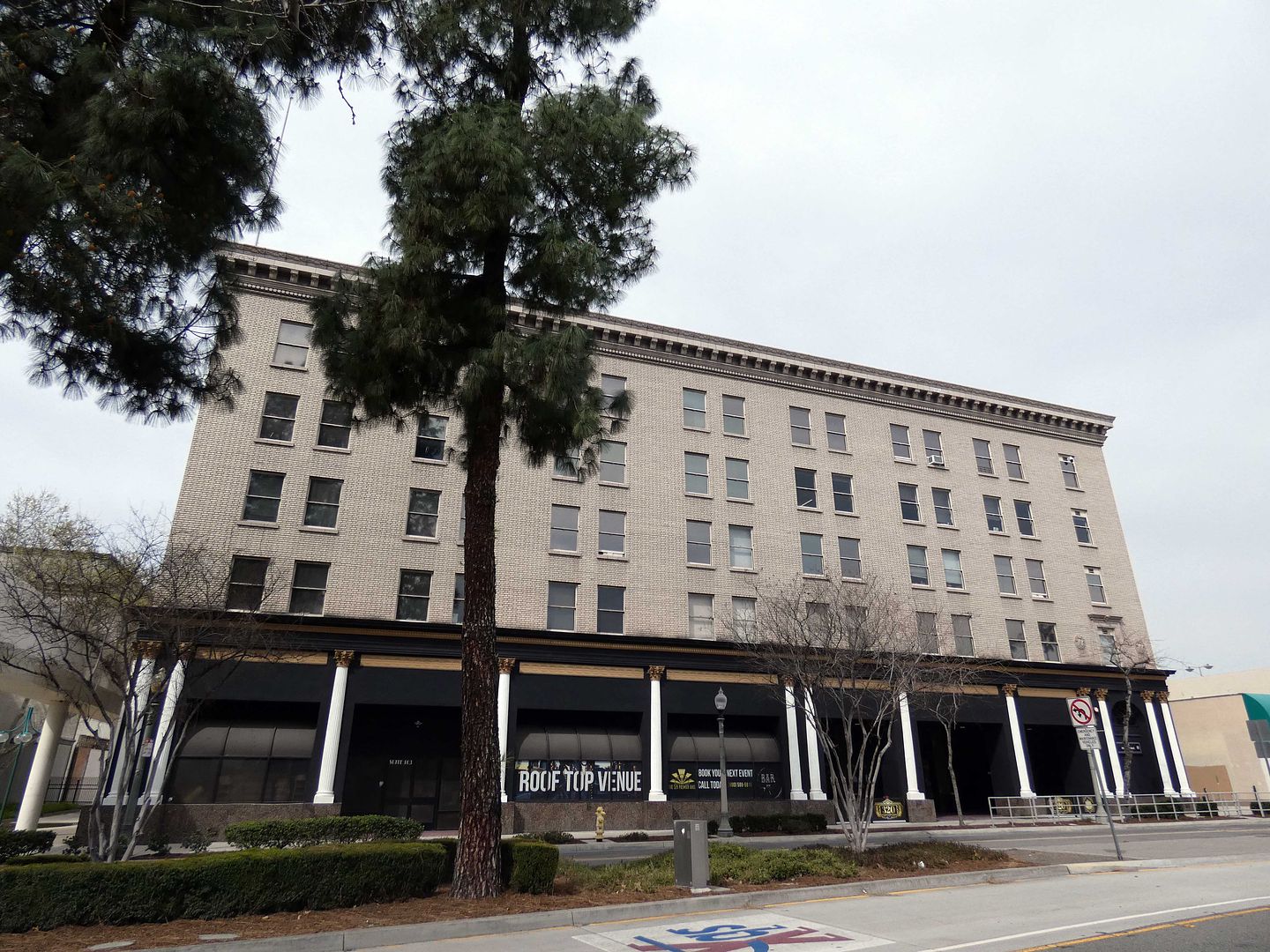
When I visited the (now-demolished) Carousel Mall in San Bernardino, I was intrigued by the two historic buildings that it butted up against—and I hoped one day I'd get inside to see what they were all about. 

That hope came true in March 2024 with one of them—the former Andreson Building, recently rebranded as The Enterprise Building. 


February 26, 2023

Photo Essay: A Driving Discovery of Modernism in Downtown Palm Springs' Commercial District

This is the first year that I won't be at Modernism Week in Palm Springs since I first went in 2017. I even went in 2021 in the middle of the COVID-19 pandemic.

But I had a friend visiting the low desert the week before Modernism Week this year—and since I couldn't afford two trips in February, I chose my friend.  


But fortunately he was very interested in the Midcentury Modern architecture of Palm Springs—so we enthusiastically signed up for a self-guided driving tour offered by Modern Tours Palm Springs, which allowed us to explore various Palm Springs neighborhoods at our own pace.

June 21, 2022

Photo Essay: A Peek Into the Millard Sheets-Designed Bank That's Becoming Chabad of Beverly Hills

A couple of weeks ago, I joined Hollywood Heritage on a bus tour of some of the Millard Sheets-designed bank buildings in the Los Angeles area. 

I'd already been inside several of them (including the closed Santa Monica location and the to-be-landmarked Sunset and Vine location)—but I was interested in what our guide, Adam Arenson (who literally wrote the book on Millard Sheets and his banks), would have to say. 

Since our tour took place on Memorial Day—a bank holiday—I assumed we'd only be able to admire these structures from the outside and peer through the windows. 

 
But then we got to the former bank on Wilshire Boulevard and Oakhurst in Beverly Hills—which I'd driven by many times.

September 04, 2020

Amusing Myself With 19th Century Pneumatic Technology at a 21st Century Bank Branch

"You're everywhere!" people say to me, in response to my pandemic amusements and adventures.

"Yeah," I respond, "But I'm pretty much just in my car..."

I'm now choosing my on-the-road meals based on the nearest drive-thrus. And if I'm not shopping online, I'm picking up items curbside—rolling down a back window or flipping my hatchback up so the store clerk can toss my purchase in and I can drive off without ever getting out from behind the wheel.

I'd thought that making bank transactions would present a challenge—because although I'd found a drive-thru ATM, some banking just requires a real, live teller. Besides, I haven't been thrilled about those touchscreens and buttons that have surely been contaminated by god-knows-what.


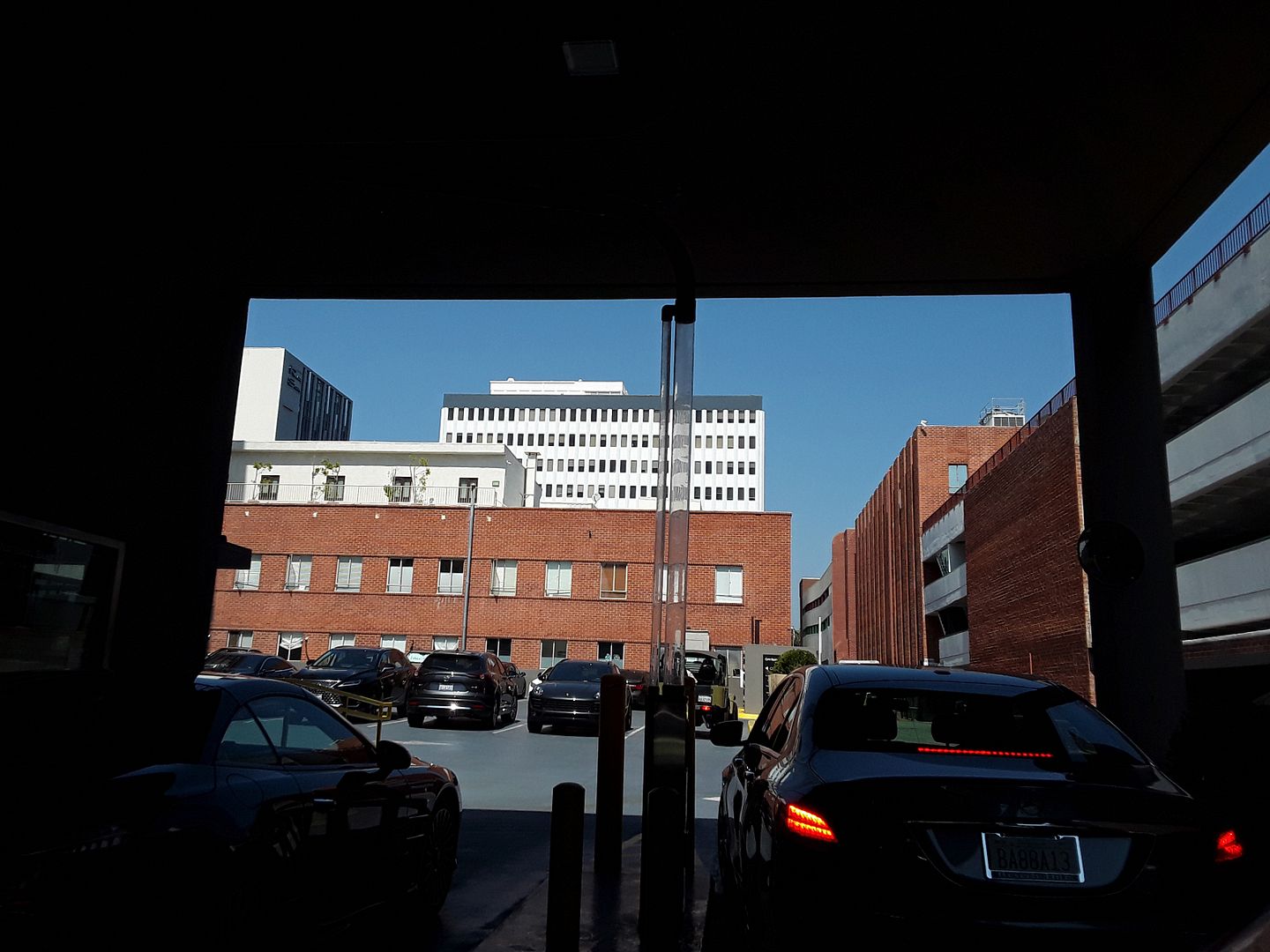
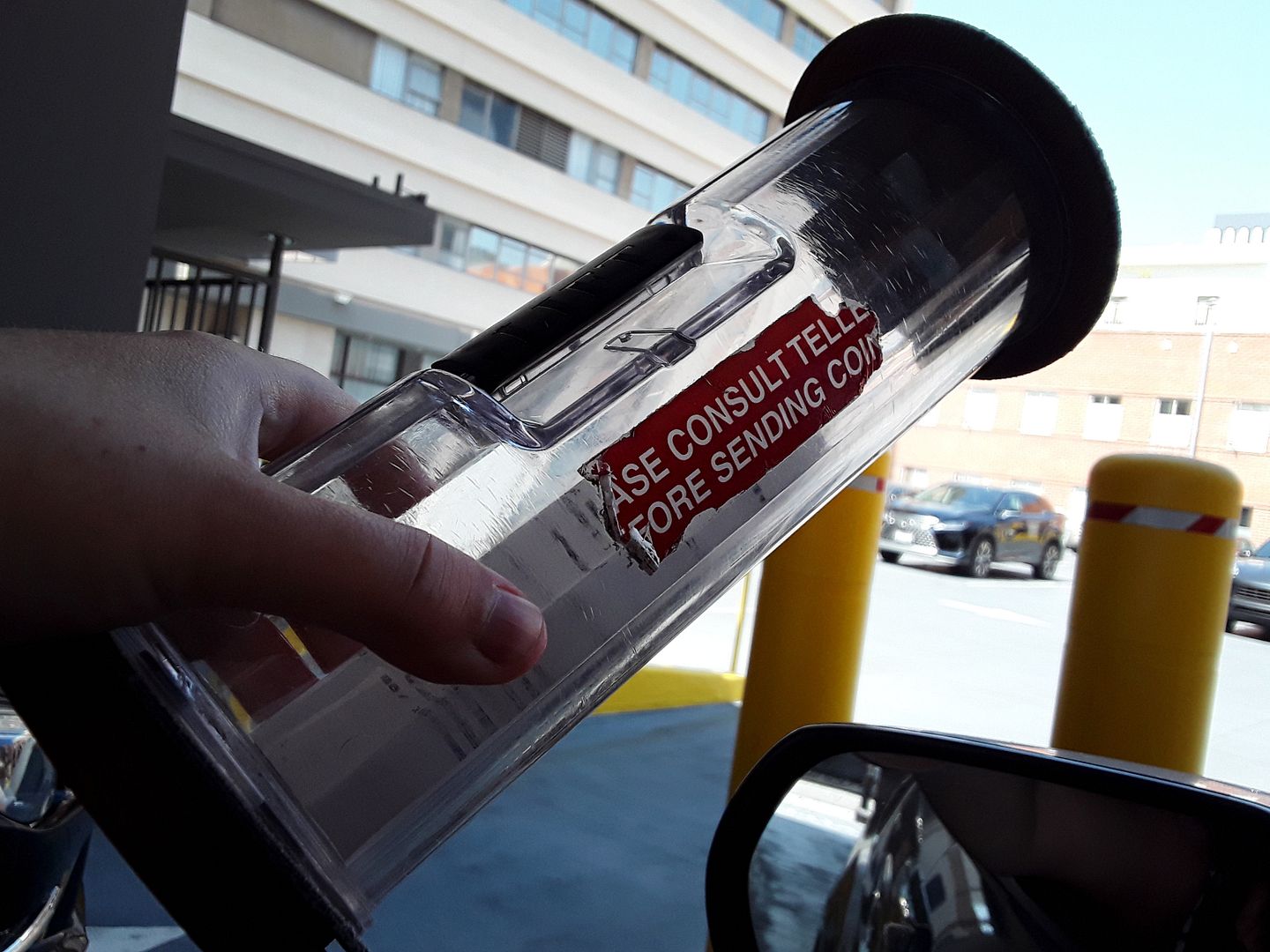
And then I found a drive-up teller at a bank branch in Beverly Hills. And to my delight, it had one of those pneumatic tube transport systems for the cars one lane away from the teller's window.


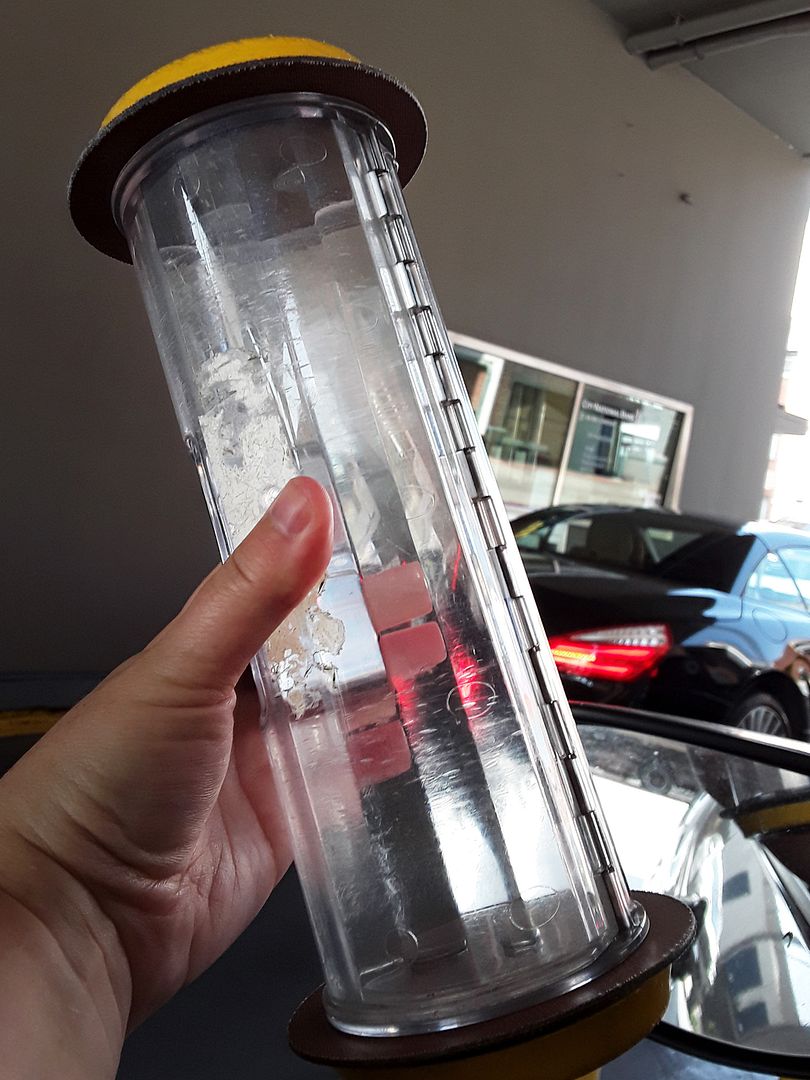
I so clearly remember these from my childhood—when I'd be sitting in the backseat of my dad's car, marveling at those cylindrical containers that carried cash, checks, receipts, deposit slips, and whatnot to and from the driver's side.


It felt like something straight out of The Jetsons. And even though it was created in the 19th century, and is utterly mechanical, it still kind of does seem like fantasy futurism.


Today on my bank run, I could've lined my car up for the teller window—but the car queue for the tubes was just about as long, so I decided to try to relive a little nostalgic bit of my childhood.

There was a difference this time, though. I got to operate the pneumatic system myself—unlatch the cash-carrying cartridge, stuff it with my documents, snap it shut, place it back on the loading dock, and hit the red button.

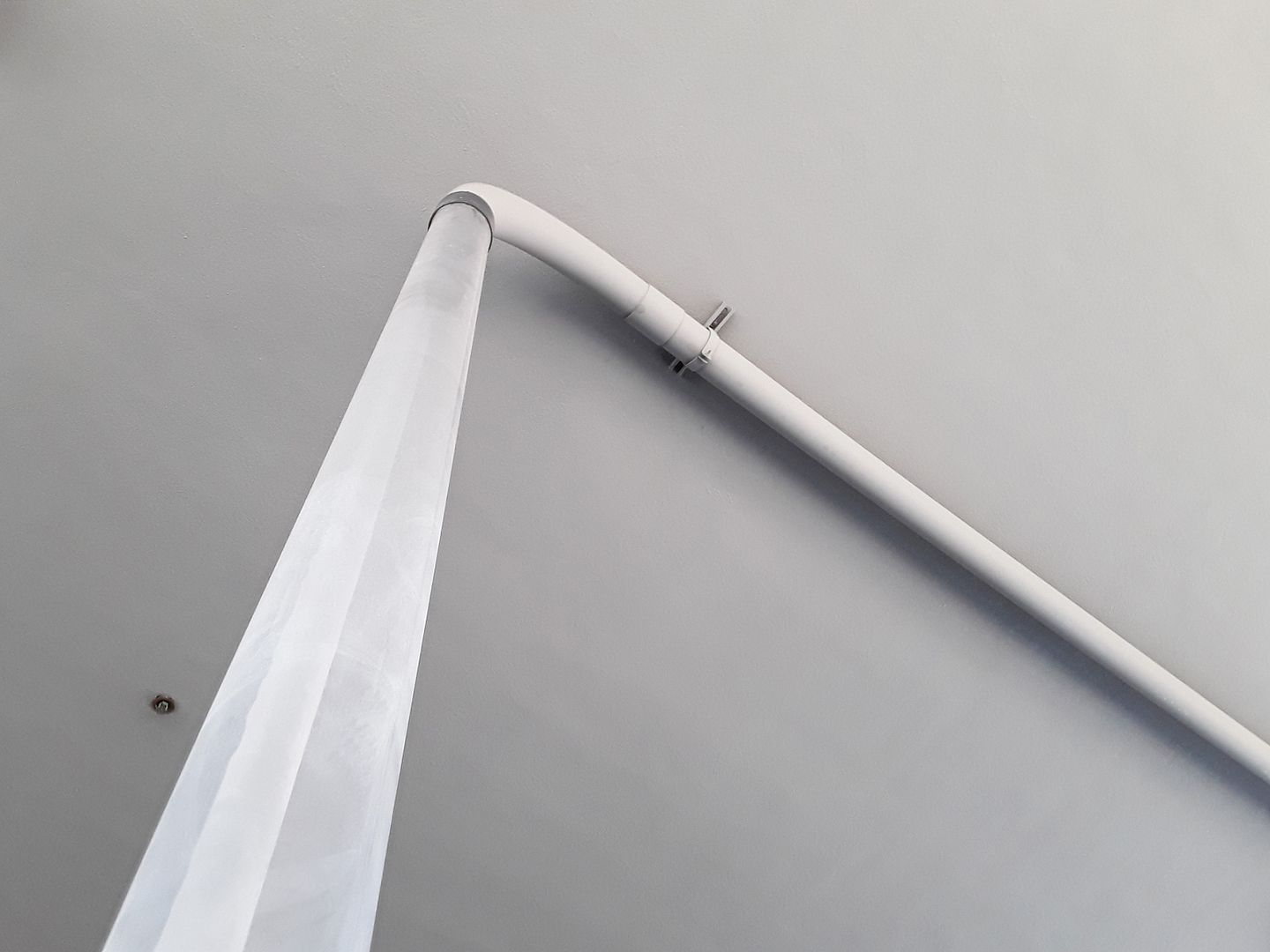
That's what triggers the plexiglass door to descend and the whoosh of pressured air to transport the carrier up through the conveyor and to a destination unseen from the driver's seat.

Thirty years after I last encountered pneumatic banking (probably), I couldn't quite figure out whether I was supposed to stay at my tube station or proceed to the one in front of me to get my receipt. I hadn't been paying close enough attention to what the cars ahead had done—and for a moment, I felt crippled by the lack of human contact.

With no one behind me, I drove forward to the next docking station and pressed the red button, accidentally sending an empty cartridge to the teller.

Assuming I'd made a mistake, I backed up to the station I'd originally used for my transaction. And then I hear a voice come over a speaker system and say, "I already sent it to the other one."

Was I supposed to go to the other one? Or did the teller send it there from afar because she'd seen me pull up to it?

I don't actually know. And I was too rattled to ask.

Is the carrier sanitized between each use? Probably not. Is it any cleaner than an ATM? Probably.

But if I could catch something from a pneumatic tube, well, I guess that was one risk I was willing to take from inside my car.

At least for today.

Related Posts:
Heading Into Chapter Two of the Coronavirus Pandemic

March 09, 2020

Photo Essay: A Beacon of Banking That Got Reincarnated As a Hotel

Founded in 1889, the former San Diego Savings Bank got a new name in 1925, officially becoming San Diego Trust and Savings Bank.

In 1928, it was about to get a new home, too—its fourth in San Diego, and its most magnificent yet.

There had been just one obstacle to its construction. The Hotel Beacon was standing on the corner lot at 6th and Broadway, which SDSB had purchased in 1924.

So, the old hotel got demolished; the new 13-story bank headquarters got built as the tallest building in San Diego at the time. (It would hold that honor until 1960.)

The funny thing is, though the bank building is still there, it's no longer a financial institution—but a hotel!

It's now the Downtown/Civic Center Marriott Courtyard (and probably the nicest Marriott Courtyard anywhere).

What goes around, comes around, I guess.
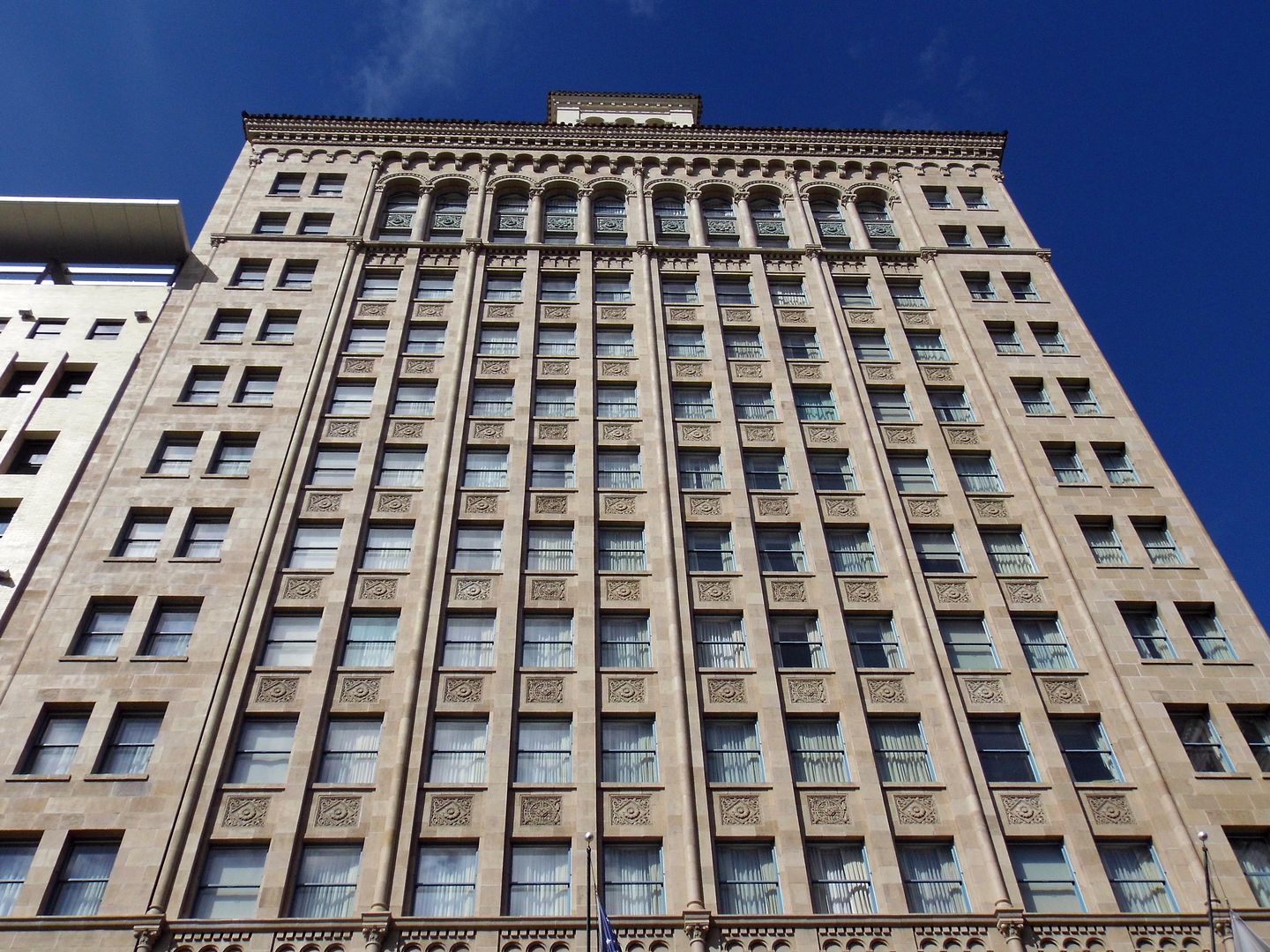


Built by William Simpson Construction Company at a cost of approximately $1.4 million, the San Diego Trust and Savings Bank building is one of only three banks ever designed by master architect William Templeton Johnson. Most would probably agree it was his best.
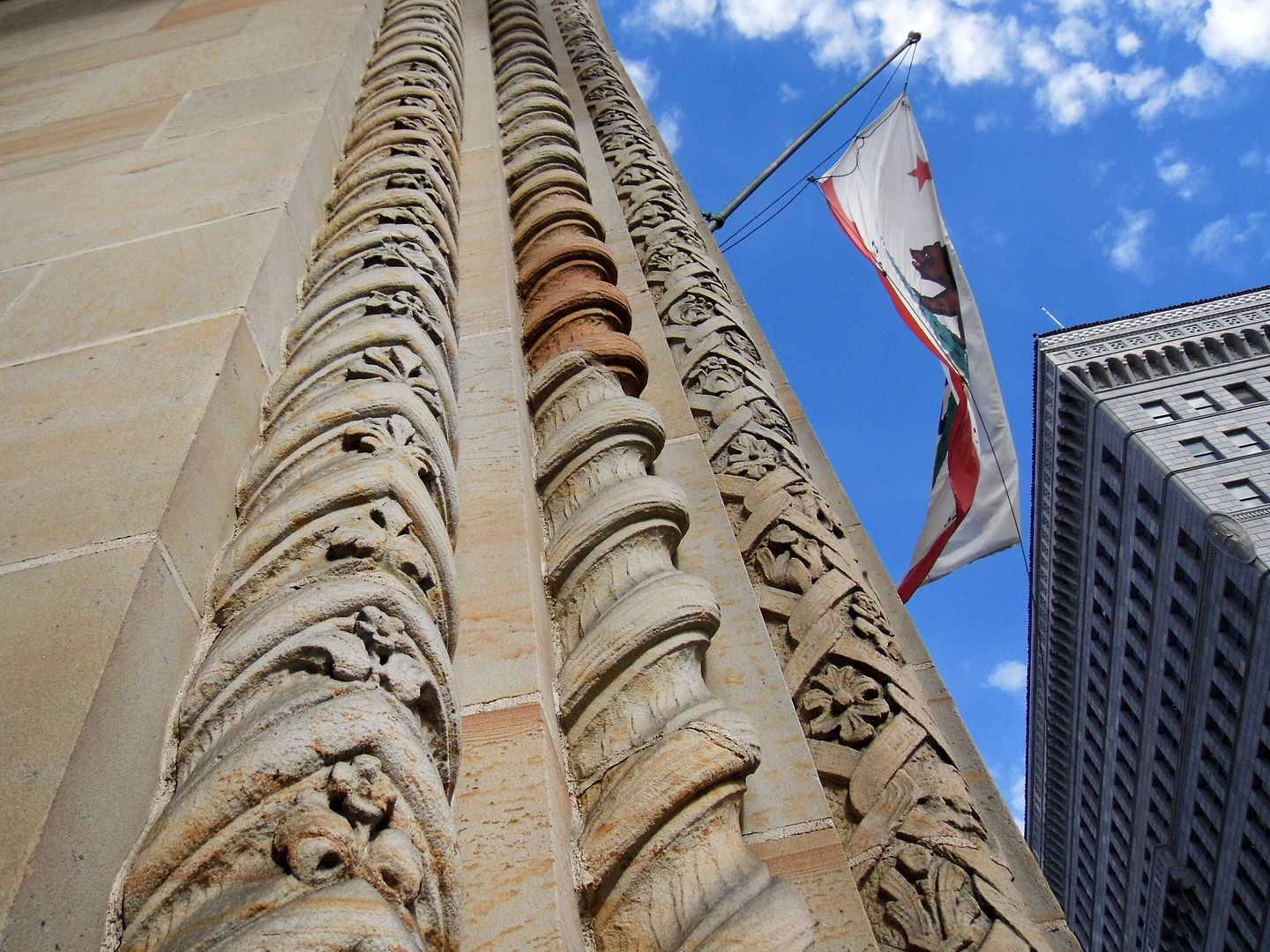


Its "bones" are made of steel reinforced concrete, but what you see on the outside is two stories of buff-colored sandstone quarried from Briar Hall in Ohio (perhaps its first exterior use on the West Coast)...
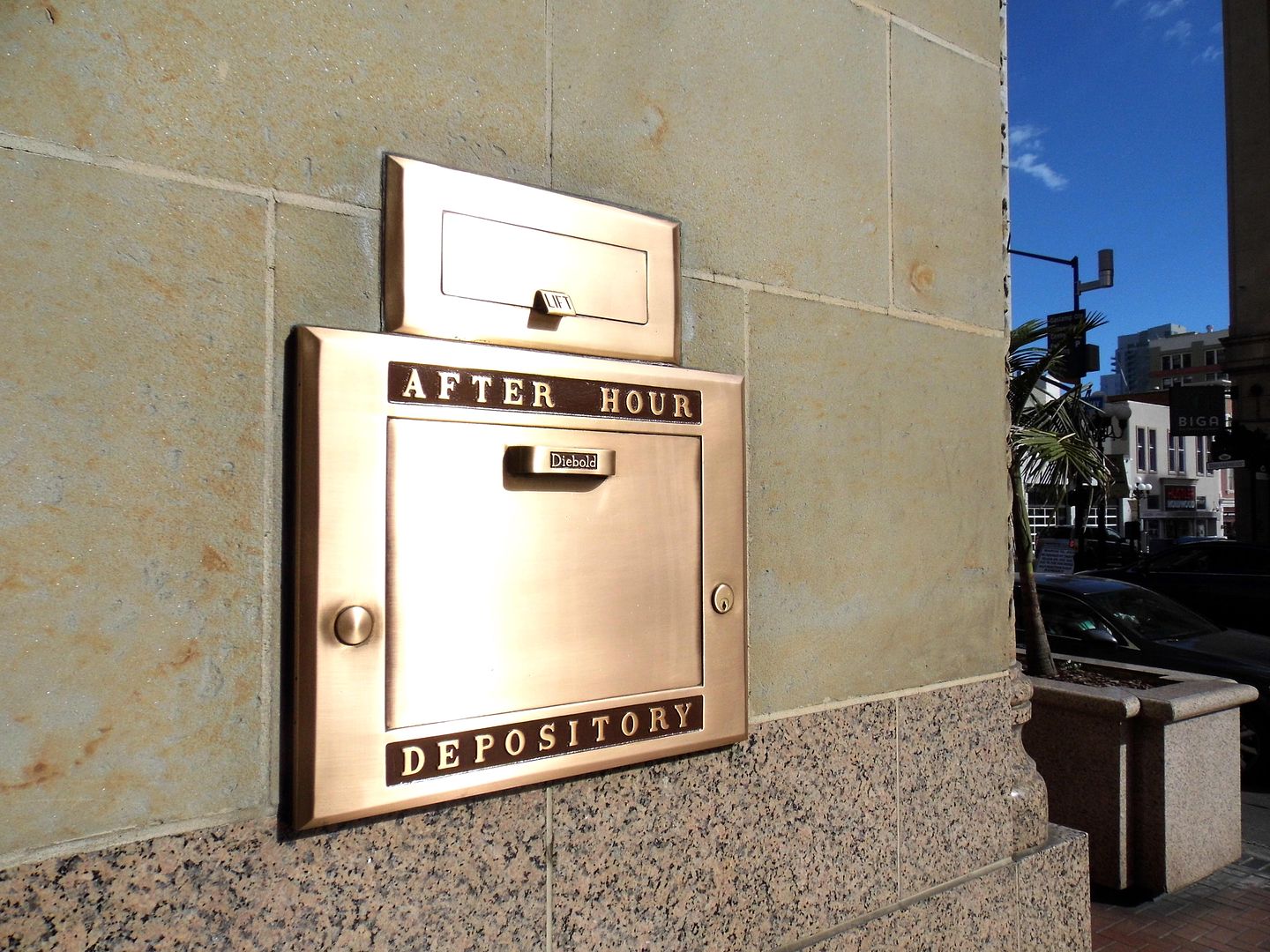


...perched atop a base of pink granite known as Scotch Rose.
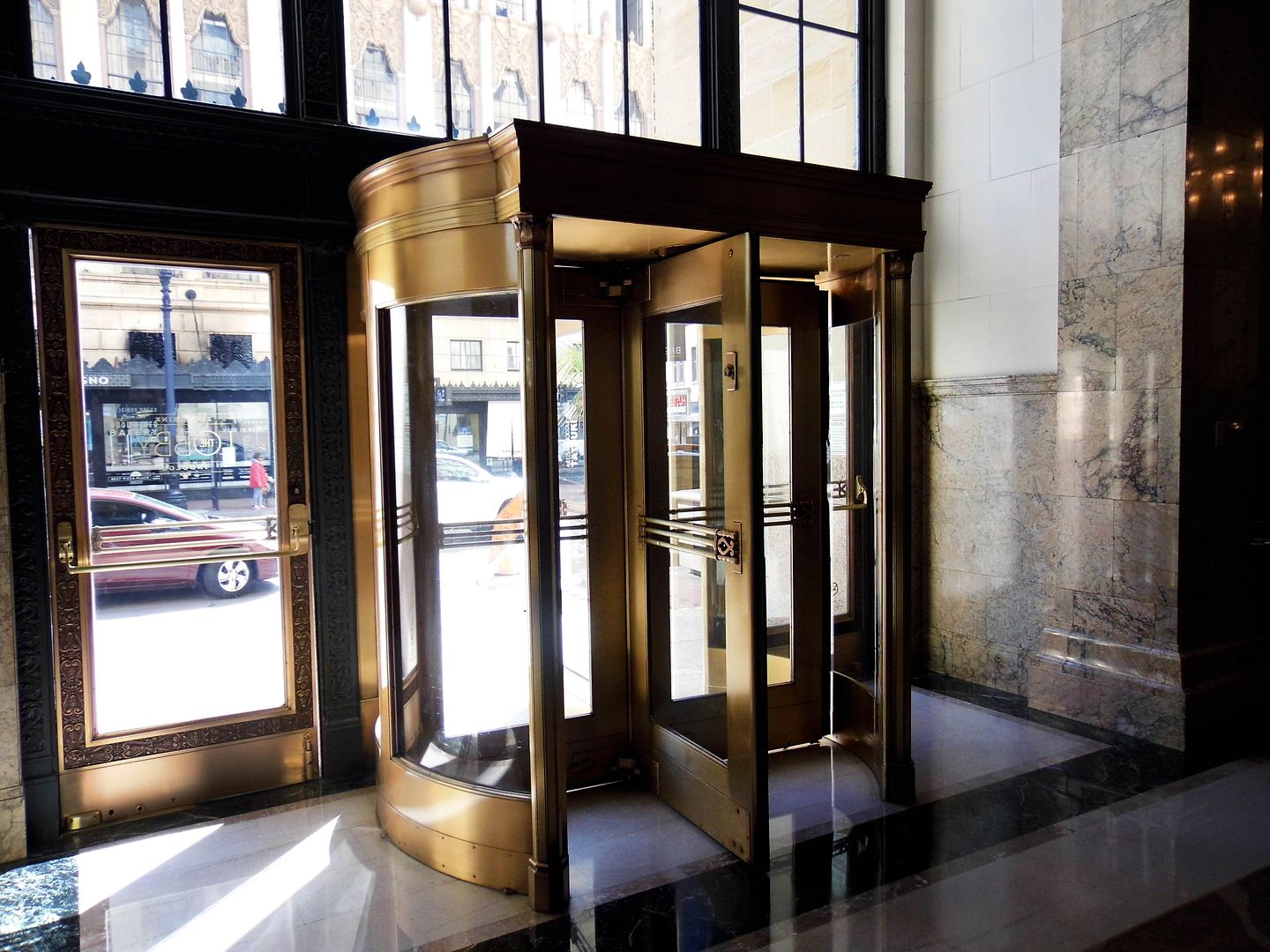


The experience of walking through the bronze revolving door of the main hotel entrance now is meant to be quite similar to when the building functioned as a bank.
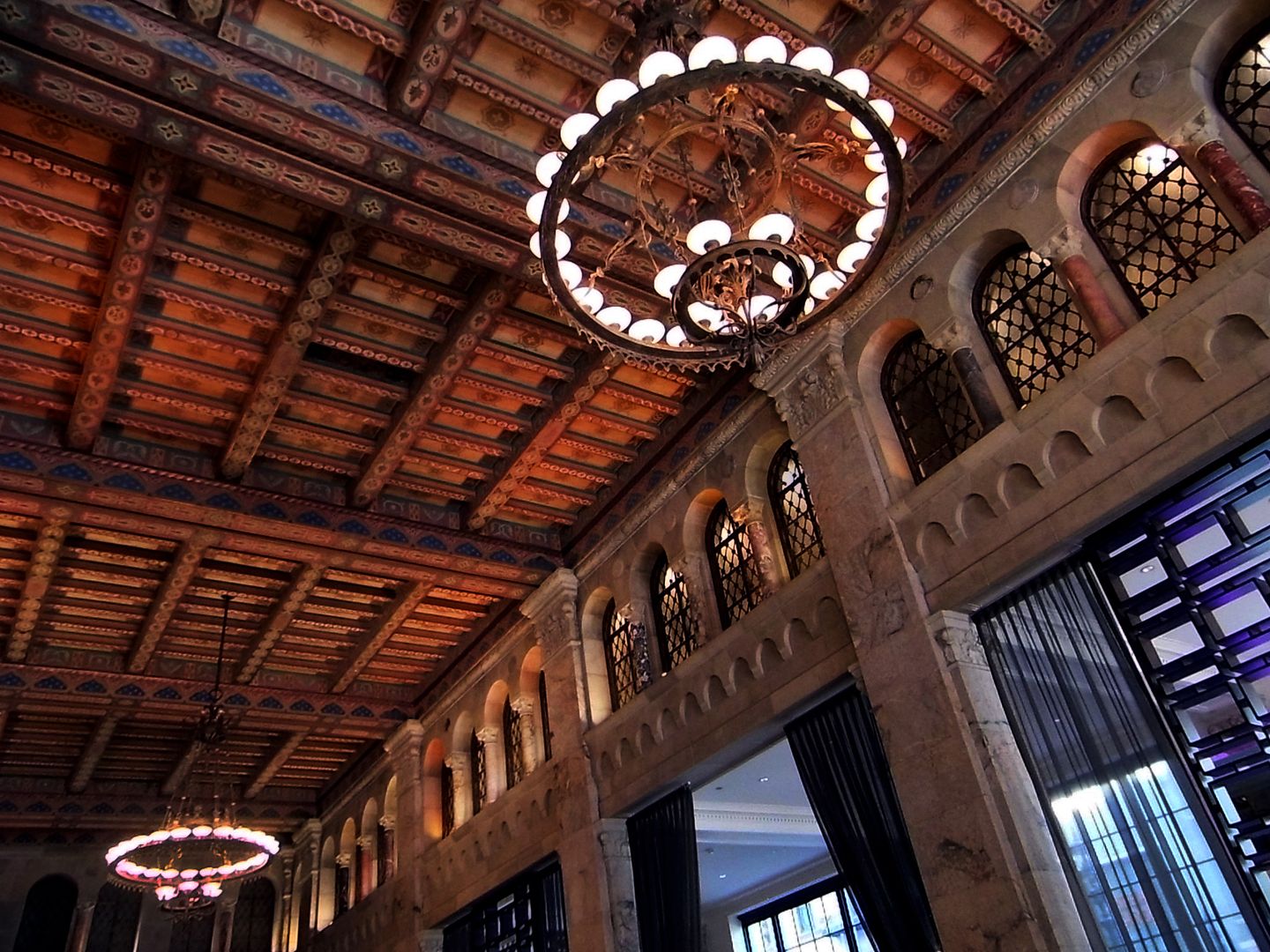


The Grand Lobby is largely intact from its former financial function—the circular antique chandeliers still hanging from the hand-painted, coffered plaster ceiling (rising 32 feet in height) and surrounded by 35 marble columns topped with Corinthian capitals. In all, 19 different types of marble were quarried from several Mediterranean countries as well as other sources around the world.
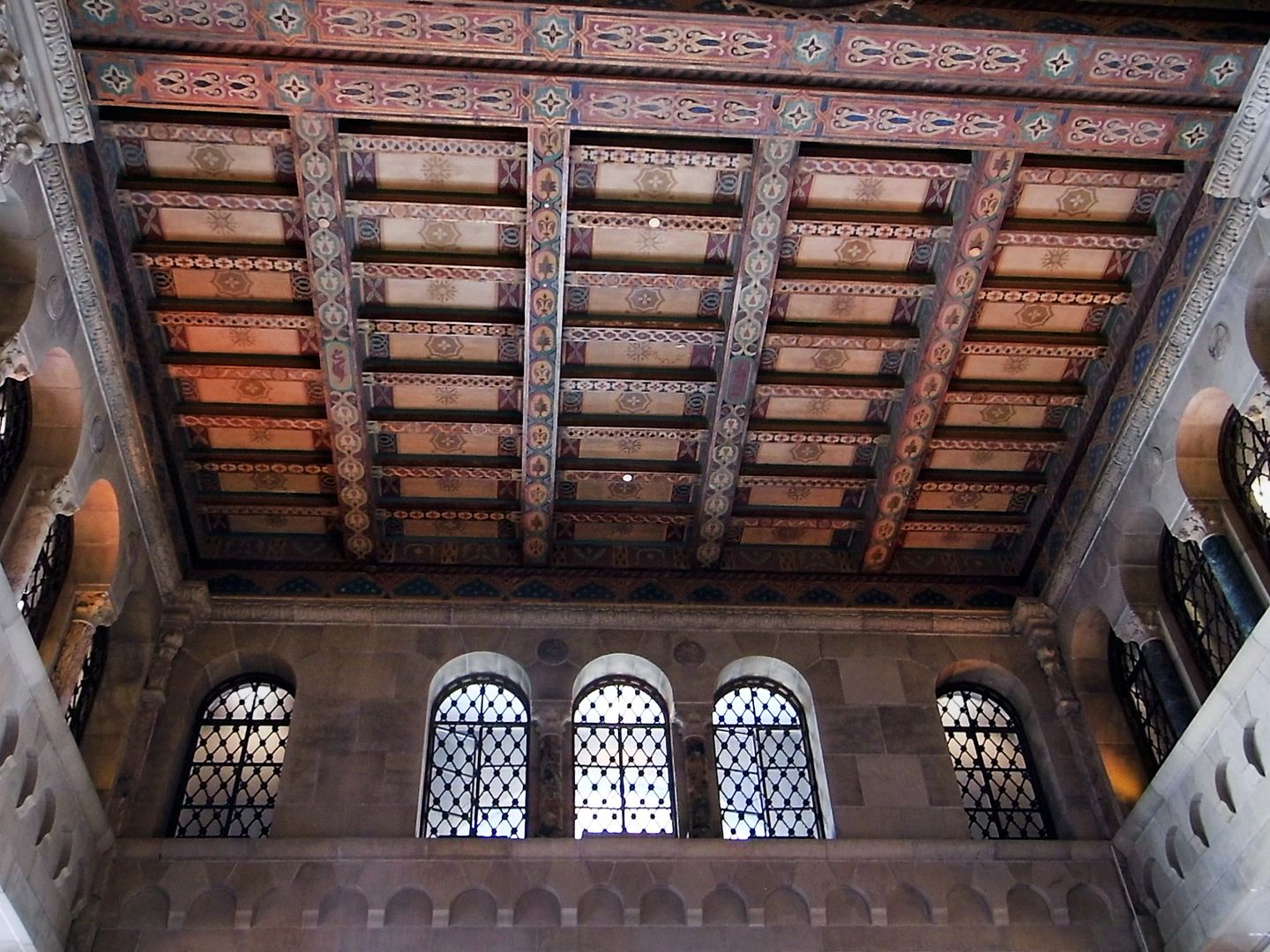


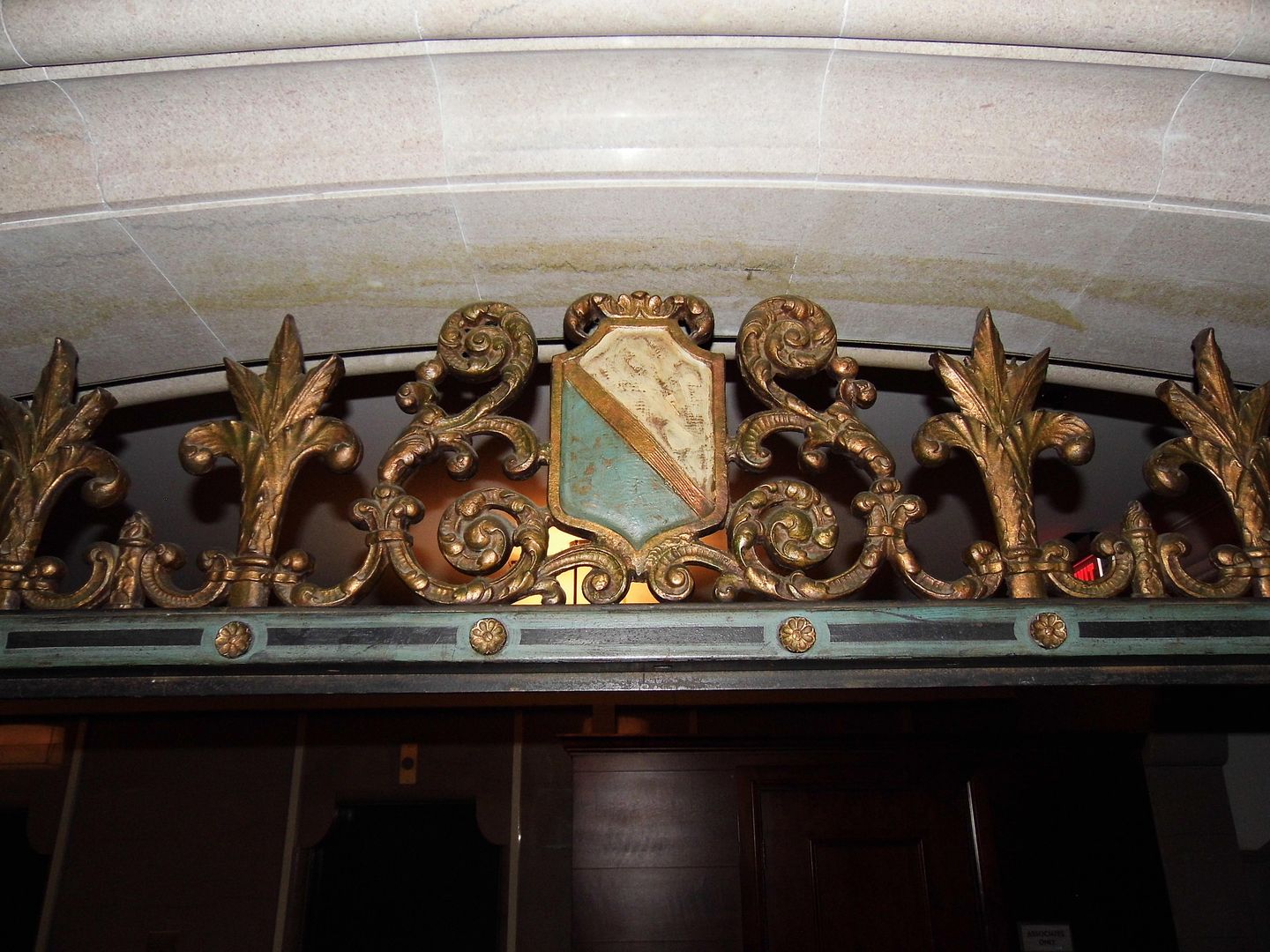
The lobby in particular evokes a medieval atmosphere, as it features all the ornamentation that came into fashion in the Middle Ages—clerestory windows behind iron grilles, grand arches, medallions, and such. Much of those arise out of the Italian Romanesque Revival/Italianate Renaissance Revival architectural style (the The San Diego Union called it "Lombard-Romanesque" at the time of its opening)—less common in commercial buildings like this one and more frequently found in churches.
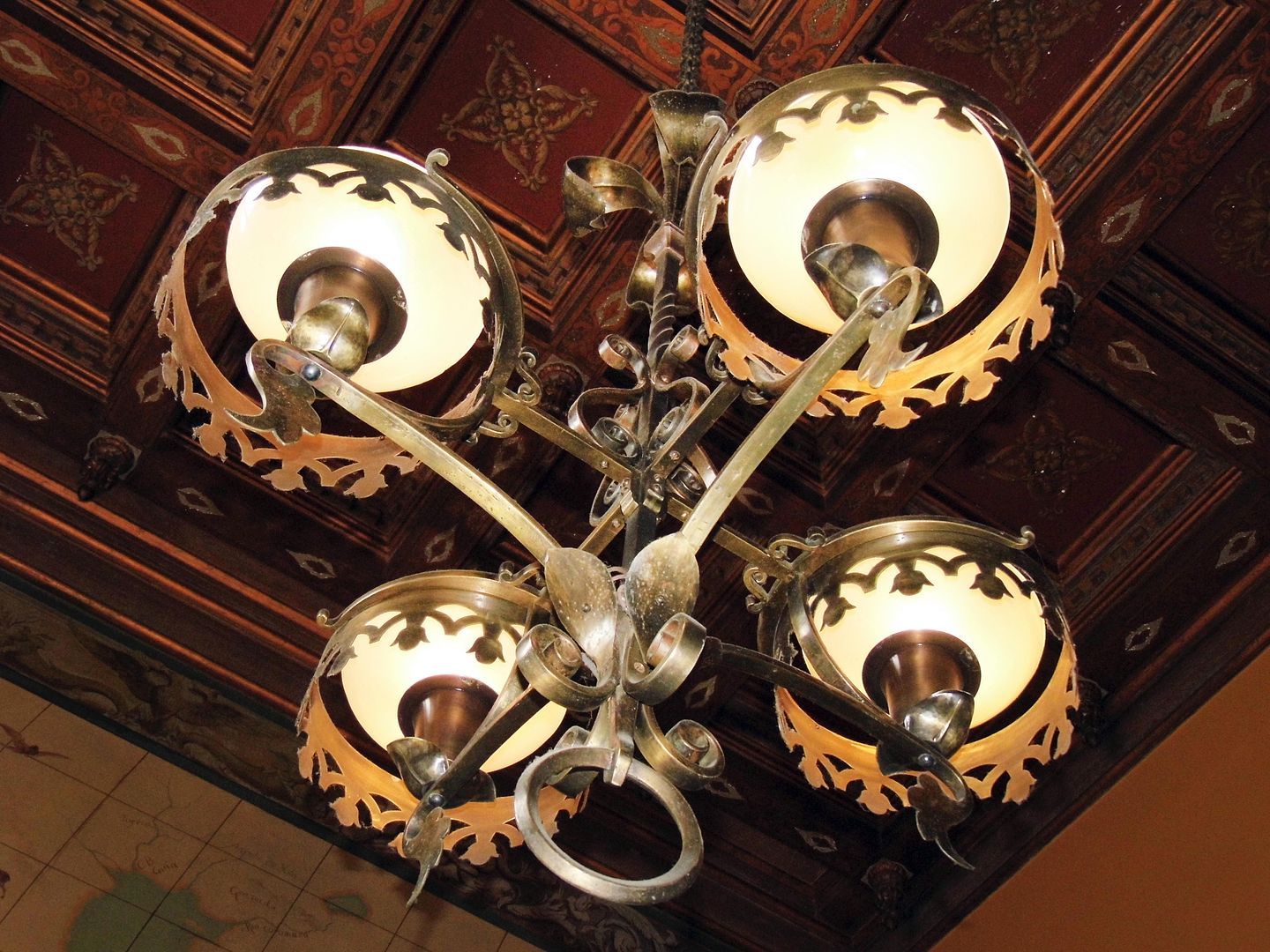


In addition to the banking services offered to the public (from the basement through the mezzanine levels), the building also housed offices in its upper stories...
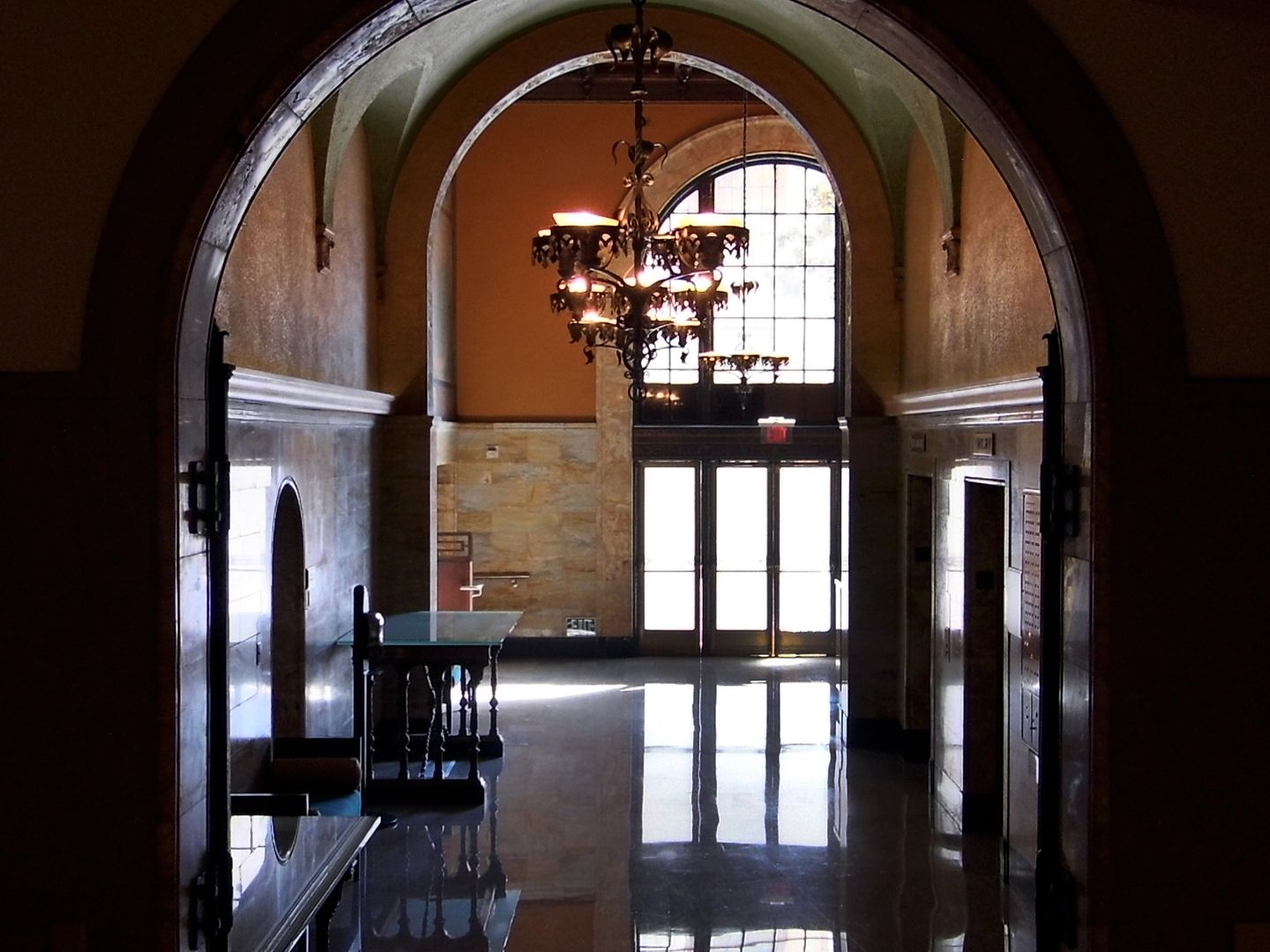


...and its original office building entrance is still there, just beyond the massive arches of the elevator lobby, the wall paneling of Italian marble, and the floor of Tennessee marble (from Gray Eagle Quarry).
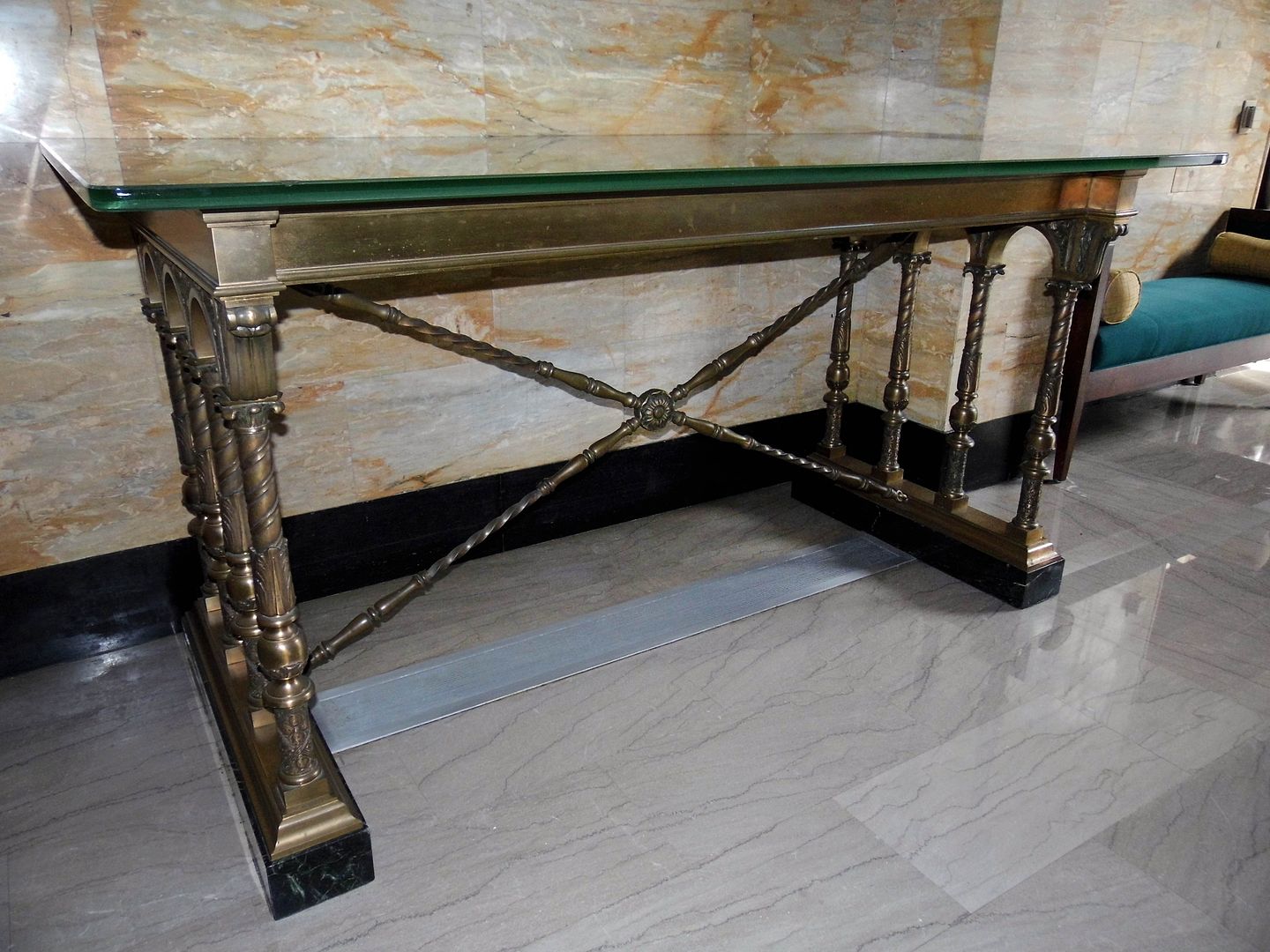


One of the original bank tables—once positioned near the teller cages for customers to fill out their paperwork and sign checks—has been relocated to the elevator lobby, with others sprinkled throughout the current hotel as well.
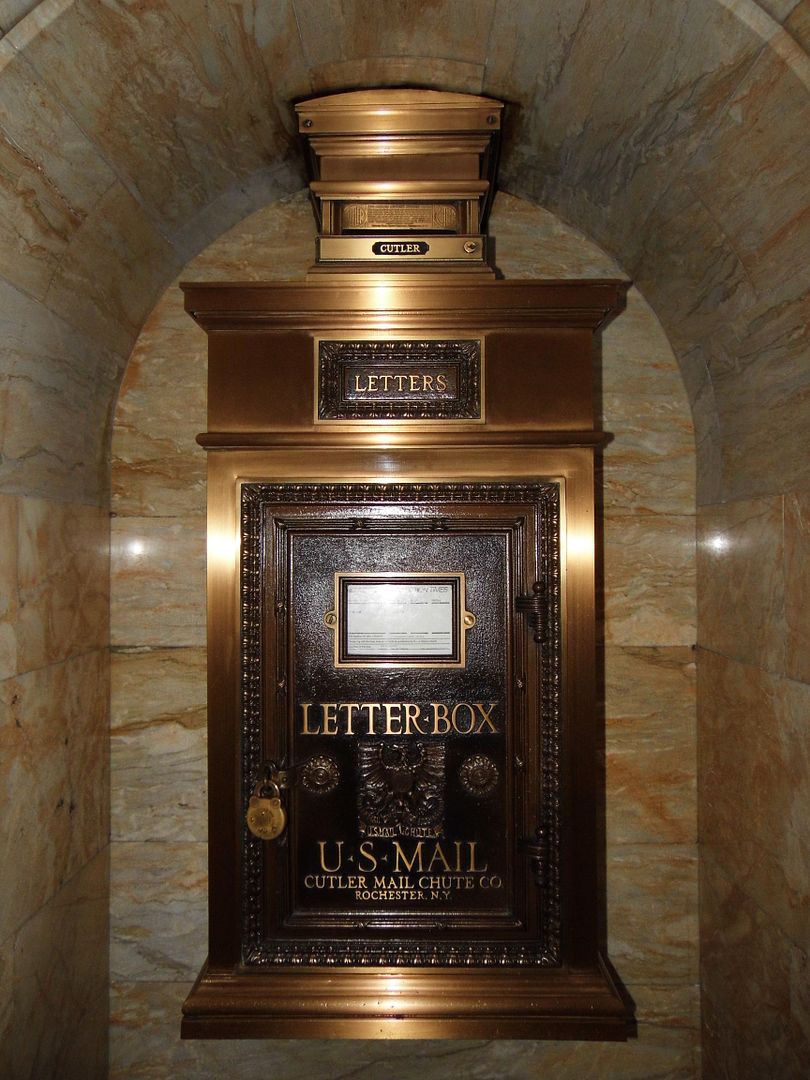


The original mail chute is still mounted in a recessed niche in the elevator lobby—and the post office still picks up the mail every afternoon at 1 p.m.
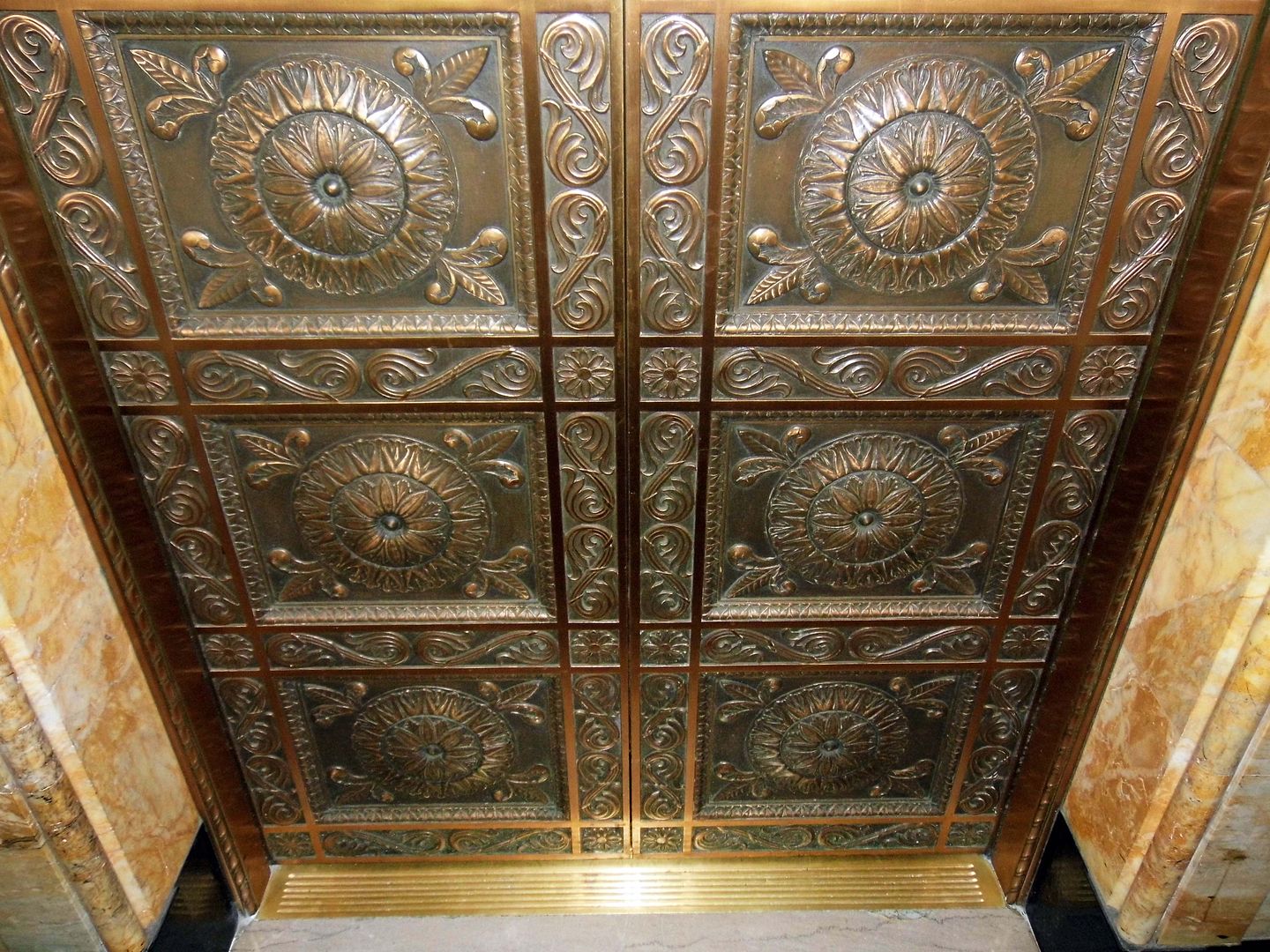


Behind sculptured bronze doors, hotel guests would find the most technologically advanced, high-speed elevators, which traveled at a maximum rate of 660 feet per minute—more than double most other buildings at the time.
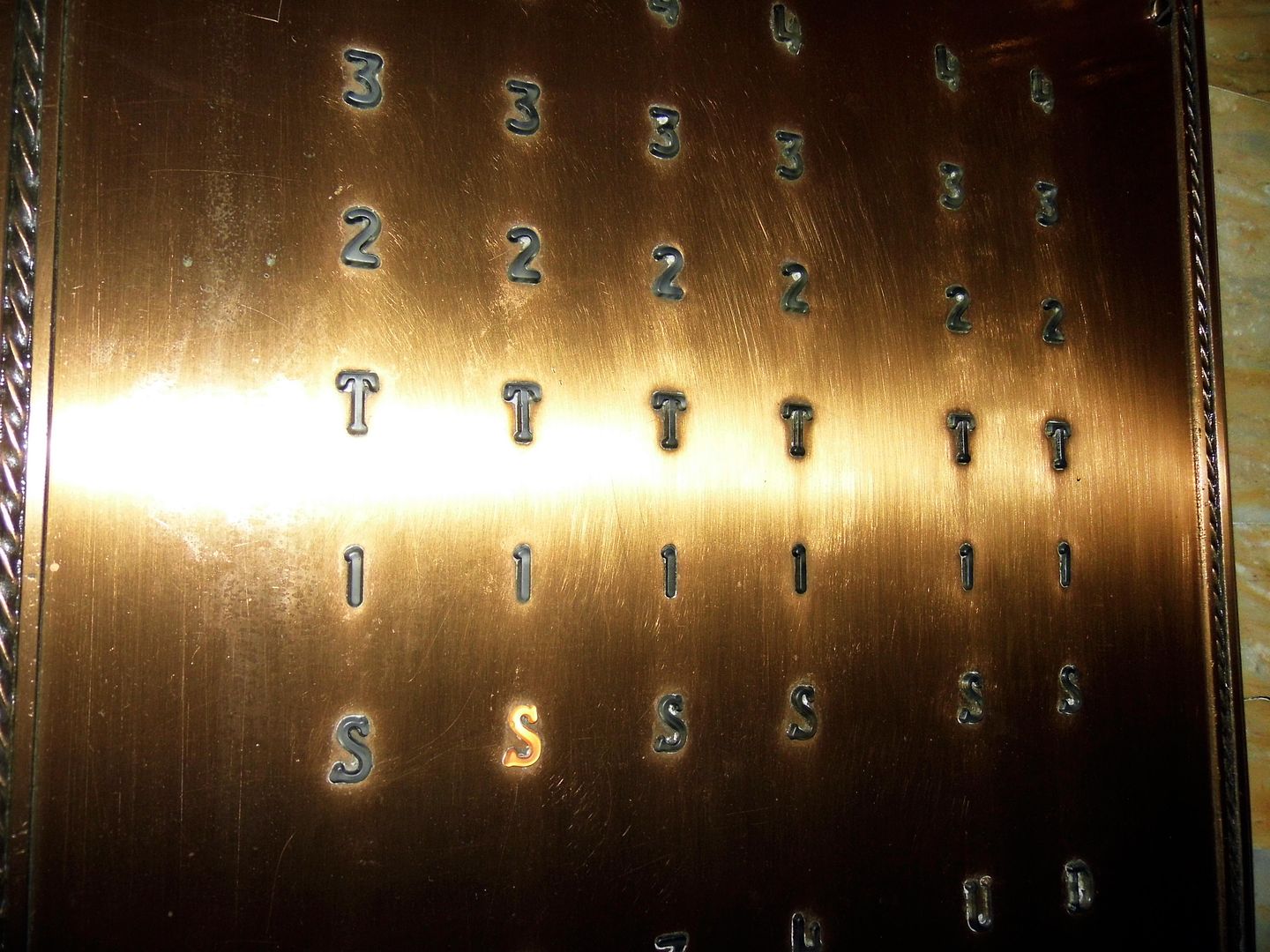


By comparison, the first-ever commercial passenger elevator (in NYC) took a full minute to climb just 40 feet.  Today's fastest elevator in the world (China's Rosewood Guangzhou, Guangzhou Chow Tai Fook Finance Centre) travels more than 4100 feet per minute. 
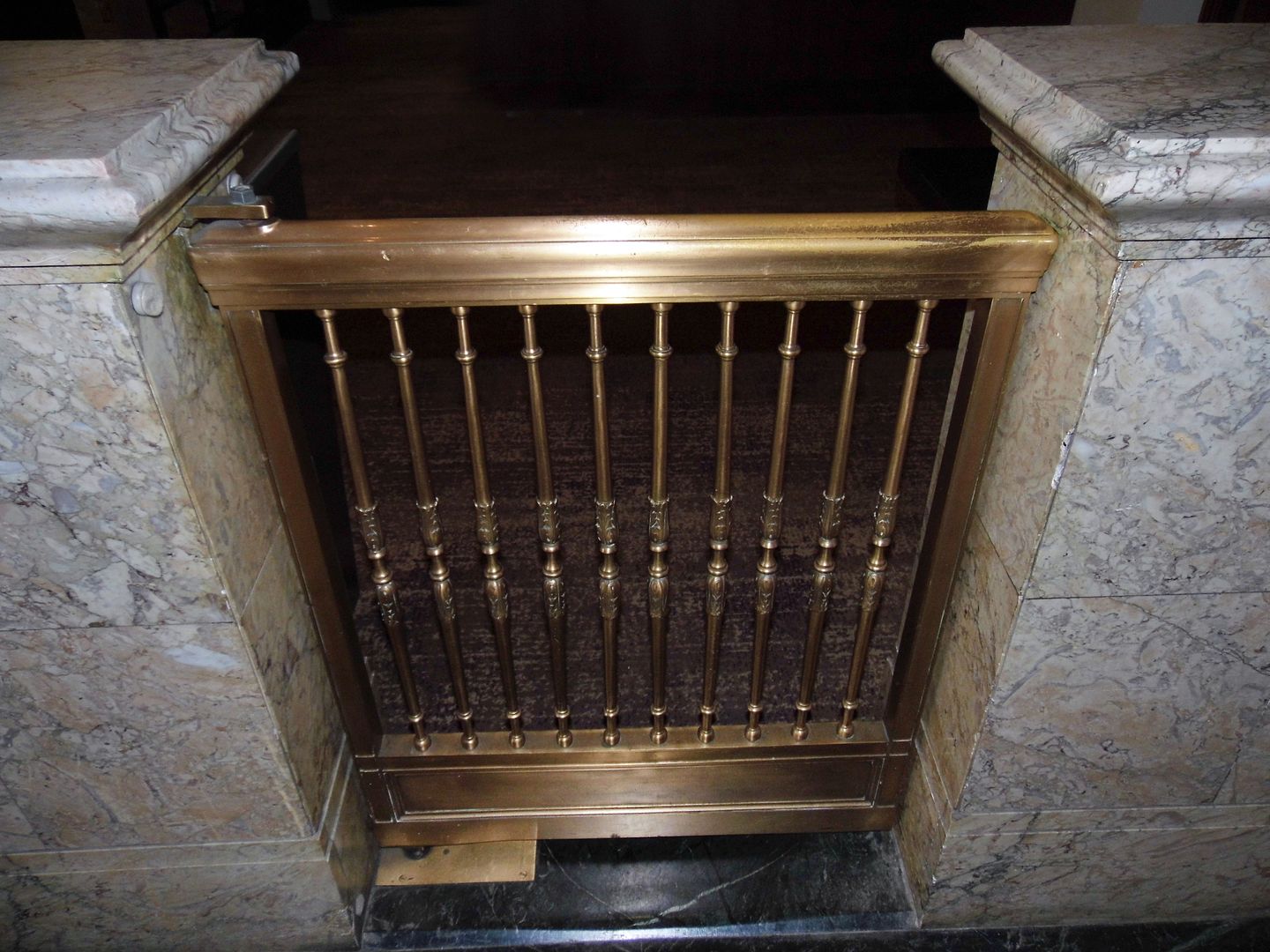


The heavy gates leading to the Bond and Investment Service and the one-on-one meeting area still swing—though now they only separate the public from the snacks for sale and a billiard table surrounded by framed, historic photos.


You can still walk down the stairs to the basement in search of the Safe Deposit Department...
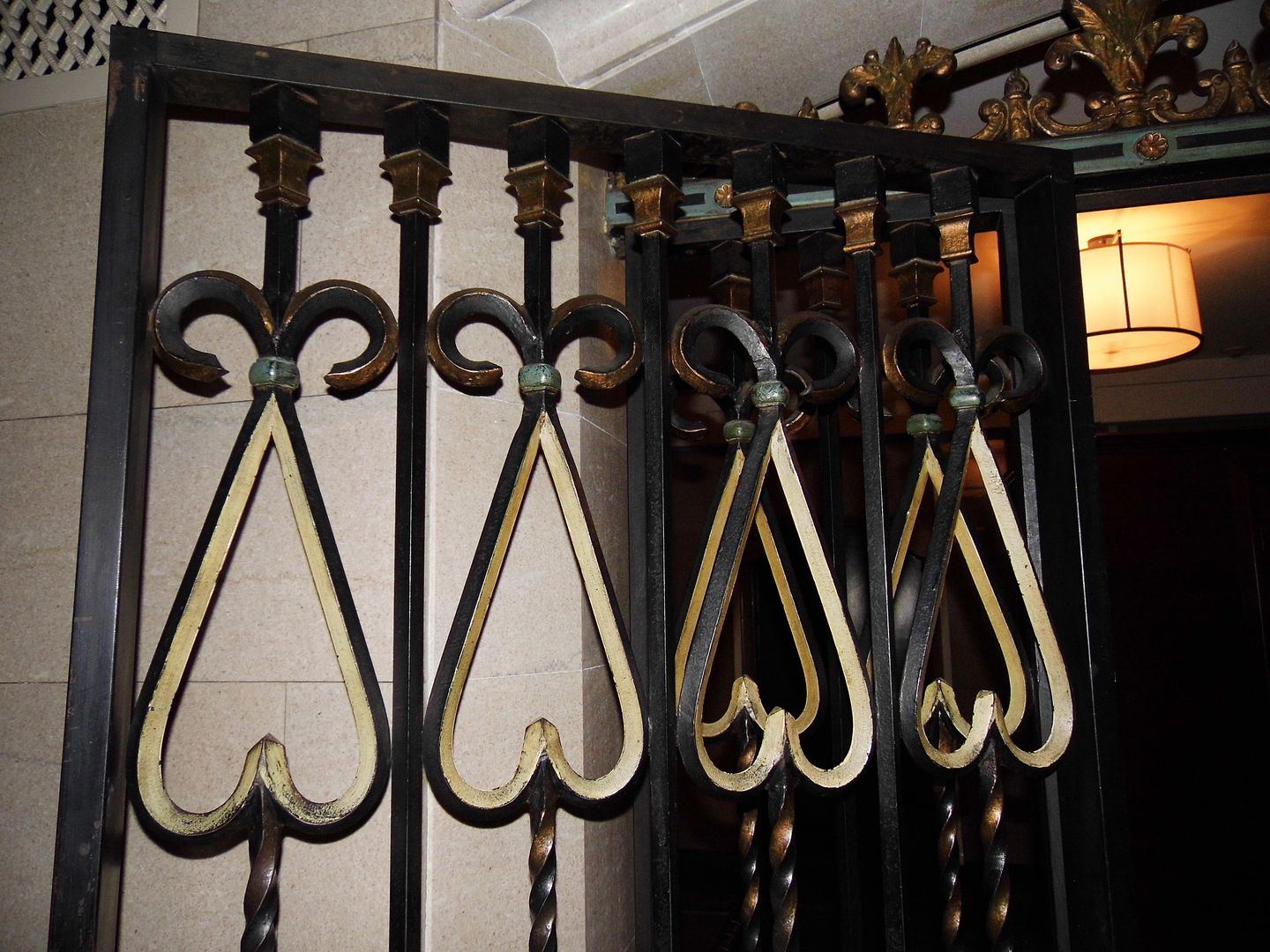


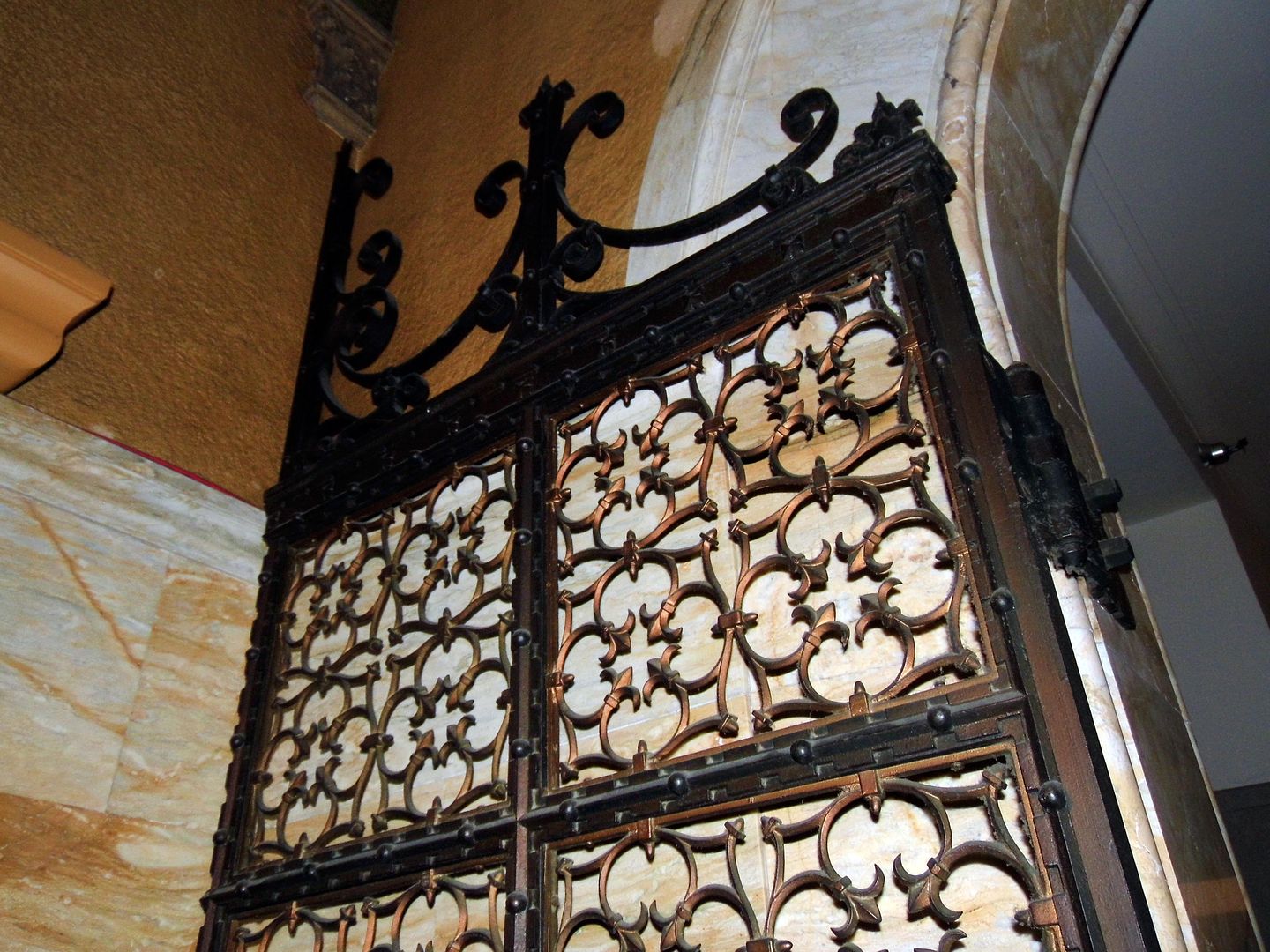
...but when you walk through the painted metal vault gates...


...which are no longer locked...
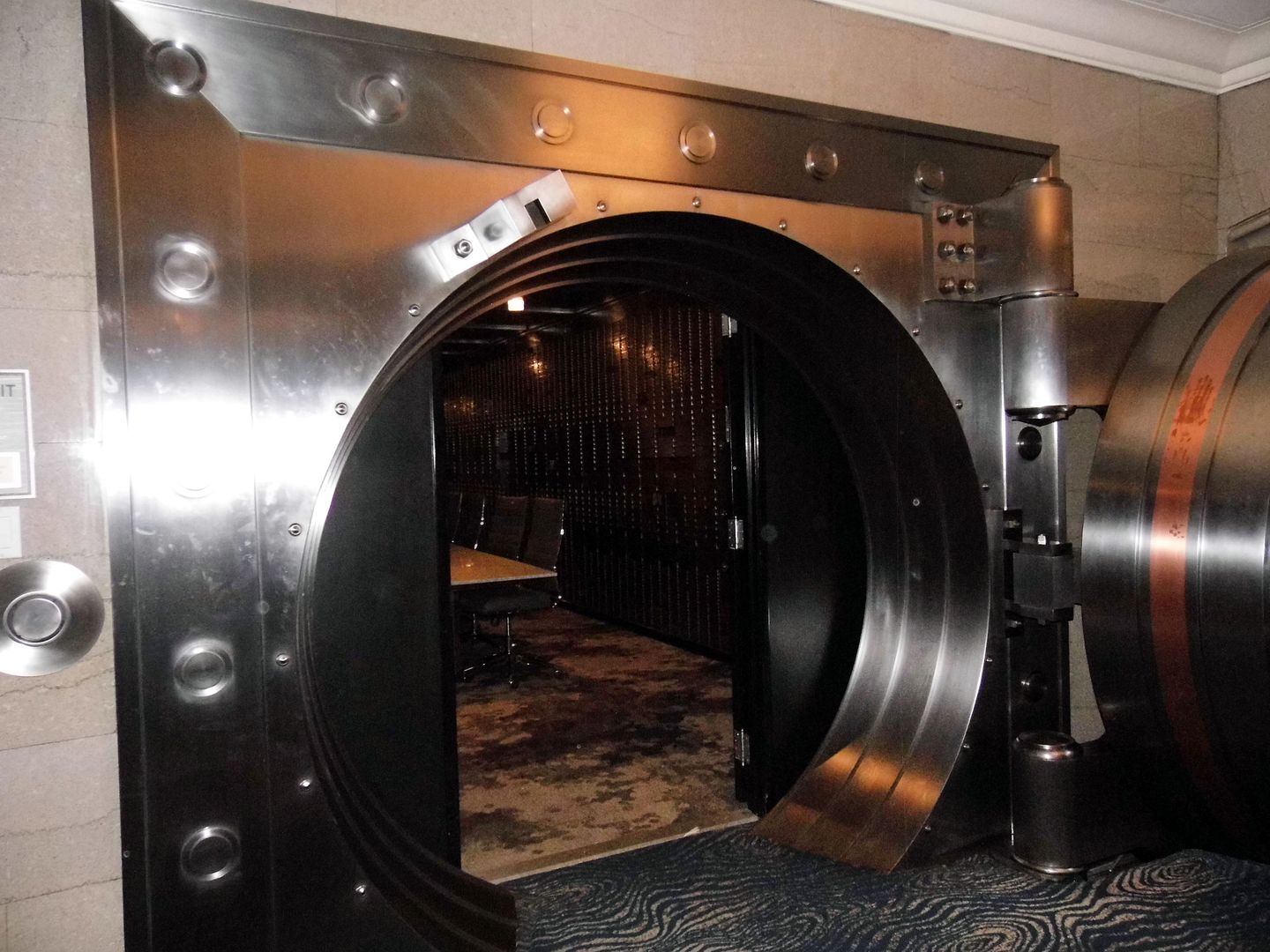


...you'll find the Safe Deposit Room...
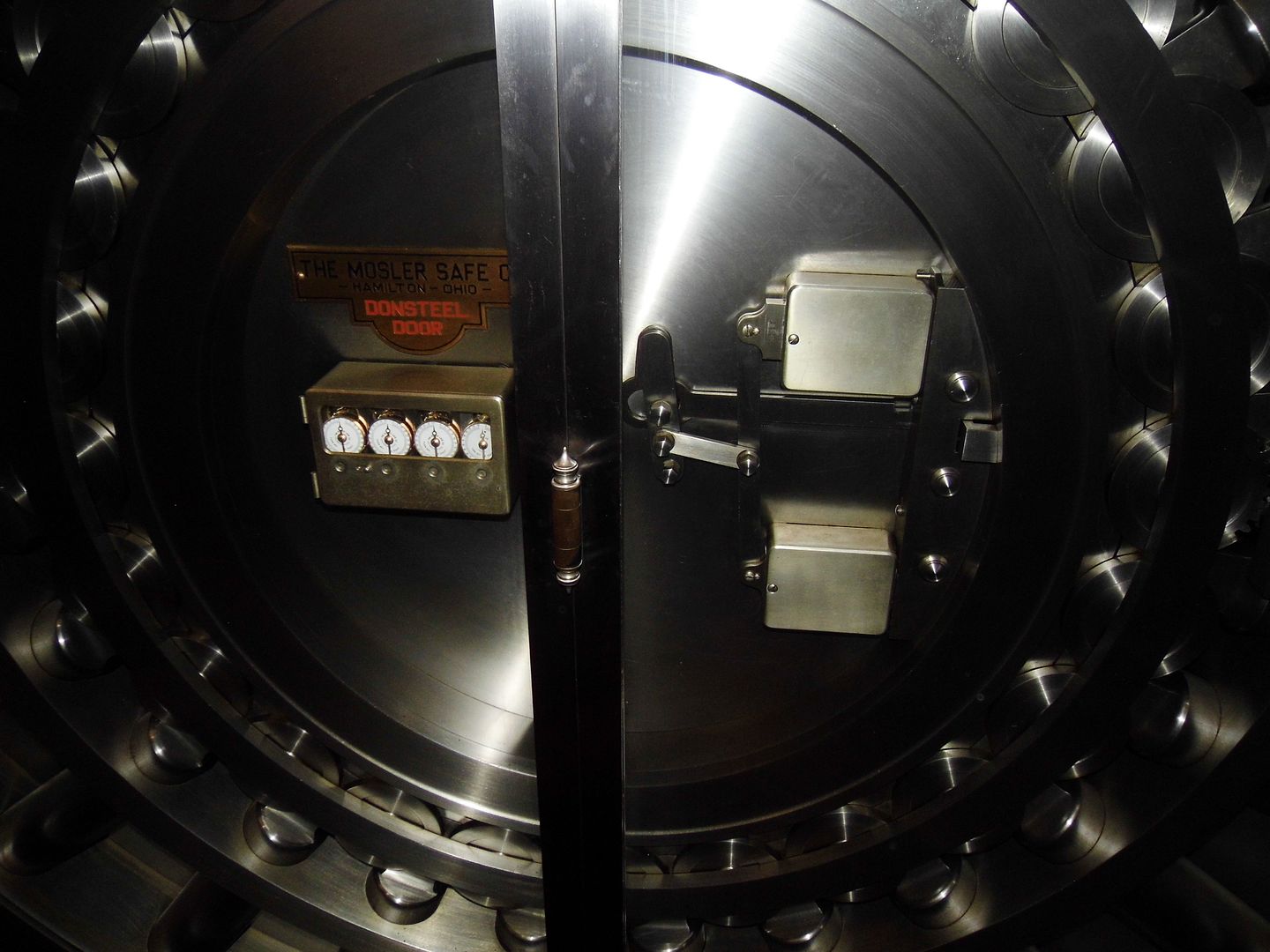


... its original 47,000 lb, stainless steel door (manufactured by the Mosler Safe Company of Ohio, which also provided secure storage for Fort Knox) permanently in the "open" position.
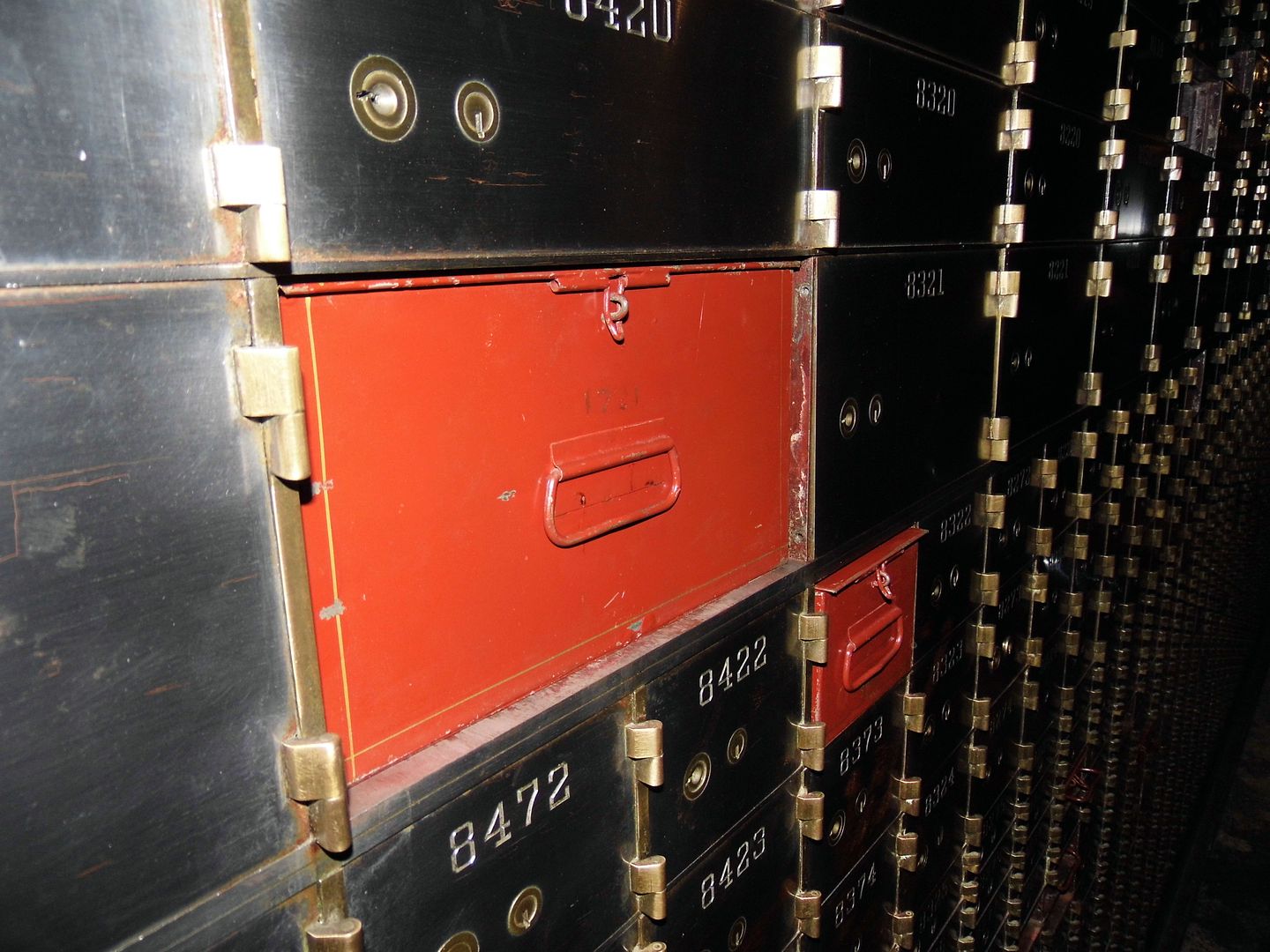


Inside, the safe deposit boxes are empty, but you can still pull them out like the drawers of a cabinet of curiosities, hoping to find something secret, special, or valuable inside.


Although the bank catered to customers of all economic status (including children, who could open an account with a starting deposit of 10 cents), the safe deposit boxes attracted some pretty big-ticket valuables that shouldn't be flashed around out in the open.
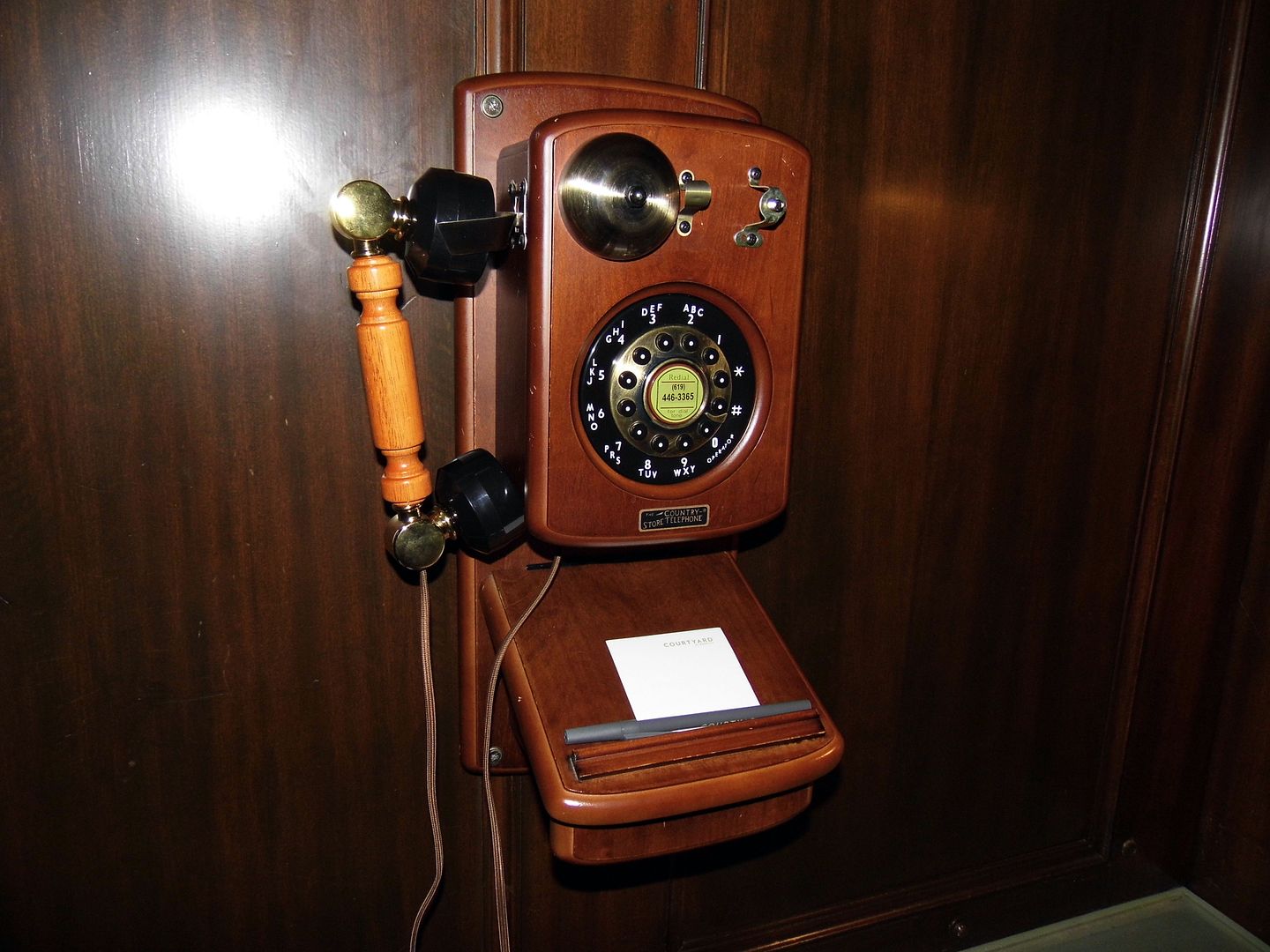


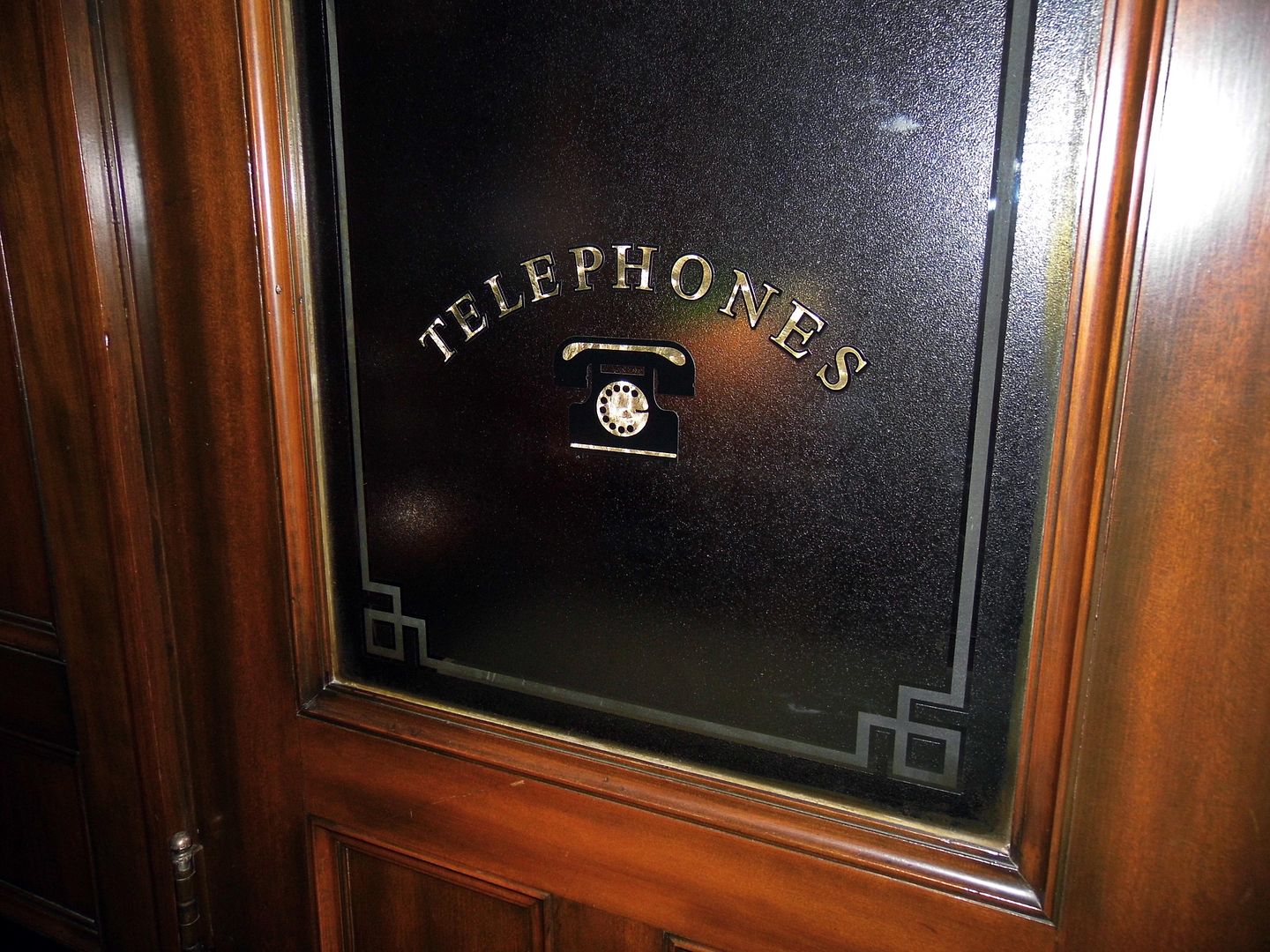
Their respective owners would be ushered into tiny offices outfitted with telephones to do their business in private. The three booths are still there—but the old style phones are now push-button, and lifting the receiver directs you to the front desk.
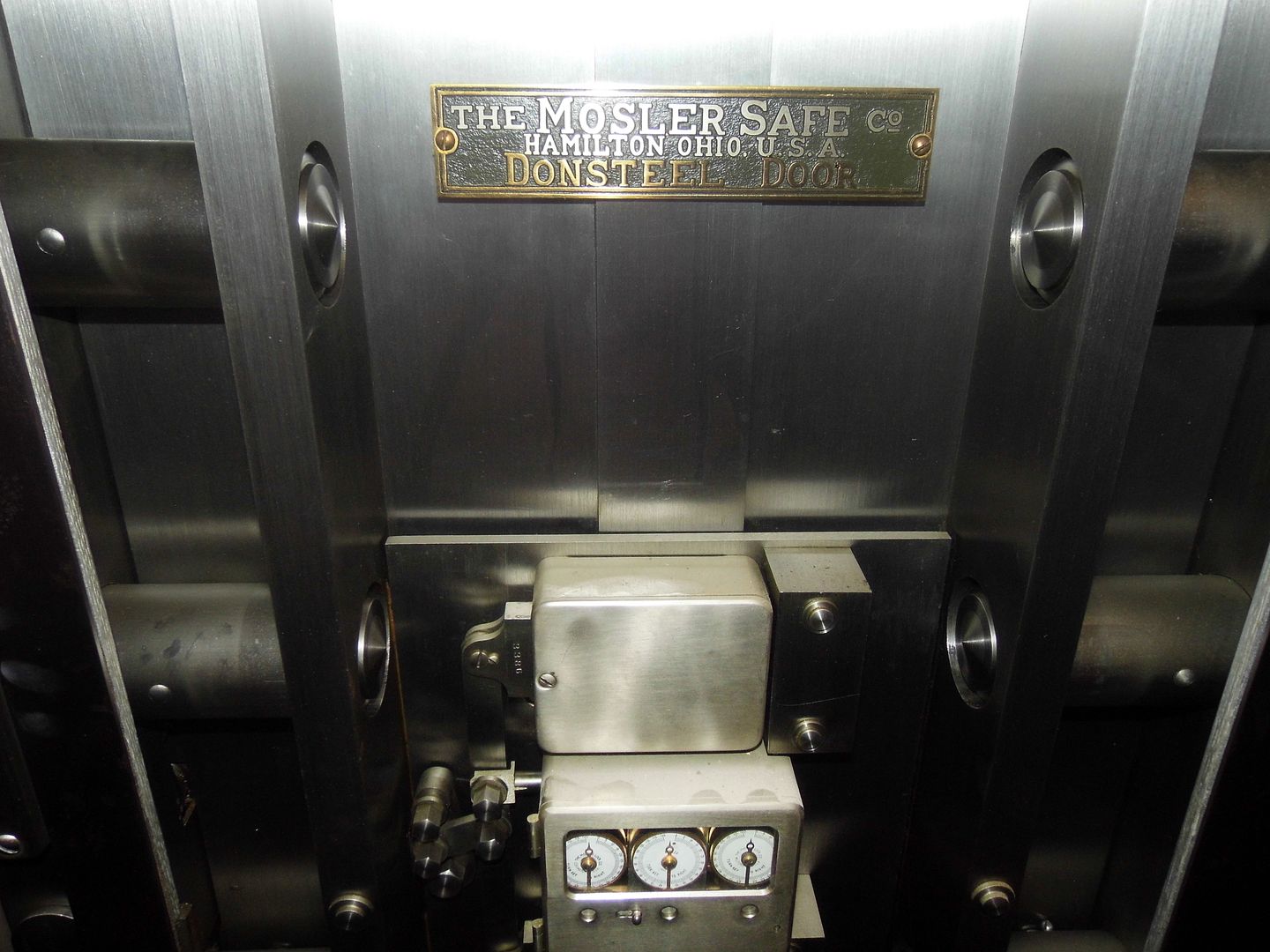


The bank theme continues in the Vault Meeting Room...
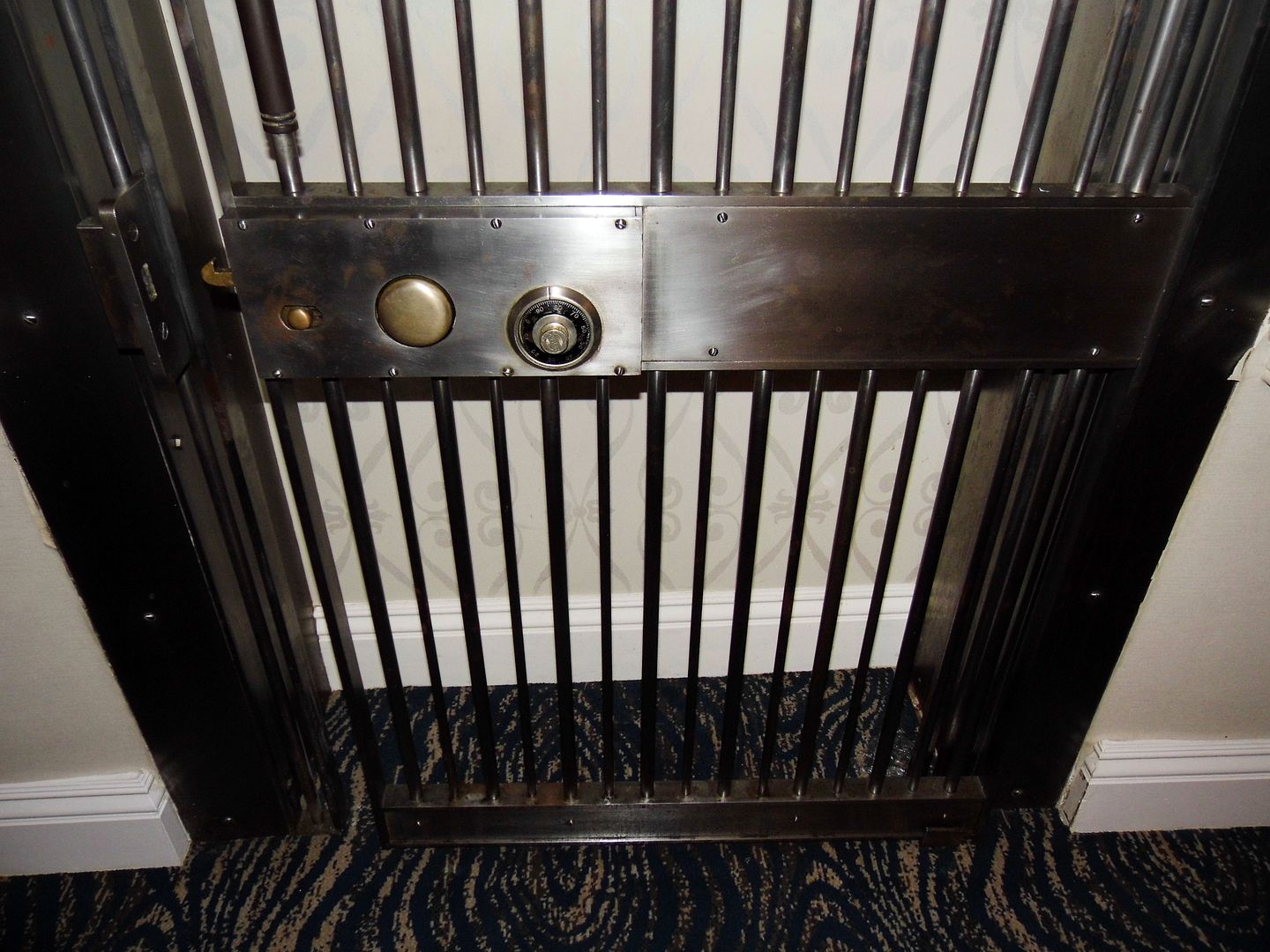


...though the "Donsteel" security doors on display are just for show.
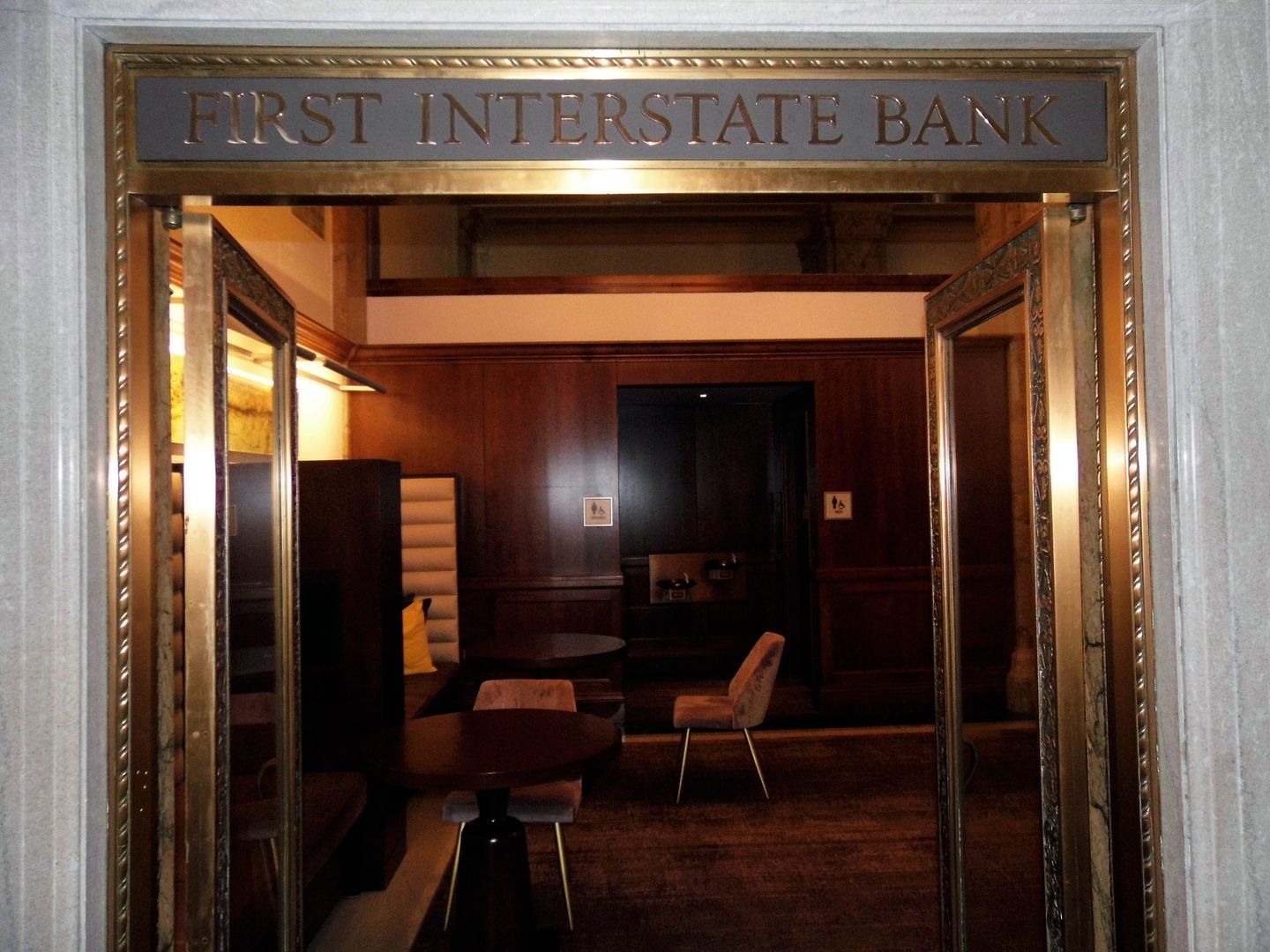


San Diego Trust and Savings Bank managed to stay a family business—run by descendants of the bank's co-founder and first president Joseph Weller Sefton, Sr.—until 1994, when the Sefton family decided to get out of banking and sold all 53 branches to the LA-based First Interstate Bank, which was later acquired by Wells Fargo. In 1996, Wells Fargo unloaded several of its San Diego properties and closed up shop on SDTSB.
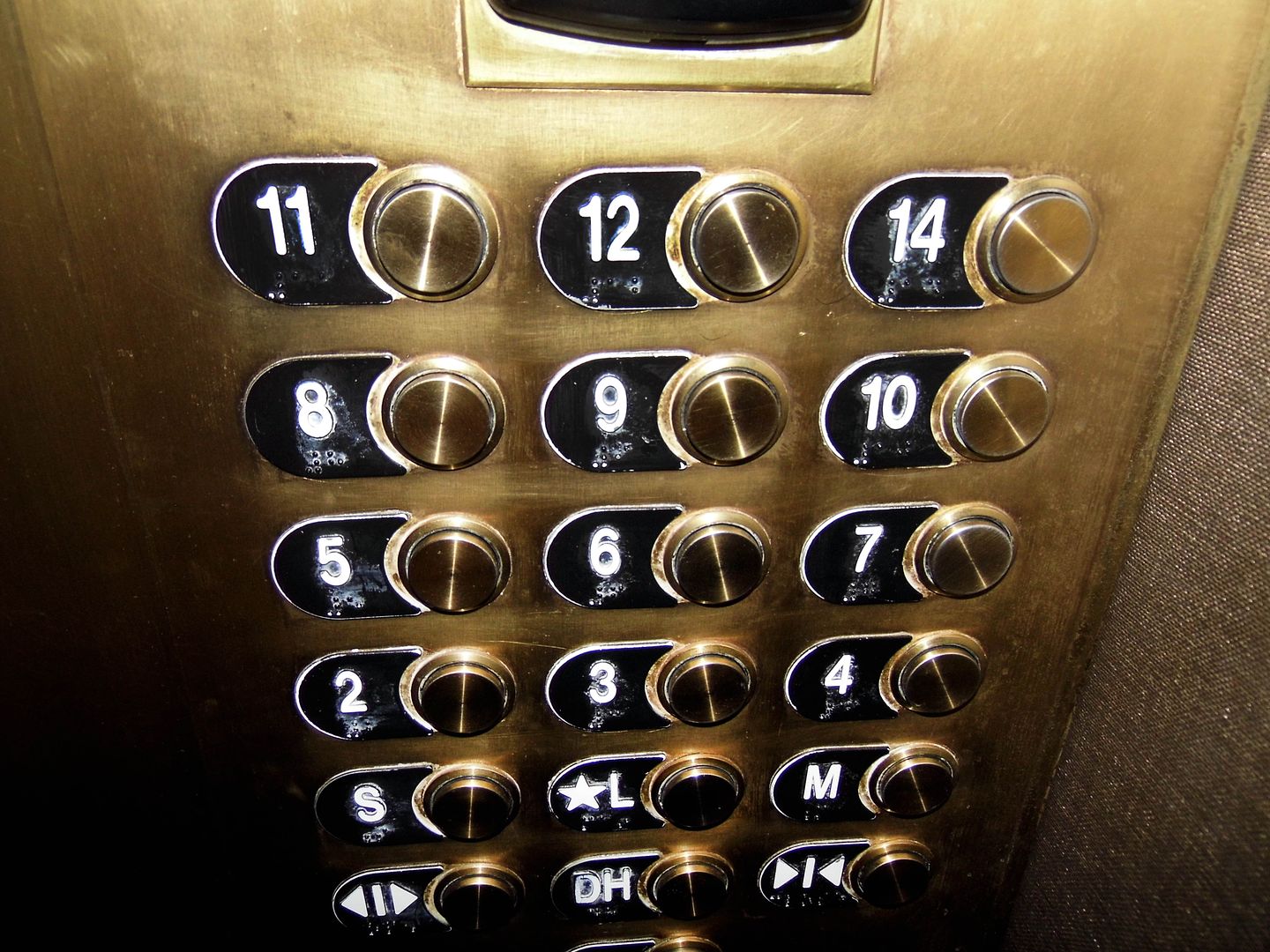


In its heyday, the bank owned the entire building and occupied most of it—with the exception of the 7th floor's FBI offices and holding cells! (Note how the elevator eliminates the 13th floor, which was rechristened the 14th floor.)
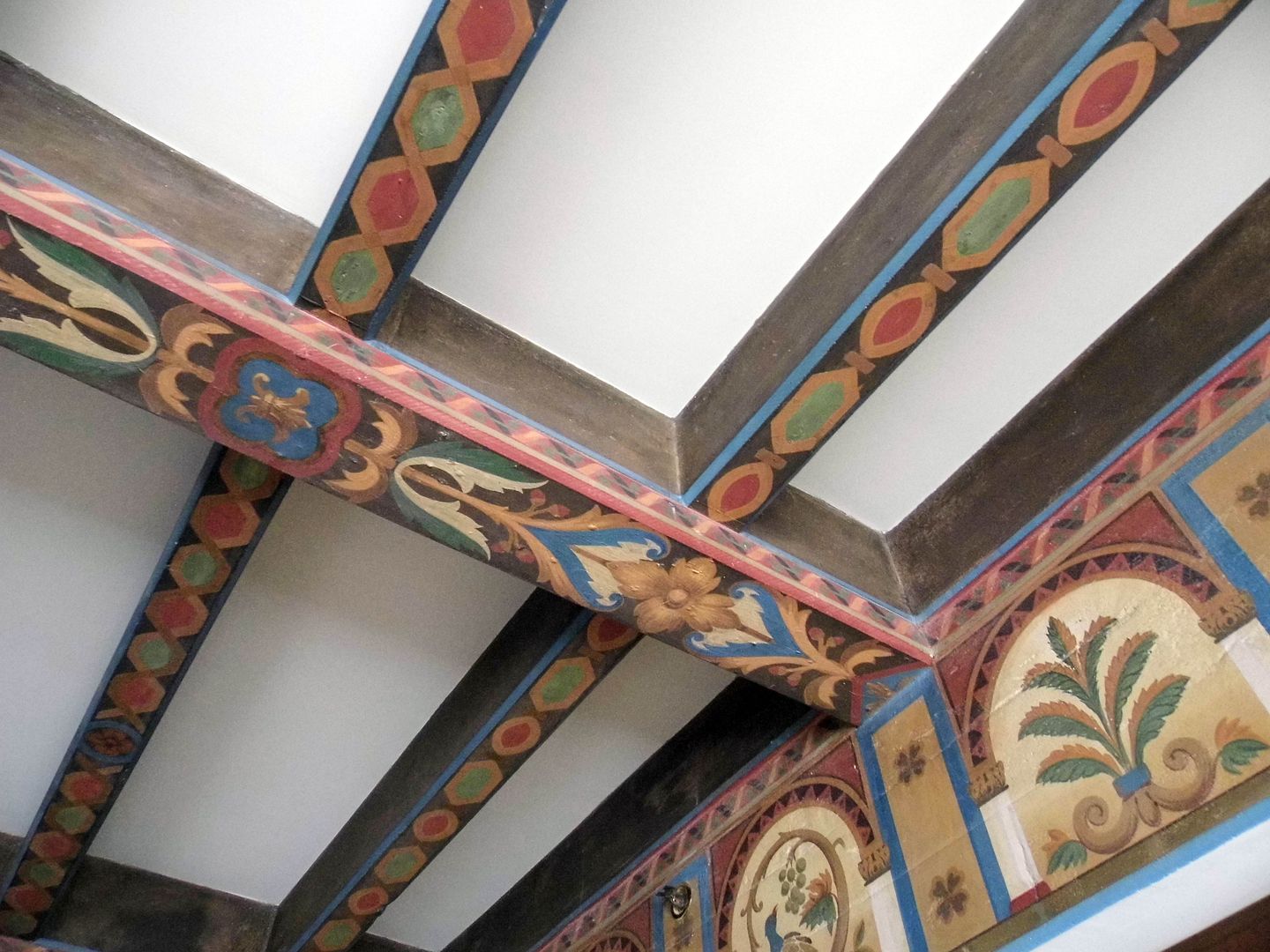


A shooting gallery (for lady tellers to practice their aim in case of a bank robbery) shared the top floor with architect William Templeton Johnson, who occupied a 1,000-square-foot office until 1954. The space is now used as the hotel's Presidential Suite, its master bedroom located in Johnson's former library (decorated with the same kind of hand-painted ceiling as in the Grand Lobby).
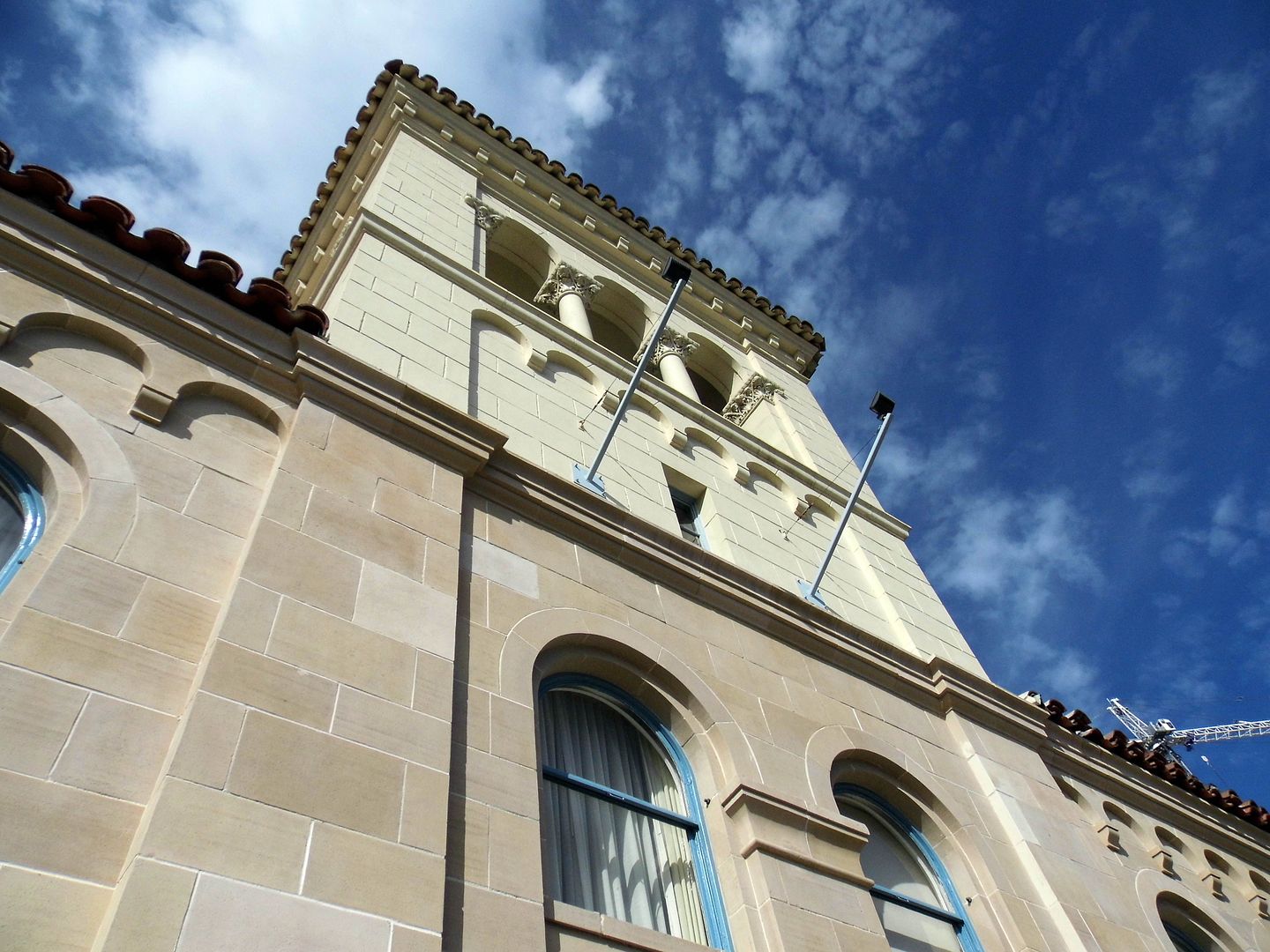


Exit onto the patio outside the Presidential Suite, and the view reveals yet another level, above the 14th floor.
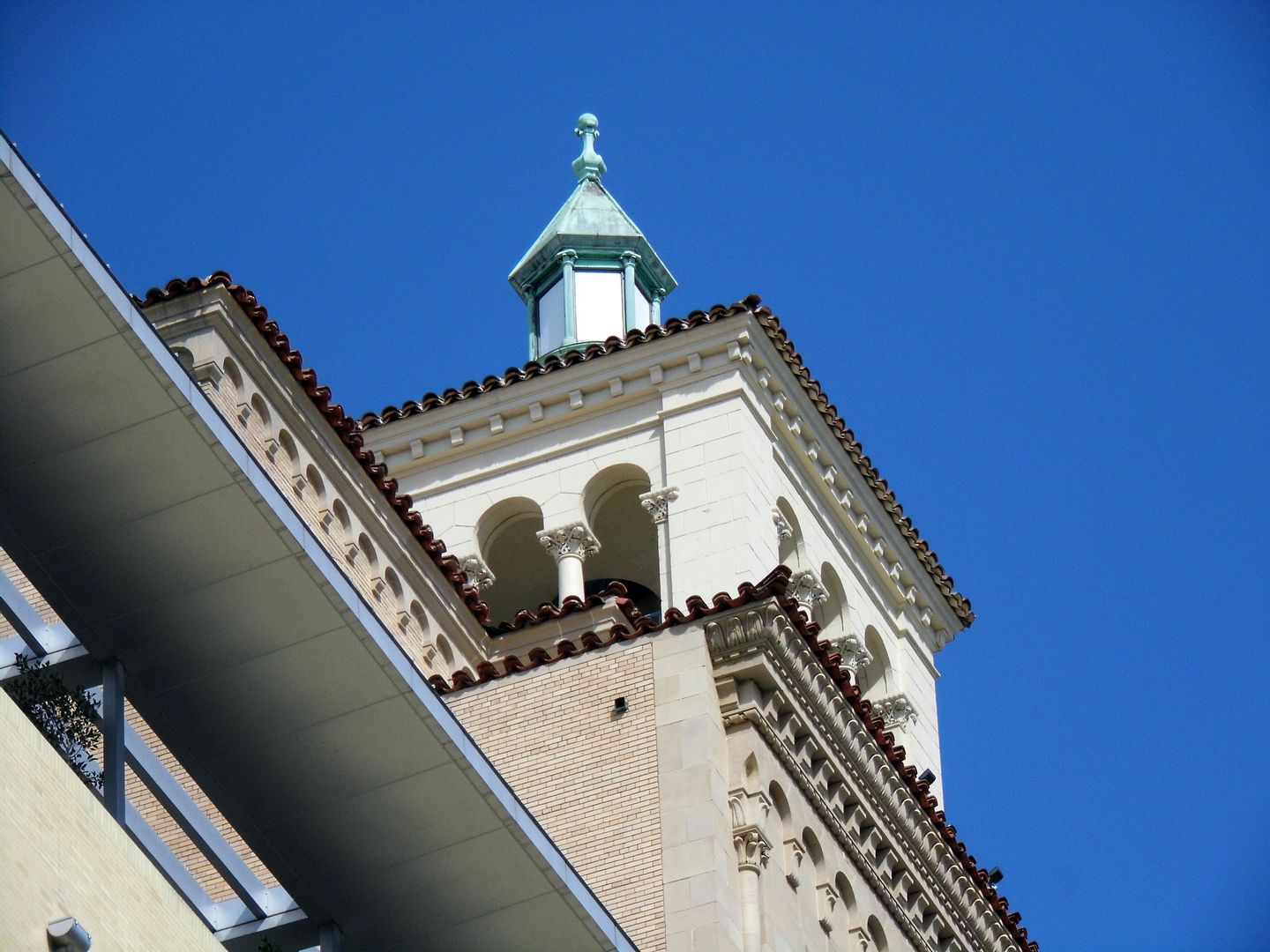


It's the copper-domed cupola, a.k.a. the "Lantern," which housed San Diego's first aviation beacon—243 feet above where the Hotel Beacon once stood. This was a really biug deal for San Diego, which had become known as "The Air Capital of the West" in World War I.
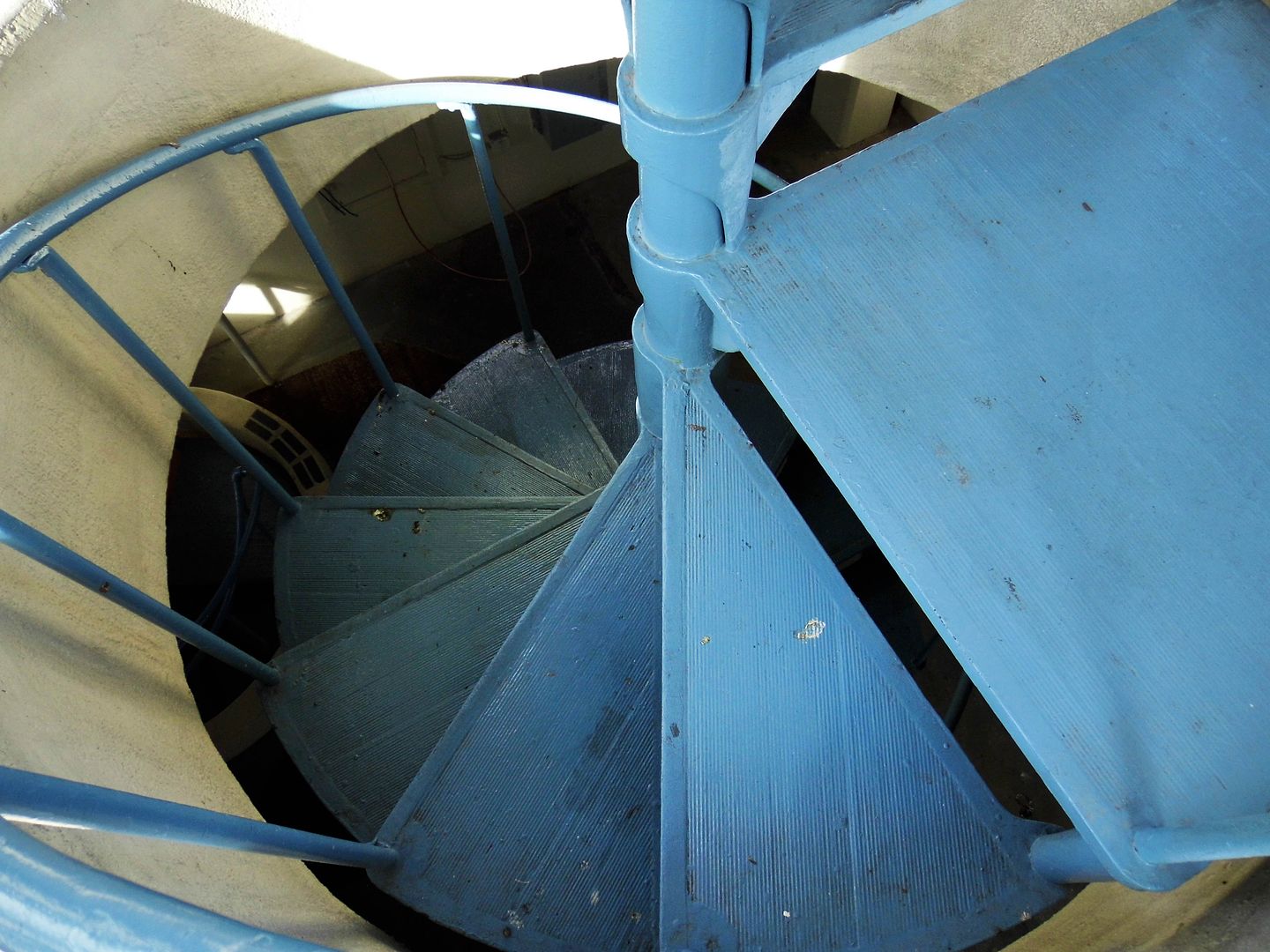


Appropriately, the "Father of San Diego Aviation" Major T.C. Macaulay dedicated the beacon, and pioneering aviator Eddie Stinson first switched it on. Visible for more than 25 miles, it revolved from dusk till dawn to guide aviators and navigators trying aim their planes toward the airport—but only during its first five years.
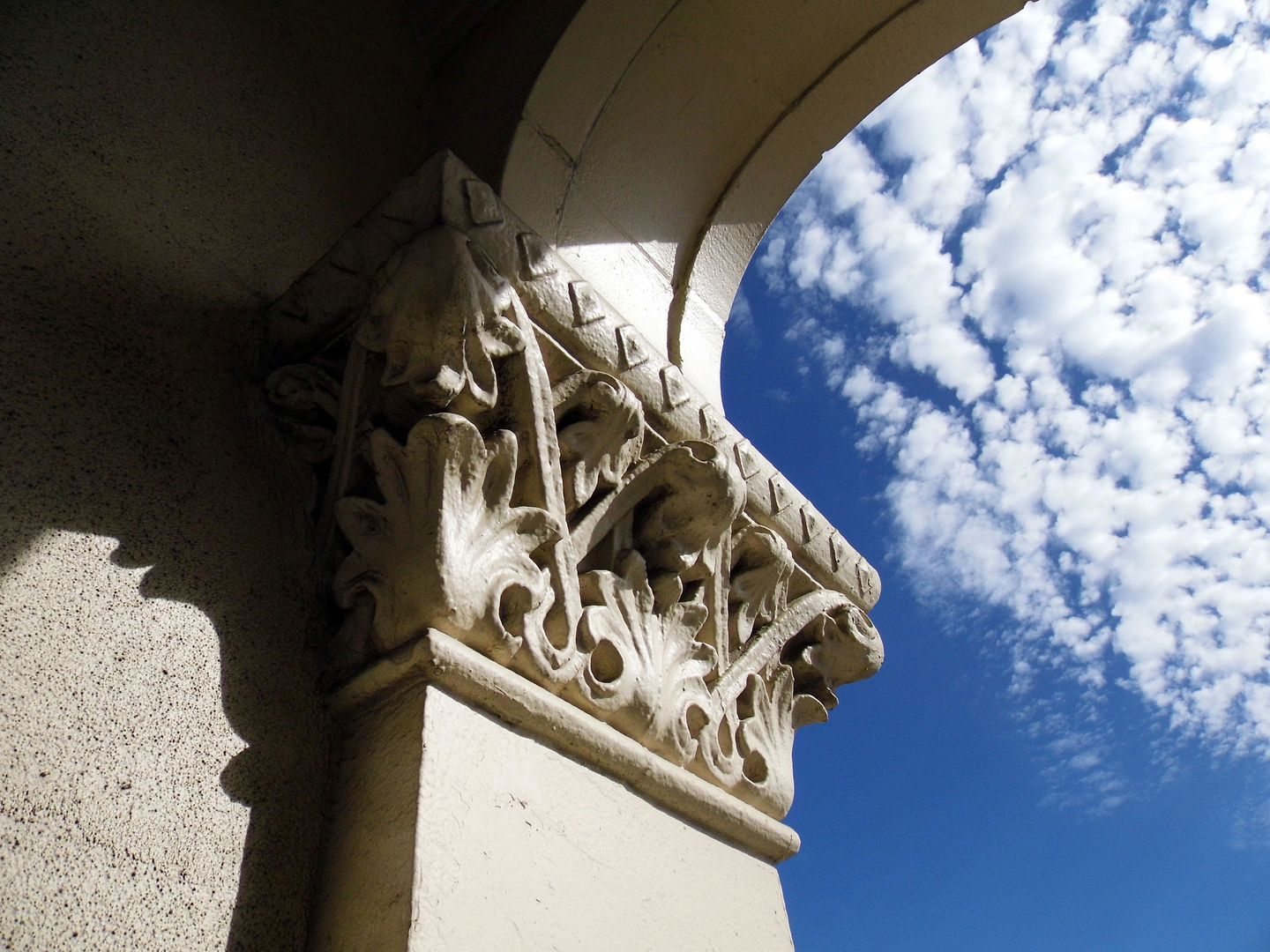


They'd also light the beacon when a ship was coming into the Port of San Diego—not only to help it avoid getting wrecked but to also notify local laborers that jobs were opening up.
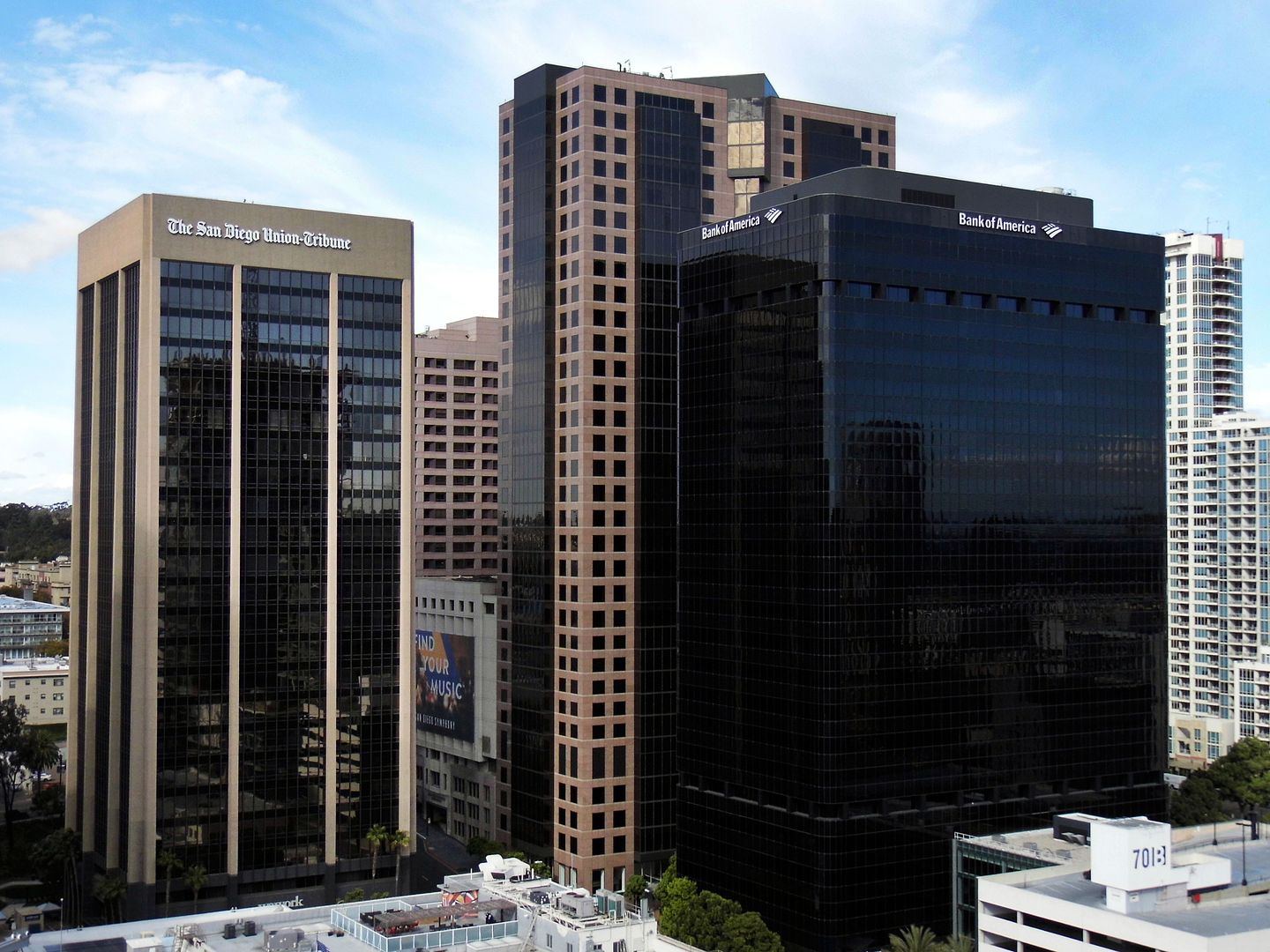


Today, the cupola still provides one of the best panoramic views of Downtown San Diego—certainly the best I've seen. Unfortunately, you can't just go up there on your own.

But ask a bellman to give you a tour, and he'll gladly oblige.

When the new San Diego Trust and Savings Bank building opened in 1928, it was the year before the stock market crash that kicked off the Great Depression. But the bank was steadfast.

The bank's second president, M.T. Gilmore, assured its customers that "the present situation is not nearly so perturbing as a more restricted view might suggest"—recalling that in the nearly 40 years since its founding, they'd already experienced five periods of "panic," two wars, and mixed periods of revival and recession.

"This, too, will pass" were the words that continued to carry San Diego Trust and Savings Bank through the next 66 years until the later generation decided to throw in the towel.

Fortunately, the doors on the bank didn't close forever—because it reopened as a hotel in 1999, preserving and reusing a large majority of original elements for the building's new purpose.

Related Posts:
Breathing New Life Into the Eyesores of Downtown LA

December 09, 2019

Chasing An Endangered Species of Art at Sunset and Vine

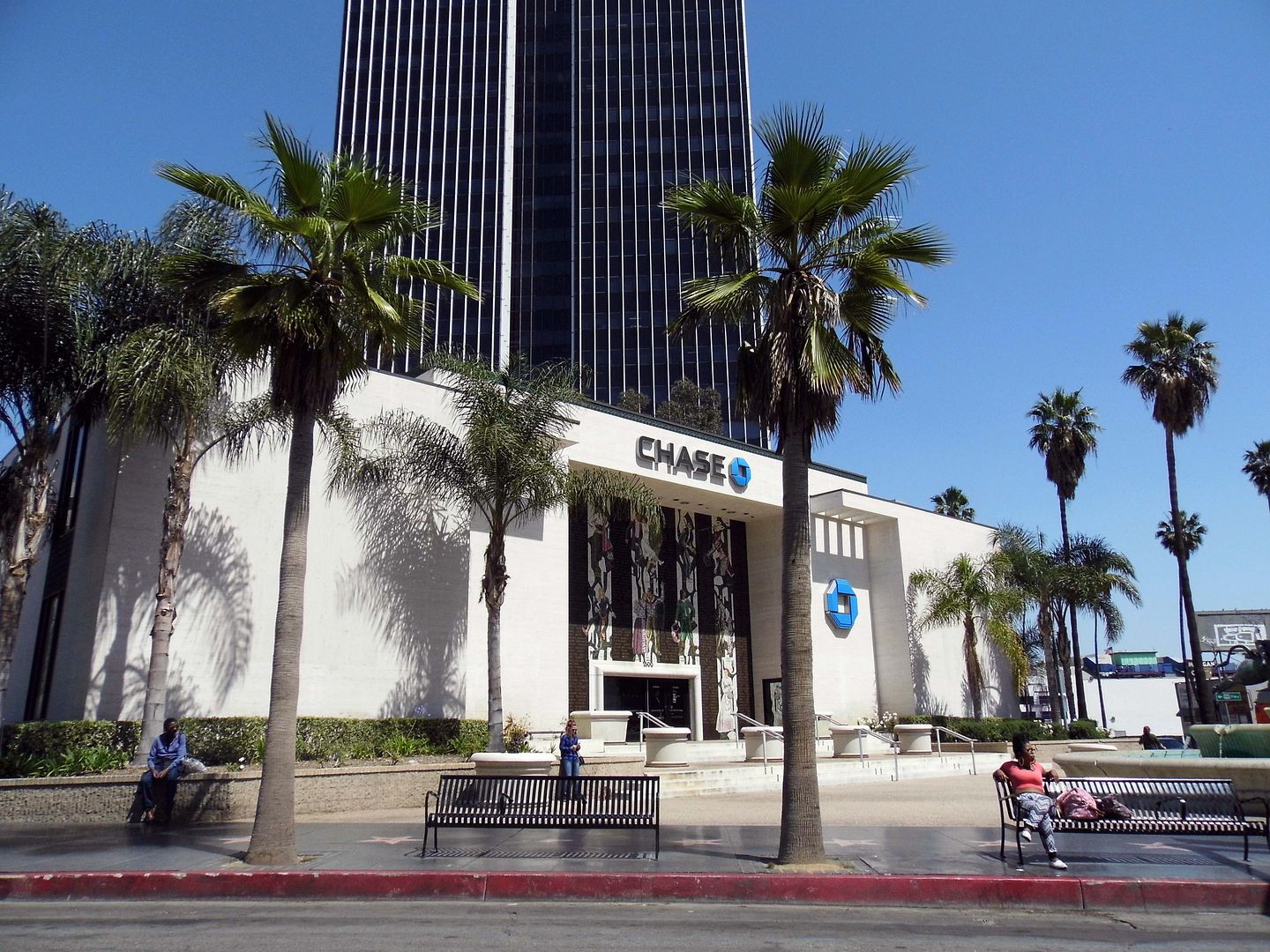
After the devastating removal of the Millard Sheets mural from the former Home Savings in Santa Monica, coupled with the closure of The Marciano Art Foundation, I decided it was time to finally go explore the former Home Savings at Sunset and Vine that features Sheets's most "Hollywood" mosaic ever.


It's a complicated corner—because while what's there now is a masterpiece circa 1968, it nudged out a beloved piece of Hollywood history (much like the Chase Bank did at the site of the Garden of Allah a few miles west down Sunset Boulevard).


This was the original location of one of Hollywood's first movie studios, Burns and Revier Studio and Laboratory. And this is where the Jesse L. Lasky Feature Play Company filmed parts of Hollywood's first full-length motion picture, The Squaw Man, in 1913. (The studio's Lasky-DeMille Barn, originally used for dressing rooms, was subsequently moved several times—eventually landing in empty lot off Cahuenga, across from the Hollywood Bowl, and housing Hollywood Heritage).


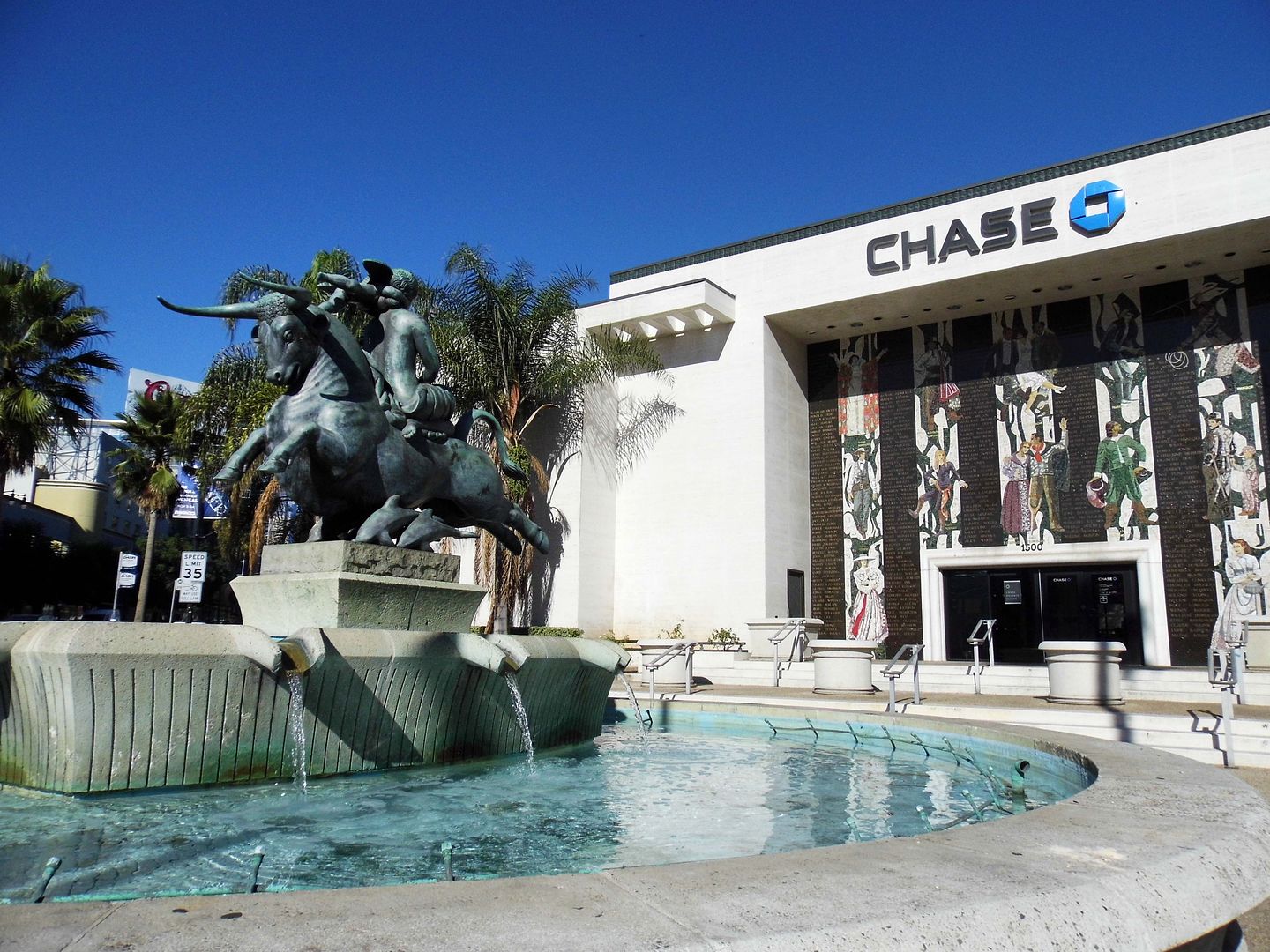
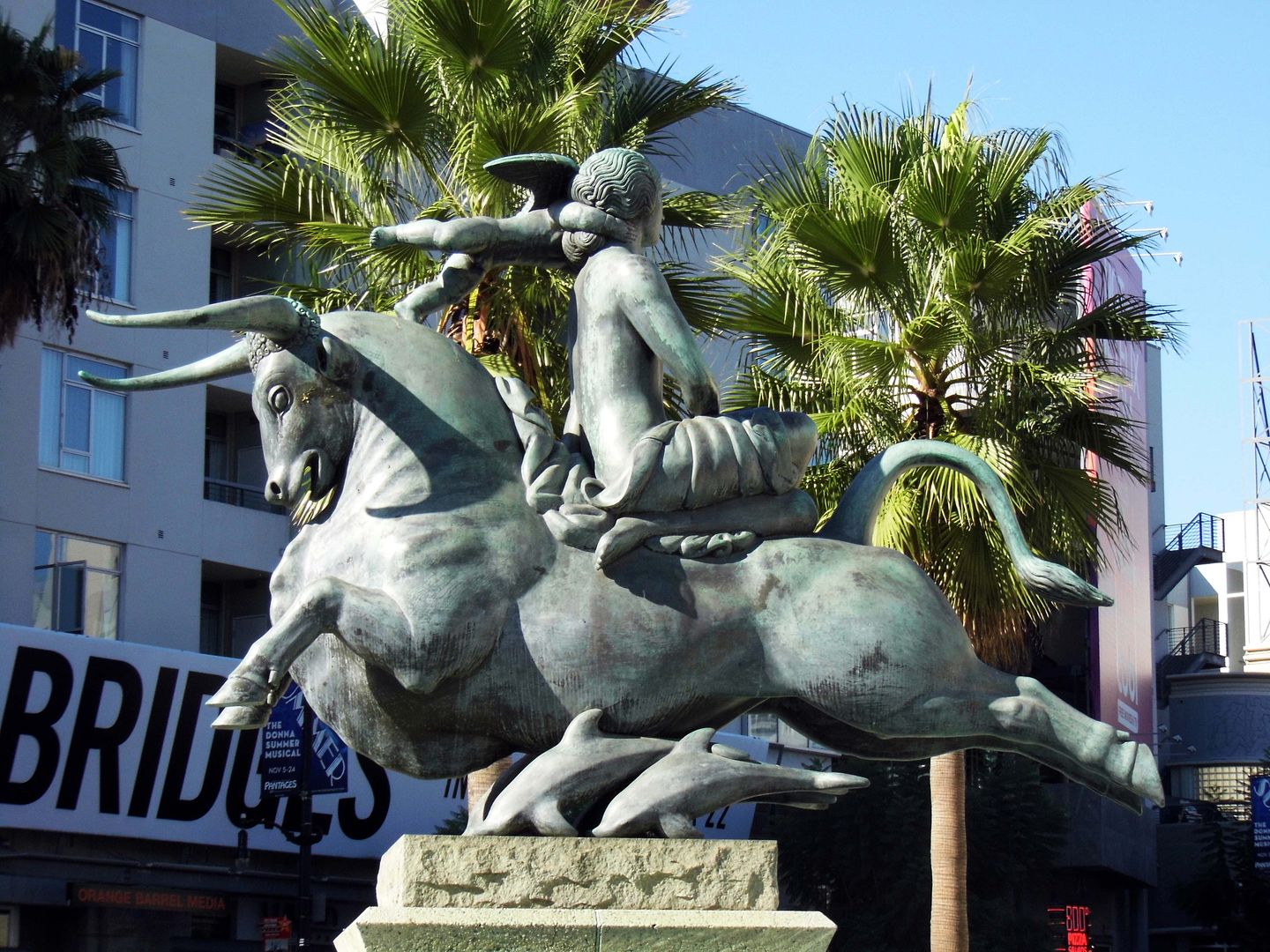
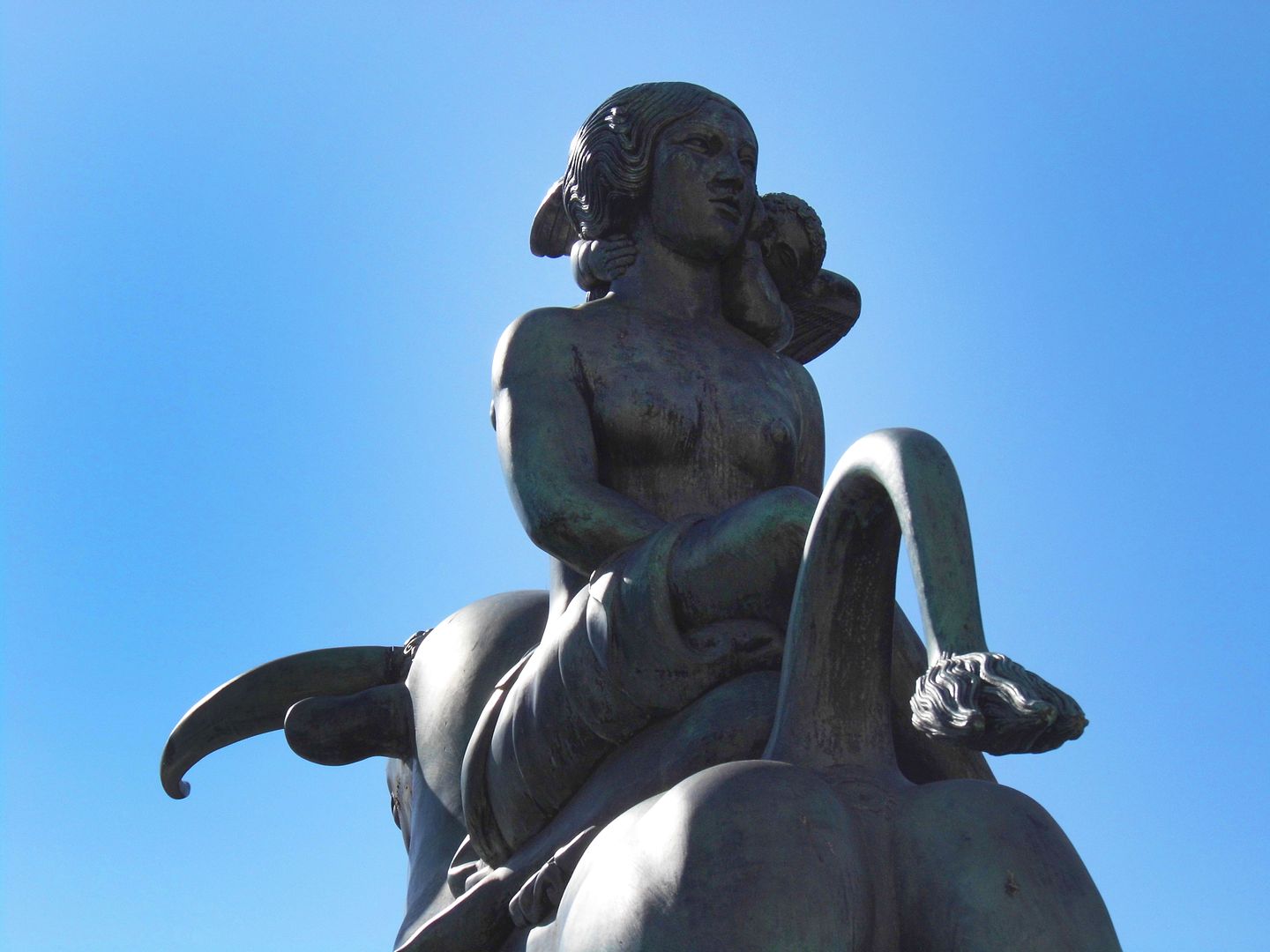
Now it's a showcase for Millard Sheets's architecture and art—about as site-specific as you can get—as well as for an important piece of public art, "The Flight of Europa" by sculptor Paul Manship, best known for his Prometheus sculpture at Rockefeller Center in New York City.


Although the sculpture was reportedly intended for a swimming pool—with water symbolizing the Mediterranean—it's well-suited to the fountain that anchors this corner of Hollywood.


It's an eyecatcher for sure—as Europa, a Phoenician maiden (and namesake of Europe), rides the back of a bull that's actually Zeus in disguise. Cupid whispers in her ear, perhaps preparing her to lose her virginity once they reach Crete.


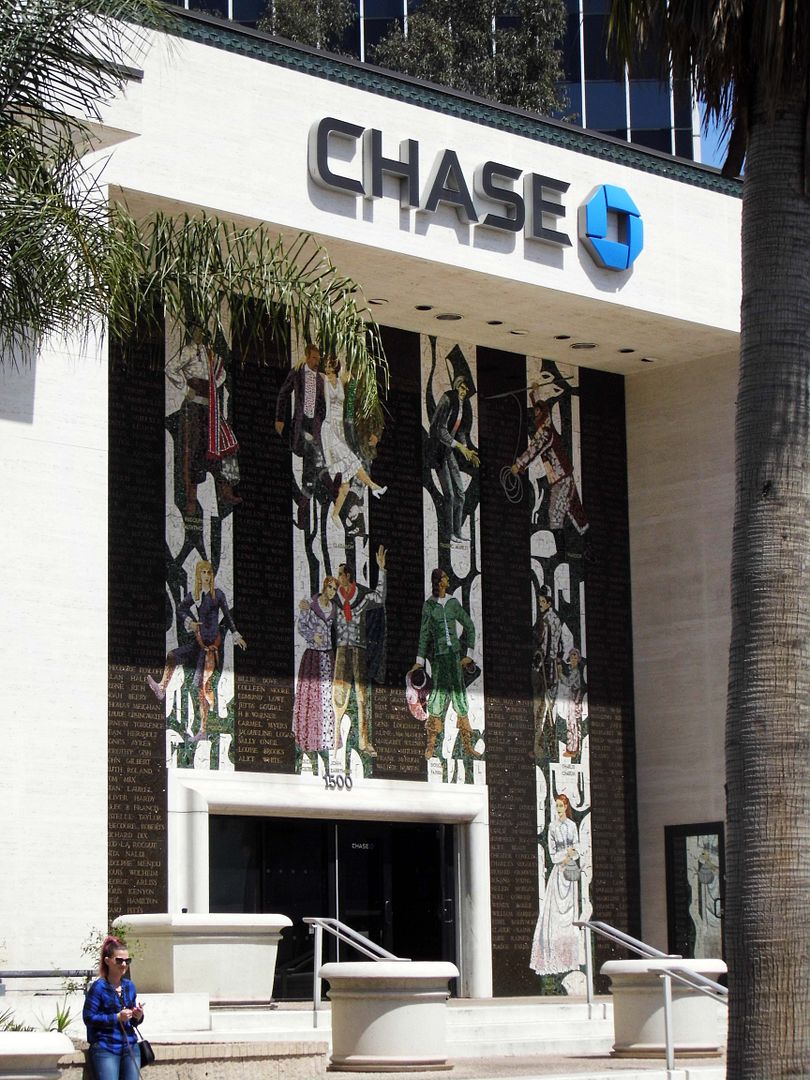
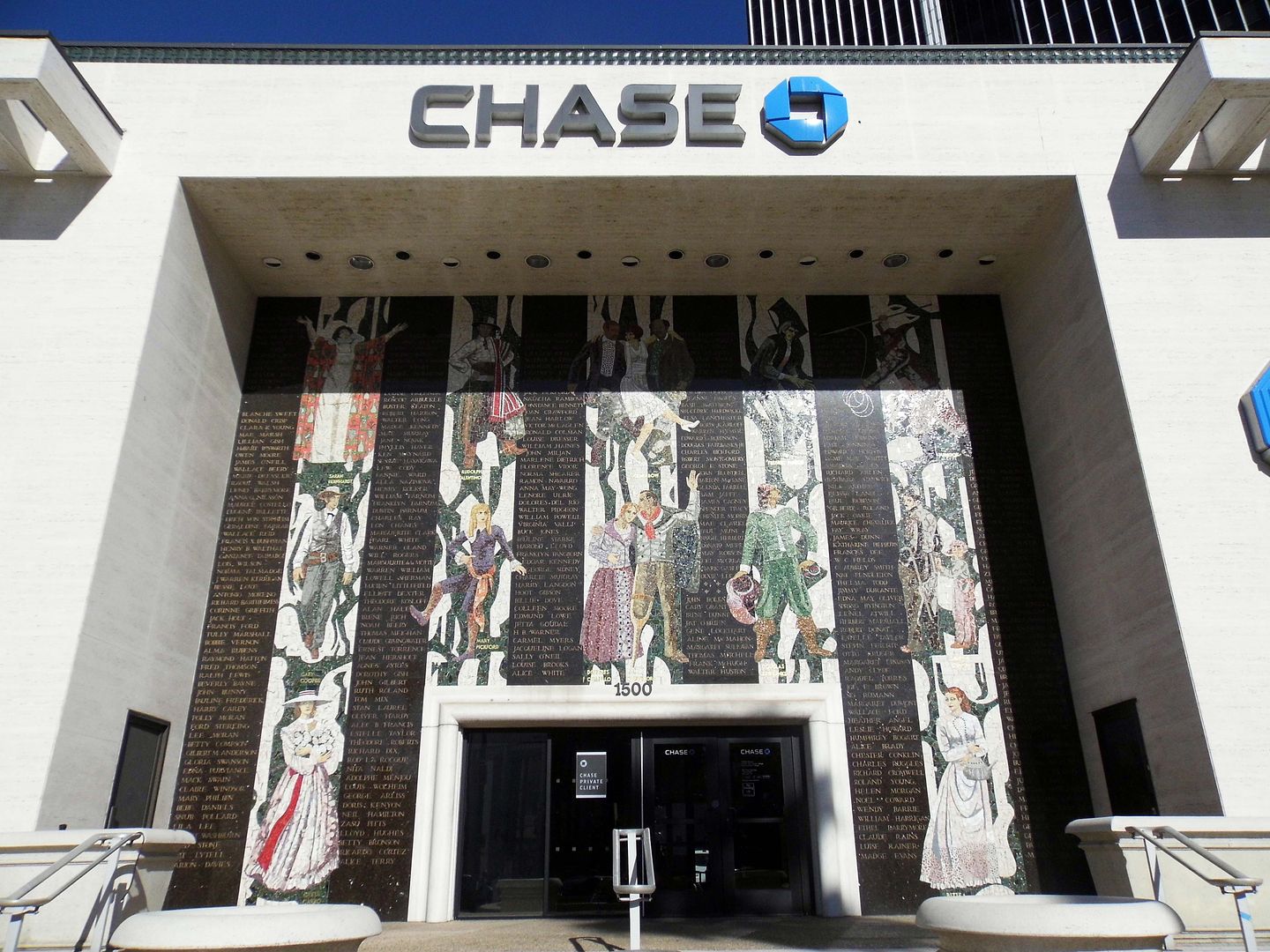
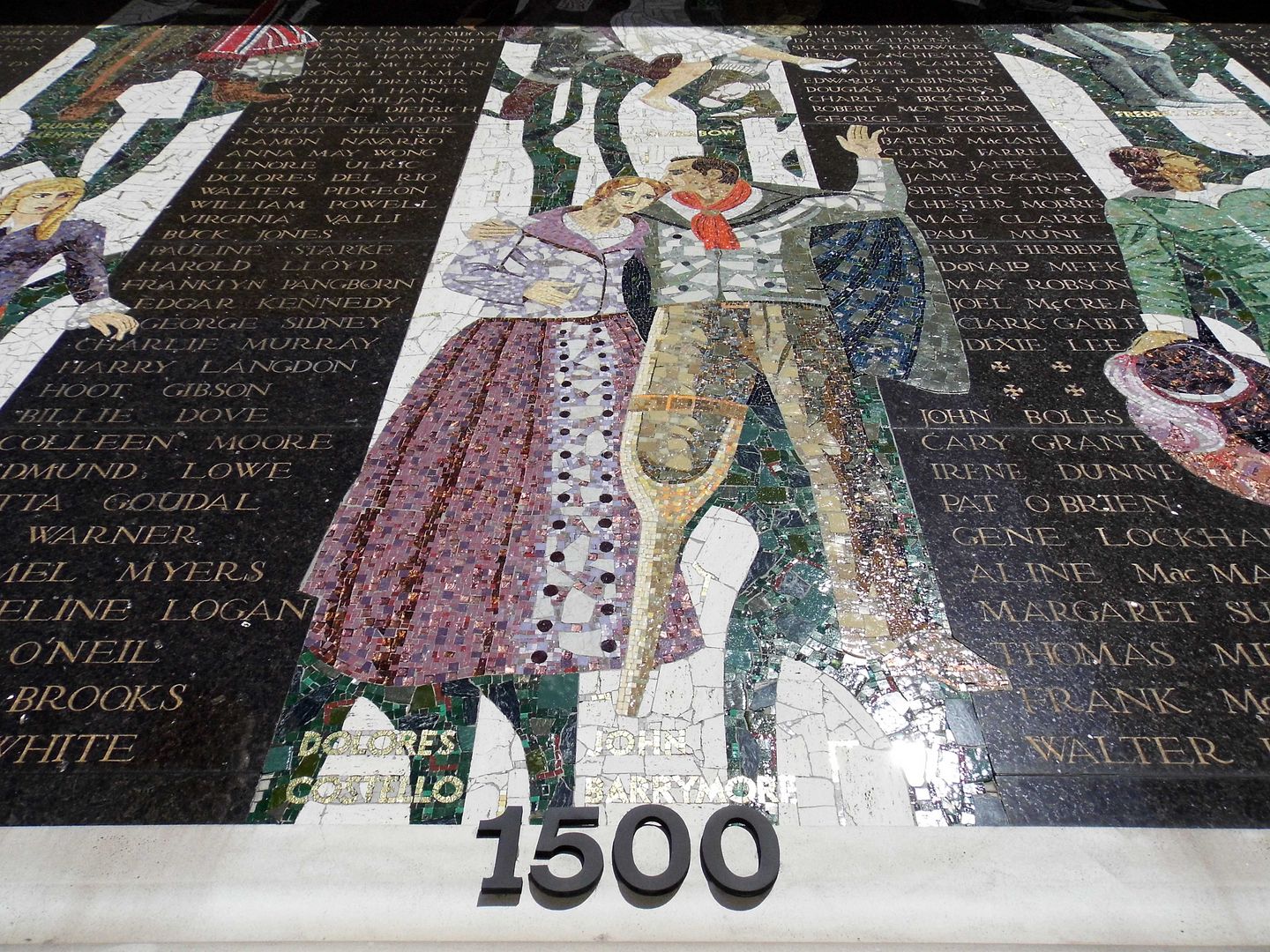
But the real attraction of this mid-century New Formalist-style bank building lies between the black granite panels of the entry façade...


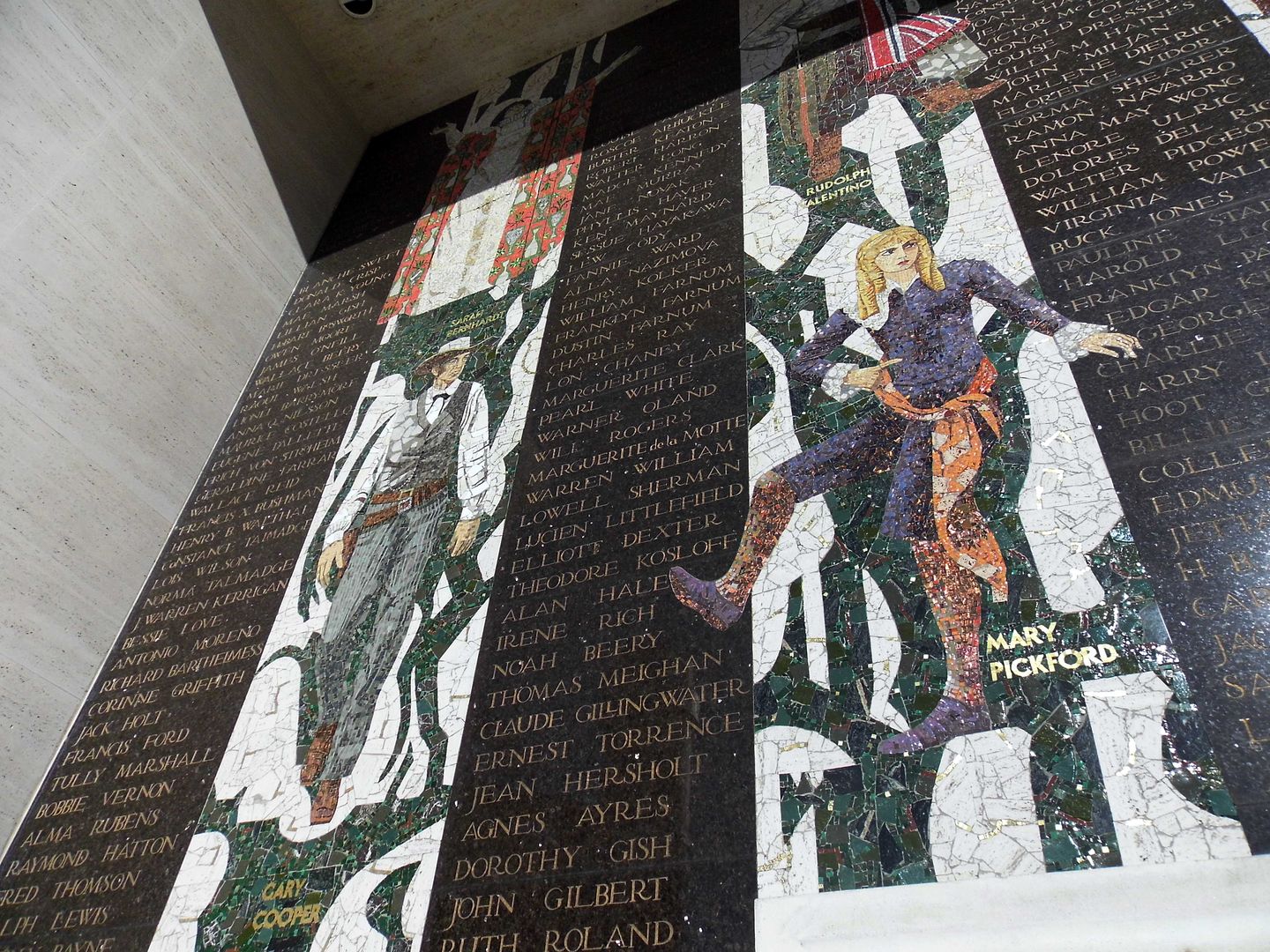
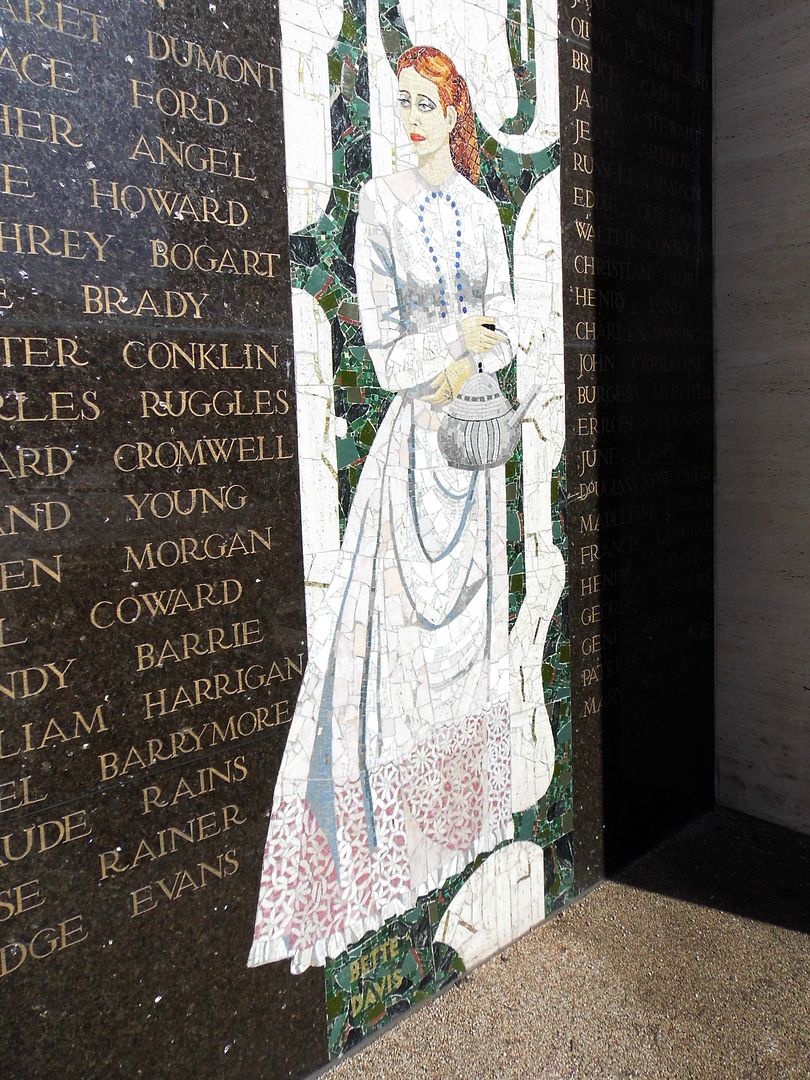
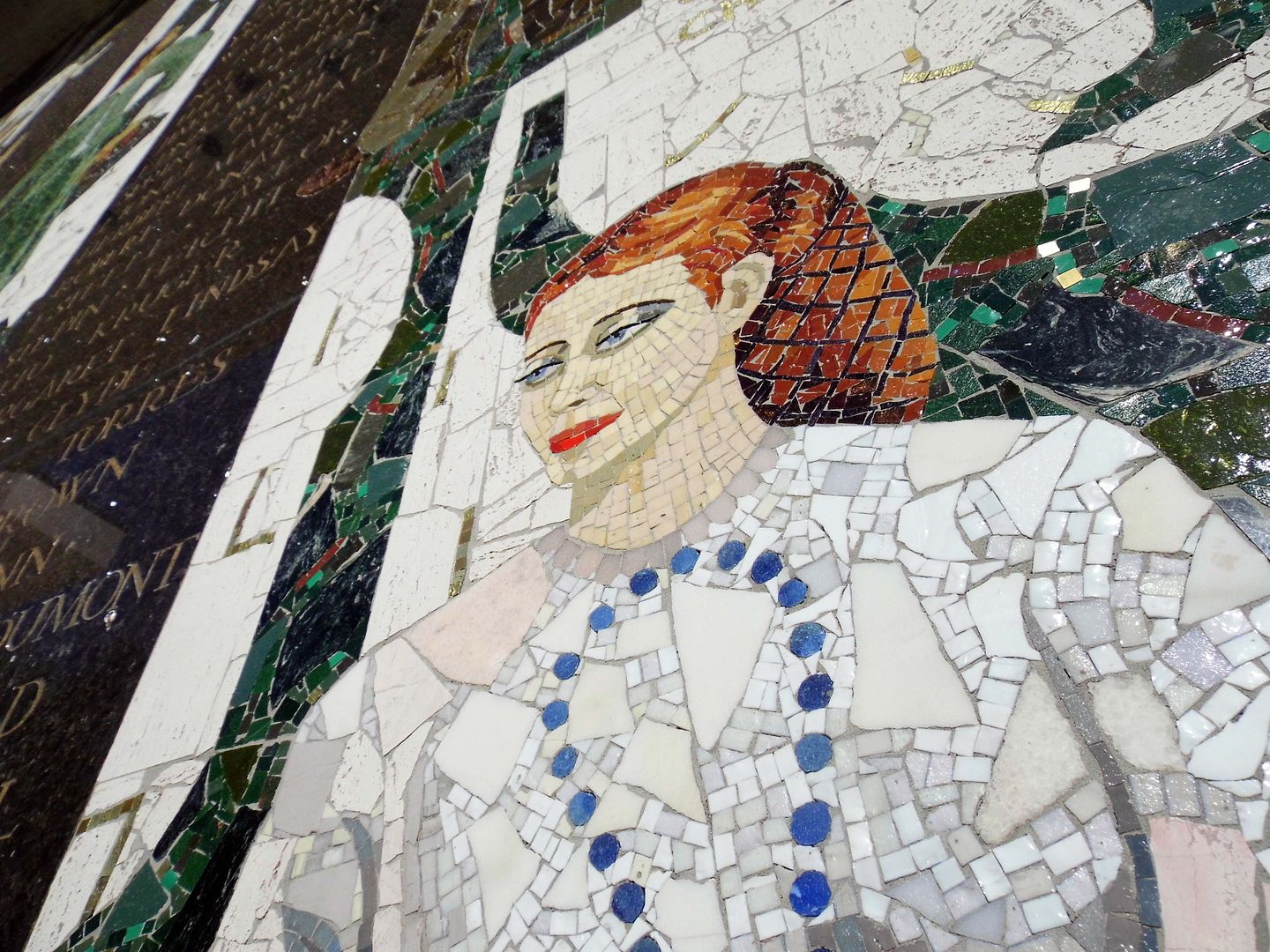
...and that's the mosaic renderings of Hollywood's biggest stars, like Charlie Chaplin, Gary Cooper, Mary Pickford, Rudolph Valentino, Clara Bow...


...and Bette Davis, in character from her Academy Award-winning role in Jezebel.


Among the 40 Home Savings banks that Sheets was commissioned to design, this one was reportedly his favorite. Maybe that'll save it from demolition one day.


I'd driven by this branch so many times but had never even walked up close to it—so I was eager to see what's inside.


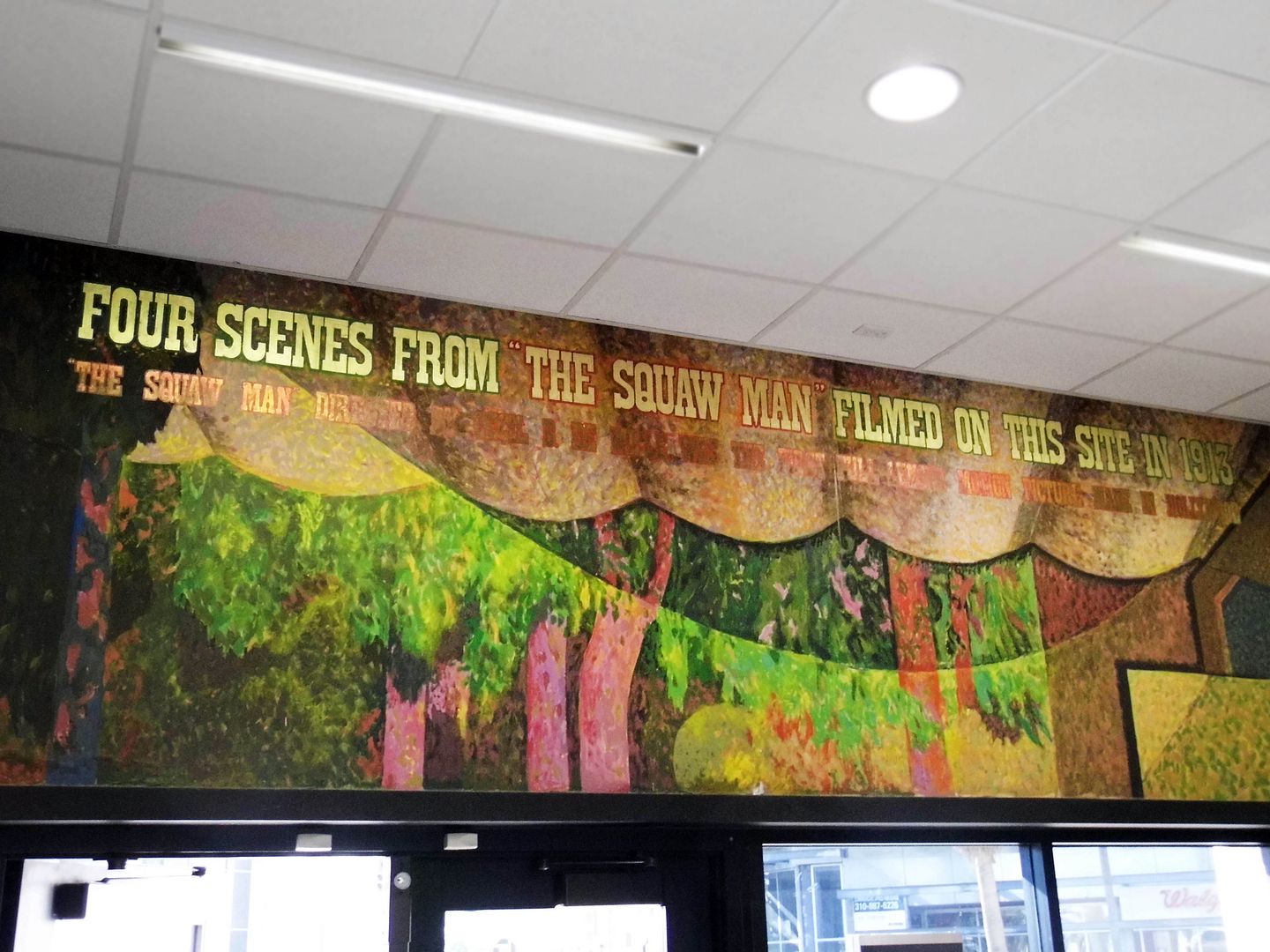
Beneath a dropped ceiling in the front lobby, there's a wall mural that pays tribute to The Squaw Man. But otherwise, it's unremarkable—until you reach the back entrance.


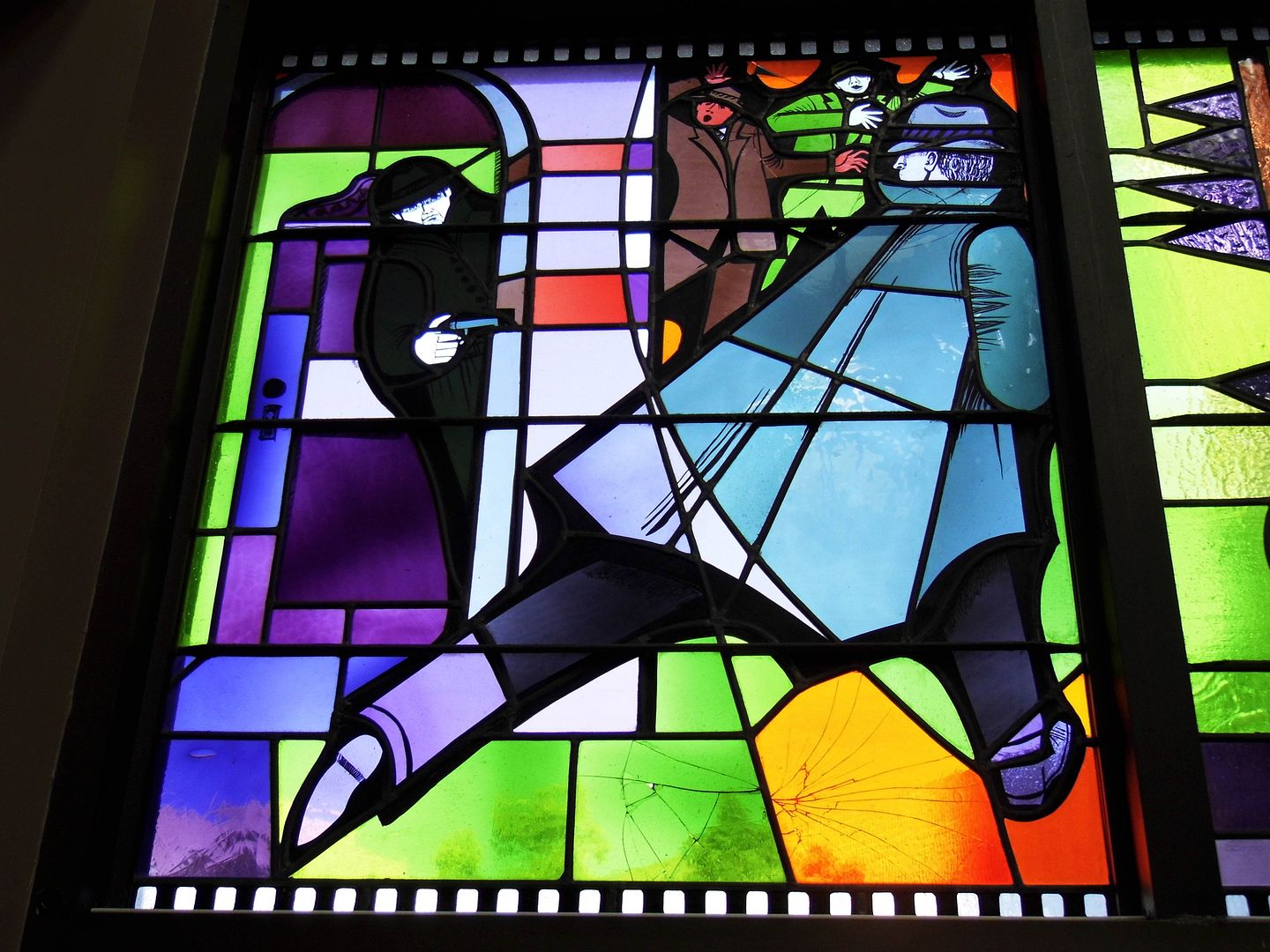
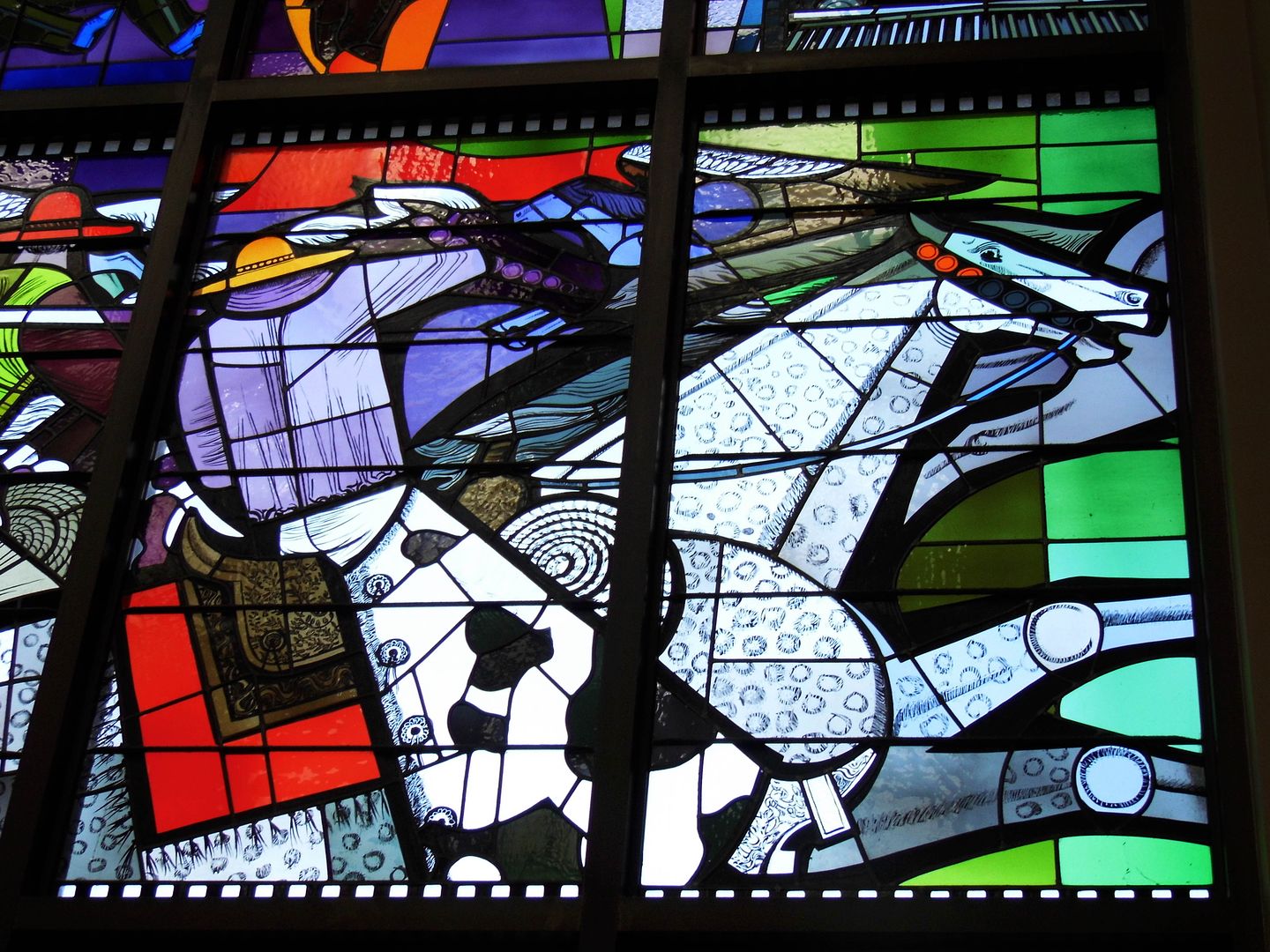
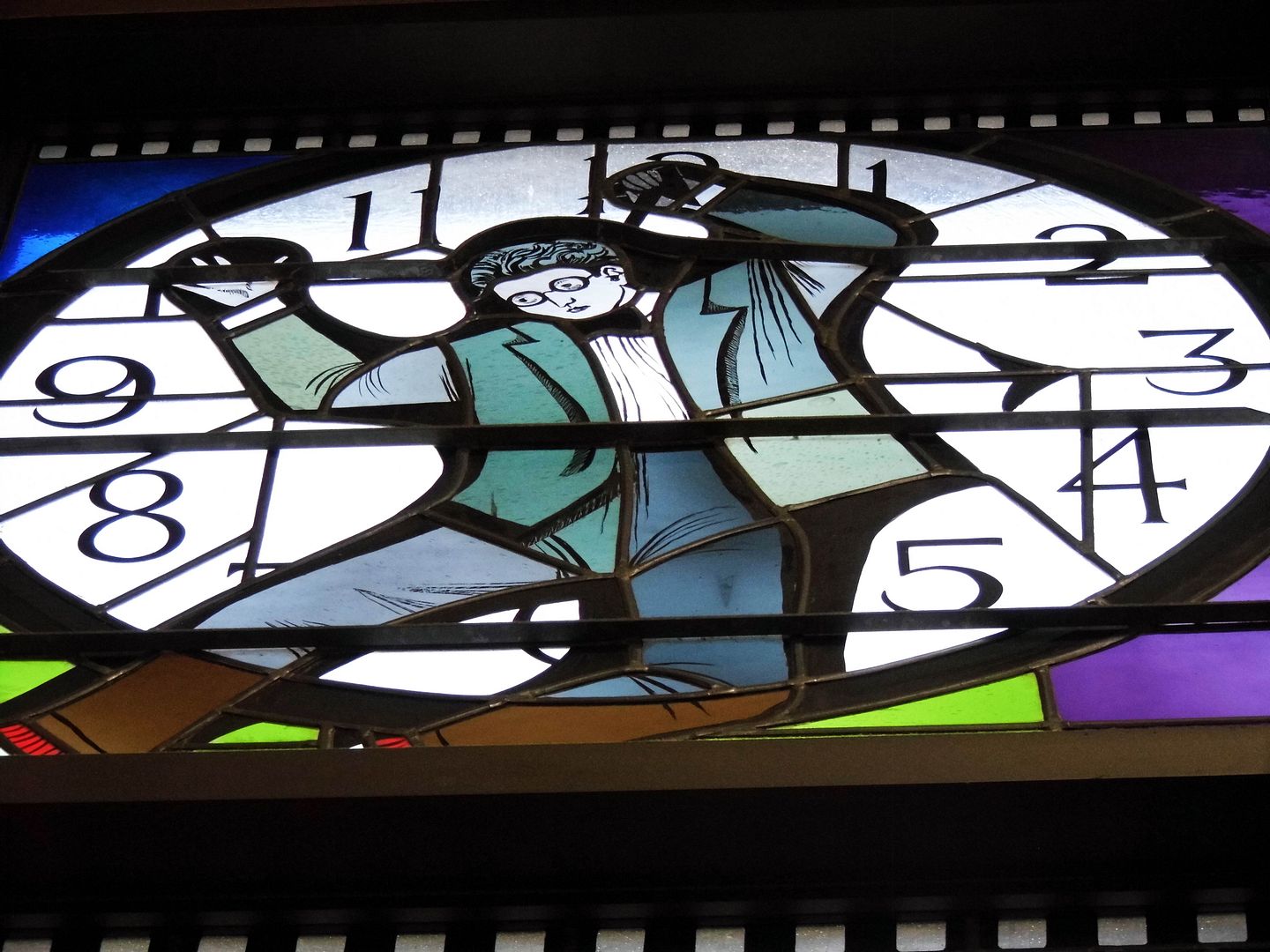
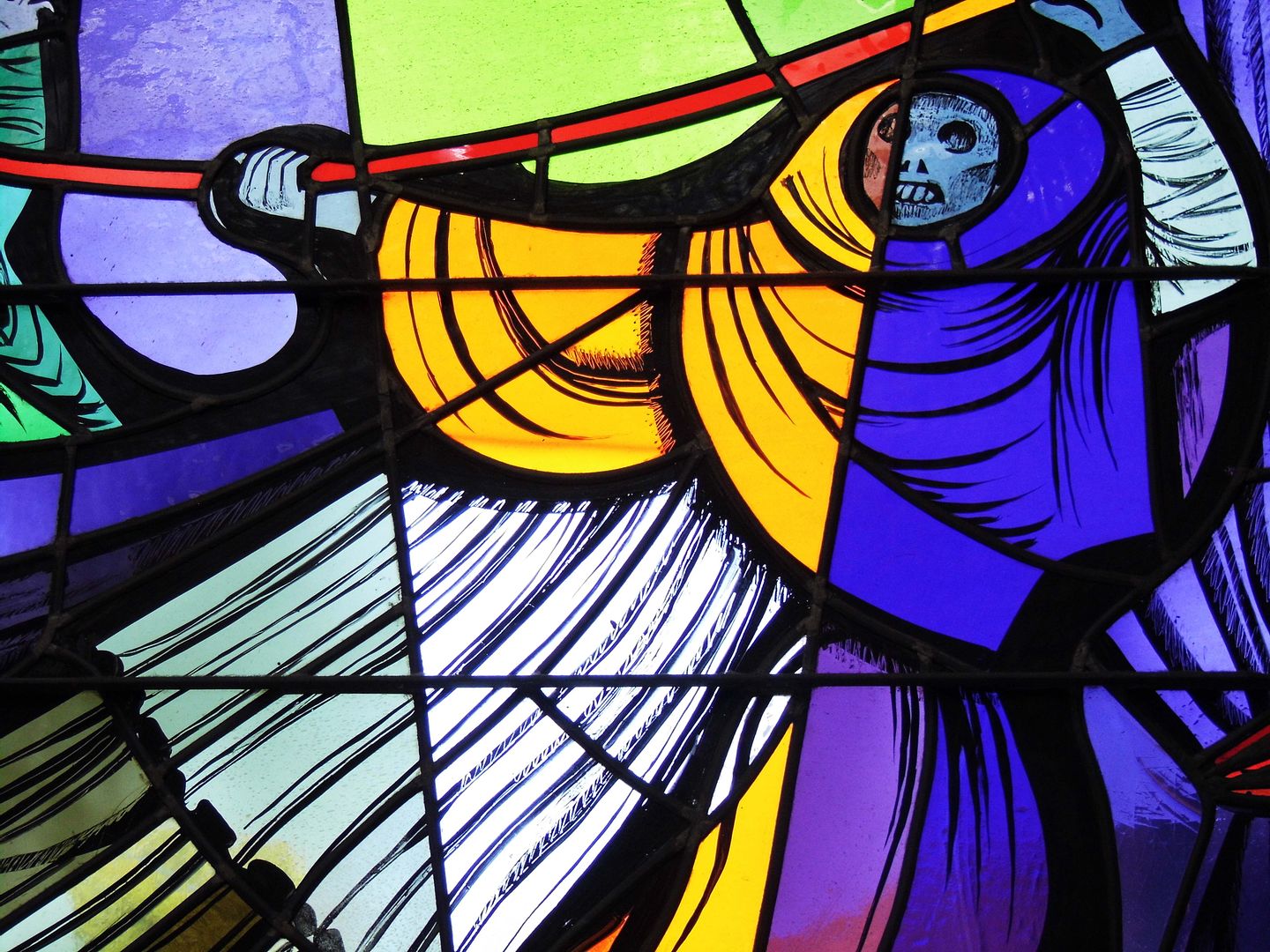
Bidding farewell to those exiting the bank is a unique grouping of stained glass windows by Susan Hertel...


...styled like a series of film strips...


...and depicting famous chase scenes featuring everyone from the Keystone Kops to Harold Lloyd.


Hertel was a frequent collaborator of Sheets, beginning as his art assistant and helping him design several of these Home Savings banks over the course of 26 years. (Fabrications were done off-site.)

What serendipity that these celluloid chases would make their way into what would become a Chase Bank.

Related Posts:
Photo Essay: It's Déjà Vu for Hollywood's Most Famous Imperiled Intersection
Another One Bites the Dust? Santa Monica Edition (Updated for 2019)
Photo Essay: Ever-Changing Hollywood, in Miniature Magic