Search

June 09, 2020

Peaking Poppies In a Pandemic

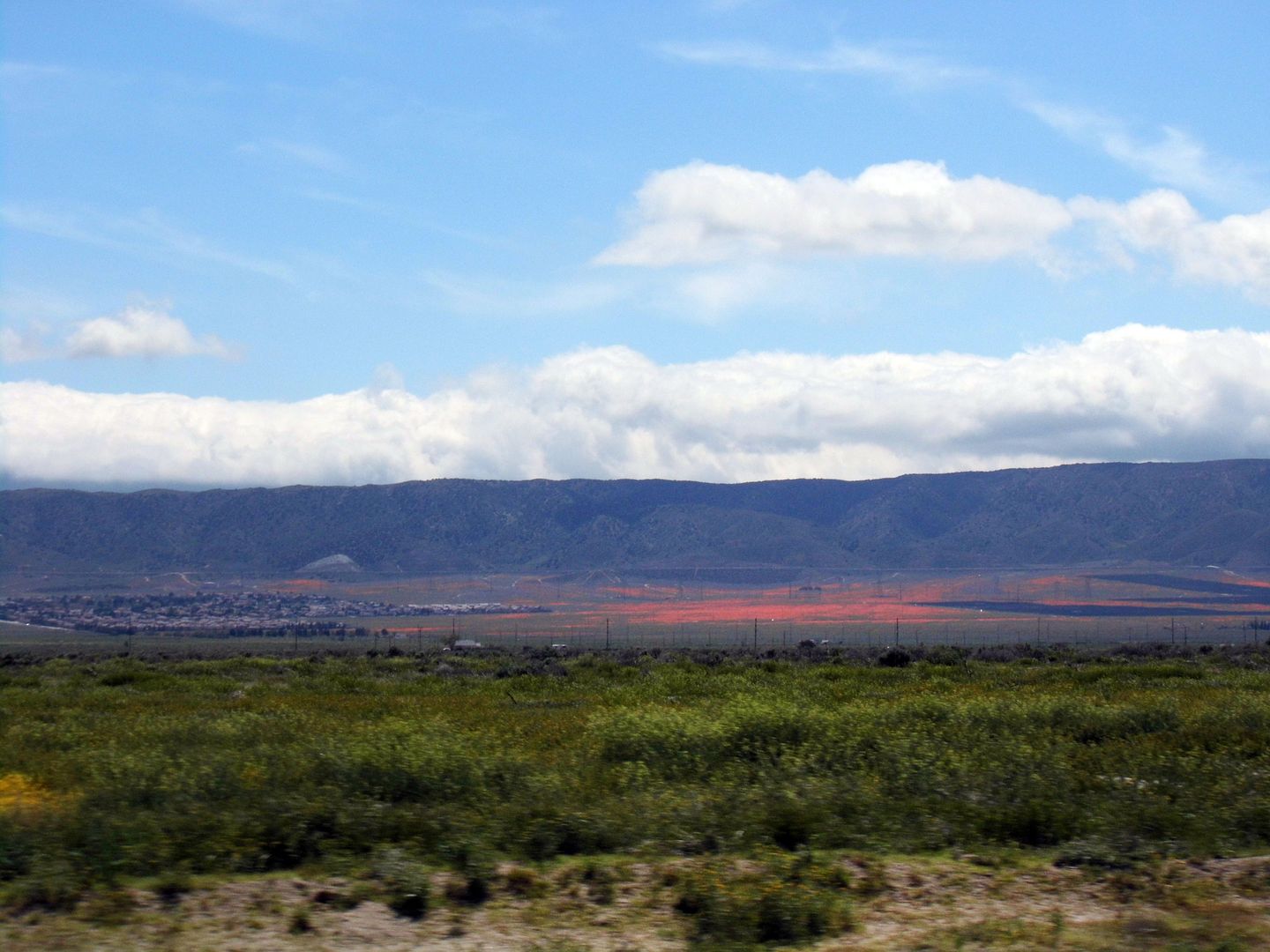
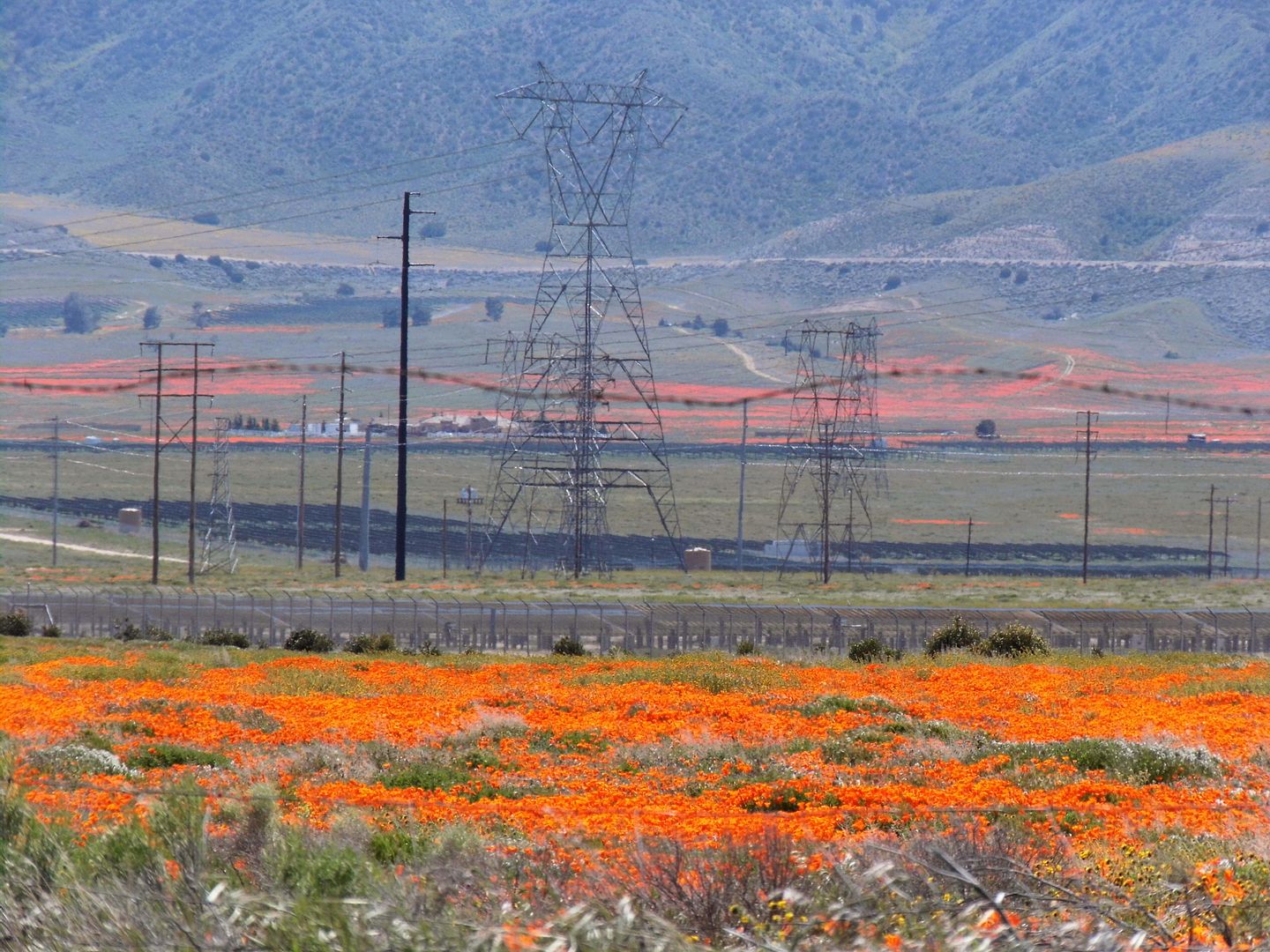
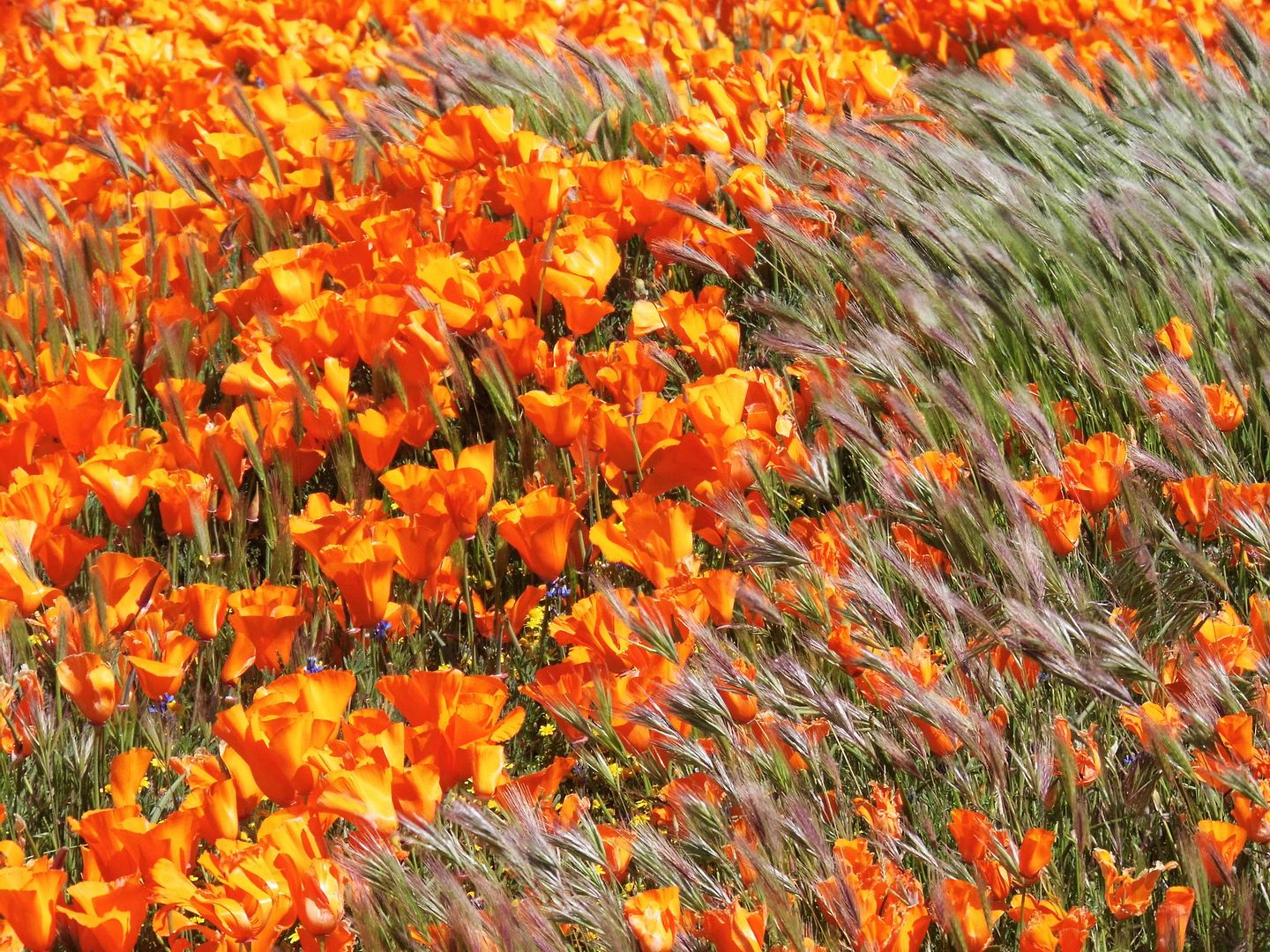
We had a mini superbloom in the Antelope Valley this spring—a late bloom boom that managed to stay incredibly intact because of the coronavirus "safer at home" guidance.


Maybe I should've stayed home. Maybe I would've been "safer" there. But after weeks of having my calendar curtailed, I realized there was something that COVID-19 hadn't canceled—and that I missed very much.


Nature had continued—and, in fact, thrived—without us.


I just wanted to see it in person—not on a live webcam from the Antelope Valley California Poppy Reserve's website, not from aerial photos or satellite images from space.


So, not knowing exactly where to go—where I could go, where I'd be allowed to go—I just drove to Lancaster, California in the direction of the state natural reserve, hoping to see a sign somewhere in the distance.


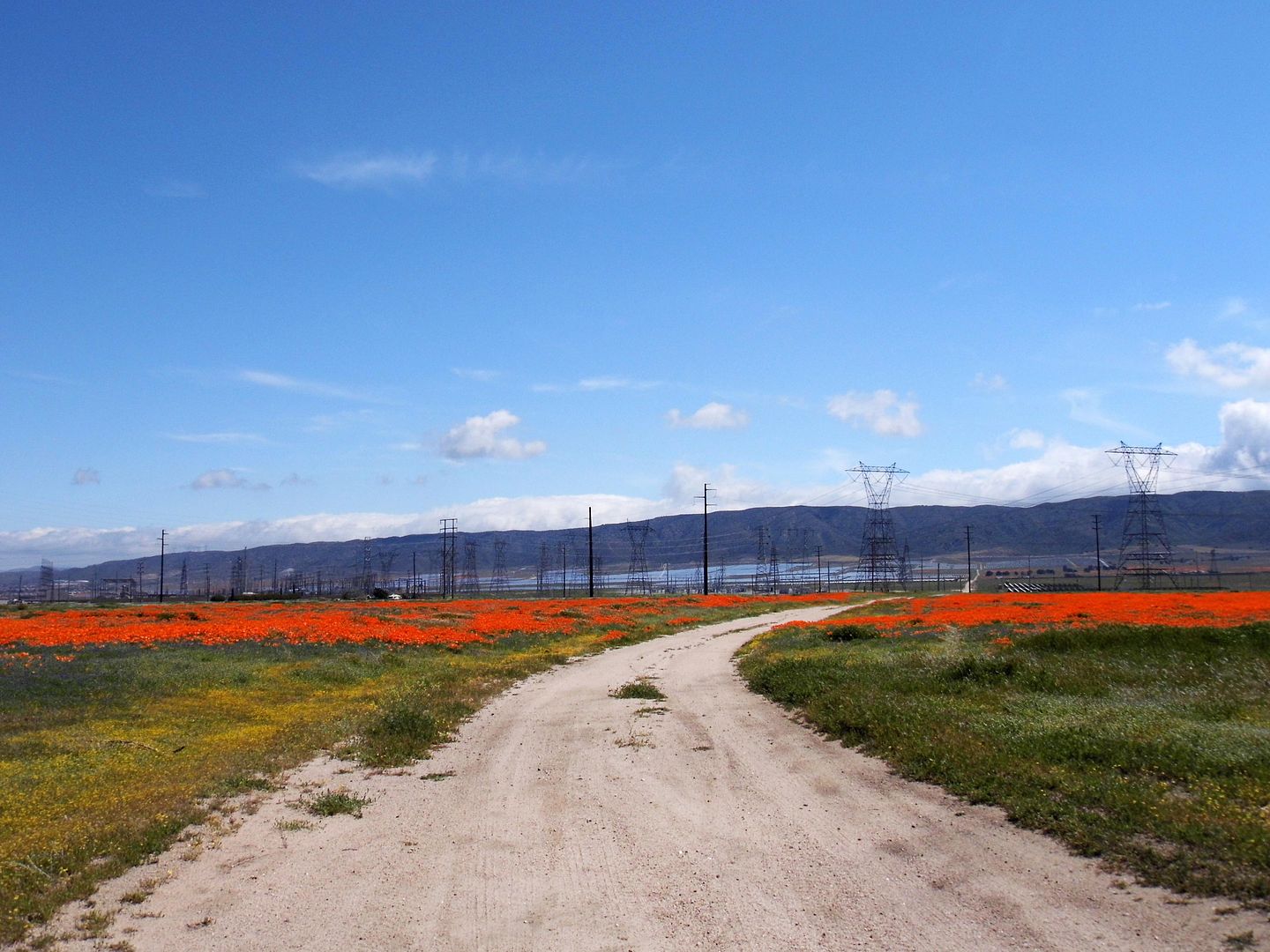
And, like last year, the Antelope Valley really delivered. I just drove with the orange straight ahead, which formed an artificial horizon in the foothills to help with wayfinding wayfarers.


The navigation was spot-on, it turned out—because I ended up on a dirt road with a stripe of orange cutting straight across it.


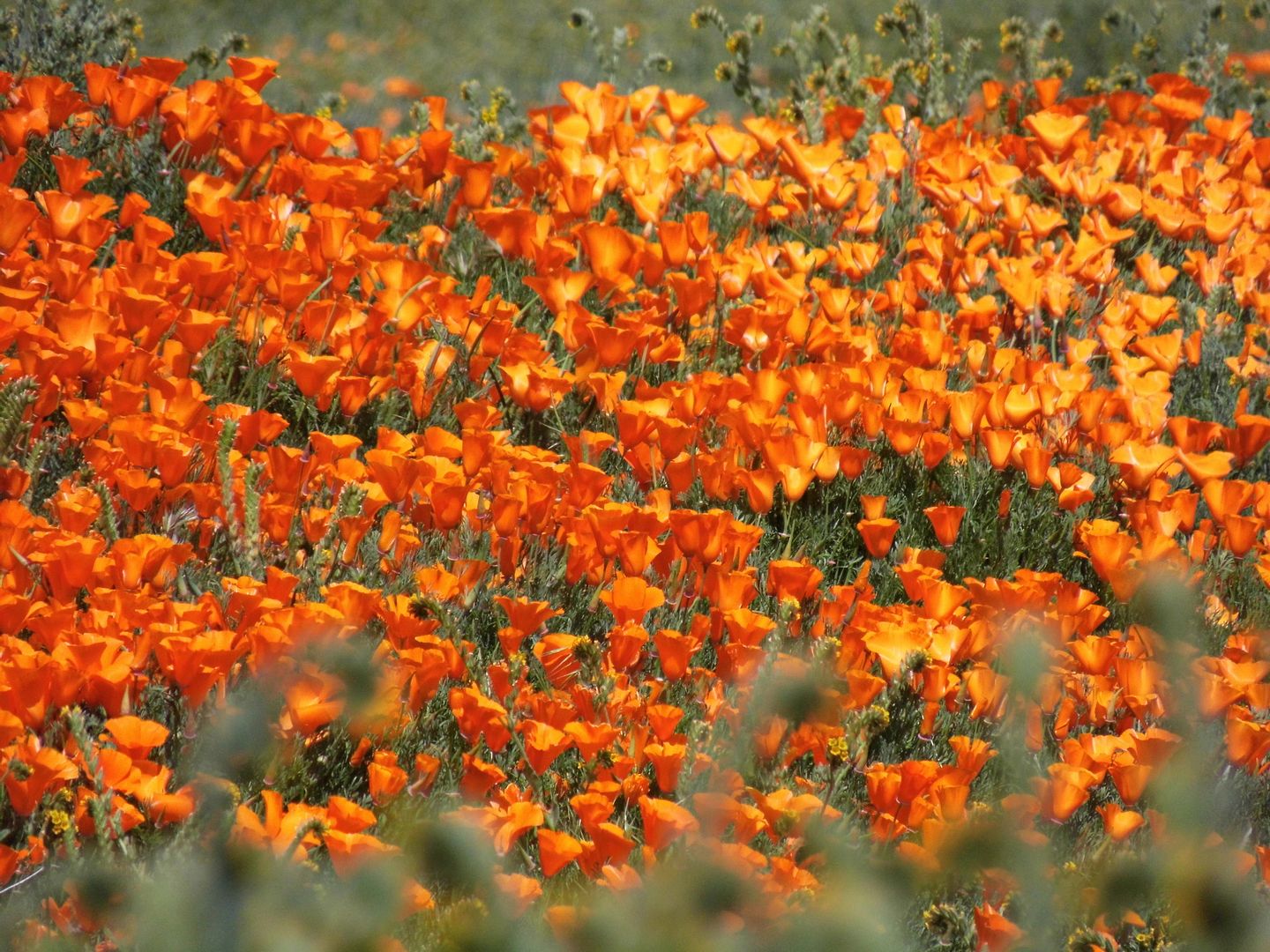
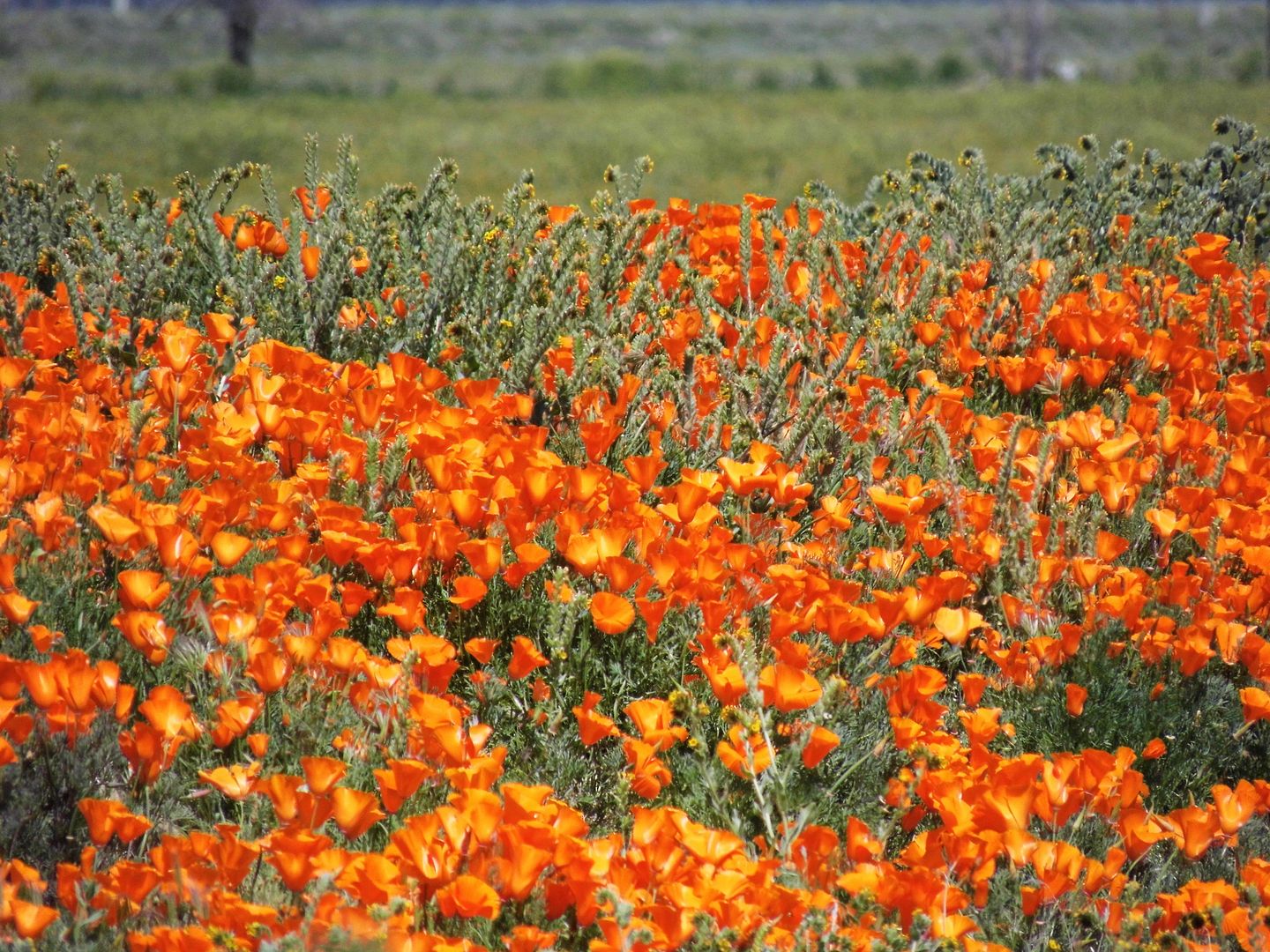
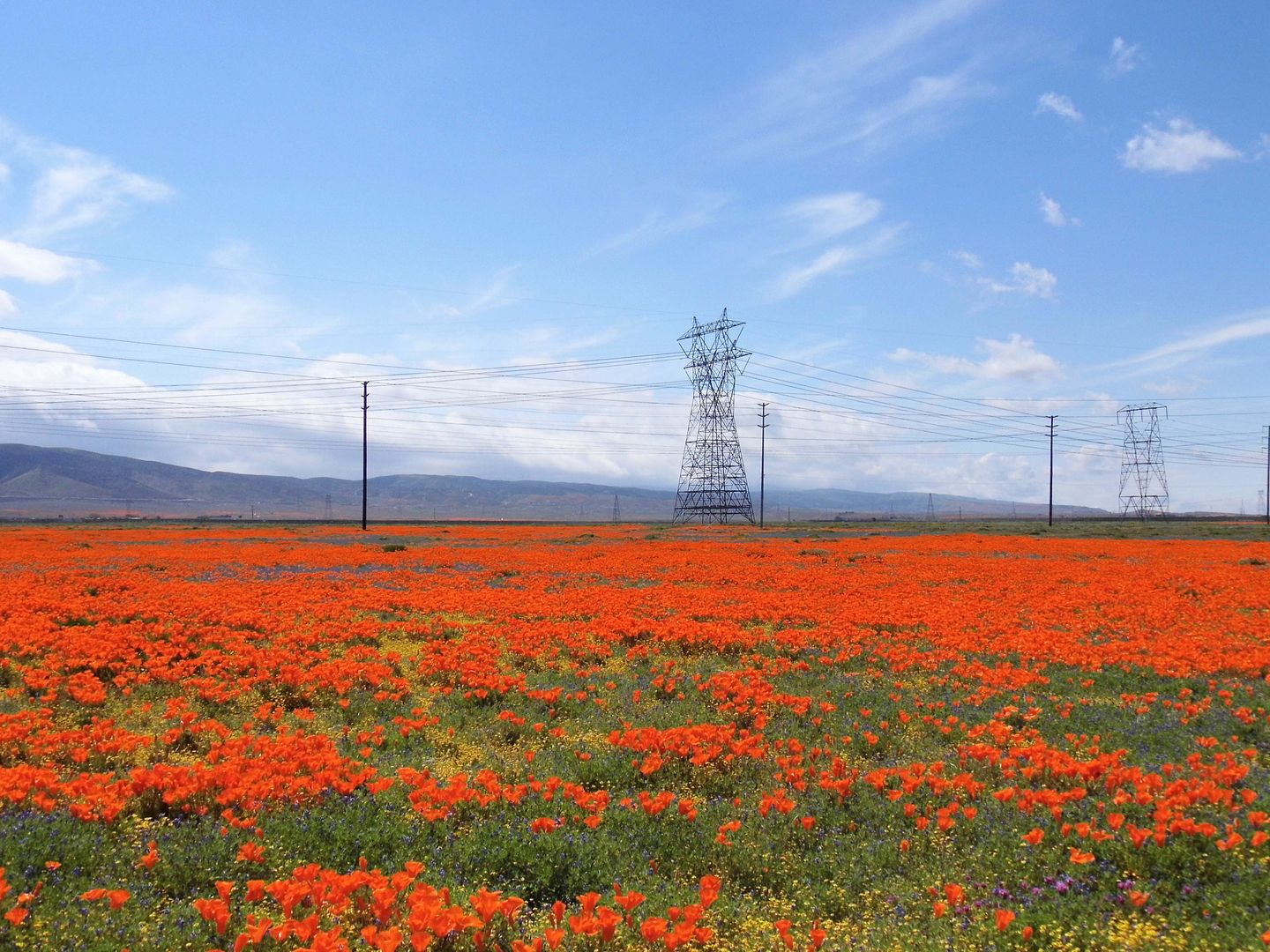
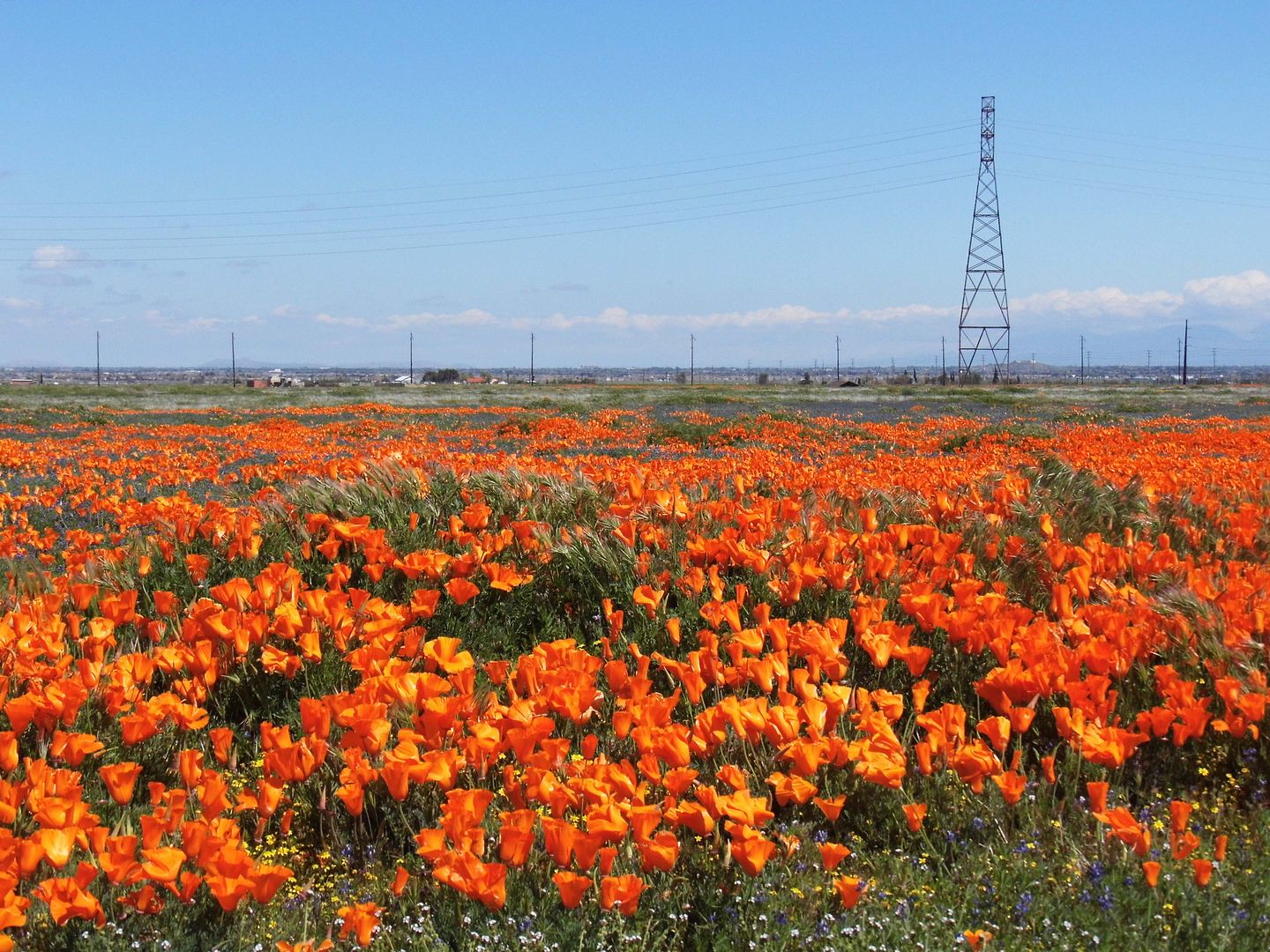
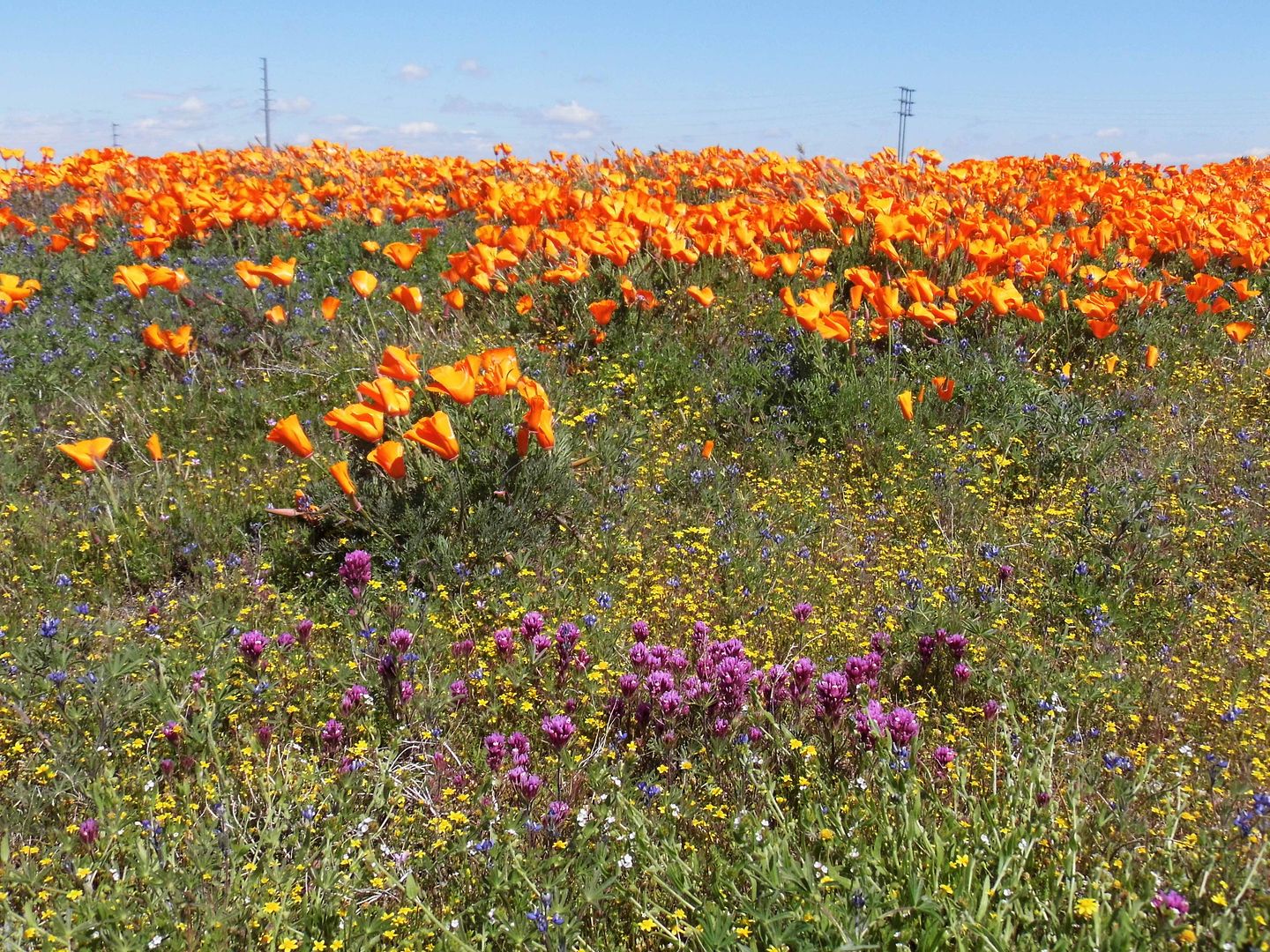
I was surrounded on both sides by the California poppy, the namesake of the poppy reserve that was closed due to COVID-19 but usually can be found in abundance outside the state park (in fact sometimes more so).


They were in full bloom on that April afternoon—a day in April I probably would've been trekking around the poppy fields anyway, had we not been advised to stay at home to stop the spread of the coronavirus.


I felt a little guilty for disobeying orders and maybe setting a bad example—but I also felt that my disobedience had been vindicated by the fact that this year's poppy bloom was different than any others I'd ever seen before.


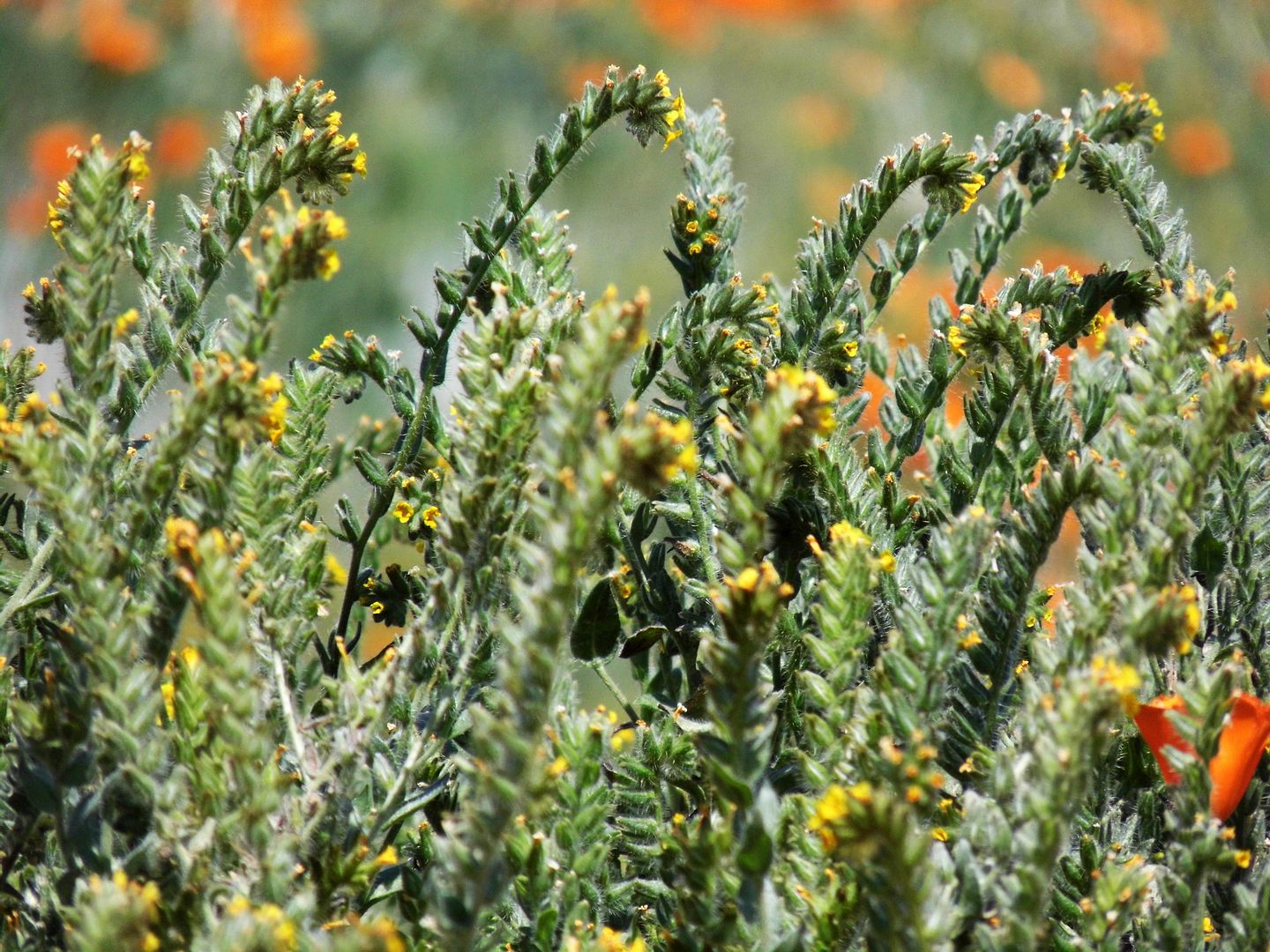
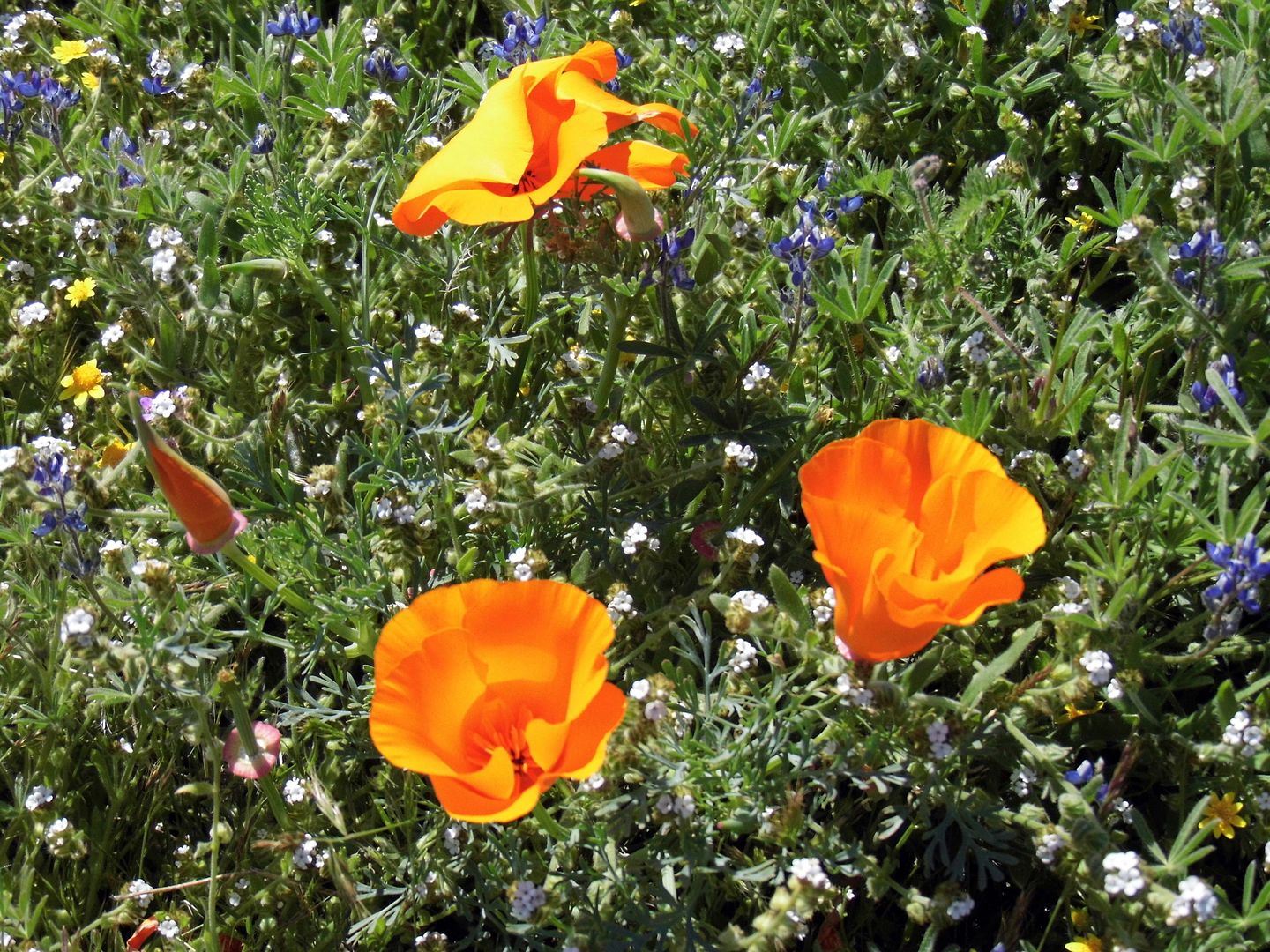
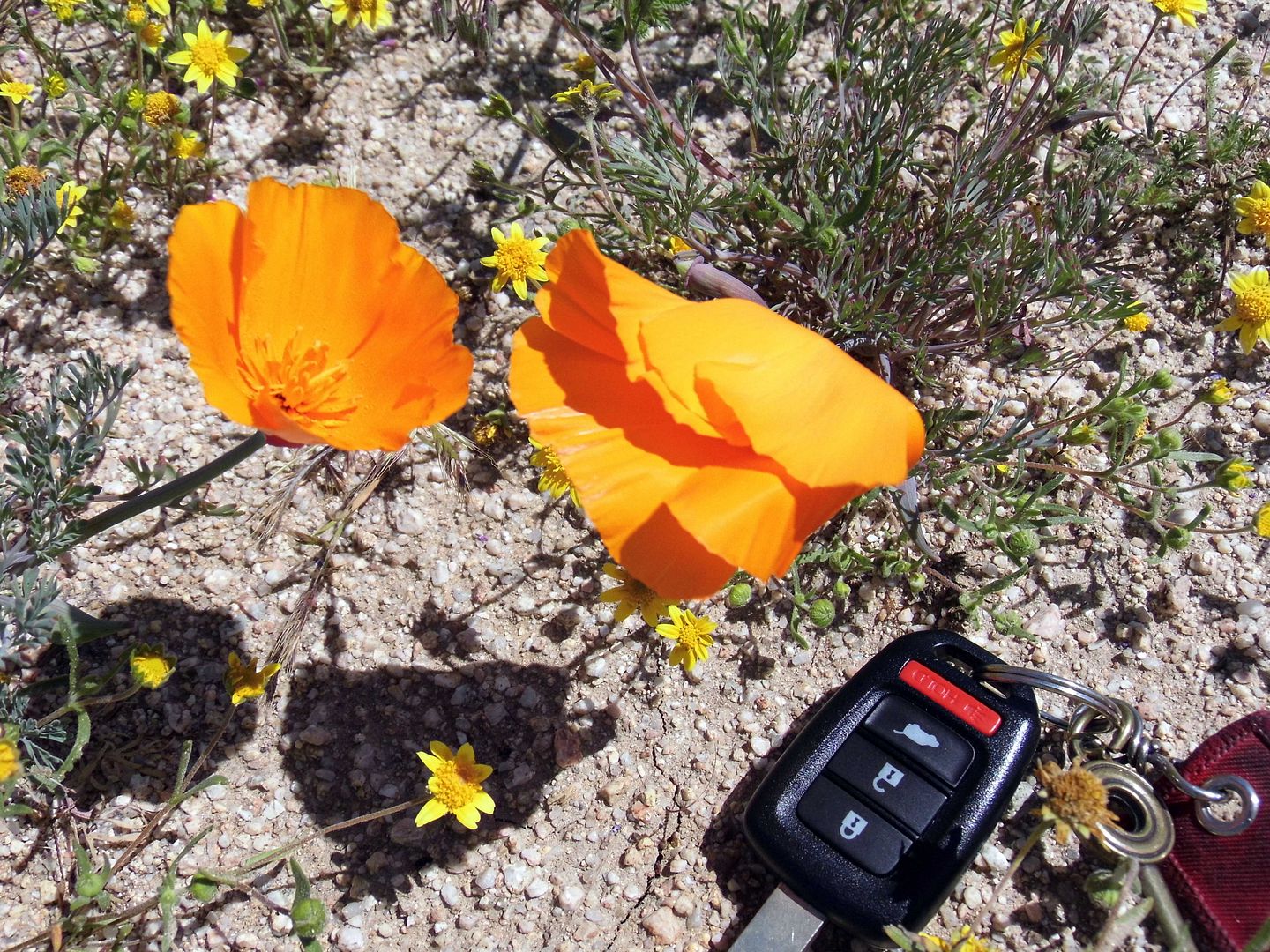
It wasn't just the orange poppies, but also purple owl's cover and yellow fiddlenecks, goldfields, and monolopia...


...set against the backdrop of blue and white pointillism that only becomes clearer, the closer you get.


For a long time, mine was the only car on that dirt road—until perhaps my presence alerted another carload to the scene and solitude.

I drove out shortly after their arrival, once I'd gotten my fill.

But I didn't join the groups alongside the paved road that were also breaking quarantine. I didn't need people yet.

I just needed to bear witness to life going on without me—even from a distance, even from just the dirt road.

The flowers were pristine from not being trampled by the masses. And I wasn't going to be the one to trample them.

I wasn't going to tell anybody, either—not until they were already long gone.

Next wildflower season, maybe the world will be somewhat "back to normal." But this year, it kind of felt like I got to keep the wildflowers as my own little secret.

Related Posts:
Photo Essay: Poppies Peaking in Antelope Valley
The Most Orangey Orange I've Ever Seen
Photo Essay: Wildflowering at Poppy Peak

June 05, 2020

The Persistence of Violence

I wouldn't characterize my father as a violent man. But one of my first memories is being spanked by him.

It wasn't just a little tap on the bottom to startle me, like you'd whack a puppy on the behind with a rolled-up newspaper.

It was brutal. And it was ritualistic.

His weapon wasn't his bare hand, but a bare plank—raw, splintery wood that he'd carved my name into. It hung from the beams of the basement ceiling near his work bench, where he kept all his tools, next to the table where my mother kept all her extra cleaning supplies.

And when I got spanked with the monogrammed board, I didn't benefit from the protection of pants or underpants. I had to strip down to my bare bottom and let my father lean me over his knee.

That seems to be the bit that alarms most people who hear the story—maybe because they thought there was something sexual about making me strip from the waist-down. It's impossible for me to know now what was going through my father's head back then, but I always assumed the no-pants rule was just to make the punishment as effective as possible.

I can't remember one thing I did to serve "the board." But I got it several times in my youngest years.

Only one incident really stands out to me—only once of actually being spanked with the board, and not just standing under it, looking up at it, knowing what it was for, and hearing my sister joke about it.

My dad got so violent while spanking me that time that my mother—the chief physical and mental abuser throughout my childhood—had to intervene and tell him it was enough. He'd lost control, his face straining and sweating, his black hair falling against his forehead where it was normally slicked back.

I hadn't thought about that one time until just recently, when depictions of person-on-person violence began to dominate the news cycle—one video of murder on repeat (the first time I think I've ever actually seen anyone killed close up) coupled with videos and images of brutality against those who protest it.

If you've been on the receiving end of violence, it really sticks with you.

It may go into hiding for awhile—even lay dormant so long you think it's finally gone for good. But like desert deadwood or the summer cicadas, it always comes back in one form or another.

Always.

It's worse when that violence doesn't just happen "in the heat of the moment" or in a fit of "temporary insanity." Authority figures often justify their tactics—as though you "deserved" it or it's for the "greater good." And my parents were no different.

My mother said repeatedly throughout our childhood, "Your father and I believe in corporal punishment." It was surprising to me and my sister, given my mother's own history of being abused by her father, often without provocation. But it turns out my grandfather trained her well—to exert an "absolute authority" over her two daughters.

She spanked us with wooden spoons, the vacuum cleaner, and her bare hands. She slapped me across the face so hard once, my eyeglasses bruised my nose. Otherwise, she was careful not to leave any marks that might be visible to teachers or guidance counselors at school, who thought she was such a good mother because we happened to excel in our classes.

She always insisted that she never struck us out of anger. The obscenities she'd spit out—and the tears that would stream down her face as she called us names—told a different story.

When we were a little older, we tried to argue against our parents' tactics. But you can't reason with authoritarian rule.

My one victory was that I came out of that nightmare scenario understanding how wrong it was. And that it wasn't my fault.

But somehow in my 20s, I fell into other violent situations, mostly with strangers. I got punched on the New York City subway, on my way to my first job after college. A person was blocking the exit door, and all I'd done is tap him with my umbrella after he didn't respond to my "Excuse me."

He knocked the wind out of me with his fist, but I went to work anyway. What else was I supposed to do?

I also got molested on the subway more than once on my way to that same job. All my boss could offer in comfort was the advice to choose a less-crowded car on the train the next time.

I spent years subjecting myself to the dangers of NYC nightlife—men who were rough with me when they reached into my panties and left me bleeding, men who secretly removed condoms before entering me, a male friend who crashed at my apartment and started having sex with me while I was asleep.

I may not have gotten beaten up—but every single one of those situations was an act of violence. And I blamed myself for letting it happen. I wondered why I didn't kick and scream then—and why, a decade or more before, I never found a way to escape my parents and their hatred for who I was as a person (or, I suppose, my mere presence).


So, in times like this—when riots and looting and police brutality is happening within earshot, a mile or two away—I'll admit I get triggered. My PTSD is raging, right alongside my anxiety.

I'm in full-on fight-or-flight mode, even though I'm not being directly attacked.

It feels like I could be. It feels like I will be.

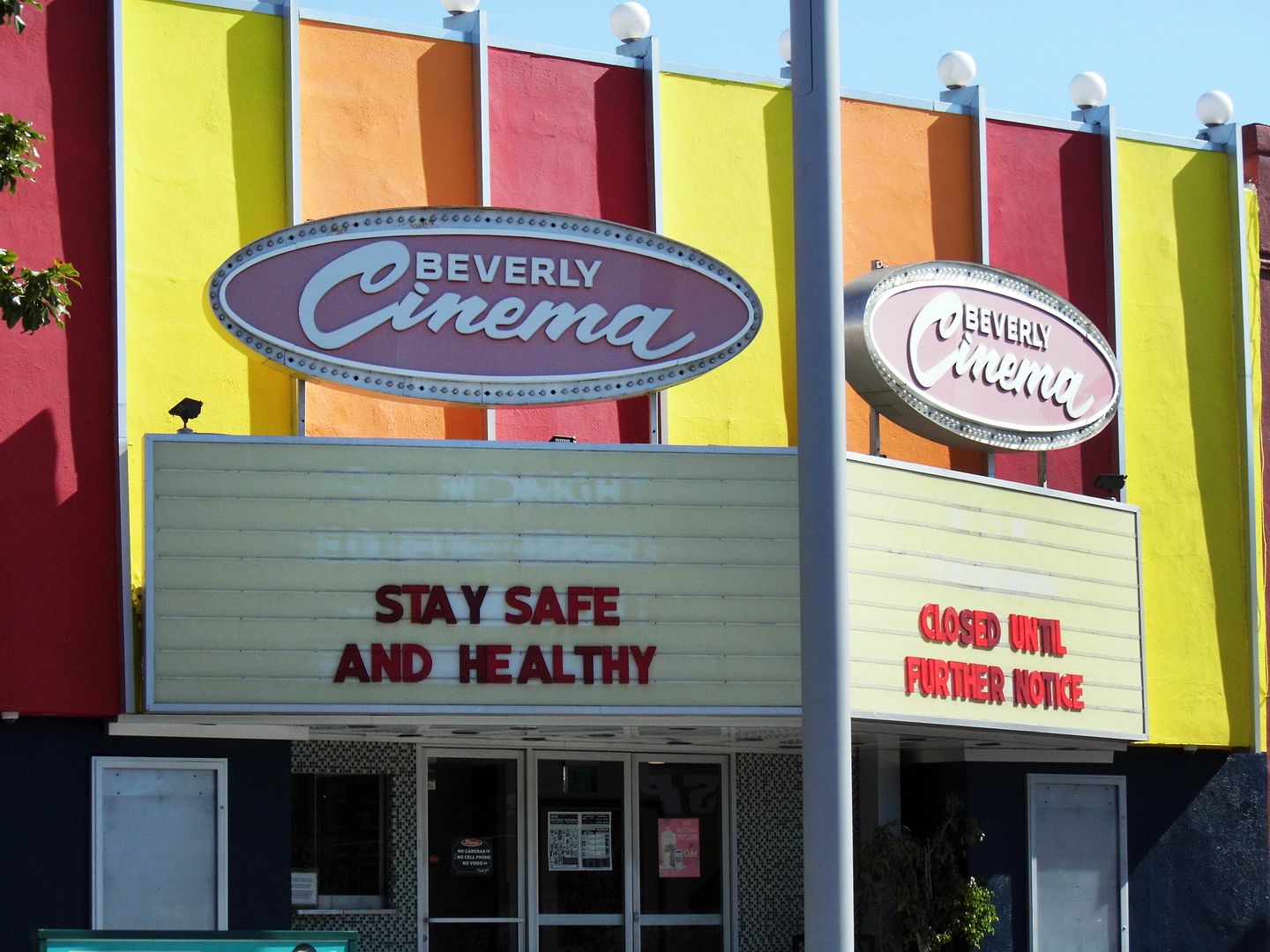
For the last three months, the resounding message has been "Stay safe." I've even said it myself (usually adding on "and sane").

But how do you "stay" safe when you never felt safe in the first place?

None of what's happening in the streets of Los Angeles right now is about me or my childhood. And I don't want to make any of it about me.

But I know what it feels like to be targeted. And I know what it's like to feel trapped—and to witness the same horrible things happen over and over again while the perpetrators and their enablers deny, excuse, rationalize, and shift blame.

Most of all, I know all too well how the violence of the past persists, encircles, and comes roaring back with a vengeance. It never becomes "ancient history."

We still feel its repercussions after a lifetime has passed. Some viscerally experience the brutality of the past generations later.

And that was something I had to share—particularly with those lucky enough to have had the luxury of living a life free of violence.

Related Posts:
Standing With Those Who Choose To Not Stand
The Anxiety of Anxiety

May 29, 2020

Puckering Up For Old Hollywood Kissability at Besamé Cosmetics
I've never been much of a makeup wearer myself. As a little girl—all the way back in nursery school, I remember—I simply adored nail polish. It was enough to get me to stop biting my nails, so as not to ruin the manicure.
And I've always gotten a kick out of wearing stage makeup or getting camera-ready for a TV appearance or film cameo.

But otherwise, I've kept mostly to lipstick or, in more recent times, shiny pink lip balm, and a little line from an eye pencil or pen. I didn't start wearing mascara until I got contact lenses around age 30 because my naturally long lashes would just scrape against the inside of my glasses. And that just wasn't cute at all.

The few times my mother ever "went out" when I was a kid—maybe to my father's workplace Christmas party—she had her standard sparkly blue eyeshadow and under-eye highlighter (after all, it was the late '70s/early '80s), punctuated by some eyeliner and mascara. 


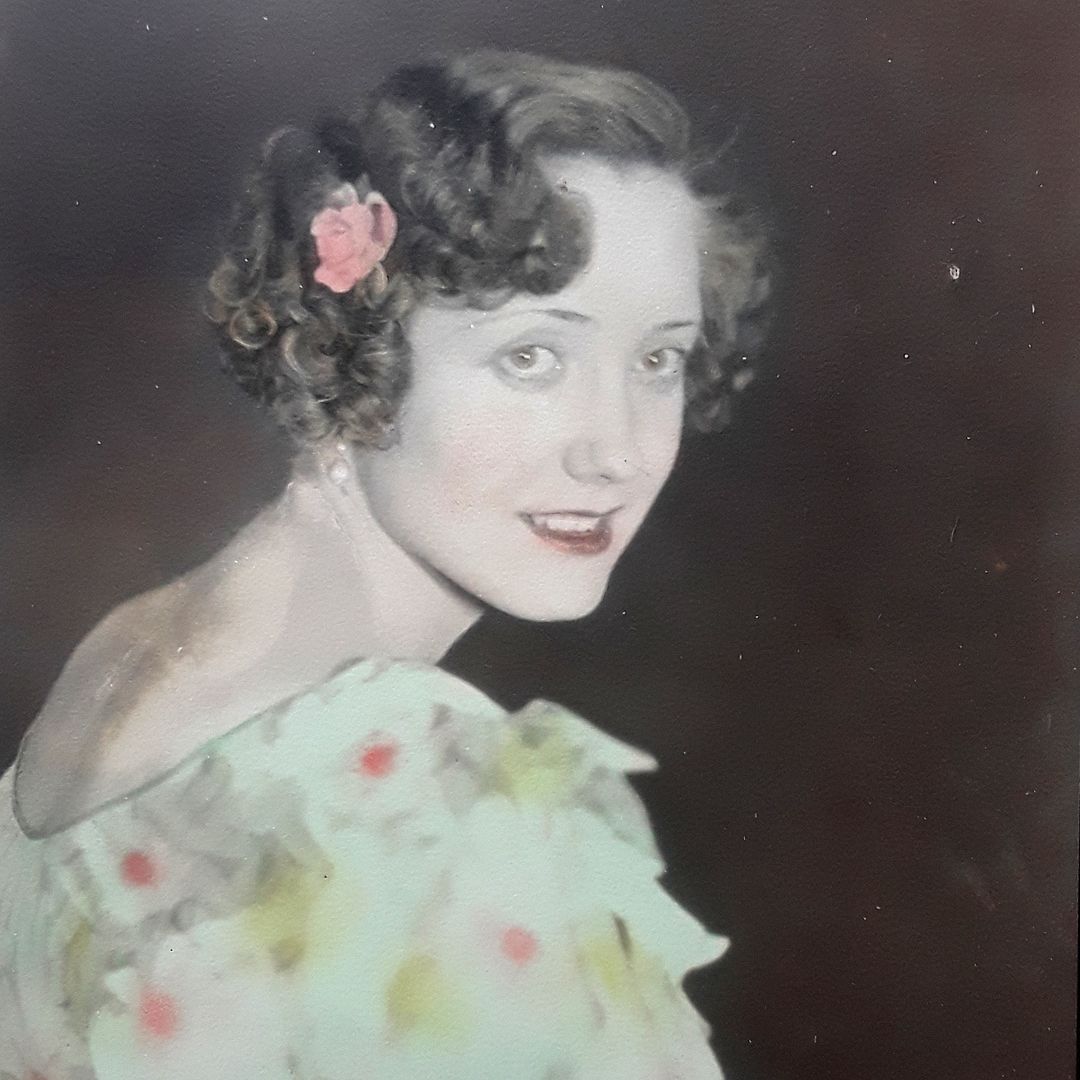
Virginia Weinheimer, age 18 (circa 1936)

But my mother wasn't exactly a beauty icon for me. Instead, I always admired my Grammy's beauty—her bright red lipstick that my Grampy hated, but that looked just fine to her in the mirror. Then again, Grammy was so colorblind, she had the rare form of the disease that rendered everything in black and white. So she was the star of her own silver screen.


Like me, cosmetics entrepreneur Gabriela Hernandez was inspired by her grandmother's beauty routine—one with a simple glamour that's somehow disappeared from modern makeup. With that vintage aesthetic in mind, she created her beauty brand, Bésame Cosmetics, and launched a single red lipstick circa 1920—later recreating historical details from several decades for contemporary versions of an entire line of her own makeup formulas.


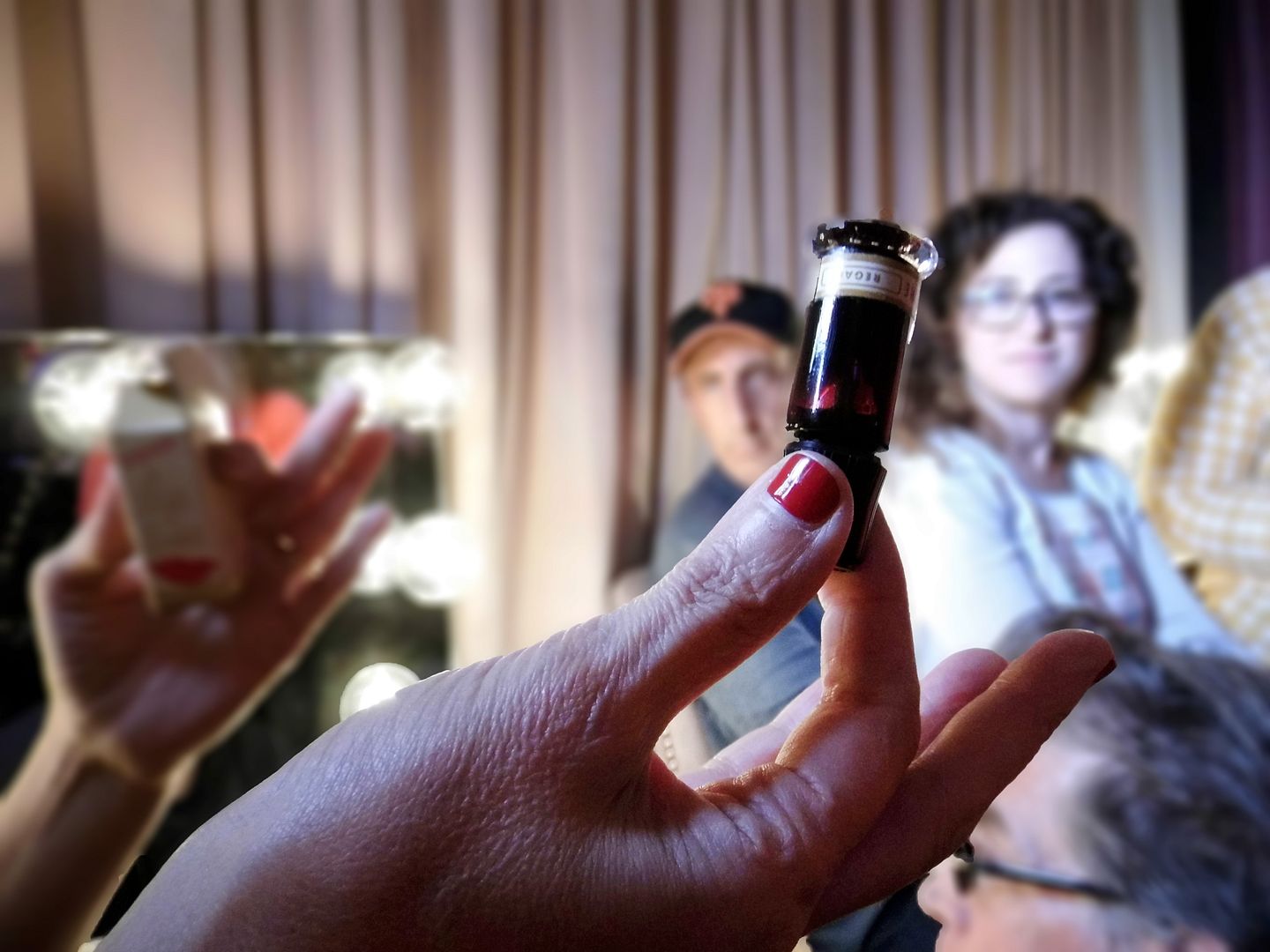
A unique combination of artist and historian, Hernandez has found herself in the role of "color detective"—analyzing old lipsticks and other cosmetics to unveil what the pigments are underneath. Because as anyone who's ever tried to wear red lipstick knows, no two reds are exactly the same.


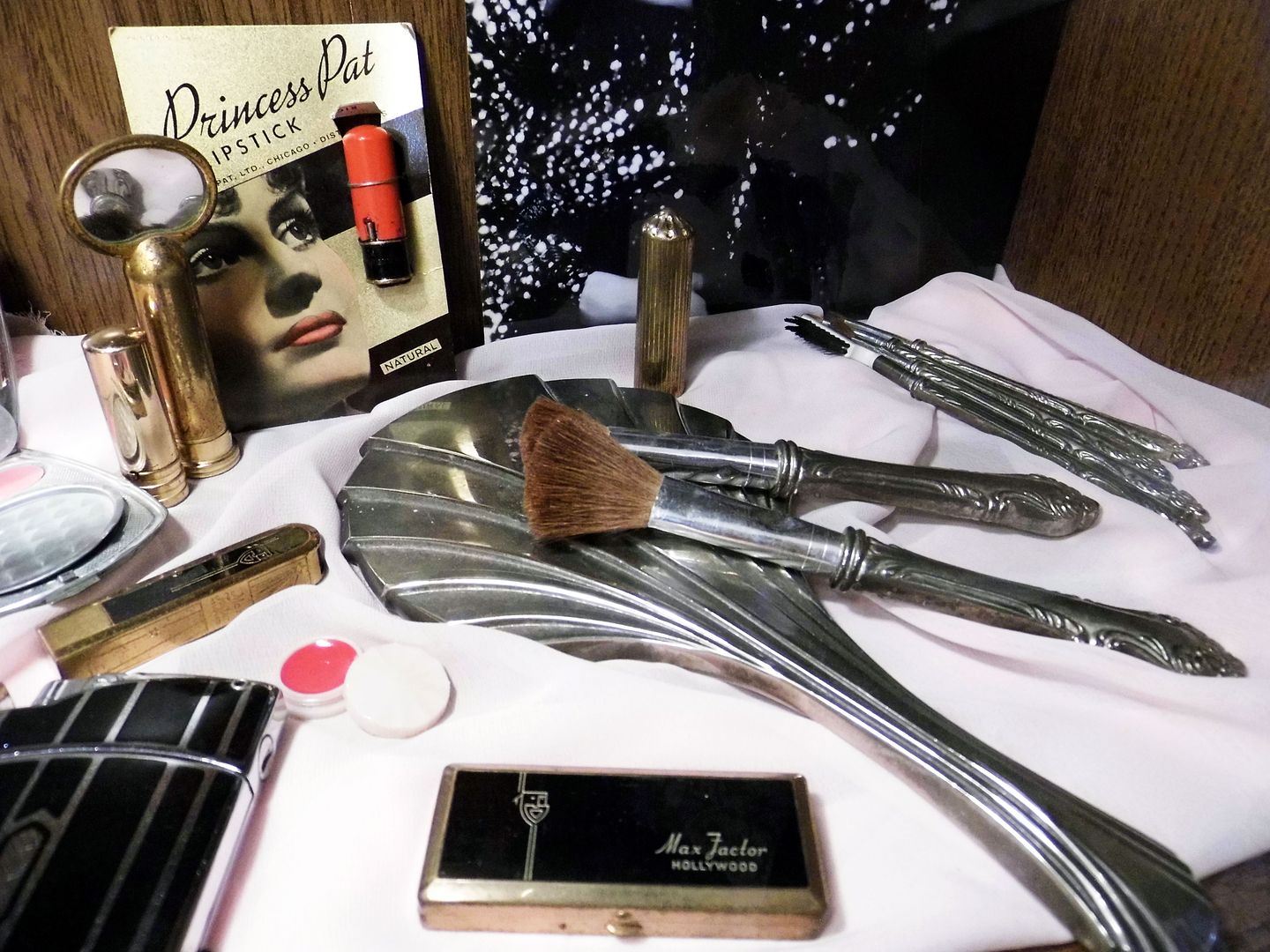
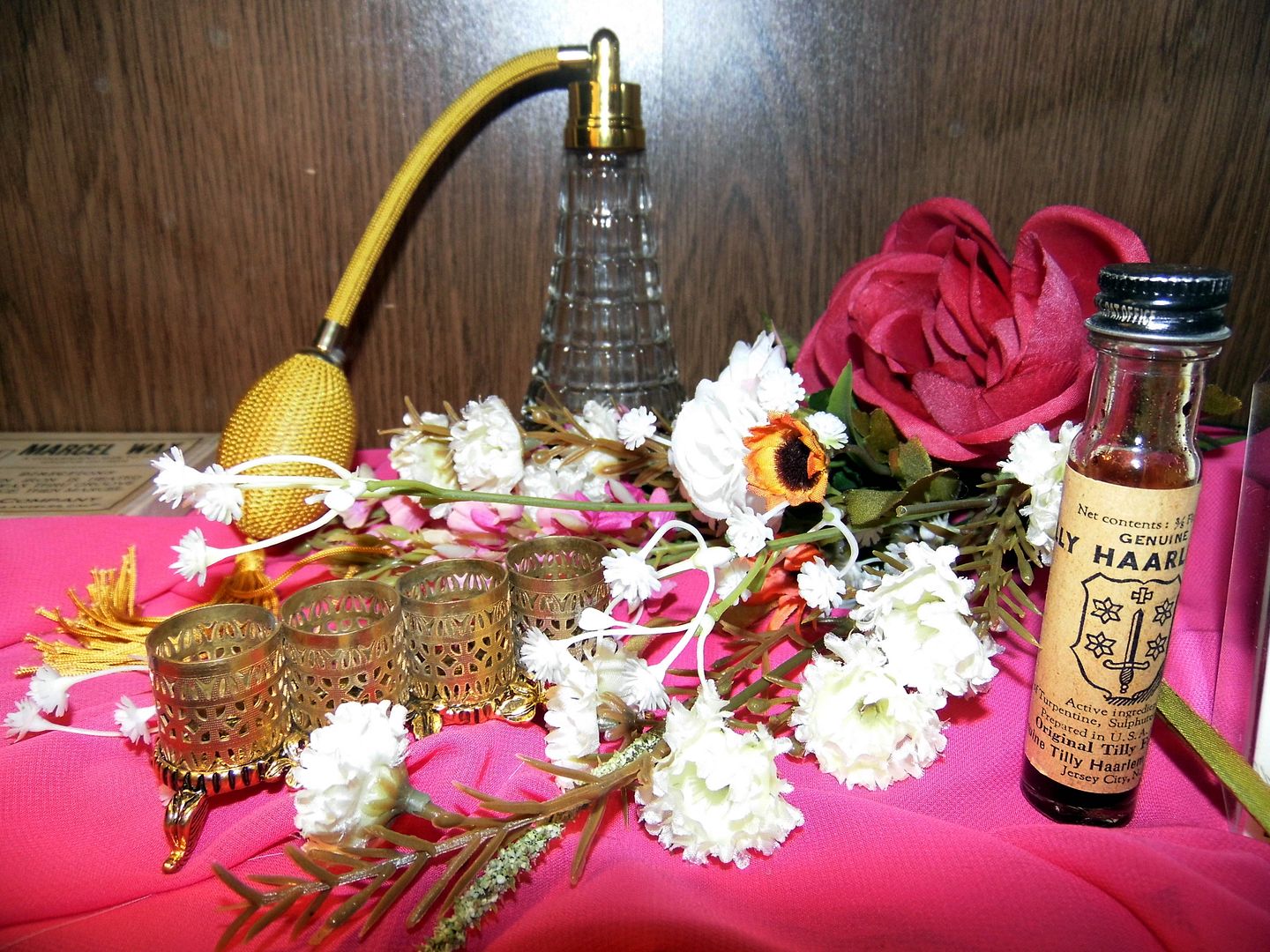
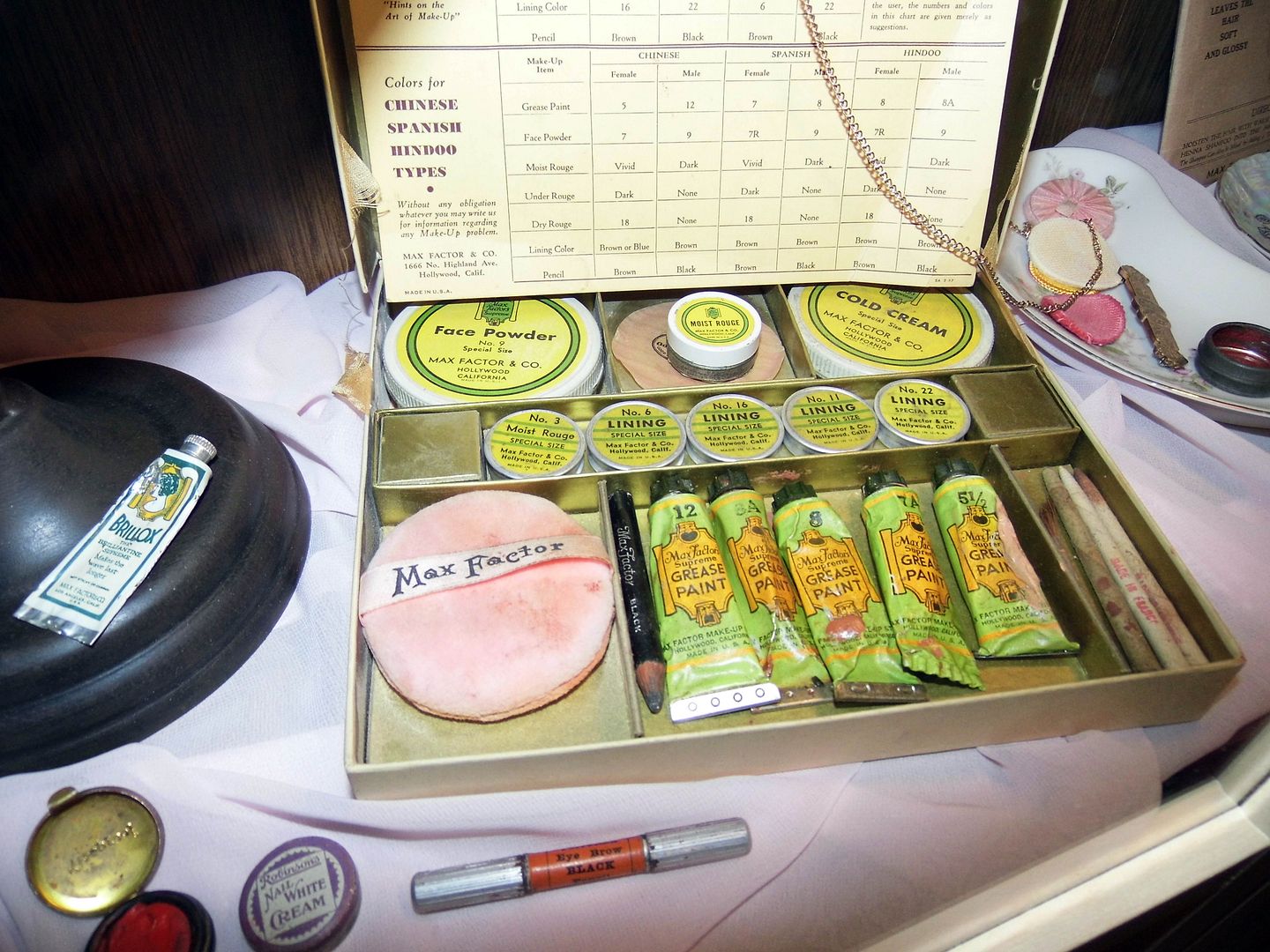
In the back of her Burbank storefront, Hernandez has got a kind of "hall of fame" of vintage cosmetic products—some of which might not be recreated exactly the same way because of where the pigments were originally sourced from (like, say, crushed bugs).


You can sign up for a makeup class, photo shoot, or makeup application in that back room when the store is open...


...or you can leisurely browse the front room...


...where Bésame-branded cosmetics are sold behind a nice old-fashioned makeup counter on one side...


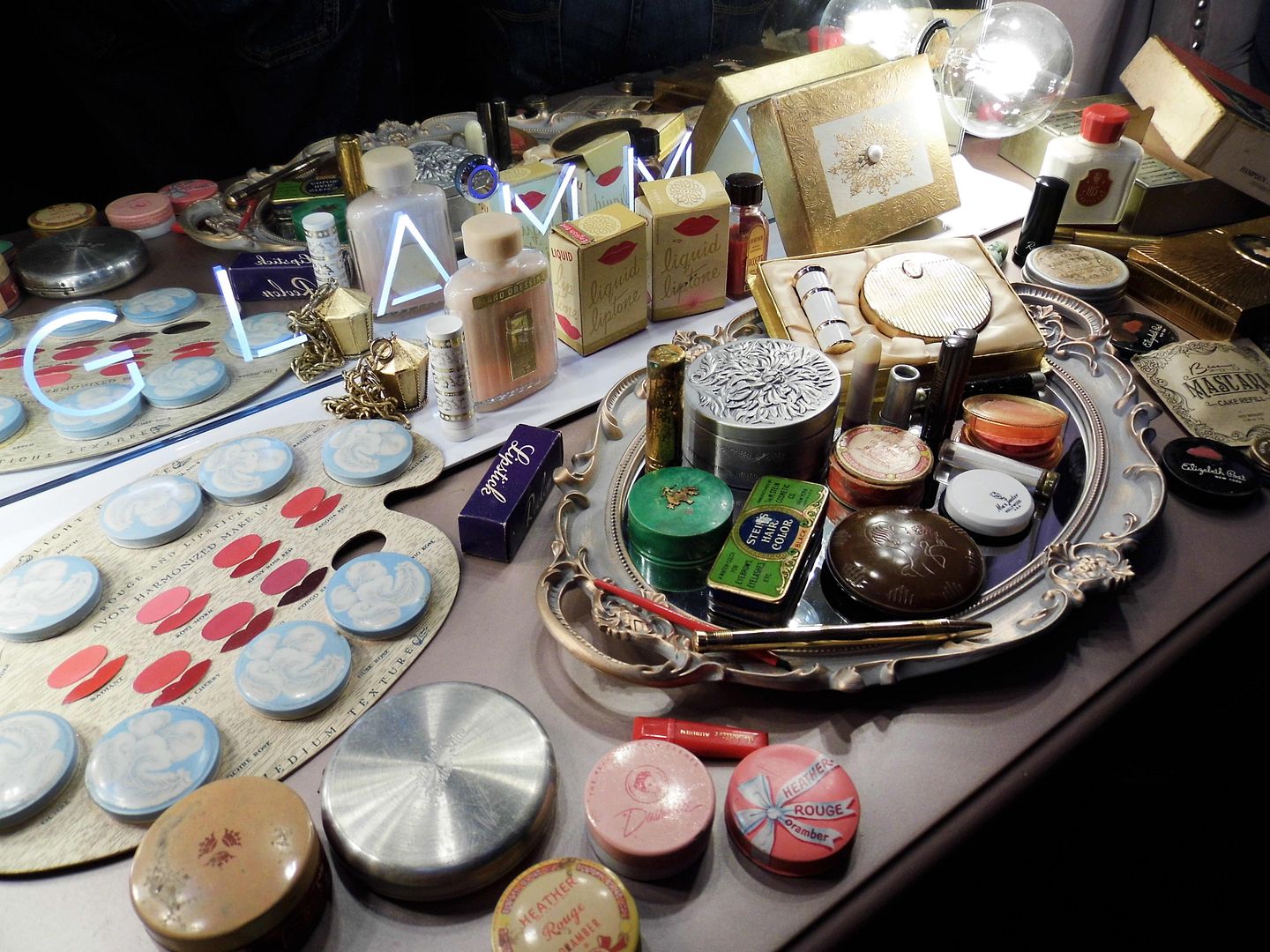
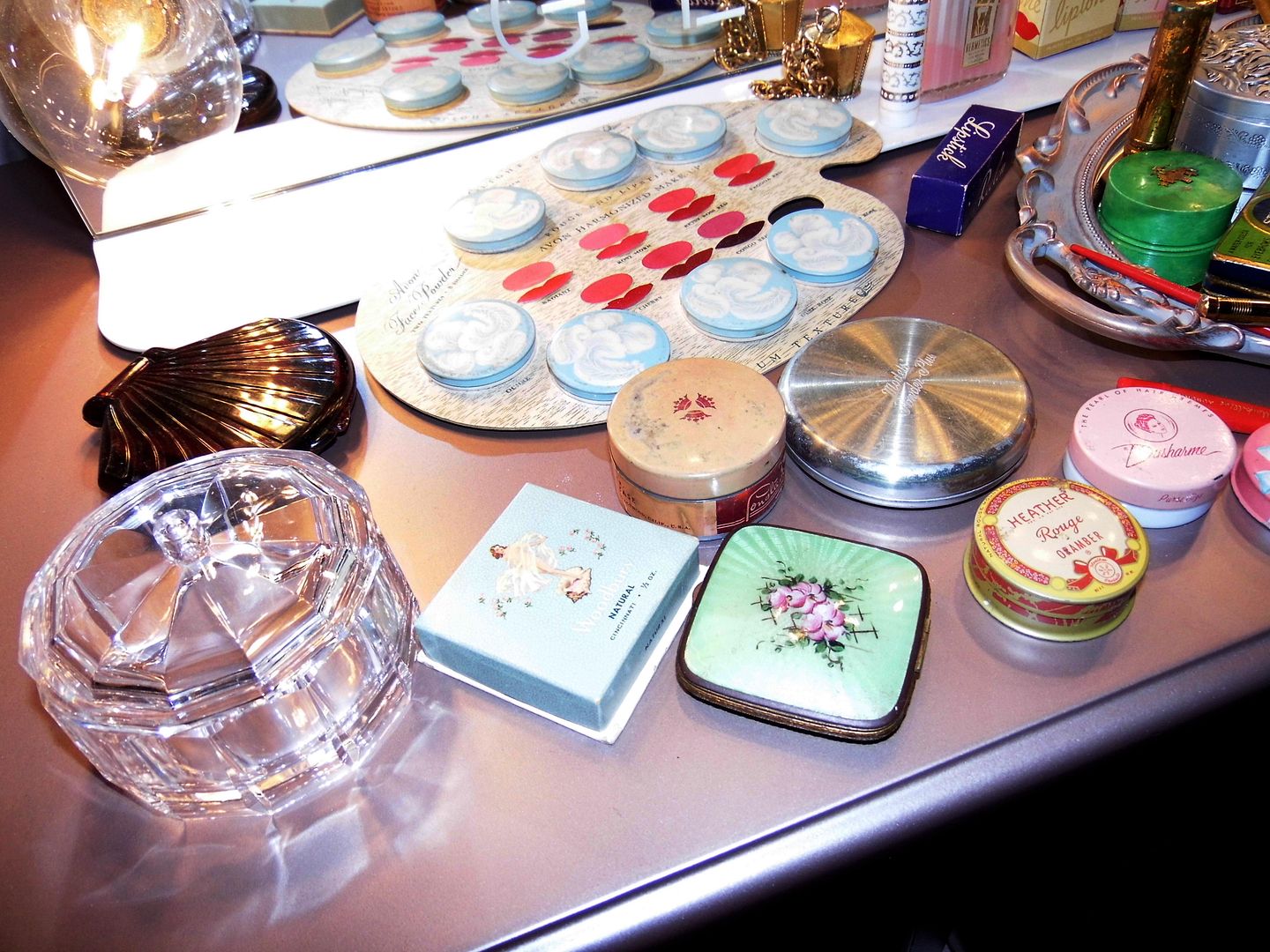
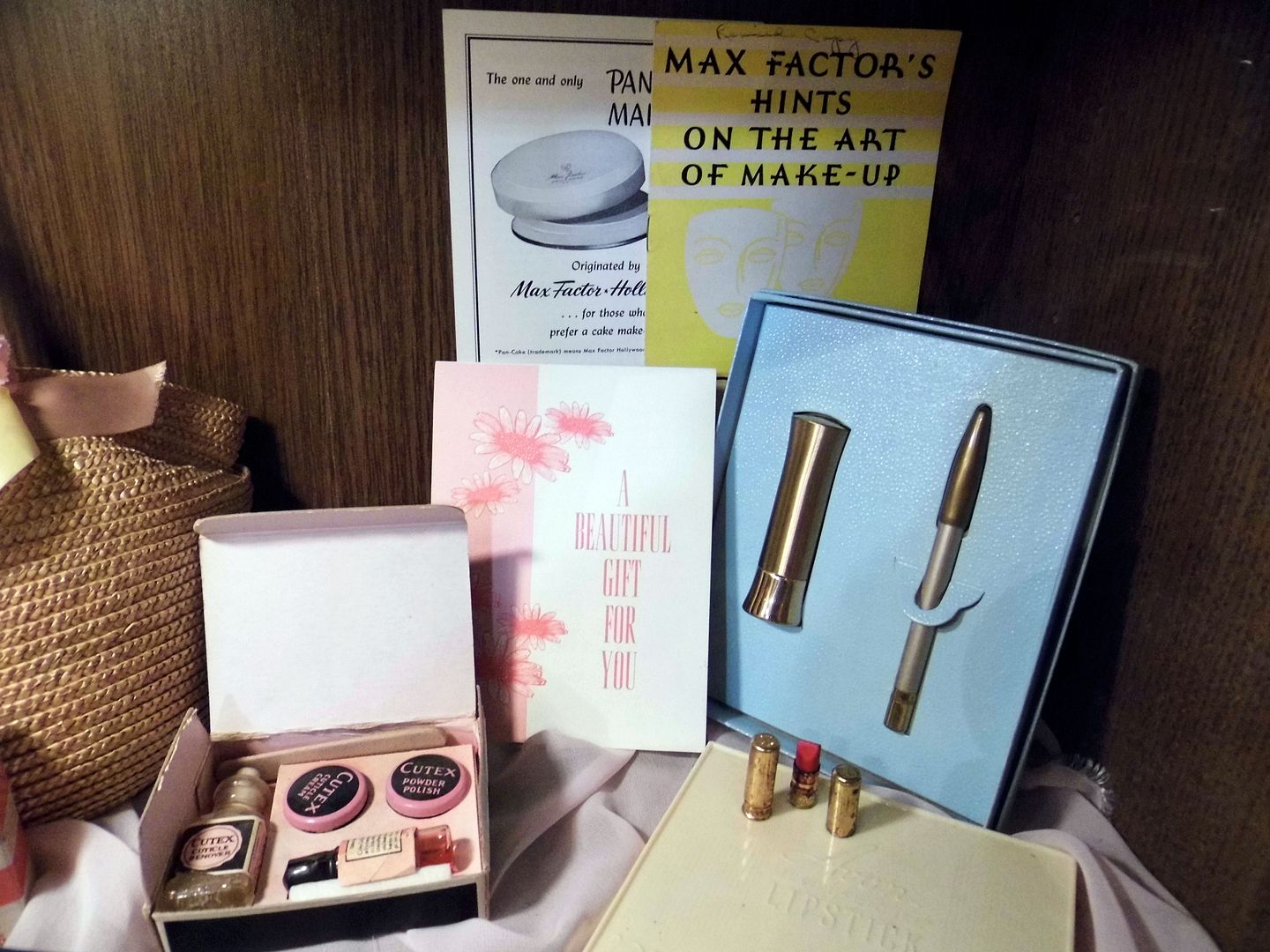
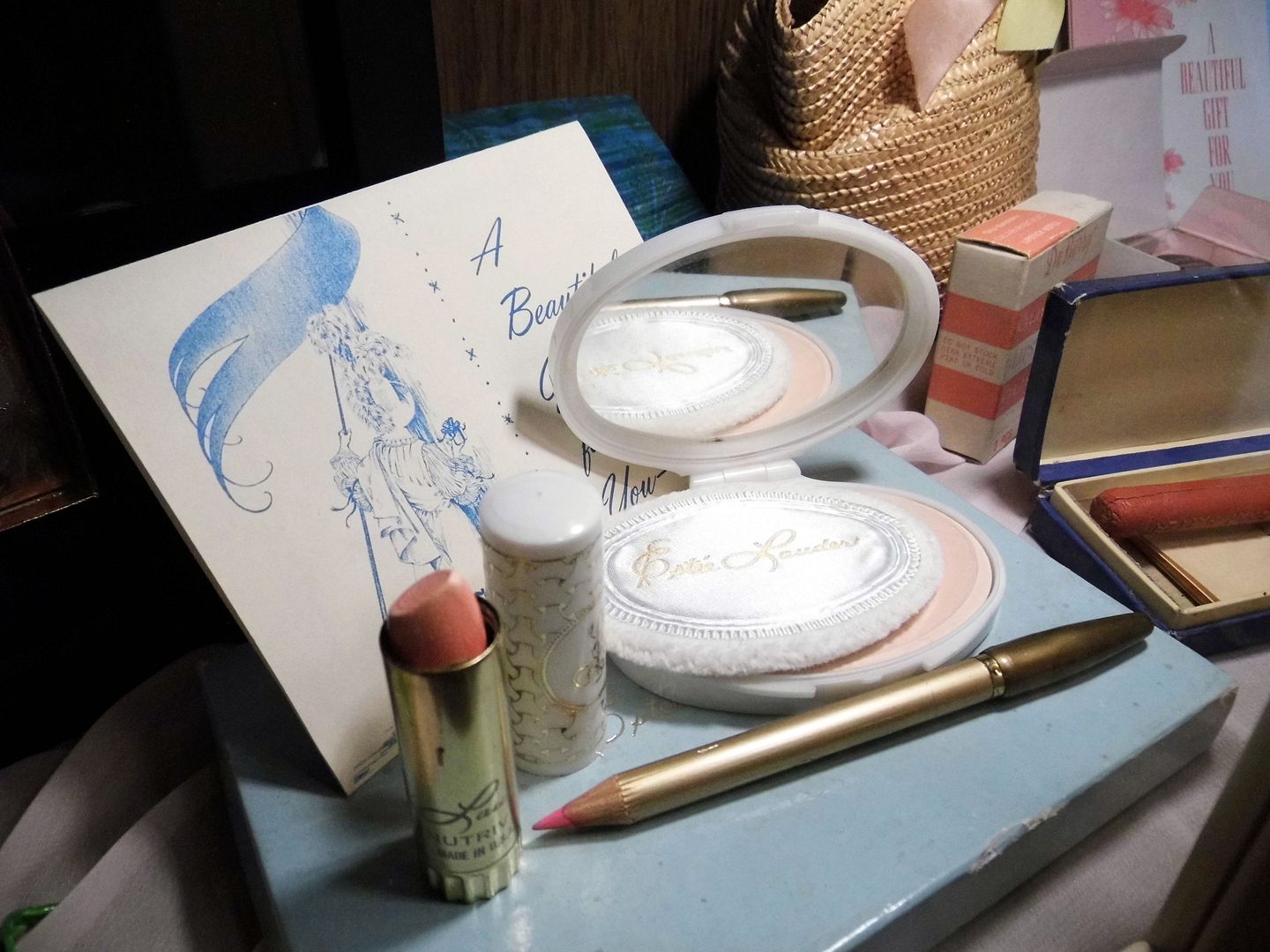
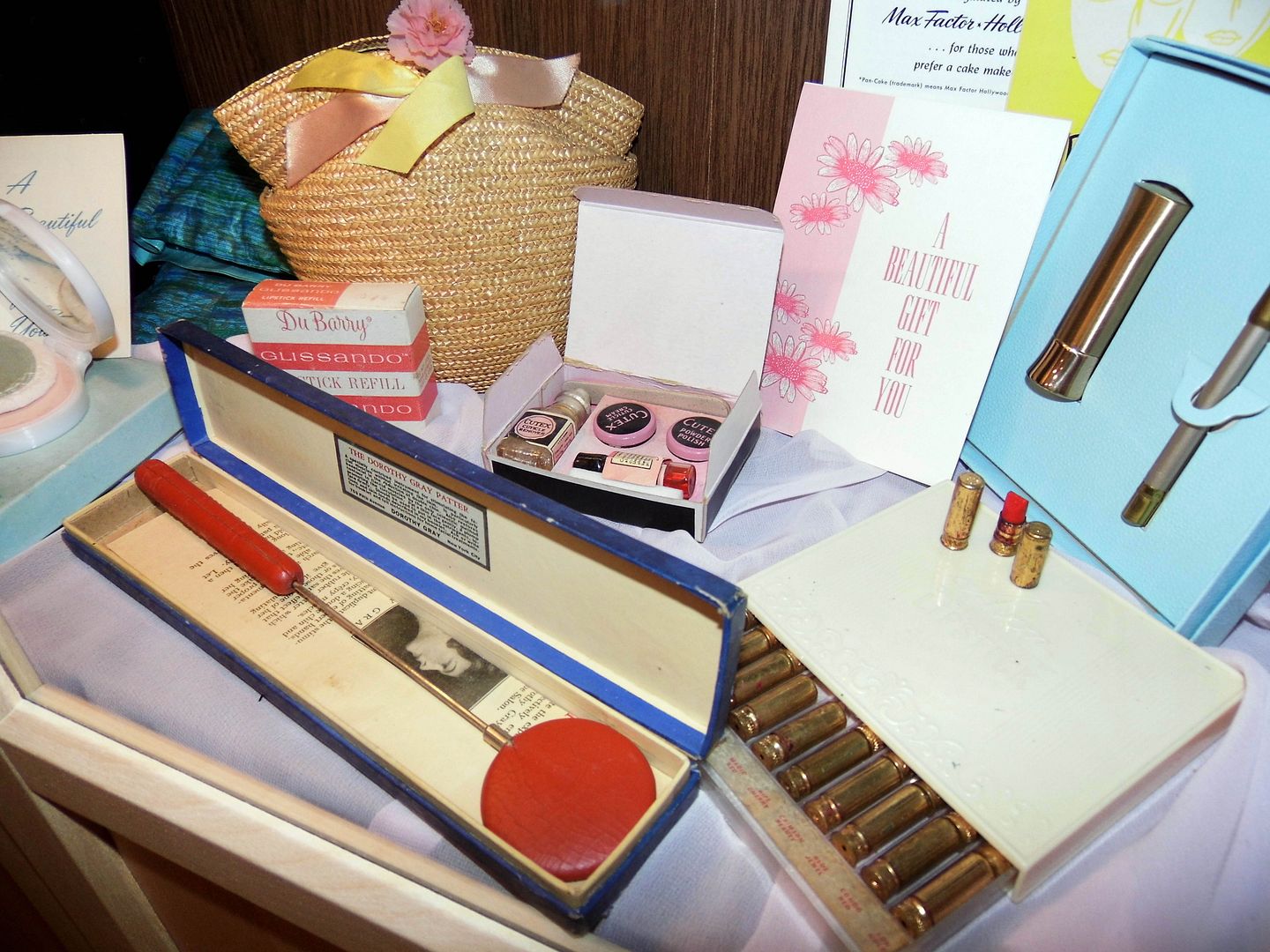
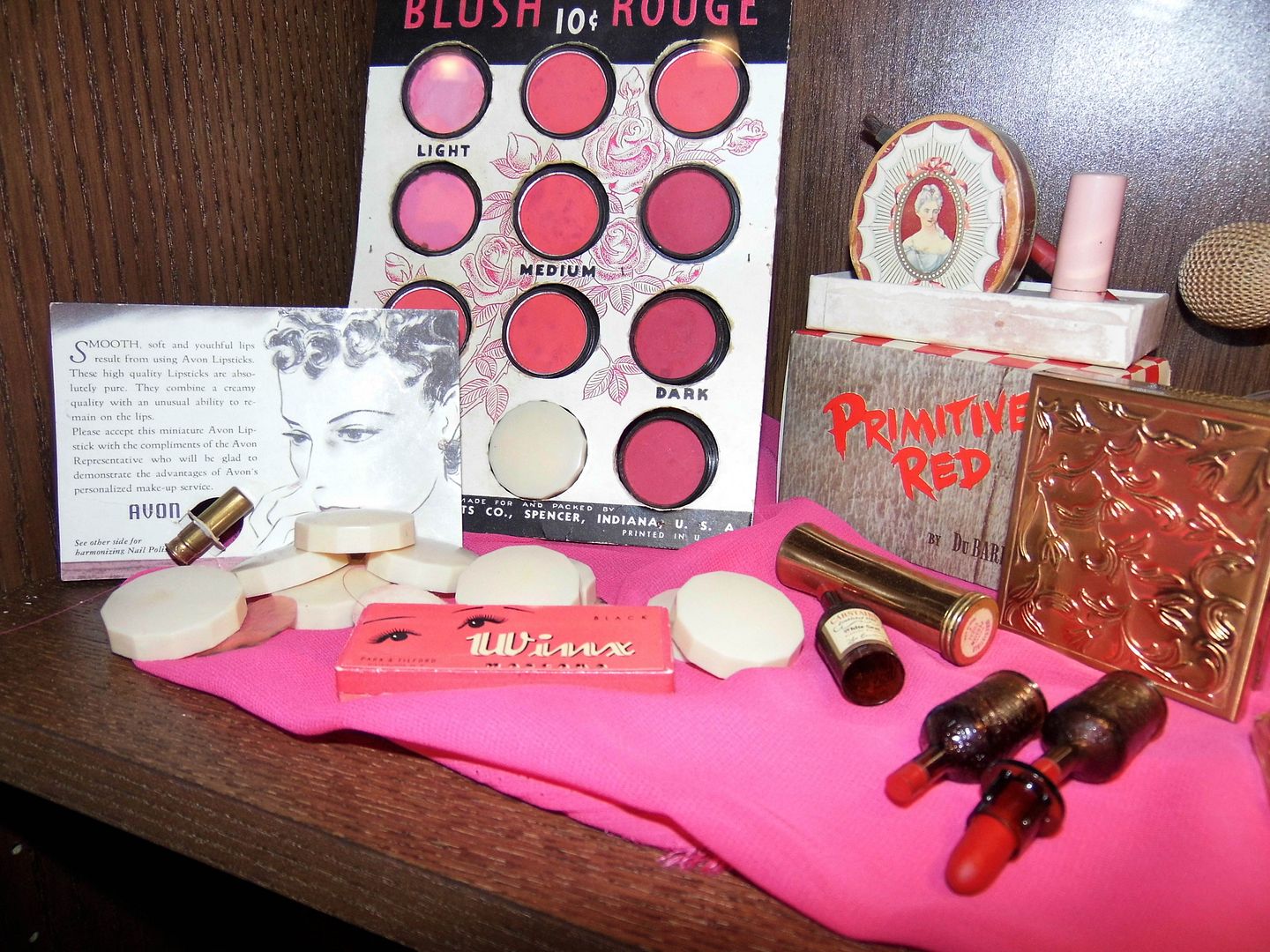
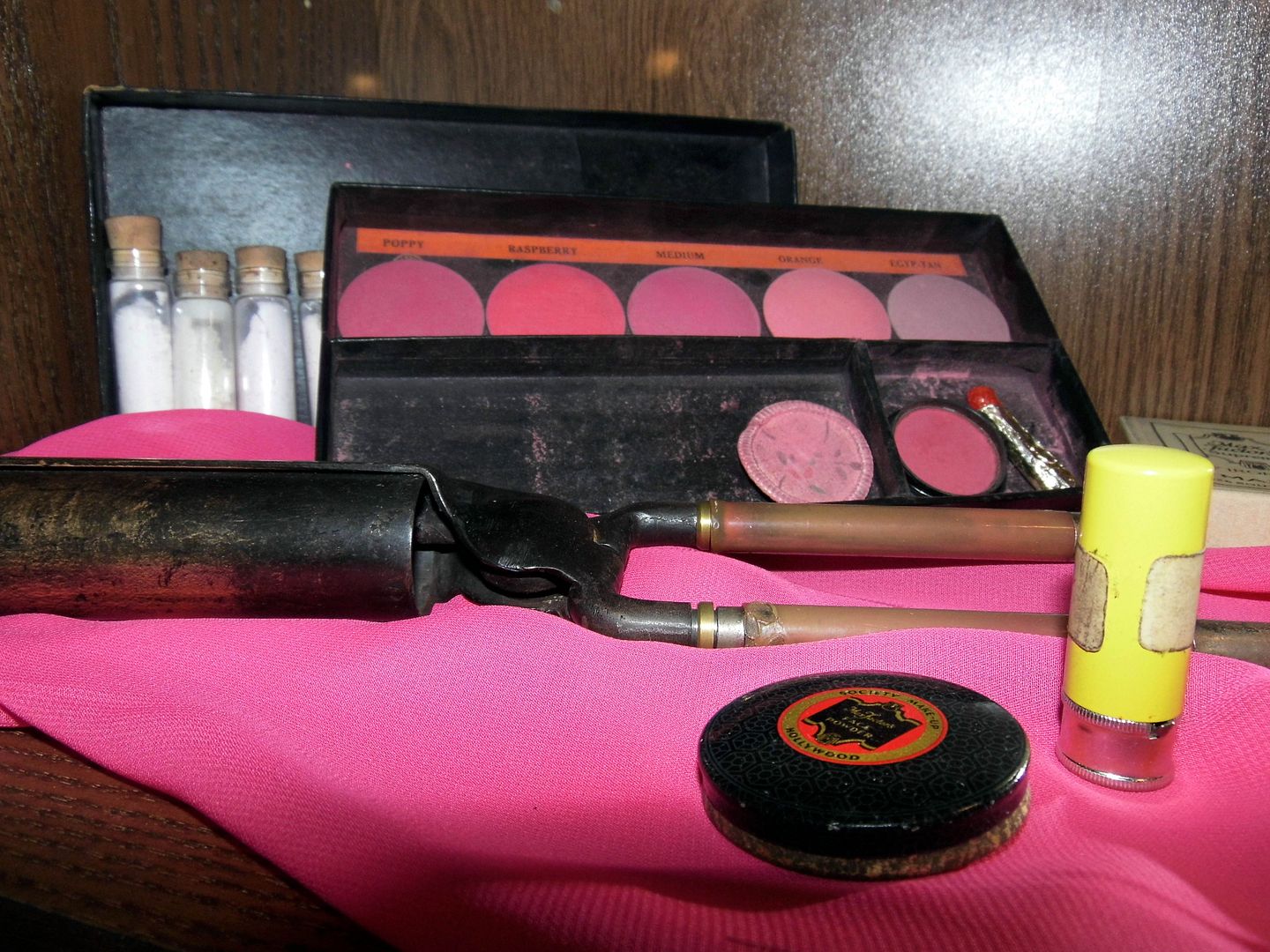
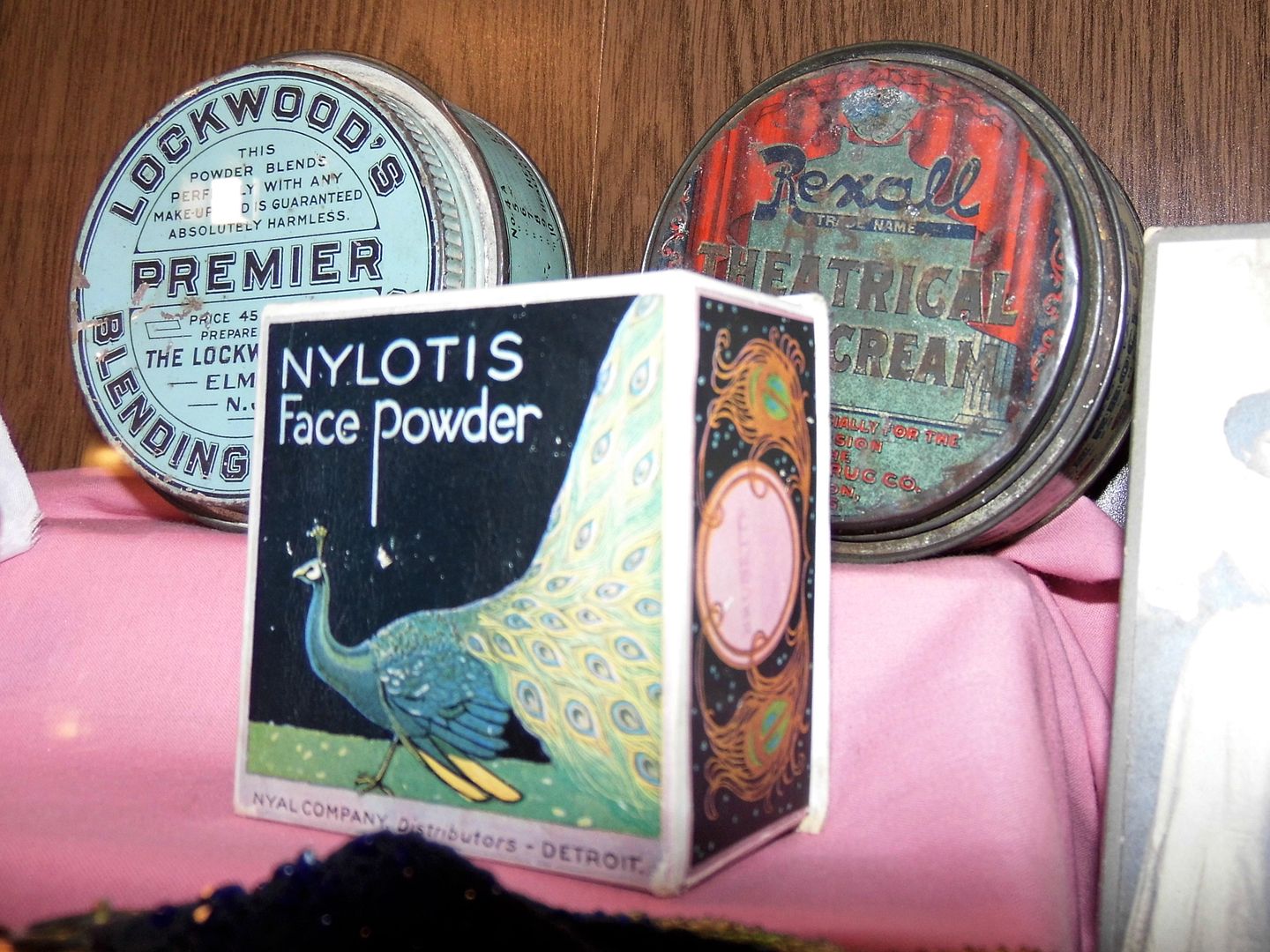
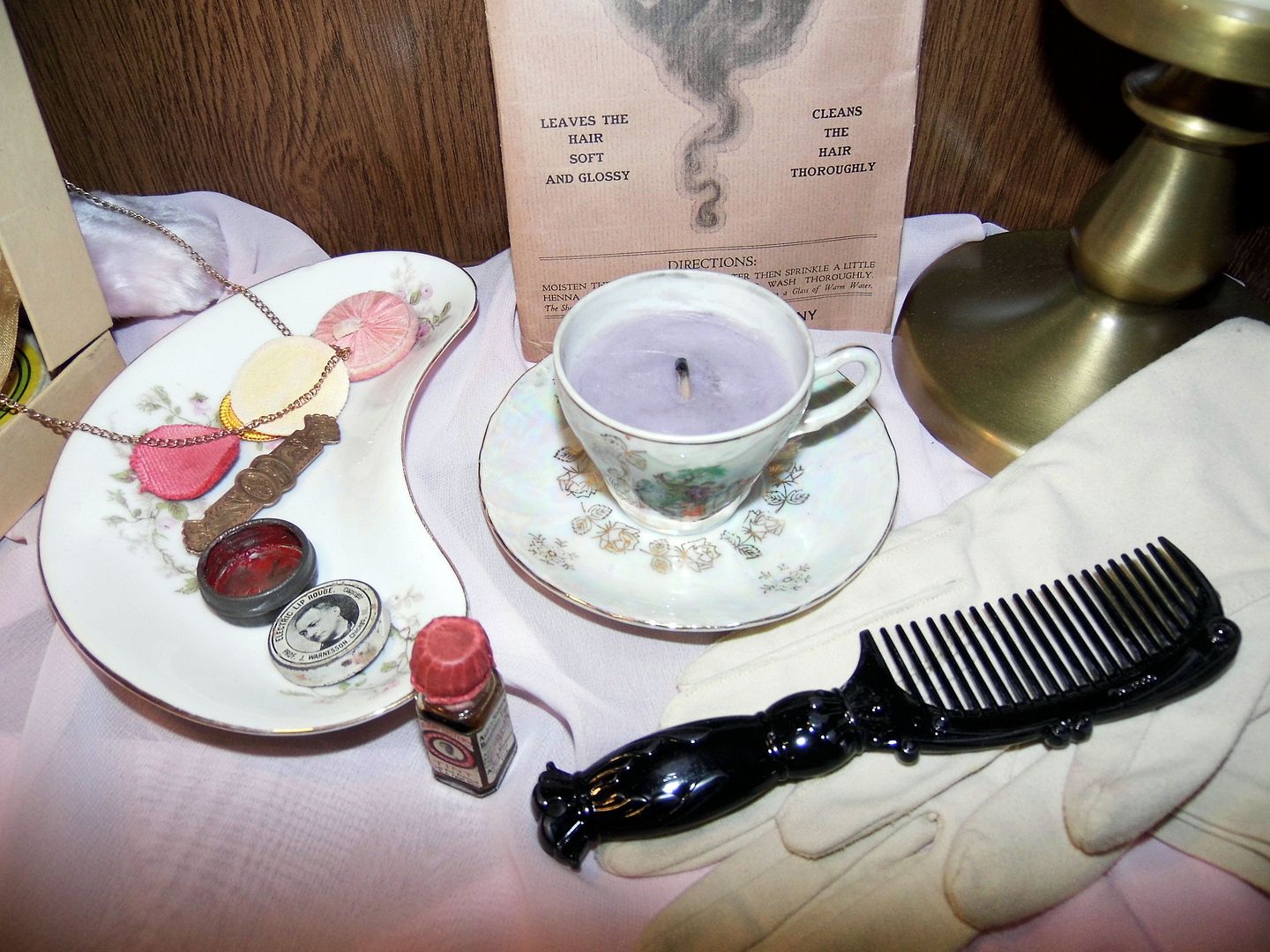
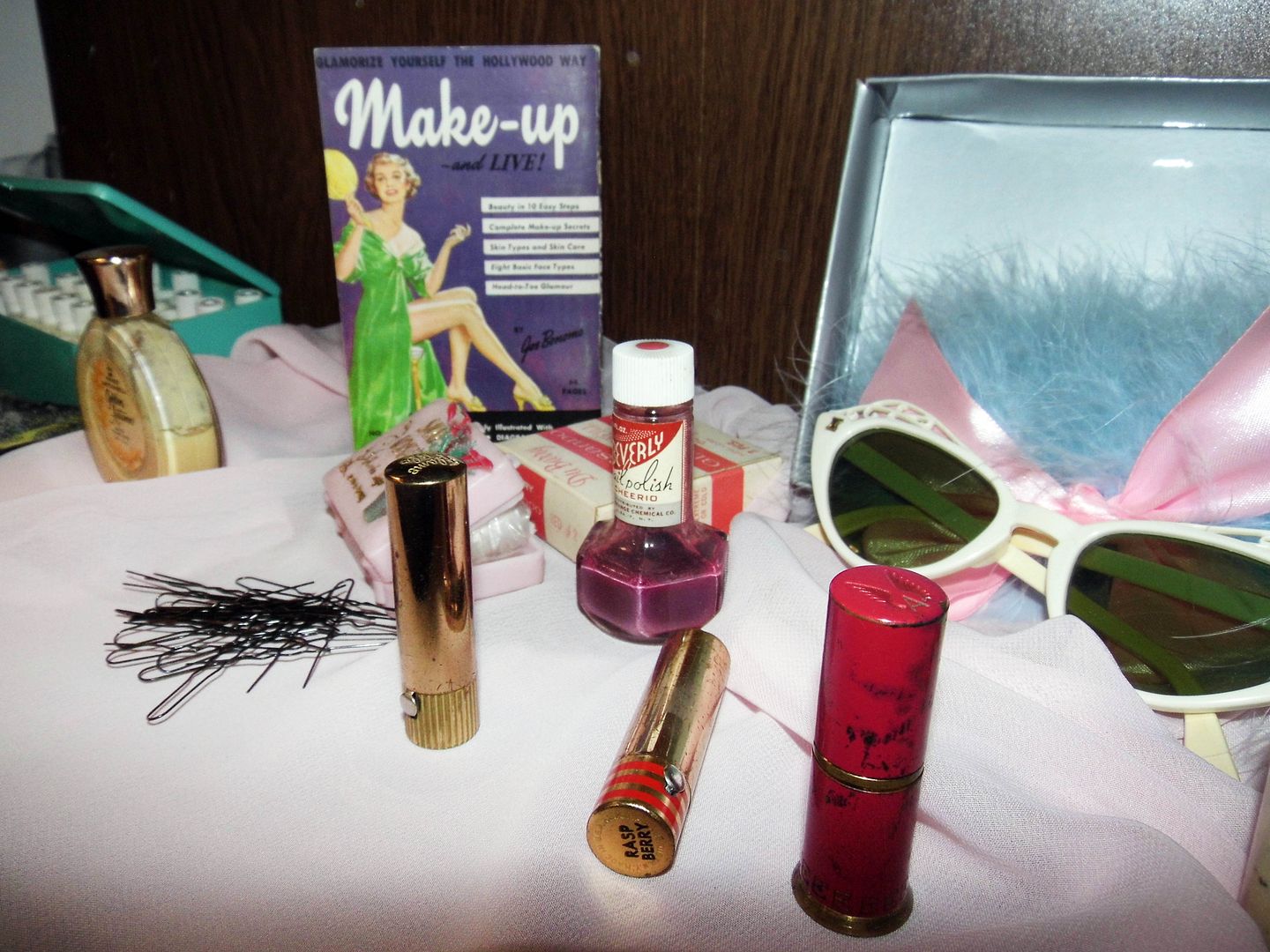
...and the other side displays selected makeup trends from the year 1900 to today, encased in glass cabinets in a kind of mini cosmetics "museum."


Of course, Max Factor is represented here, as are Avon and Cutex...


...and old "cake" forms of mascaras, like those sold under the brand name Winx.


Practically everything started out as a powder in some form or another, whether loose or compressed...


...and the formulations evolved as makeup started to be worn by more than stage or film actors...


...and entered the lexicon of "everyday" beauty.


I don't ever remember seeing my Grammy without her red lipstick on. And I rarely saw her outside of her own home.


Meanwhile, I haven't worn any makeup for two and a half months. And I'm not sure when I'll have the opportunity to again.


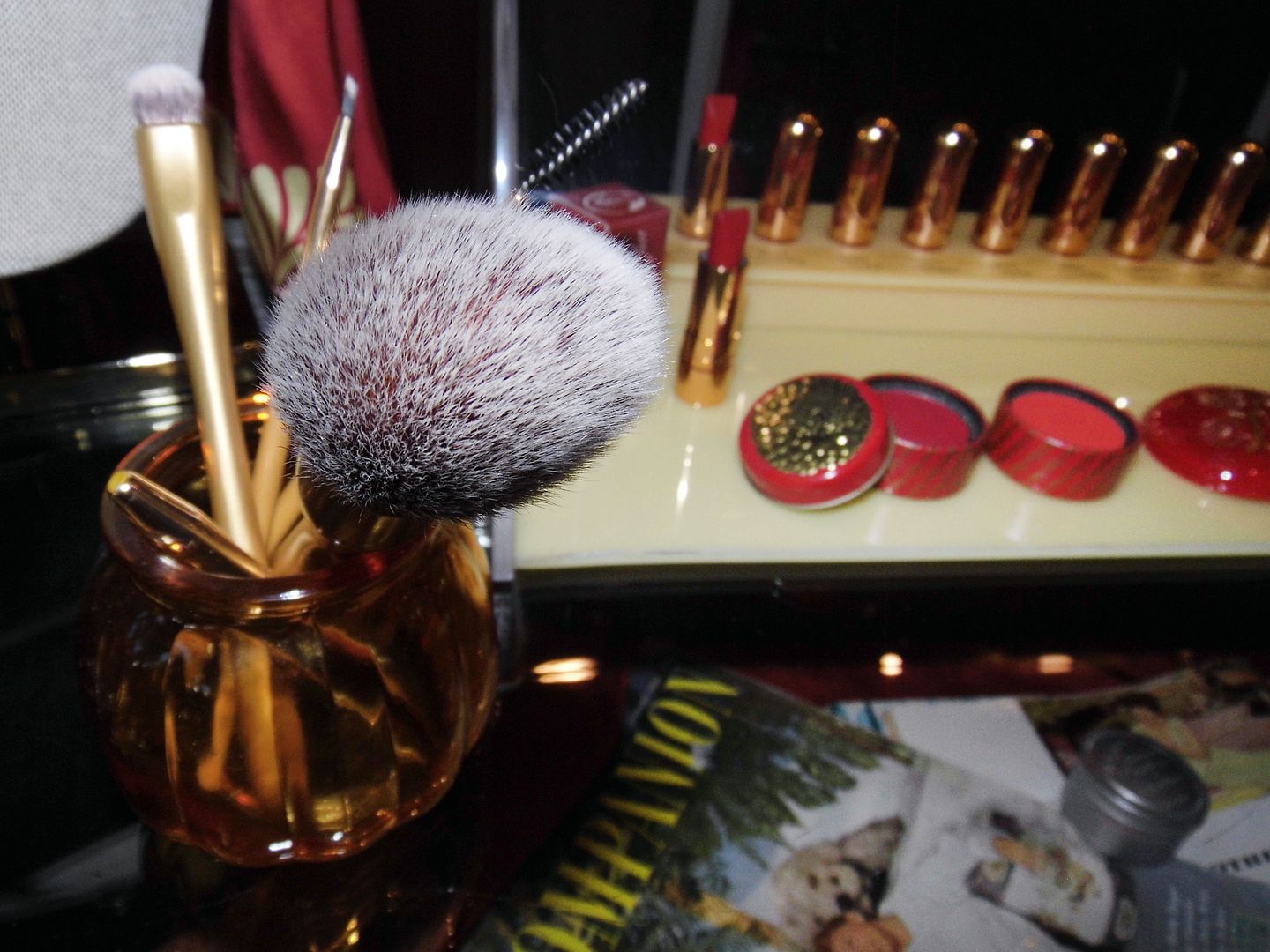
When I'm ready to emerge back out into the world—whatever that world will be like—maybe I'll splurge on something nice from Bésame, like its rouge brush made from soft, cruelty-free hair, and featuring a contoured wooden handle.

If I watched much TV, I might try to look like Jessica Lange on American Horror Story: Freak Show
or the multiple actresses featured in the Netflix series Hollywood who wore multiple shades of red from Bésame.

Or one day, maybe there will be an occasion special enough for me to get my makeup done there.

In the meantime, it's reassuring to know that someone values the beauty of "Old Hollywood"—and that there's enough of a consumer market to snap up the heirloom-inspired products that continue to be released.

Related Posts:
Photo Essay: The Jewel Box of the Cosmetic World and Its Pink Powder Puff
Meditations on Chroma

May 25, 2020

Photo Essay: Santa Barbara's Spanish Castle of Courts (And Its Ever-Ticking Clock)

I've had no official reason to visit the Santa Barbara County Courthouse, as I'm not a constituent of the county and haven't broken any laws therein.


I haven't even gotten the chance to get married there, though one of my ex-lovers has. I must admit, his heartbreaking nuptials piqued my interest about the place.


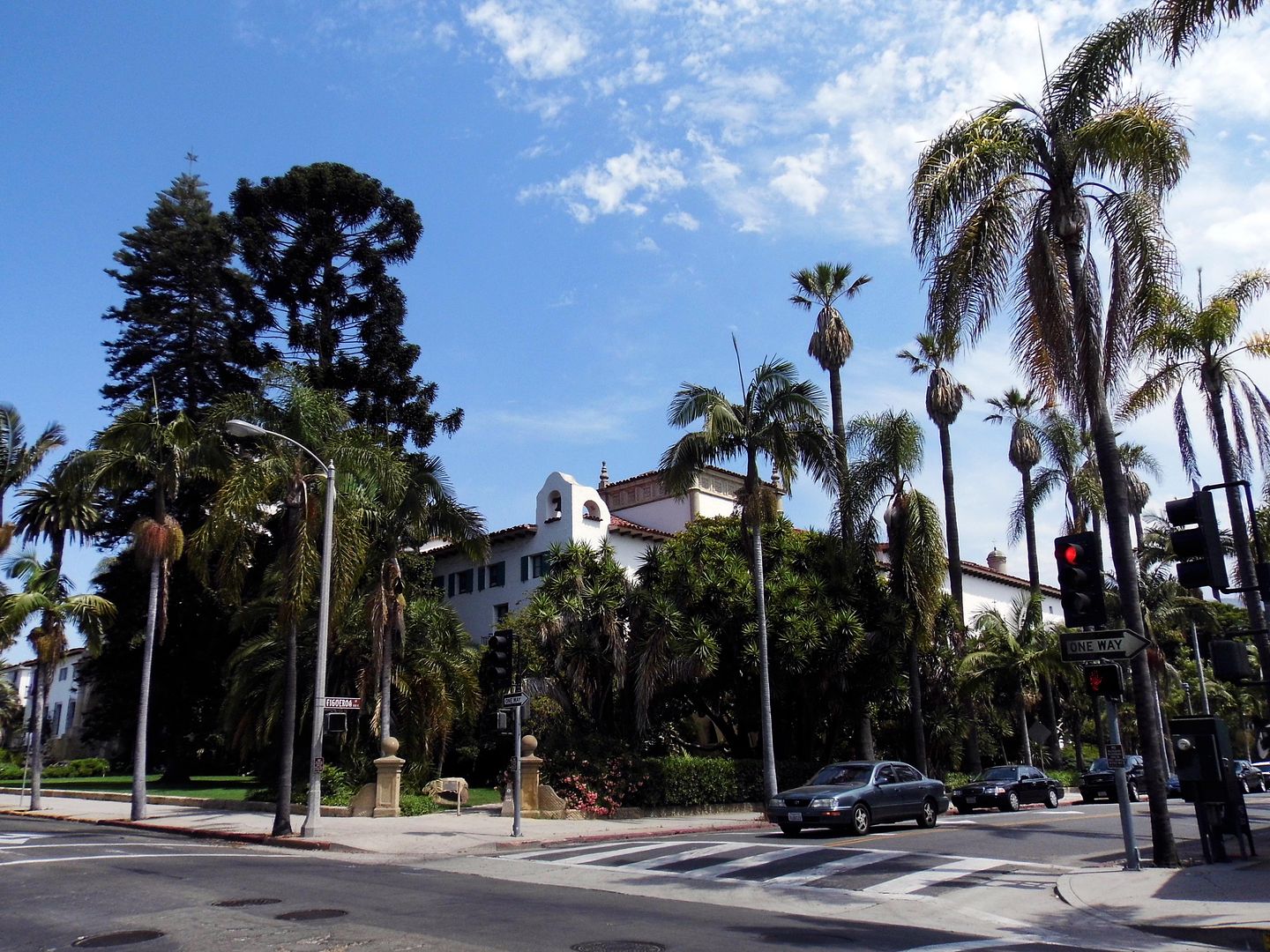
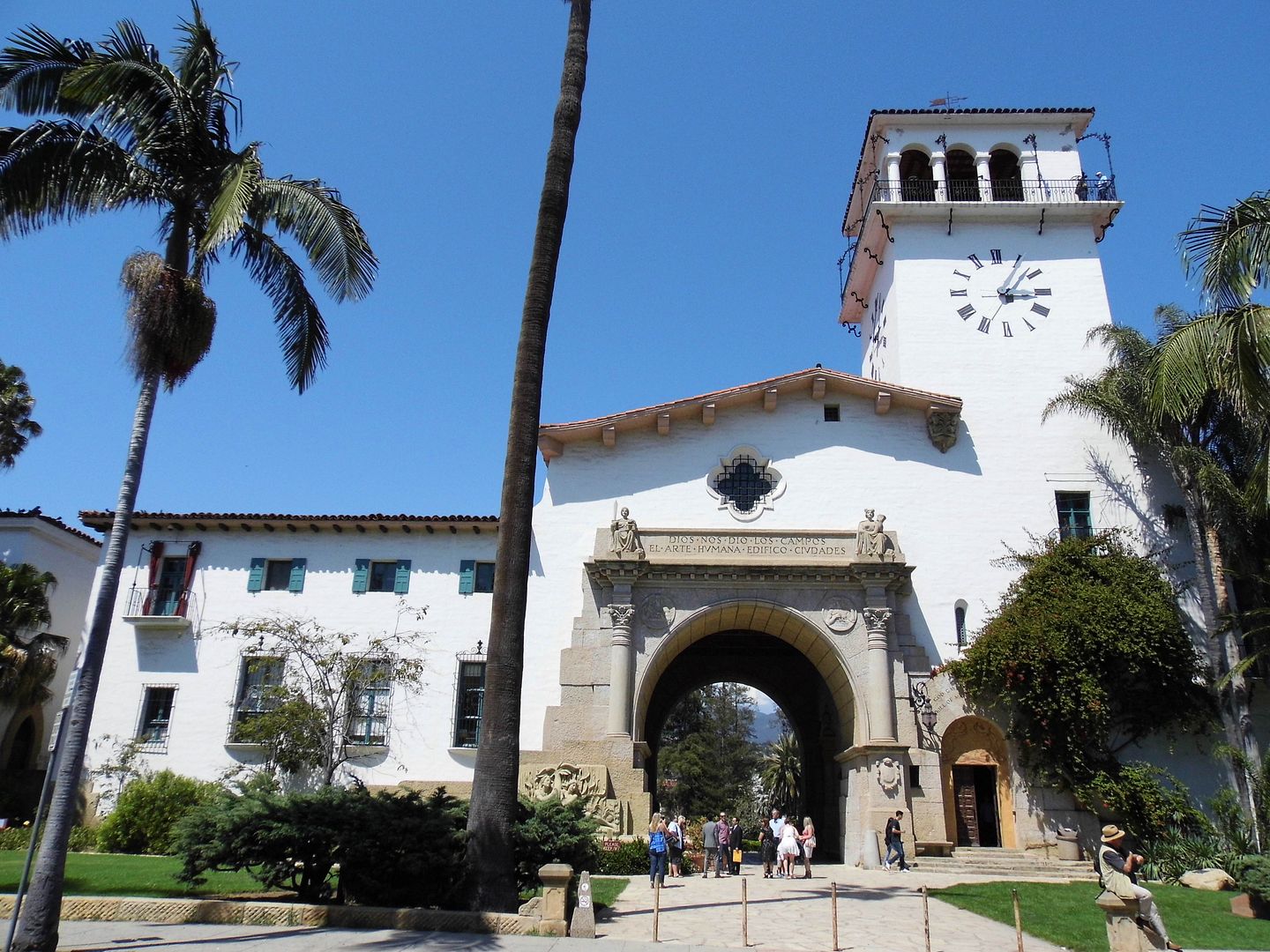
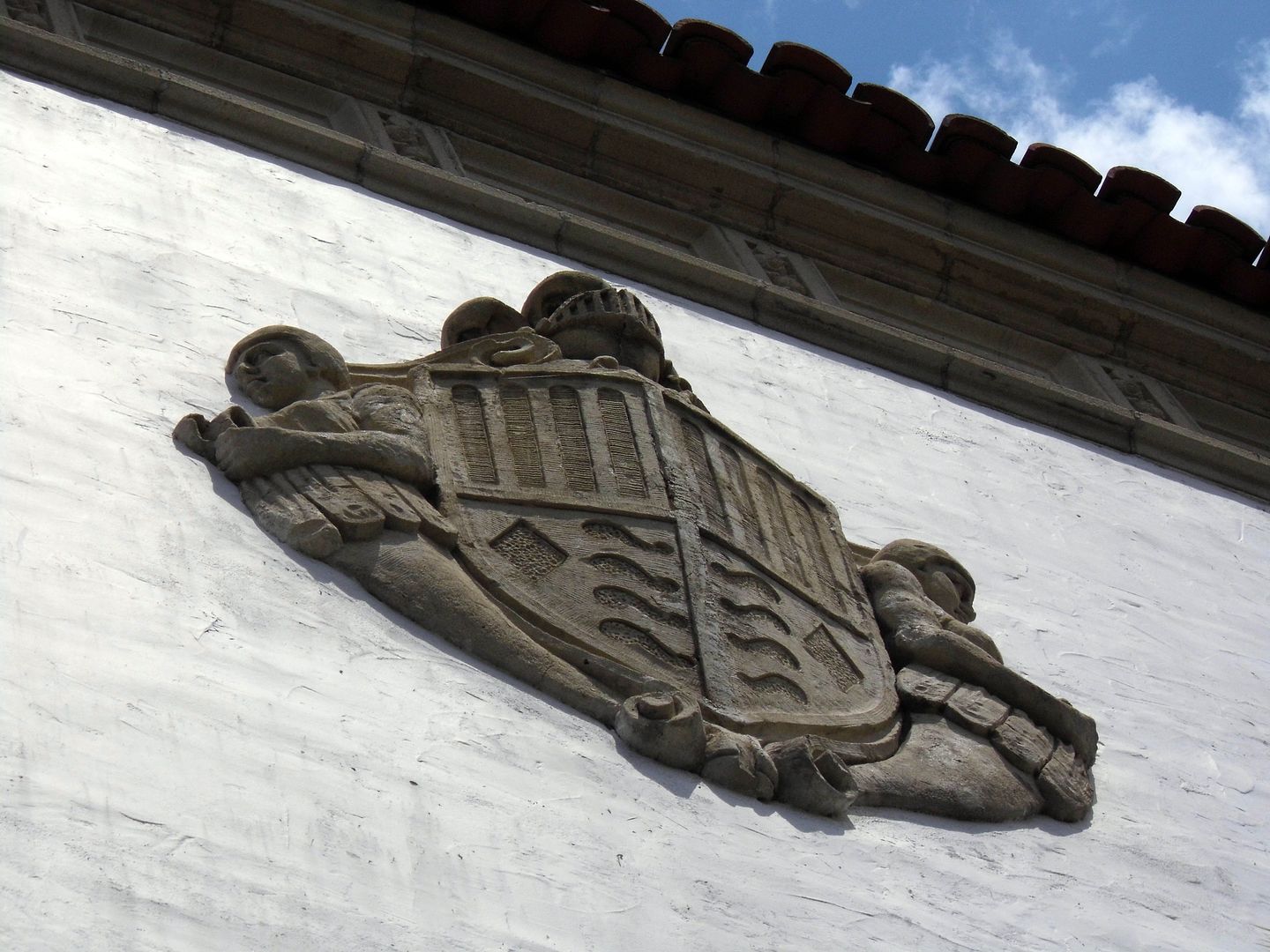
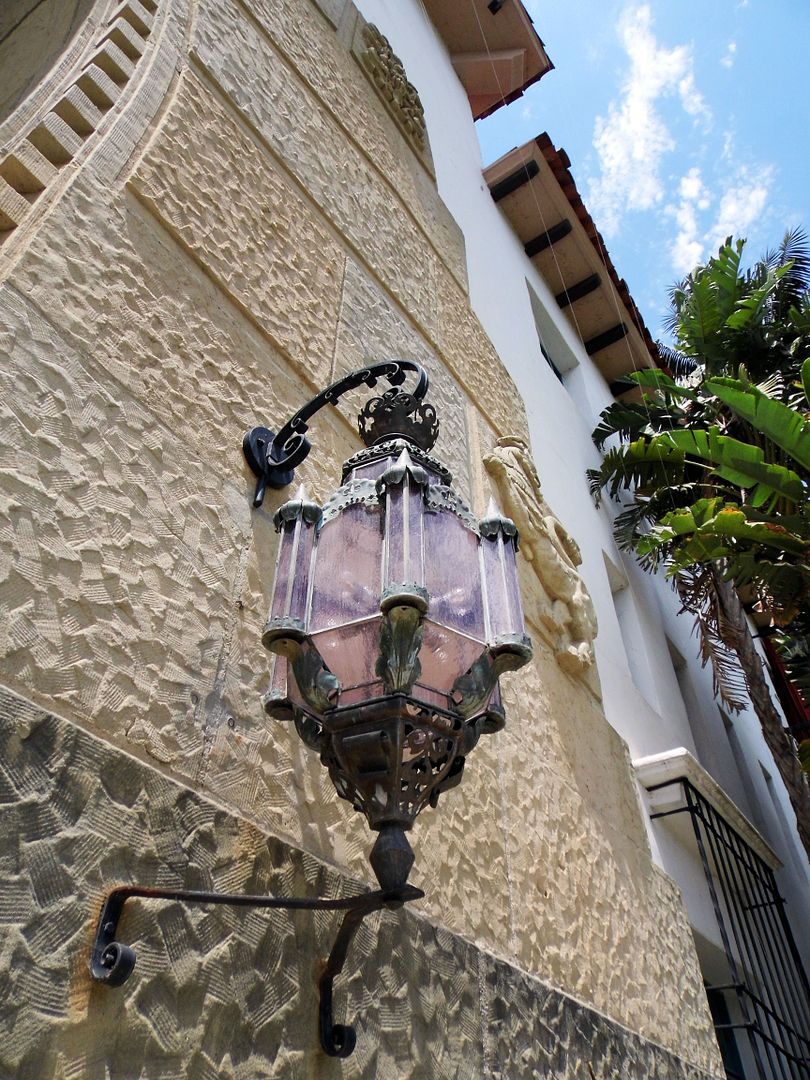
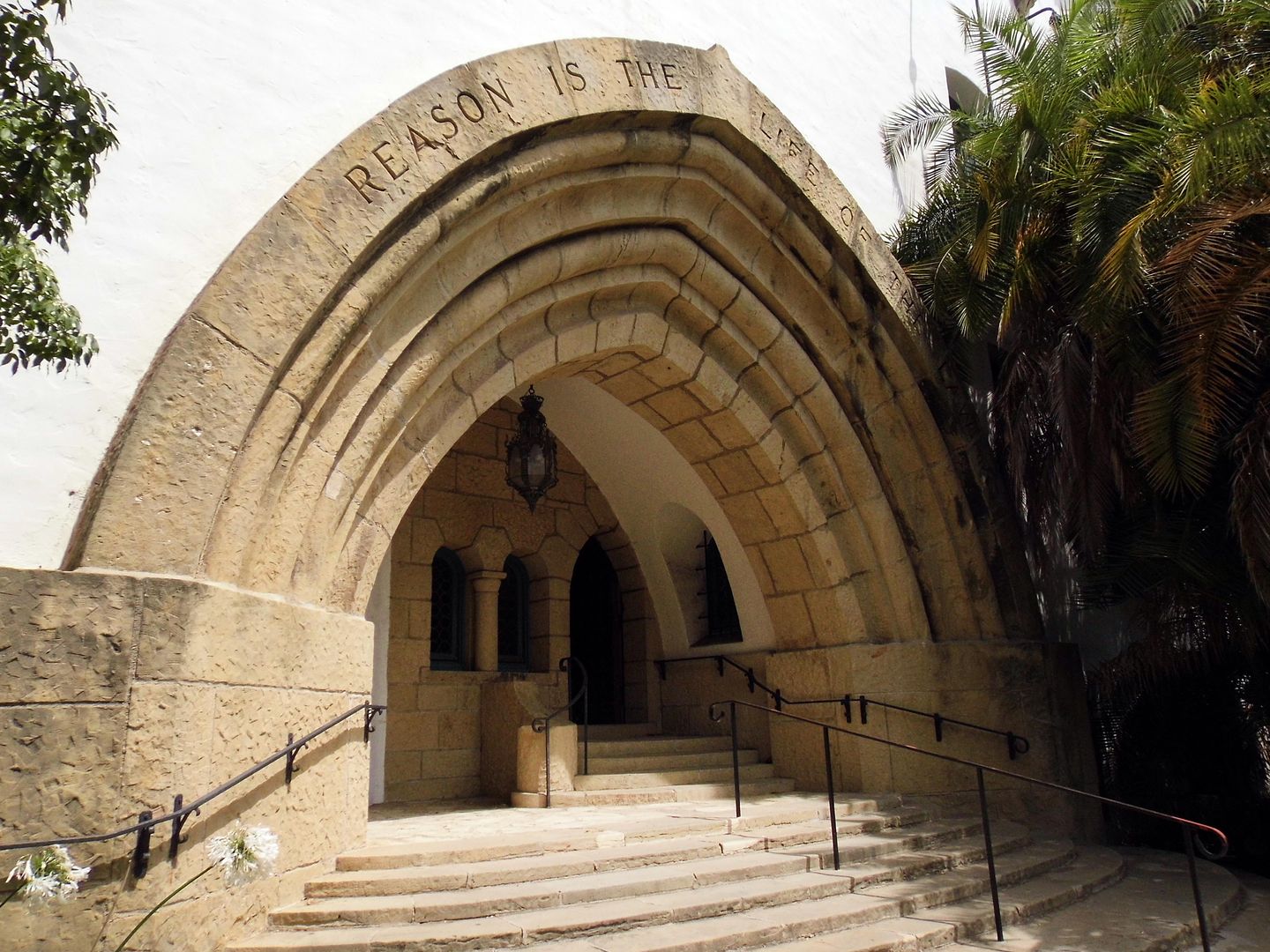
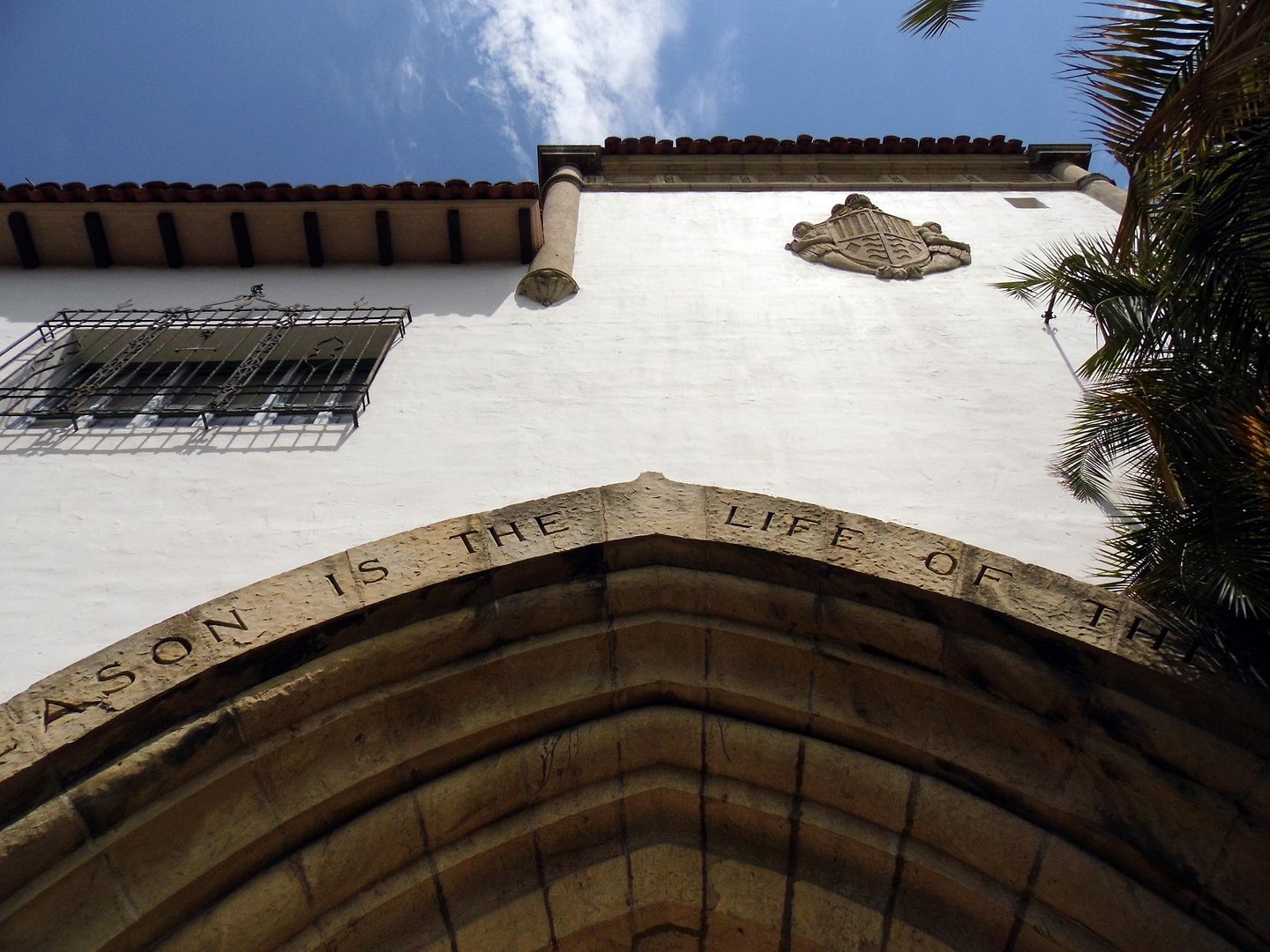
So, on two different occasions when I had some free time on my own to explore the historic core of the city of Santa Barbara, I chose to visit the 1929 Spanish Colonial Revival courthouse.*


Mostly, I went back a second time not to torture myself more—but to get into the clock tower, which was closed for visitors my first time around.


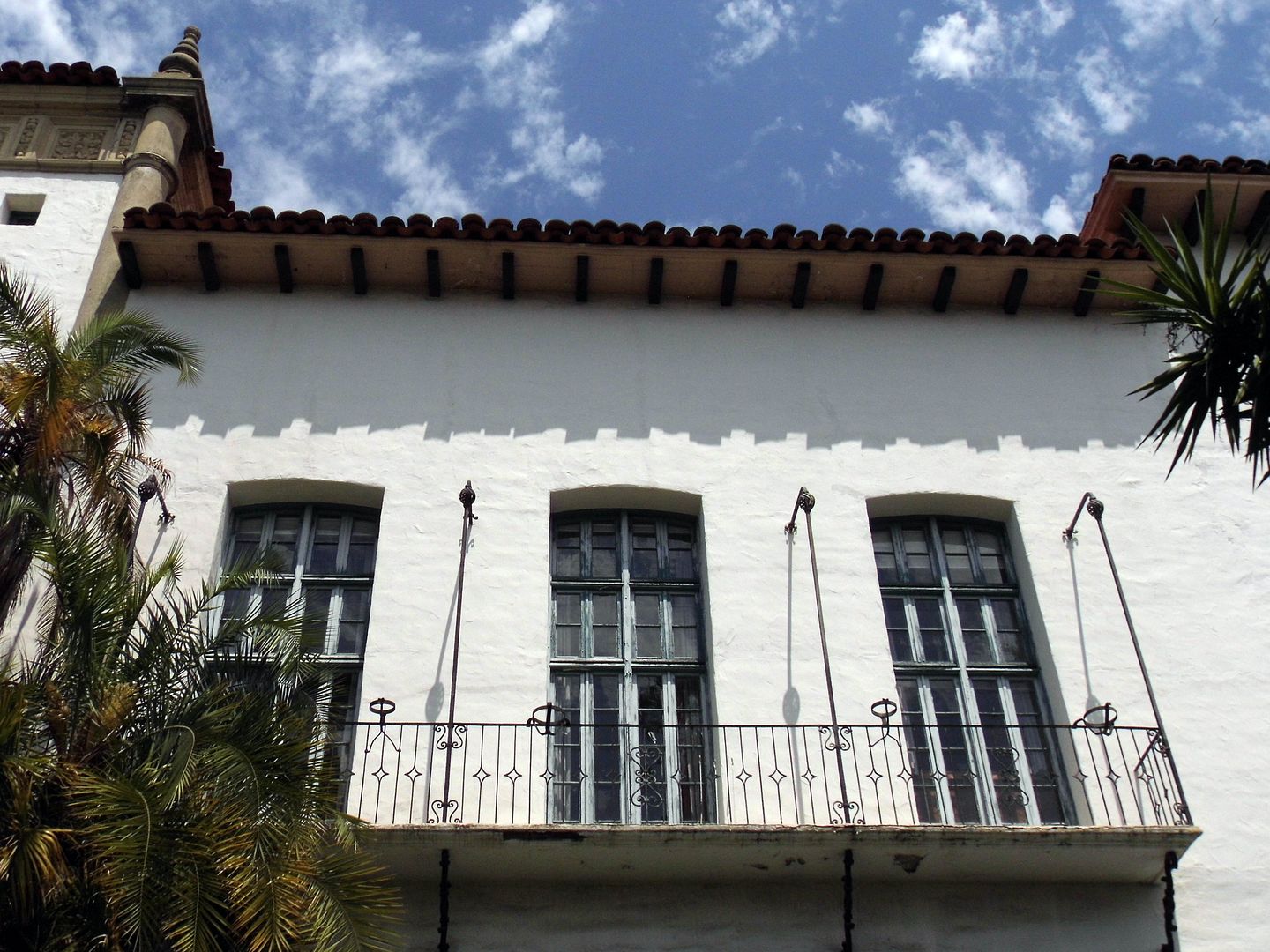
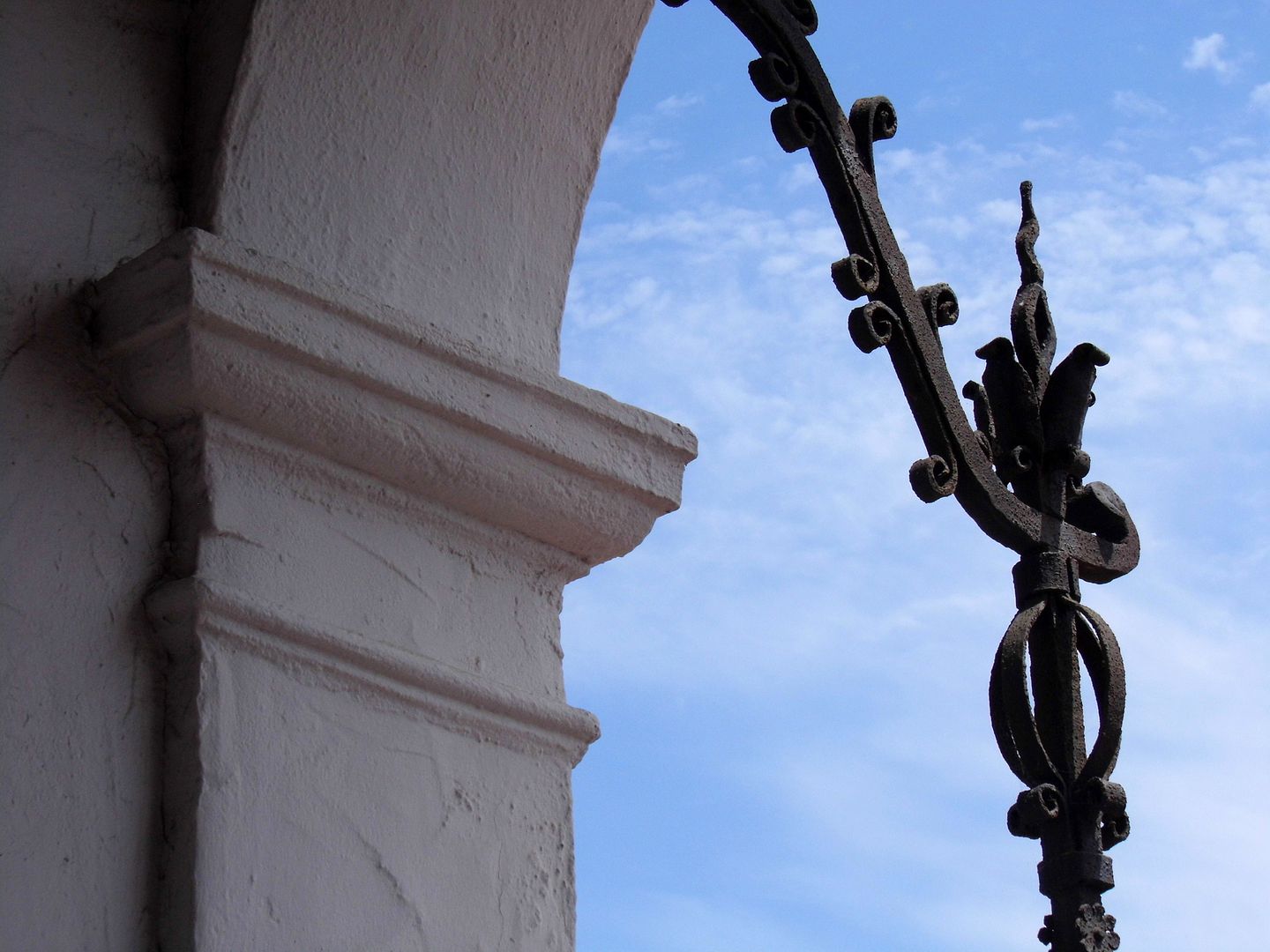
Under that red terra cotta tile roof—and beyond its white stucco walls and window grilles—there are the day-to-day operations of the Santa Barbara Courts and Public Administration.


But visitors like me want to see the structure itself—a national landmark that took only three years to build, starting in 1926.


Originally designed by Paris-trained architect William Mooser III, the courthouse as-built was reportedly more the result of modifications made by architect J. Wilmer Hershey. Unfortunately, Hershey died before he could see his work come to completion.


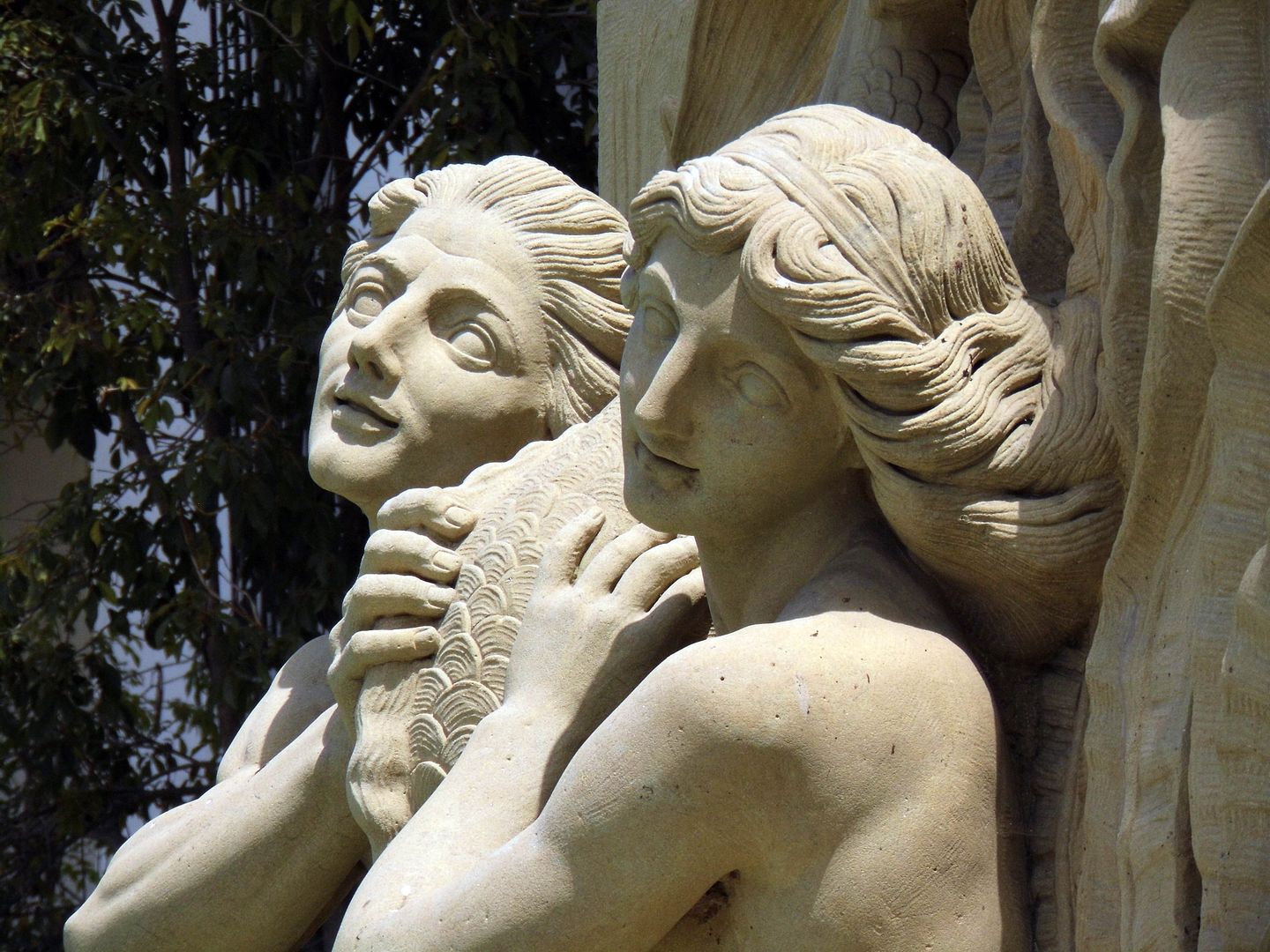
The Spirit of the Ocean fountain, by the Anacapa Arch

Finished at a cost of nearly $1.4 million, the courthouse was funded by oil tax revenue that had come in from the 1928 oil strike at Ellwood. And it's a good thing, too—because the courthouse was dedicated just two months before the 1929 stock market crash that kicked off the Great Depression. 


It could've been even more expensive, too—but using some local materials, like sandstone, helped defray some costs.


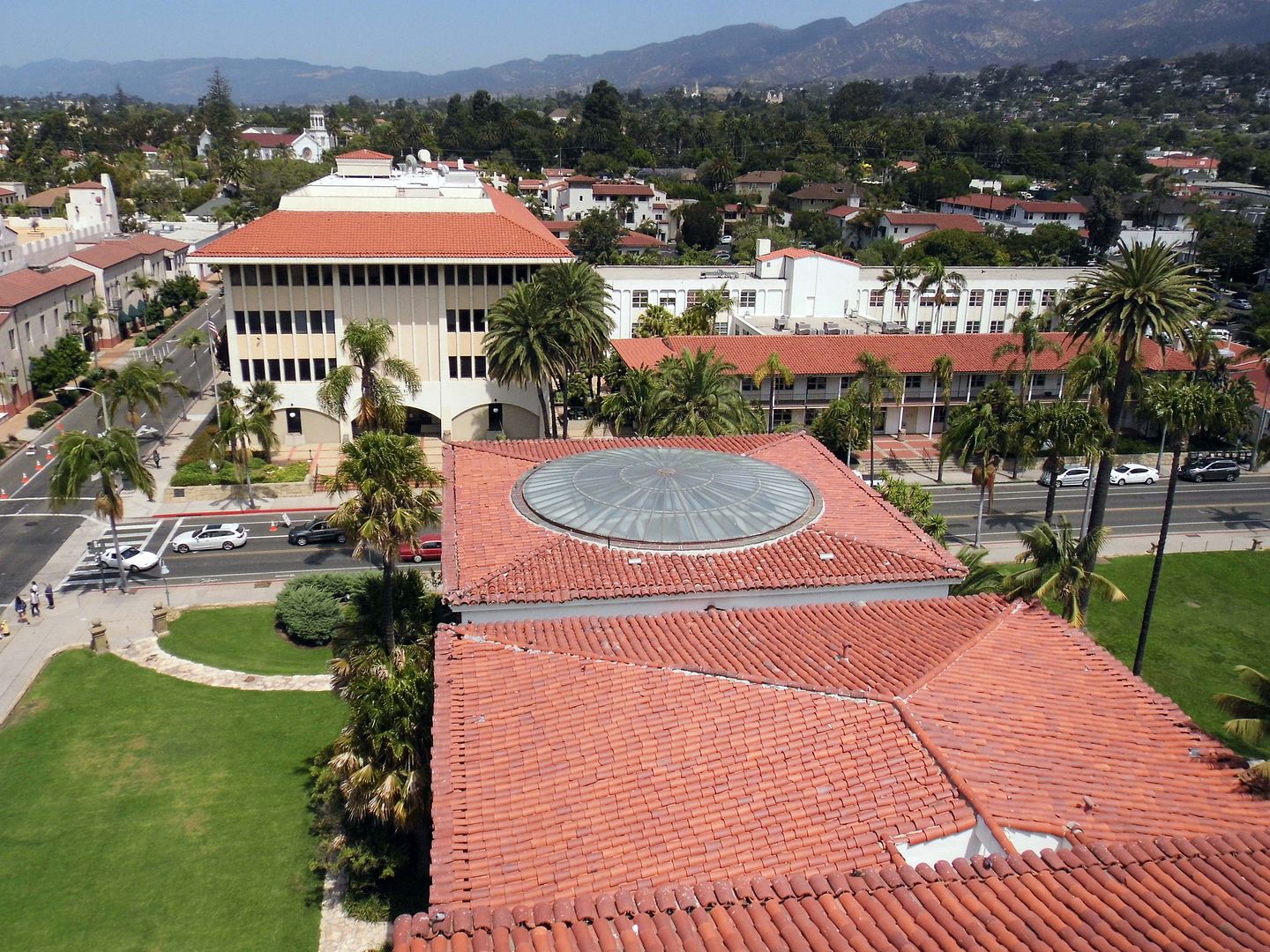
And while it's only three stories tall, it's actually an L-shaped amalgamation of four separate buildings, connected by arches, bridges, or breezeways.


In addition to the Superior Court proceedings, the Santa Barbara courthouse also handles small claims, civil, and criminal cases (including traffic court), as well as family law, juvenile court, probate, and appeals.


It no longer, however, houses prisoners in its "Jail Wing."


circa 2016
`
There are other county courthouses in Lompoc, Santa Maria, and Solvang—but as the City of Santa Barbara is the county seat of Santa Barbara County, this one is the flagship of the county's court system.


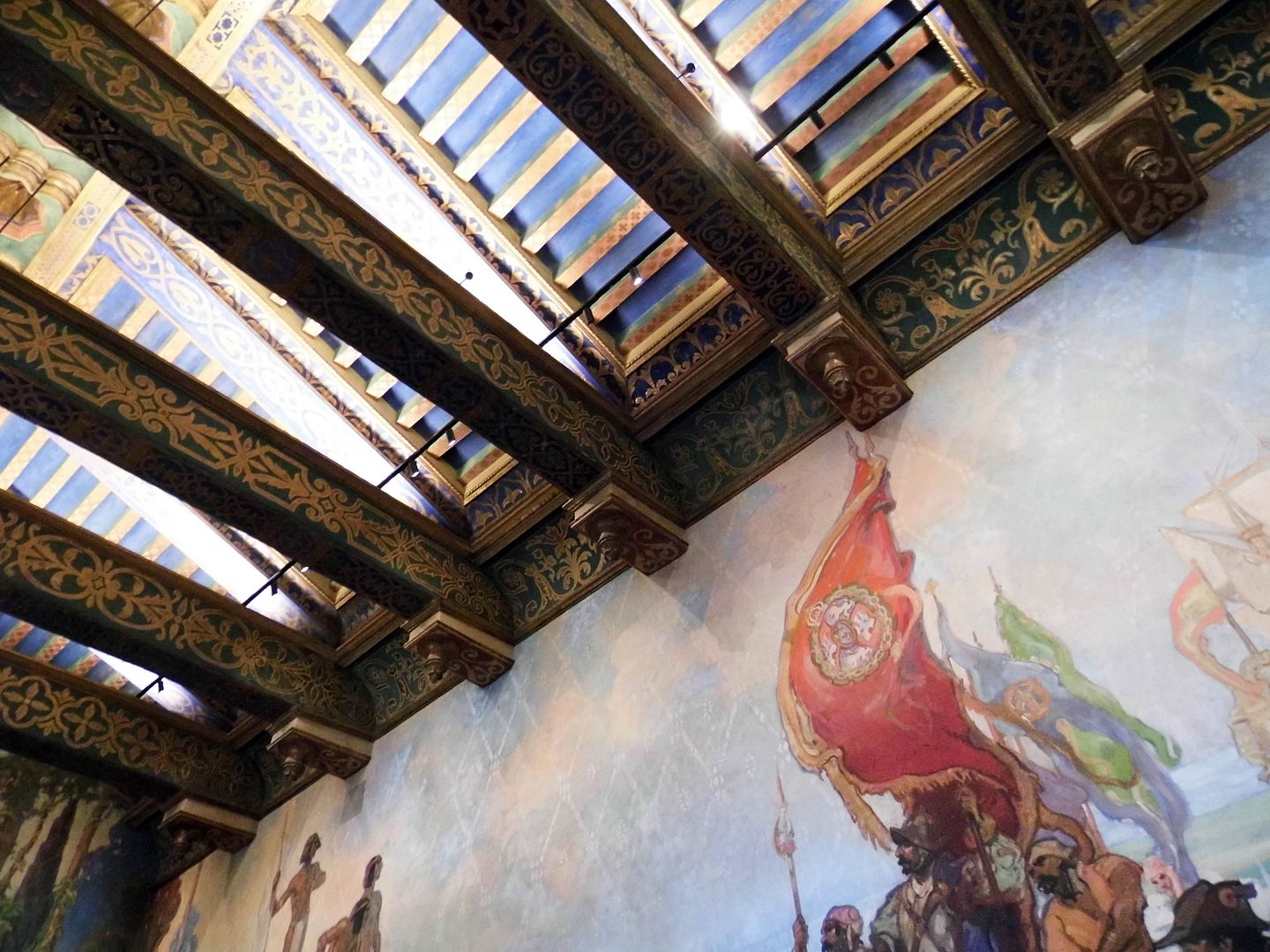
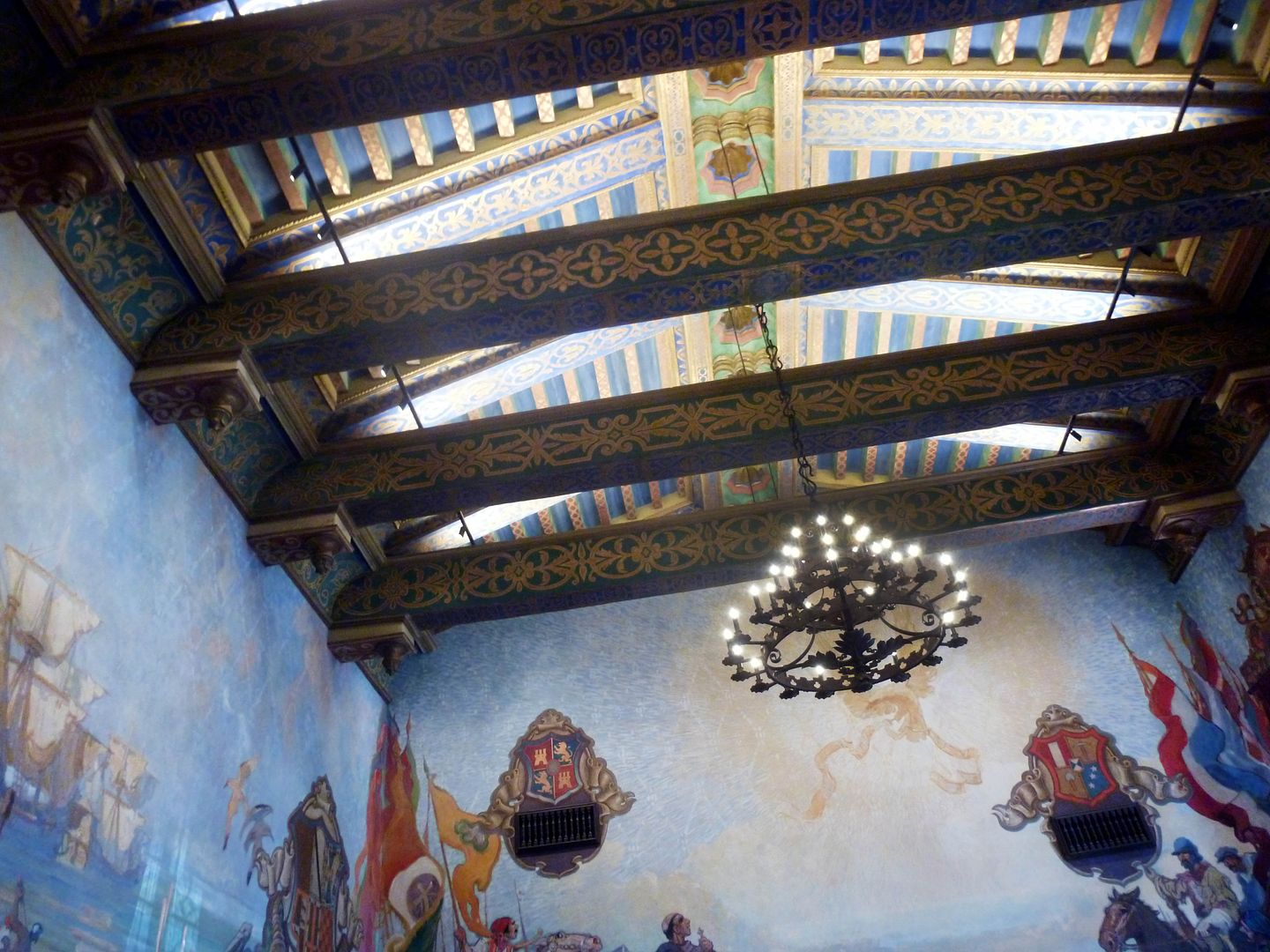
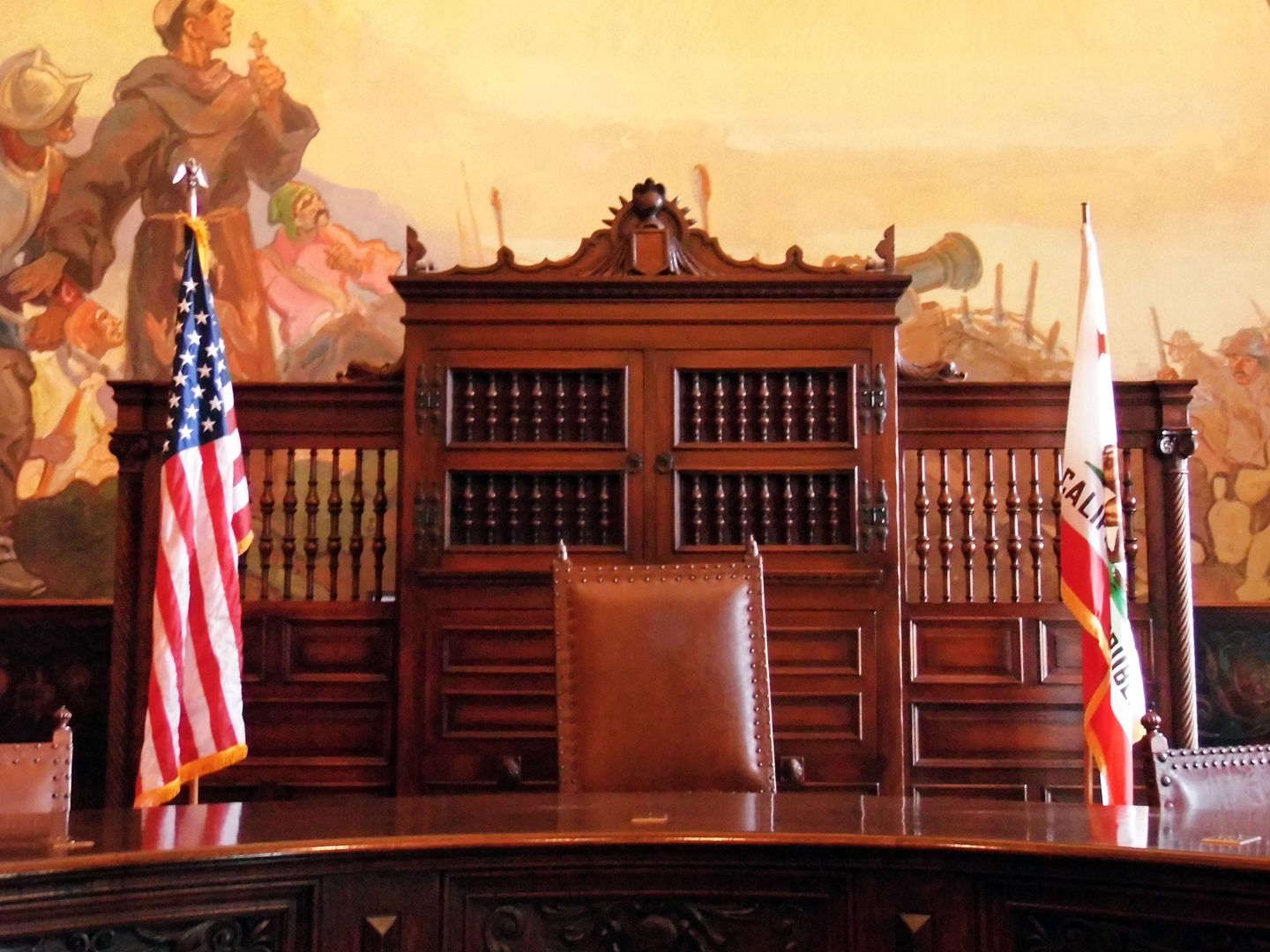
On the second floor, the former County Board of Supervisors' assembly room is now the Mural Room—featuring a 4200-square-foot mural depicting Early California (at least, the Spanish colonial period,  starting in 1542). Daniel Sayre Groesbeck hand-painted it in just four months. 


circa 2016

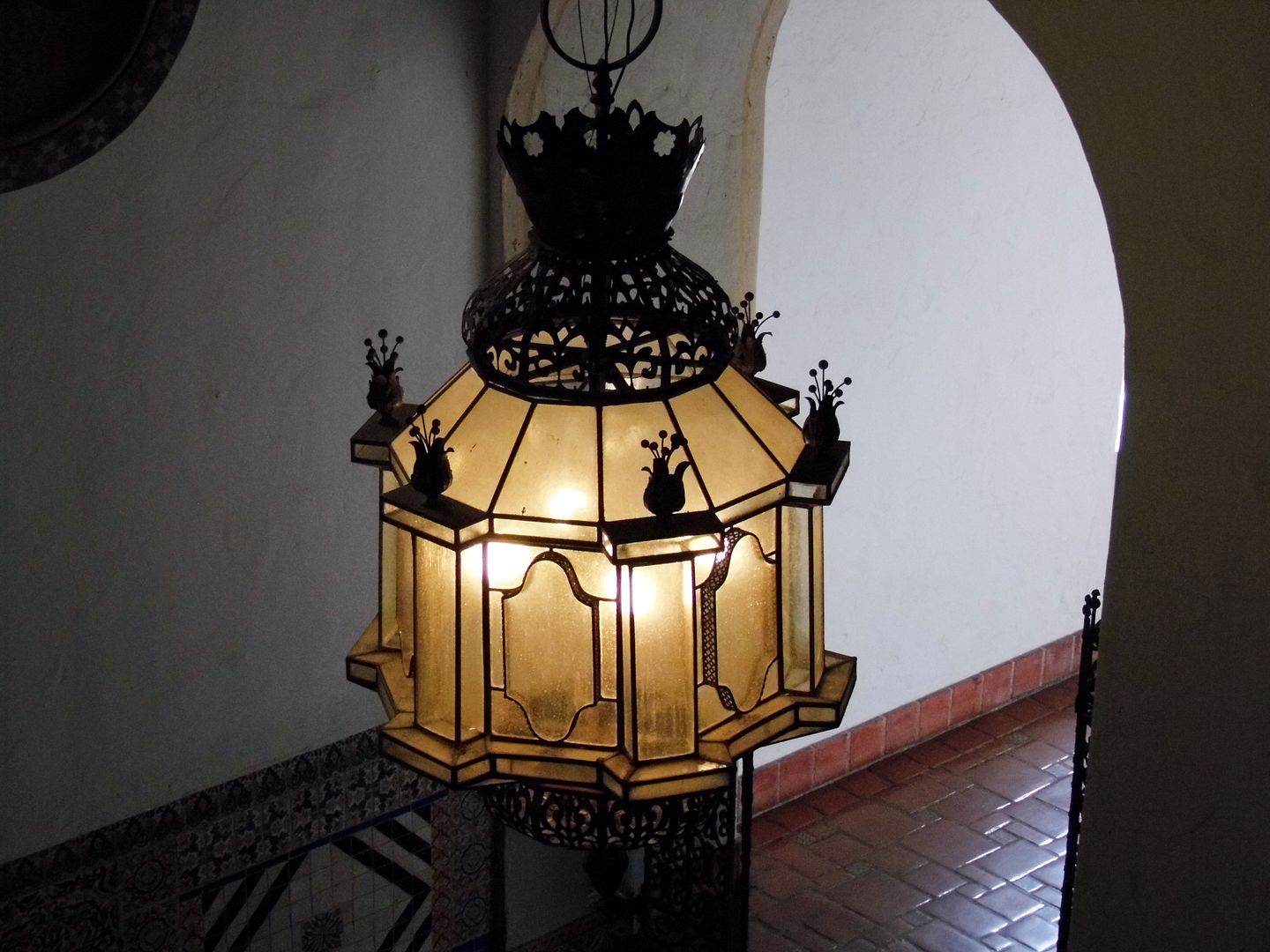
That's where the docent-led tours start—and that's where lots of people get married, right there under the wrought-iron chandeliers and 30-foot coffered ceilings, in front of depictions of explorers and conquistadors like Cabrillo and Vizcaíno and Frémont. 


When Mooser was working on the architectural plans for the courthouse, he considered this a kind of "throne room"—reinforcing the sense that you're in an Andalusian castle.


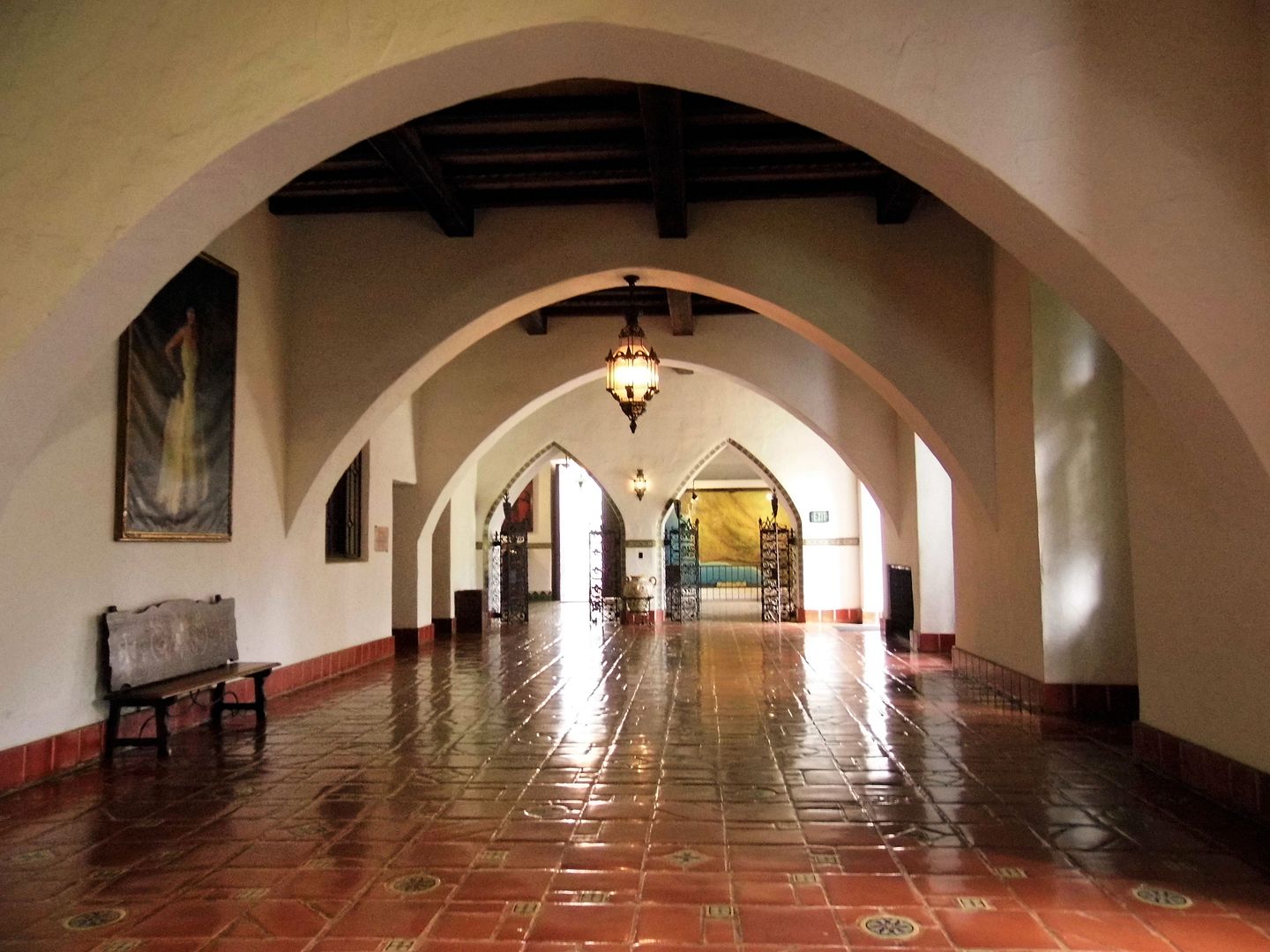
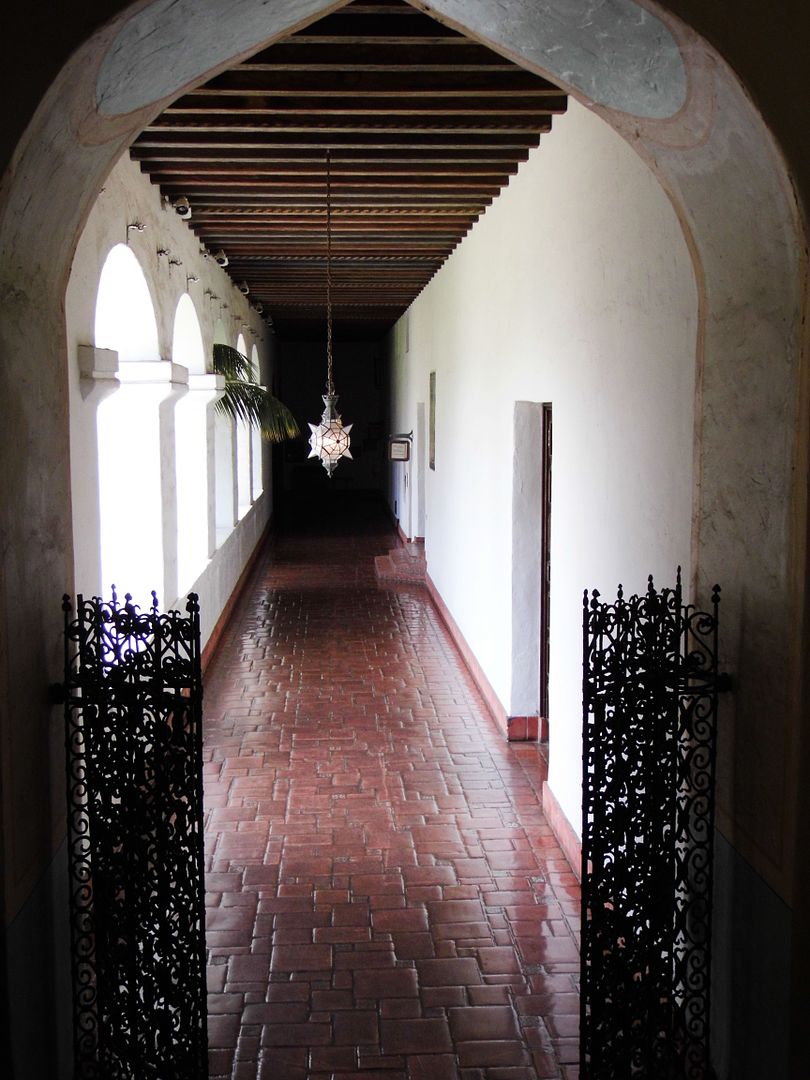
Hand-made terra cotta floor tiles throughout the building were made by Gladding McBean...


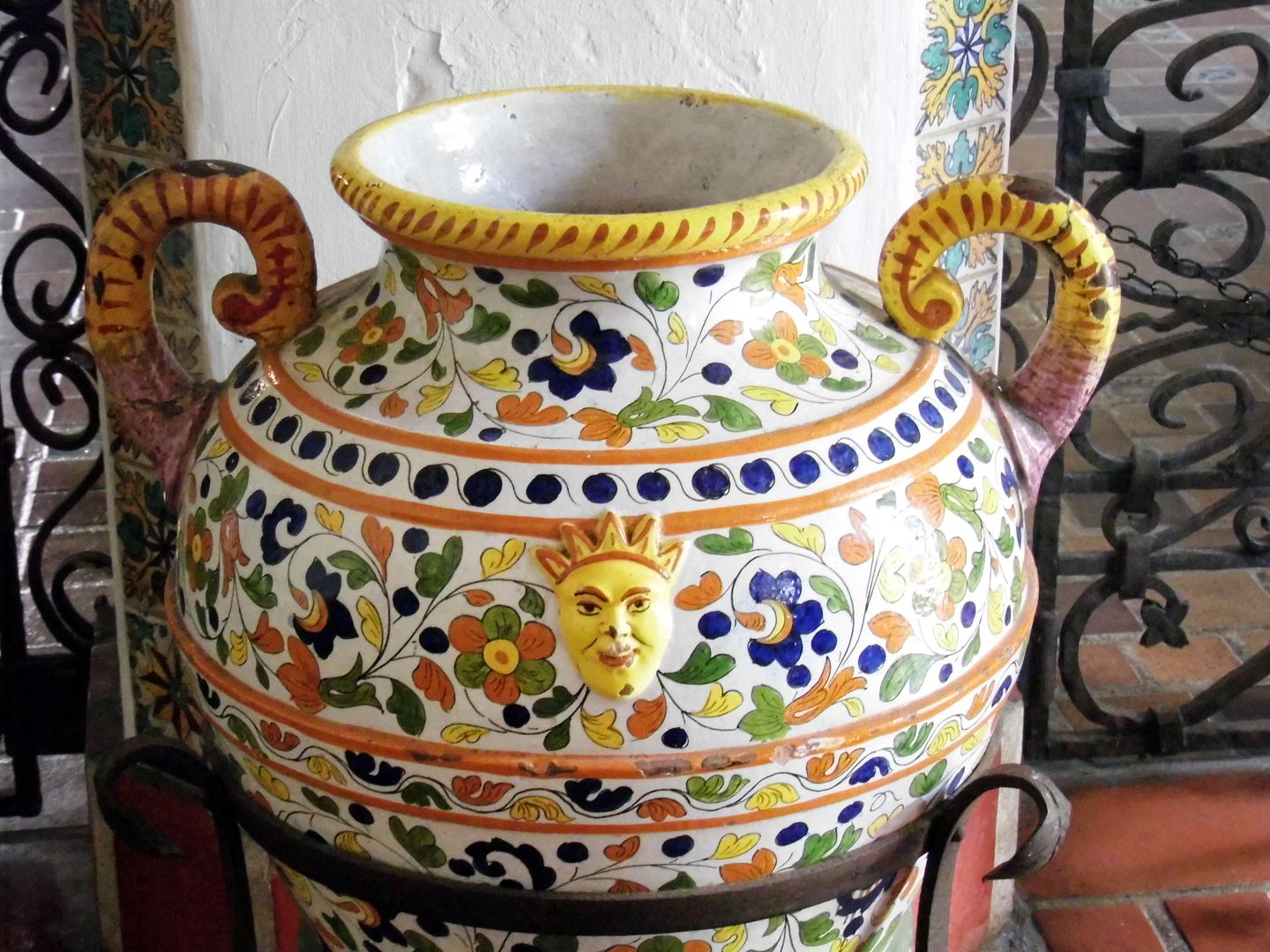
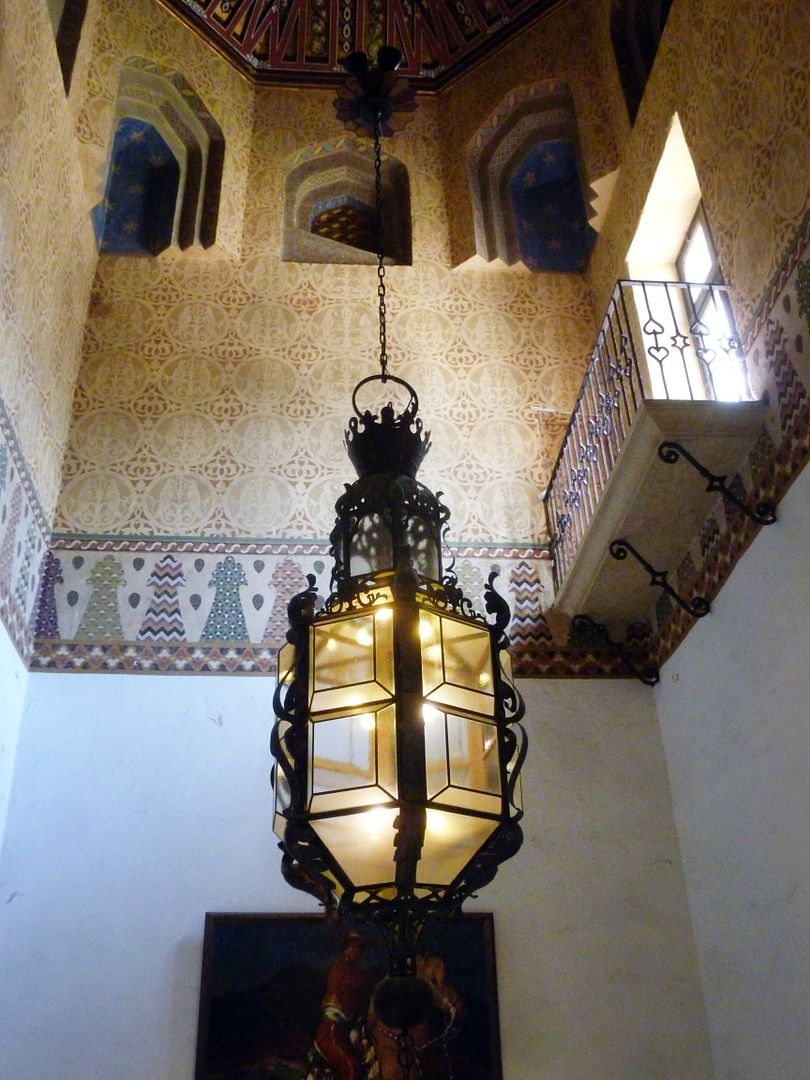
...and the feeling of "Old Spain" has been preserved inside and out, despite multiple renovations (including some ADA improvements).


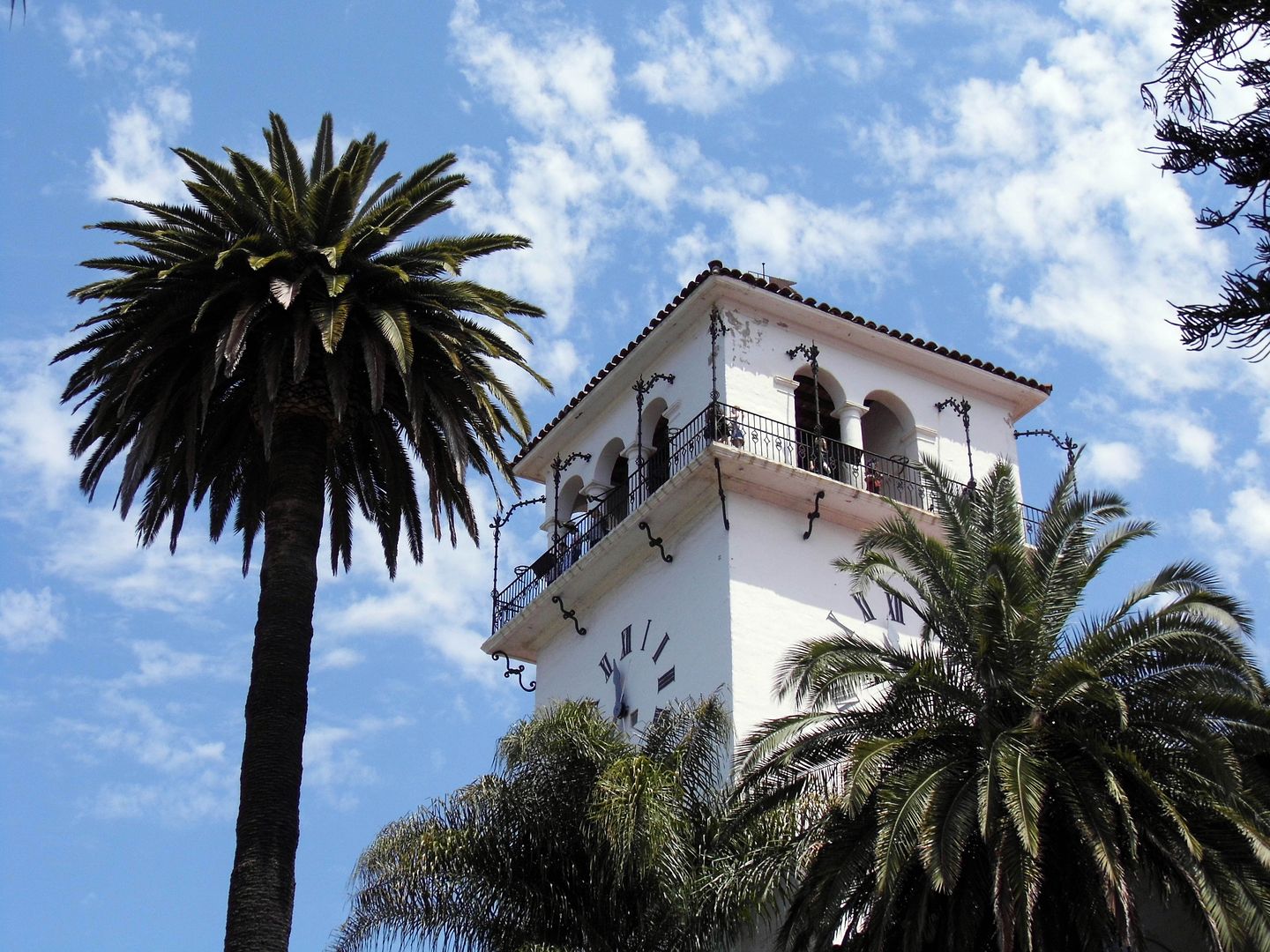
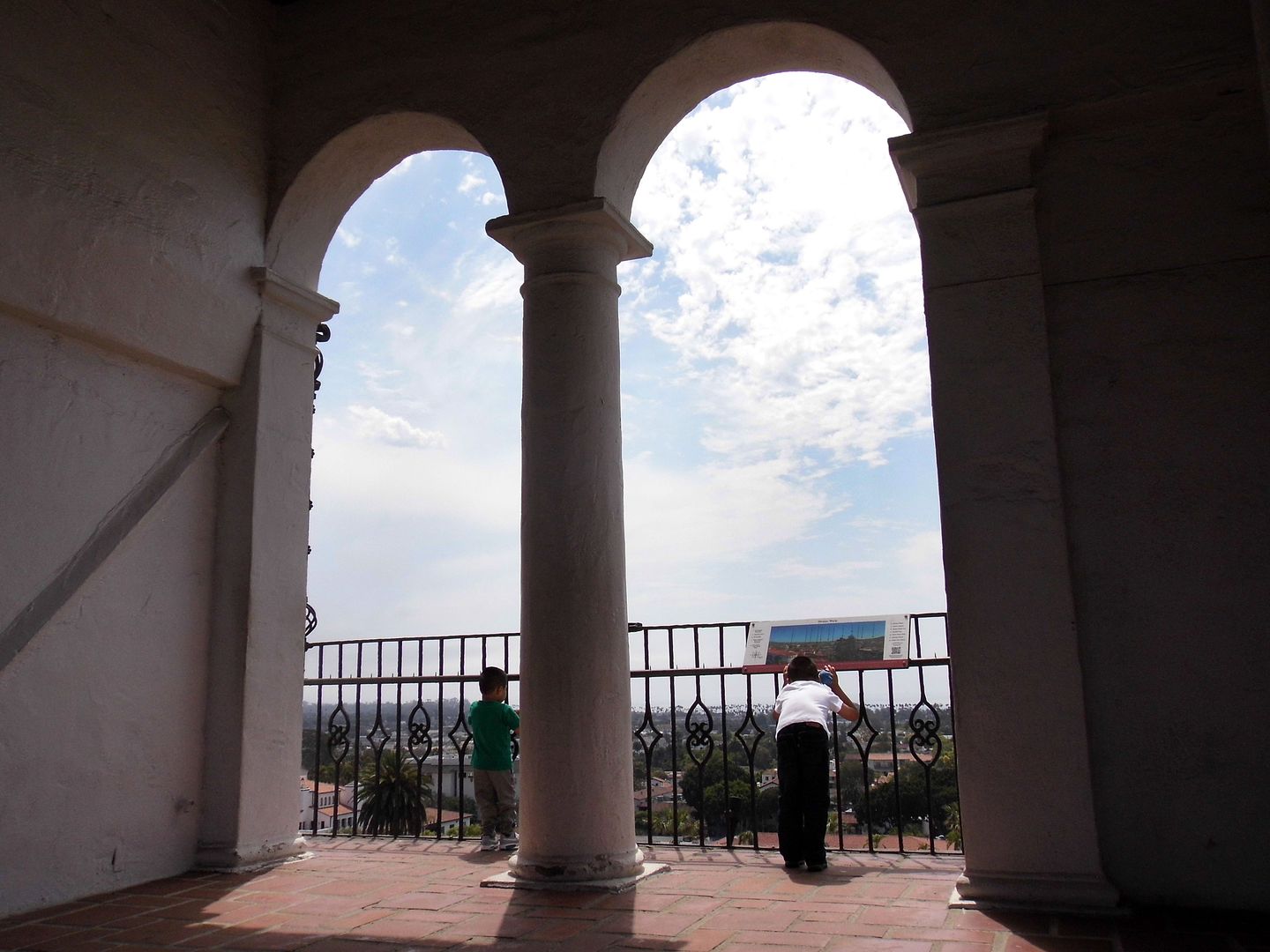
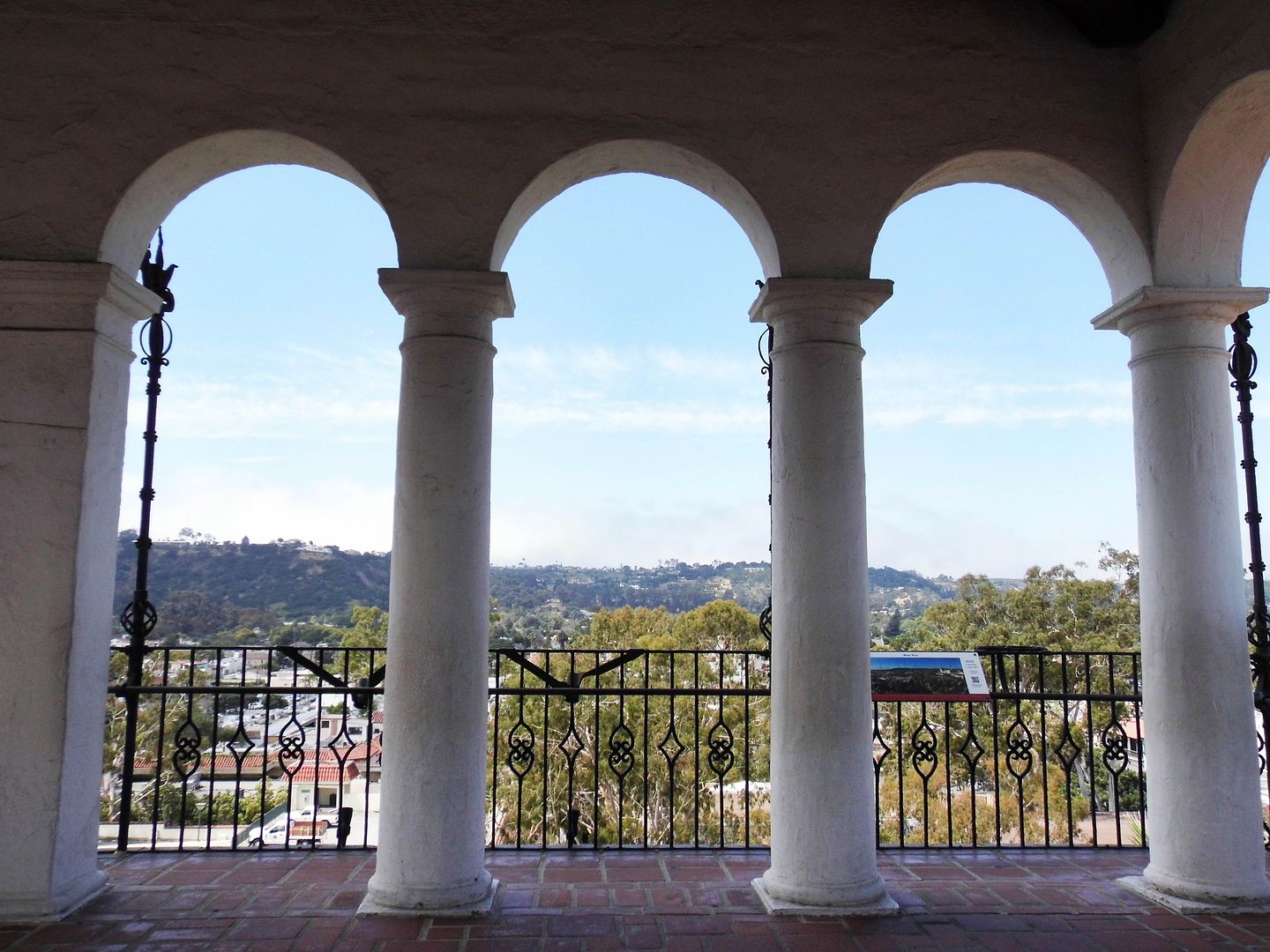
Adding to the romance of the structure—or, I suppose, its romanticized representation of Santa Barbara's founding—is the 85-foot-tall clock tower and "El Mirador" observation deck.


Up there, the Spanish fortress opens up a little bit.


The Seth Thomas mechanized clock is still ticking—and there's an entire gallery devoted to its inner workings.


Too bad they don't let you have weddings up there. That's where you've got the best view—and where you can see how the courthouse occupies an entire city block. Seems like a good spot to exchange vows.

Most public festivities take place in the Sunken Garden—where the original 1872 courthouse stood until it was destroyed in a 6.3 earthquake in 1925. Hopefully its replacement has received all the seismic retrofitting necessary to survive the next "big one" that's sure to come.

Modern engineering has figured out ways to keep a building from crumbling under massive shaking.

But modern medicine hasn't yet figured out how to keep a heart from breaking—or how to put a broken heart back together.

*all photos circa 2017 except where noted

Related Posts:
Photo Essay: The Gardens of the Blacksmith (Los Jardines del Herrero), A Slice of Spain Outside of Santa Barbara
Photo Essay: The View from Above Balboa Park's Former Expo Grounds